
Is your little one starting to point at the letters on the cereal box, leaving you wondering how to help without turning the living room into a classroom? 😊 Learning the alphabet with your child is an adventure that usually begins with play and recognising their own name from around the age of two. Here are our gentle tips and hands-on activities to turn every letter into a familiar friend in everyday life, all while respecting the natural pace of your child’s development.
- Learning the alphabet at the right time, stress-free
- Their name: the perfect first playground
- Touch and build letters to remember them better
- Linking each letter to its real sound
- A gentle path towards joined-up writing
- Tips for overcoming common little hurdles
🔤 Learning the alphabet at the right time, stress-free
Once you accept that every child moves at their own pace, the next step is turning this discovery into a moment of shared fun rather than a school chore.
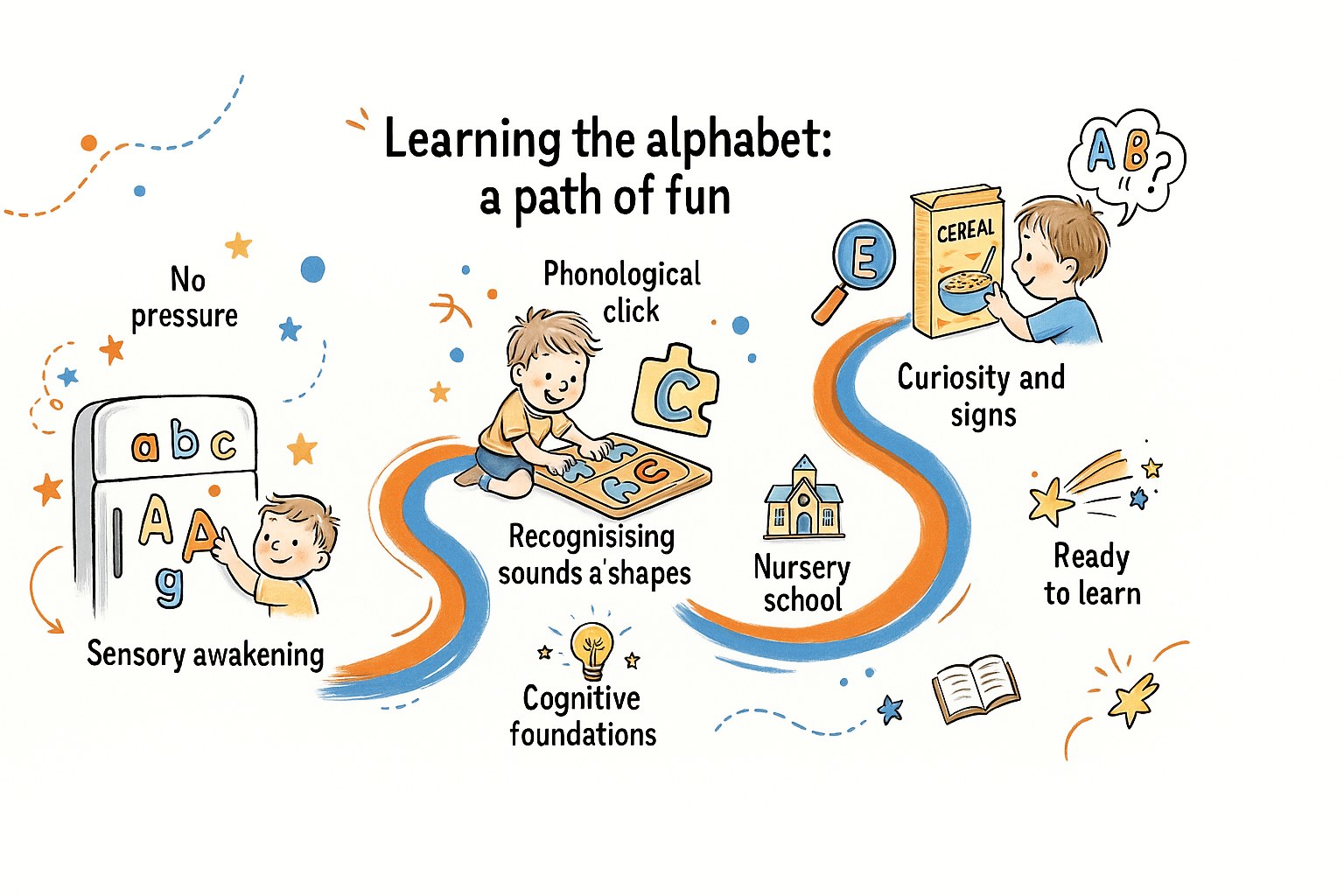
👶 Sensory awakening from the age of two
Around the age of two, you’re not after results. It’s all about simple visual exposure. You surround your child with letter shapes, with no pressure at all.
Suitable tools like magnets or wooden puzzles are perfect. Little hands explore the curves of each letter. Your child takes in the shapes.
Not expecting an instant result is precious here. You play, you handle, you watch. This calm approach helps avoid any future block with the written word.
💡 The lightbulb moment around three or four
The shift from spotting shapes to hearing sounds is a key stage. Your child starts to understand that a sign makes a sound. This is the start of decoding.
Nursery school plays a real driving role in this awakening. Teachers shape these discoveries through daily routines. The group setting often sparks the urge to learn.
It’s a turning point, when the sign-to-sound link settles in for good. The cognitive foundations of reading rest on this neural activation. This mechanism becomes the engine of the future reader.
✅ The signs that show your child is ready
Watch for the little signals, like pointing at the letters on a cereal box. Your child asks questions about the writing all around them. Their curiosity wakes up naturally.
Pushing a child to learn before their brain is ready can create lasting anxiety around books and school.
An interest in familiar logos or book titles is a great sign. Your child starts to memorise whole shapes. That’s the cue to bring in more games.
You must follow your child’s rhythm at all costs. If they lose interest, don’t push. You simply wait for the next wave of curiosity.
🏷️ Their name: the perfect first playground
If the alphabet feels abstract, there’s one word that never does: their own name, the perfect way in.
❤️ The emotional power of the letters in a name
The letters of a name carry a strong emotional charge. A child identifies naturally with these familiar strokes. They become their very own belongings, scattered everywhere.
Learning the letters of one’s name is often the starting point. The first initial is usually the first letter remembered. It forms the solid bedrock of self-confidence.
Tapping into this sense of identity gives motivation a real boost. Learning “their own” letter brings huge pride. It makes the whole exercise concrete and instantly rewarding.
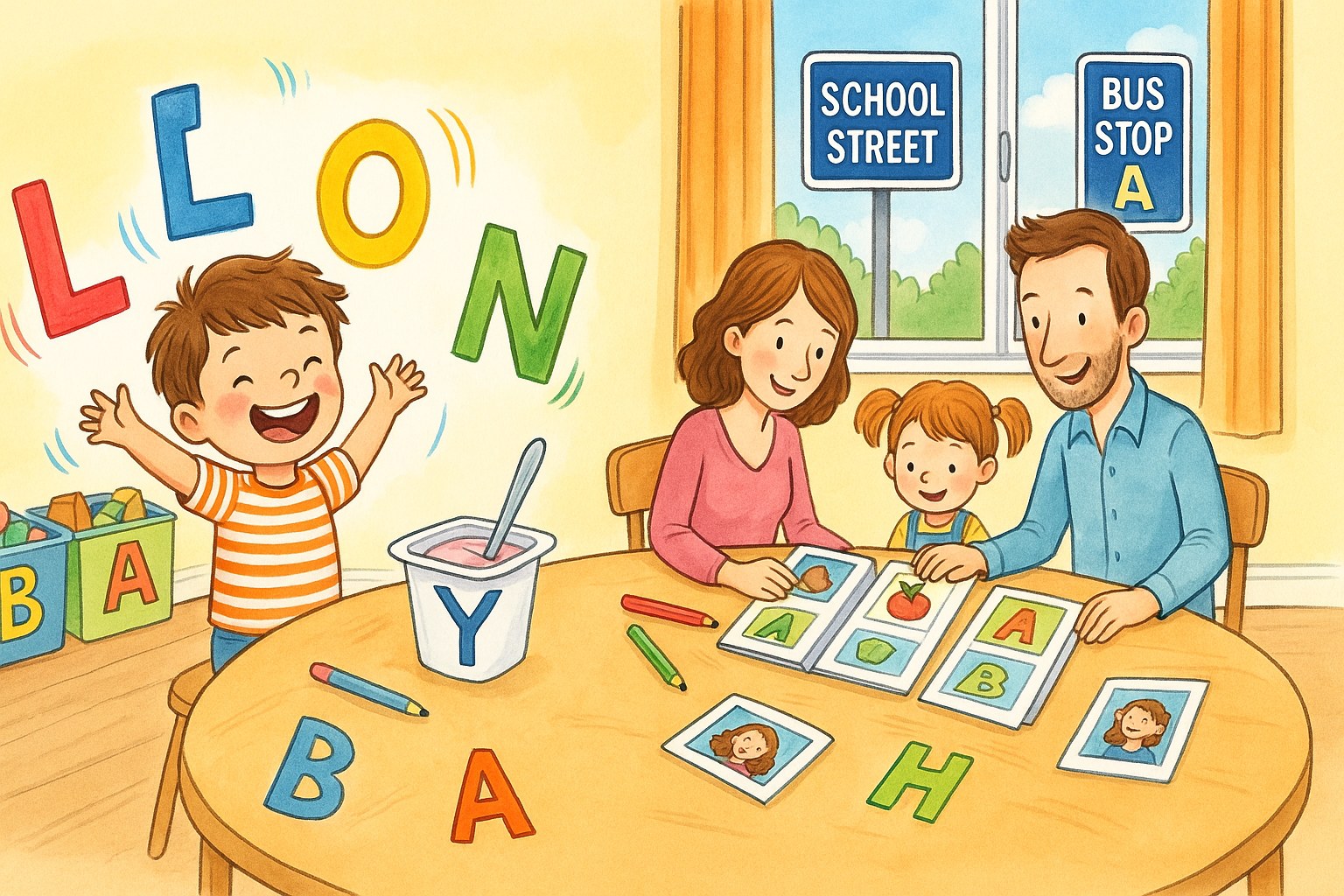
🔍 A letter hunt all around the house
You can have fun spotting the letters of a name on everyday objects. You look for the “A” on the yoghurt pot. The living room turns into a place to explore.
Tidying up becomes a game too. You stick labels with the first initial on the toy boxes. Your child links the symbol to their own world. It’s passive yet effective learning.
You also look out for known letters on shop signs while out walking. You use street signs as learning tools. The alphabet finally steps outside the strict frame of a book.
📸 Make a one-of-a-kind photo alphabet
Creating a personalised visual aid with photos of favourite things is a brilliant idea. “D” for the comfort blanket, or “M” for Mum. Here, feelings support how the brain remembers.
You link each letter to a family member or a friend. Sticking faces next to the letters strengthens the social bond. The tool becomes a real personal treasure.
Here’s how to put this project together easily with a few bits and bobs:
- What you’ll need: photos, glue, card sheets, thick felt-tip pens.
- Steps: pick one word per letter, stick the photo on, draw the letter nice and big.
🤲 Touch and build letters to remember them better
For the brain to engrave these shapes for good, you need to go through the hands and the body, a method that has proven its worth.
🔤 The power of textured sandpaper letters
Texture offers a huge advantage for muscle memory. The fingertips follow the exact path of the letter. The brain records the movement long before the symbol.
This touch naturally prepares the hand for writing later on. You build fine perception without even holding a pen. It’s an essential in-between stage. The feel of the texture strengthens the mental image.
You can suggest making them at home with sandpaper or glued-on glitter. It’s a cheap and creative activity. Your child happily joins in making their own materials.
🎨 Sculpt the alphabet with modelling clay
Hands-on shaping helps your child grasp how the signs are built. You roll little sausages to make bars or bridges. The letter becomes a real 3D object.
Using pipe cleaners lets you vary textures and colours. You twist, bend and adjust them easily. This shows that letters are made of joined-up segments. It’s very visual.
| Activity | Material | Main benefit |
|---|---|---|
| Modelling clay | Hands-on shaping | Understanding the structure |
| Pipe cleaners | Flexibility | Joining up segments |
| Sand | Free tracing | Remembering the movement |
🧱 Use building bricks to spell out words
Writing letters on building bricks with a permanent marker is a clever move. The construction game becomes a language tool. Your child puts sounds together with curiosity.
Snapping the blocks together lets them build names or very short words. You can stack the letters to make tall word towers. A mistake is easy to fix and nothing to worry about.
Mixing the pure fun of play with serious learning is the key. Your child has no idea at all that they’re working. They build their knowledge brick by brick, plain and simple.
🔊 Linking each letter to its real sound
Recognising the shape is one thing, but understanding that this shape “speaks” is the final step towards reading.
🔊 Telling the name and the sound apart
The sound of a letter matters more to a child than its alphabet name. Saying “fff” is far more useful than spelling out “eff”. This makes blending sounds together much easier later.
Helping your child hear the “song” of each consonant is a game. You play up the sound of the letter in simple words. The “S” then hisses like a snake. The approach becomes wonderfully vivid.
You need to avoid mix-ups when putting words together. A youngster who knows the sounds will read “papa” far faster. The letter’s name can sometimes get in the way of this tricky process.
🎵 Use songs to fix the order of the alphabet
Singing is a truly powerful tool for memory through the ears. The tune naturally helps your child recall the logical order of letters. It’s a great classic, timeless and above all very effective.
Varying the rhythm keeps the activity lively and far less dull. You can sing fast, softly, or even in a whisper. Your child has fun with their own voice. This deepens the overall memory.
Adding simple gestures to the words of the song helps a lot. You clap your hands or mime the letters. The whole body takes an active part in remembering the rhythm of the music.
⭐ The star game to link picture and sound
Drawing a big star on the floor or on paper is enough. Each point holds a word shown with a simple drawing. Your child then has to spot the very first sound they hear.
Asking your child to place the matching moveable letter on the right point is playful. It’s a sound-sorting exercise. It links the written symbol to the real object. The game stays visual.
Strengthening the link between writing and the real world is rewarding. Your child finally understands that letters are there to name what they see. It’s a major intellectual win for them.
✍️ A gentle path towards joined-up writing
Once the sounds are tamed, tracing becomes the new challenge, calling for a precision you build up step by step.
🔠 Why start with capital letters
Straight lines are perfect for beginners. These simple sticks need less control than tricky loops. Your child quickly gains confidence in their hand control in front of the page.
Capitals also offer instant visual recognition. They stay nice and distinct and aren’t easily muddled. It’s the ideal format for first reads. Your child spots their first words effortlessly.
Pulling off an “A” or an “L” seriously boosts a little one’s ego. It’s rewarding to make a sign that everyone can read. These first wins are brilliant drivers for what comes next.
🔡 Bridging the gap to lower-case letters
You can set up a matching game to link the two formats. The idea is to find the “little sister” of each big letter. This visual workout quickly becomes a habit you need for good reading.
Using alphabet charts that show several fonts helps a lot. Your child grasps that an “A” is still an “a”, even when its shape changes. This is the start of seeing the letter as an idea, a key stage.
Lower-case letters are the true queens of storybooks. So you need to get to know them without delay to make real reading easier. You always do it gently, with no needless pressure.
✋ Building fine motor skills for tracing
Pre-writing patterns get the fingers ready well before actual writing. Drawing waves, bridges or circles builds up the hand. It’s real physical preparation for your budding little writers.
Working on the pencil grip comes through colouring or cutting out. You build up the pinch between thumb and index finger. It’s an essential technical step. Without this strength, writing soon becomes tiring.
Getting ready for joined-up letters means practising flowing loops. You start big before shrinking the size down. The movement should become smooth, almost automatic, so your child learns the alphabet calmly, step by step.
💡 Tips for overcoming common little hurdles
Even with the best will in the world, obstacles sometimes pop up, but they’re a normal part of how learning works.
🔄 Sorting out the b, d, p and q muddle
Seeing letters as mirror images is completely normal in little ones. The brain simply has to learn to orient these shapes in space. It’s absolutely not a neurological disorder.
You can give very concrete visual cues to help. The “b” has a big belly, for example. Using simple memory tricks helps a lot. Your child needs pictures to tell these close shapes apart. It’s reassuring.
There’s no need to worry if these slip-ups carry on until age eight. Maturity comes with time and regular practice. Every child moves at their own pace with no needless pressure.
The brain maturity needed to steady the orientation of letters can take several years, and that’s nothing to worry about.
🤷 What to do if your child sulks at letters
If tension builds, it’s better to suggest a complete break straight away. You simply put the books and workbooks away. Fun must stay the main driver.
Switching tools lets you bring in movement or the outdoors. You can trace letters in sand or with water. Learning then turns into a physical adventure. This often unblocks the situation.
Praising other skills is key to keeping self-confidence alive. You highlight how good a drawing or a model is. Your child must never feel defined by their struggles. Patience pays off.
🔁 Weave the alphabet into the routine, no homework
Using number plates on car journeys is a brilliant idea. Together you hunt for a certain letter on the cars going by. It’s a genuinely fun speed game.
You can also play at finding letters on menus at the restaurant or on posters. The alphabet is everywhere in town. You turn waiting into a moment of shared discovery. It’s light and easy.
Keeping a relaxed tone stops the game from turning into a heavy chore. You don’t mark and you never judge. You simply share a moment of discovery day by day.
Here are a few ideas to learn the alphabet with your child, stress-free:
- Name the letters on shop signs while out walking.
- Spell out the ingredients while cooking a snack together.
- Hunt for specific letters in the leaflets that come through the door.
By leaning on sensory awakening, the child’s name and play, you give your child solid foundations without stress. Try these activities right now to turn learning the alphabet into a future school success. With a little patience, these letters will become their best allies for the adventure of reading.
❓ FAQ
👶 What’s the ideal age to start learning letters?
You can absolutely start to spark a little one’s curiosity from the age of two. At this age, it’s not about lessons, but simply about getting them familiar with the shapes of letters through puzzles or magnets.
The real lightbulb moment, when a child grasps the link between the written sign, the sound and the word, usually comes a bit later, between three and four. The key is to follow their pace and never put them under pressure.
🔤 Which letters are best to start with?
The most effective approach is to begin with the letters of their own name. It’s a magical playground because a child is so emotionally attached to it. They’ll be proud as punch to recognise their initial on the yoghurt pot or the cereal box.
You can also lean on capital letters at first. Their straight, simple strokes, as in “L” or “A”, are far easier to remember and trace for little hands than the loops of joined-up writing.
🔄 How can I help a child who muddles b, d, p and q?
Don’t panic, these “mirror letter” mix-ups are completely normal and can last until around age eight. The brain needs time to orient itself in space. You can use little tricks like the picture of a bird: the “b” is its beak, the “d” its back, the “p” its paws and the “q” its tail.
Another fun trick is to say the “d” has a big bottom while the “b” has a big belly. These vivid visual cues help your child steady the orientation of letters while having fun.
🔊 Why is it better to learn the sound of letters rather than their name?
Here’s a little reading secret: it’s often more useful to say the letter “S” goes “sss” (like a snake) than to call it “ess”. Learning the phoneme, that is, the song of the letter, makes blending sounds together far easier later on.
If your child knows the “P” goes “puh” and the “A” goes “aah”, they’ll find it much more natural to read “papa”. The letter’s name is extra information that can sometimes muddle things when they’re decoding their first words.
🤲 Which sensory activities help with memorising the alphabet?
Touch is a precious ally! You can make textured letters with sandpaper or salt so your child follows the path with their finger. Handling modelling clay or pipe cleaners to sculpt letters also helps the brain engrave these shapes for good.
Movement games work really well too. You can have fun miming letters with your body in front of a mirror, or jumping on letters chalked on the ground. The more a child uses their senses and body, the more learning becomes a natural pleasure.
