
Do you often wonder why your little one’s reactions look like real storms that are impossible to stop? Understanding how the brain works helps you see that these behaviours aren’t tantrums, but the result of an amazing machine that’s still under construction. This article explains how neurons connect to help your child grow, learn and handle their emotions better thanks to your warmth and patience.
- Three zones to drive the machine
- Why do emotional storms break out?
- 3 secrets of brain plasticity
- The vital role of connection and rest
- Play, the engine of cognitive learning
- Environment and good daily habits
🧠 Three zones to drive the machine
To understand a child’s reactions, you first need to look under the bonnet. Discovering how their brain is organised into three separate levels helps you make better sense of their everyday behaviour.
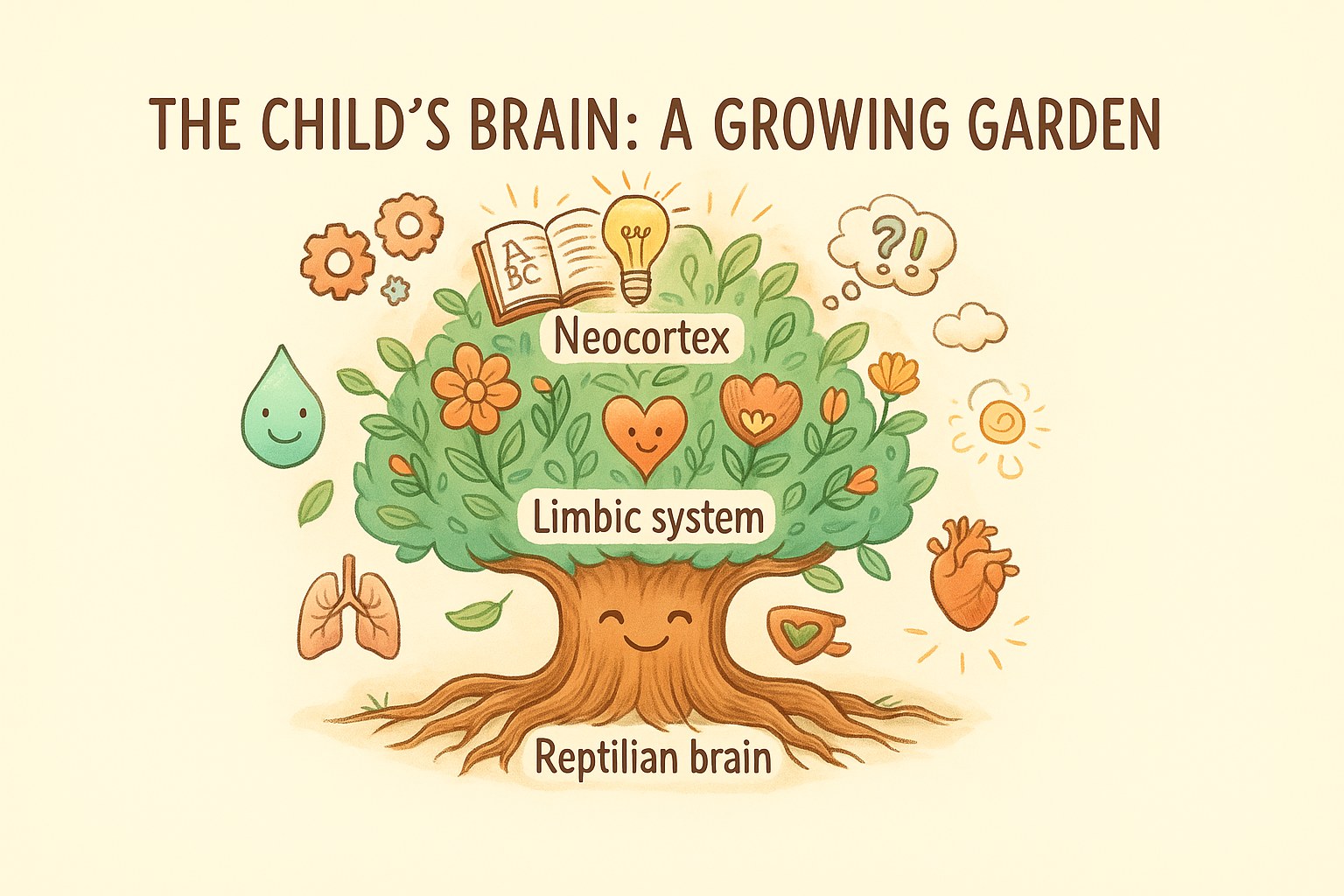
🦎 The reptilian brain handles reflexes
The ancient brain sits at the base of the skull. It runs the automatic functions that keep us alive. Breathing and digesting happen here without any need to think.
When danger strikes, it switches on survival mode. Fight, flight or freeze kick in. In a toddler, this response is instant and non-negotiable.
This zone ignores logic. It only takes care of immediate safety.
❤️ The limbic system processes emotions
This is the home of emotions and emotional memory. The amygdala works like a sentry on permanent alert. It picks up fear or joy with huge intensity.
Memories link up here with feelings. A familiar smell or a particular place can bring back a strong emotion stored in this space.
The limbic system is the beating heart of childhood, where every experience paints the world with a lasting emotional colour.
🧠 The neocortex handles reasoning
The upper part is the thinking brain. Language, analysis and logical problem-solving all live here. It’s the main tool for learning at school.
Yet it matures very slowly. Unlike the instinctive zones, this clever brain takes years to become truly effective and stable.
A child can’t always call on this zone. Often, their emotions block the way to reason.
🌪️ Why do emotional storms break out?
Now that we know the players, let’s see why they struggle so much to get along during a big meltdown.
🌱 A prefrontal cortex that’s still very immature
The prefrontal cortex acts as a brake on strong emotions. In a child, this brake is still very fragile or missing. Calming down on their own is therefore biologically impossible.
The brain is like a house in the middle of being built. The upper floors aren’t yet wired to the ground floor. Emotions overflow because the message can’t get through.
It’s a brain under construction. It grows slowly.
⚖️ Telling wanting apart from being able to
A tantrum often hides a real neurological overload. The child isn’t trying to defy your authority. The truth is, their nervous system simply can’t cope with the situation any more.
- The difference between deliberate disobedience and a biological limit.
- The part played by an immature frontal brain.
- The need for outside co-regulation.
Punishing an emotional storm is like punishing a fever. It’s a physical state the child goes through. They need help, not punishment.
😰 The effect of stress and cortisol
Intense stress releases cortisol into the body. This hormone floods the brain and blocks clear thinking. At that point, the thinking brain shuts down completely.
An inner alarm set off too often harms the neurons. Stress stops the higher connections from forming. The body stays stuck in permanent survival mode.
Soothing is the only key to bringing cortisol down. Only calm makes thinking possible.
💡 3 secrets of brain plasticity
But nothing is set in stone, because a child’s brain has an incredible superpower: the ability to keep reshaping itself.
🌳 The forest path analogy
Picture a completely untouched forest. Every new experience is like a first walk through the tall grass. You move slowly and feel your way a little. With each crossing, a small path slowly takes shape.
These paths are really the connections between neurons. The more a child practises an activity, the wider the path becomes. It then gets far easier to follow. This is quite simply how learning works in real life, day after day.
Brain plasticity makes this possible. It lets the brain adapt all the time.
⚡ Speeding up the signal with myelin
Myelin is a kind of insulating sheath wrapped around the nerves. It works exactly like the plastic around an electric wire. Its job is simple: it boosts the speed of the signals travelling through the head.
Myelin turns those little dirt paths into information motorways, making movements and thoughts smooth and automatic.
That’s why children suddenly become far more skilful. Their nerve circuits are now better insulated. So the messages travel much faster and more efficiently.
🔁 Strengthening connections through repetition
Repetition plays a huge part in making progress. Doing the same movement a hundred times literally builds the brain. Neurons that fire together end up forming truly strong, lasting links.
There’s also a natural sorting process called synaptic pruning. The brain clears away the connections it doesn’t use to work more efficiently. It keeps only what really serves the child’s daily needs.
So the environment shapes the brain’s physical architecture. Every interaction counts enormously. This is how we build strong networks for the future.
💤 The vital role of connection and rest
For this wonderful machine to build itself well, it needs two key ingredients: love and sleep.
🤗 Secure attachment builds confidence
The reassuring presence of a calm adult instantly soothes the alarm system. A child who feels safe then releases oxytocin. This precious hormone directly supports their brain growth.
When their emotional tank is full, a child finally dares to wander off and explore the world. Their brain then becomes free to learn. It’s no longer simply trying to survive.
Warmth and kindness aren’t a luxury. They’re the biological soil that healthy development depends on.
😴 Locking in memories during sleep
While a child sleeps, their neurons actively sort and file the information they took in. The day’s learning then settles firmly into their memory.
Sleep carries out vital missions for those little neurons:
- Locking in memories
- Clearing out brain toxins
- Balancing mood
- Maturing the nerve circuits
A tired brain loses its ability to manage its most basic emotions. A lack of sleep feeds irritability.
🥗 The energy a balanced diet provides
The brain burns a huge amount of energy to function. It needs good fats such as omega-3s. Slow-release carbs also help avoid pointless spikes of crankiness.
Without the right nutrients, the nerve signals slow down. The child then becomes more easily distracted. Their ability to learn drops sharply because of these gaps.
A proper breakfast changes everything. It’s the first engine of the day for the neurons.
🎮 Play, the engine of cognitive learning
If connection and rest are the foundations, play is the architect that fine-tunes the most complex functions.
💪 Building up working memory
Working memory acts like a little mental notepad. It holds a specific instruction in mind while you carry out another action. Play trains it hard.
Take board games or riddles. The child has to hold the rules in mind while watching the others. This workout strengthens their short-term storage and their thinking.
It’s a key stage in their development. This is how the brain organises itself.
🎲 Gaining mental flexibility through fun
Flexibility is the art of changing your mind or your strategy. Free play lets a child test ideas, get things wrong and start over differently, with no pressure to succeed.
| Executive function | Role in play | Everyday benefit |
|---|---|---|
| Working memory | Holding the rules in mind | Following an instruction |
| Mental flexibility | Switching tactics | Adapting to the unexpected |
| Inhibitory control | Waiting your turn | Managing impulses |
This flexibility will later help with solving complex problems. It’s learning to adapt all the time and grow stronger for it.
🛑 Taming inhibitory control
Inhibitory control means being able to say “no” to an impulse. It’s learning to wait your turn or not touch a forbidden object, even when the urge is strong.
Group games encourage this skill. The child has to hold back their immediate urges so the game can carry on. It’s a workout session for their prefrontal cortex.
Play isn’t a waste of time. It’s the most serious work of childhood for understanding how the brain works, explained for kids.
🌱 Environment and good daily habits
To finish, let’s look at how our everyday choices as parents can protect or stimulate this precious brain.
📱 Staying alert to screen time
Sitting passively in front of fast-moving images tires the nervous system. The brain takes in too much information without being able to process it. This often creates unusual restlessness in a child.
Screens get the brain used to artificial, instant stimulation. Real-life activities, which are slower, then start to feel boring. The child then struggles to focus their attention on simple tasks.
Cut screen time right back. Make real interactions the priority for healthy development.
💬 The richness of social interaction and language
Talking to your child, even as a baby, switches on the language areas. The human brain is wired to learn through contact with another human. Constant conversation is the best food of all.
These everyday exchanges nurture essential skills:
- The importance of eye contact
- The role of taking turns in conversation
- A growing vocabulary
- The development of empathy
No app can replace a chat. Human warmth is the best engine for communication.
🧘 Practising co-regulation to calm down
Co-regulation helps manage emotional meltdowns. The parent lends their own mature brain to the child. Through their calm, they help the child’s nervous system settle.
Use slow, deep breathing or a protective cuddle. These gestures send a signal of safety to the limbic brain. The emotional storm can then gently and surely drift away.
Keep in mind the idea of the “thermostat” parent. You’re the one who sets the emotional temperature of the home.
Understanding how children’s brains develop lets you guide them through their storms with warmth and patience. By making play, sleep and secure connections the priority, you build up their neurons for the long run. Give them this fertile soil today to calmly raise the happy adult of tomorrow. Every cuddle shapes their future.
❓ FAQ
💭 How can you explain how the brain works to children in simple terms?
You can picture the brain as an amazing machine hidden inside our head. It works as a command centre that helps us think, learn new things, feel emotions and move our body.
At the start, a baby’s brain is tiny, but it grows at an incredible speed. It builds billions of neurons, which are like little electric wires, to create a huge internal communication network.
🏠 What are the three main parts that make up our brain?
To keep it simple, you can see the brain as a three-storey house. Downstairs, the reptilian brain runs our survival reflexes and basic needs, such as breathing or digesting, all on autopilot.
In the middle, the limbic system is the home of our emotions and emotional memory. Right at the top, the neocortex is the part that thinks, analyses and lets us talk or solve tricky problems.
😡 Why do children sometimes have big meltdowns that are hard to calm?
It’s often down to biology! The prefrontal cortex, which acts as a “brake” on emotions, is still very immature in little ones. During an emotional storm, the brain is flooded with cortisol, a stress hormone that freezes clear thinking.
The child isn’t disobeying on purpose; they’re simply in neurological overload. Their thinking brain shuts down, and they need an adult’s help to settle and find their calm again.
🧩 What exactly is brain plasticity?
It’s the brain’s superpower! Brain plasticity lets the brain change and adapt according to our experiences. Every new bit of learning creates connections between neurons, as if we were tracing paths through a forest.
The more we use a connection, the stronger and faster it becomes thanks to myelin, a protective sheath that boosts the nerve signals. The other way round, the brain does a natural sort and removes the paths it no longer uses, so it stays efficient.
🌟 How can you help a child’s brain develop well?
The brain needs three essential ingredients: love, rest and a good diet. A safe, secure environment boosts oxytocin, a hormone that supports the growth of neurons and self-confidence.
Sleep matters just as much, because it’s at night that the brain sorts and files away the day’s memories. Finally, a diet rich in omega-3s and slow-release carbs provides the energy this wonderful machine needs to run at full power.
🎯 Is play really useful for a child’s intelligence?
Absolutely — playing is the most serious work of childhood! Play builds the executive functions, such as working memory or mental flexibility, which lets us switch strategy when we get something wrong.
While playing, a child also learns inhibitory control, meaning the ability to wait their turn and hold back their impulses. It’s a real training session for their future adult brain.
