
Explaining how the heart works to kids can feel tricky when you don’t have the right words for that hollow muscle thumping away in the chest. This guide turns anatomy into an easy-to-follow adventure, helping curious little ones understand their own bodies without any stress. You’ll discover how this natural pump pushes red and blue blood around the body thanks to its own built-in electrical system and a set of clever little valves.
- How the heart works, explained simply
- The four rooms of the heart house
- The journey of red blood and blue blood
- The heartbeat and the electrical circuit
- Taking your pulse and watching it change
- Keeping a strong heart for life
❤️ How the heart works, explained simply
Now that we know how important this organ is, let’s find out what’s hidden inside our chest.
💪 A tireless muscle in your chest
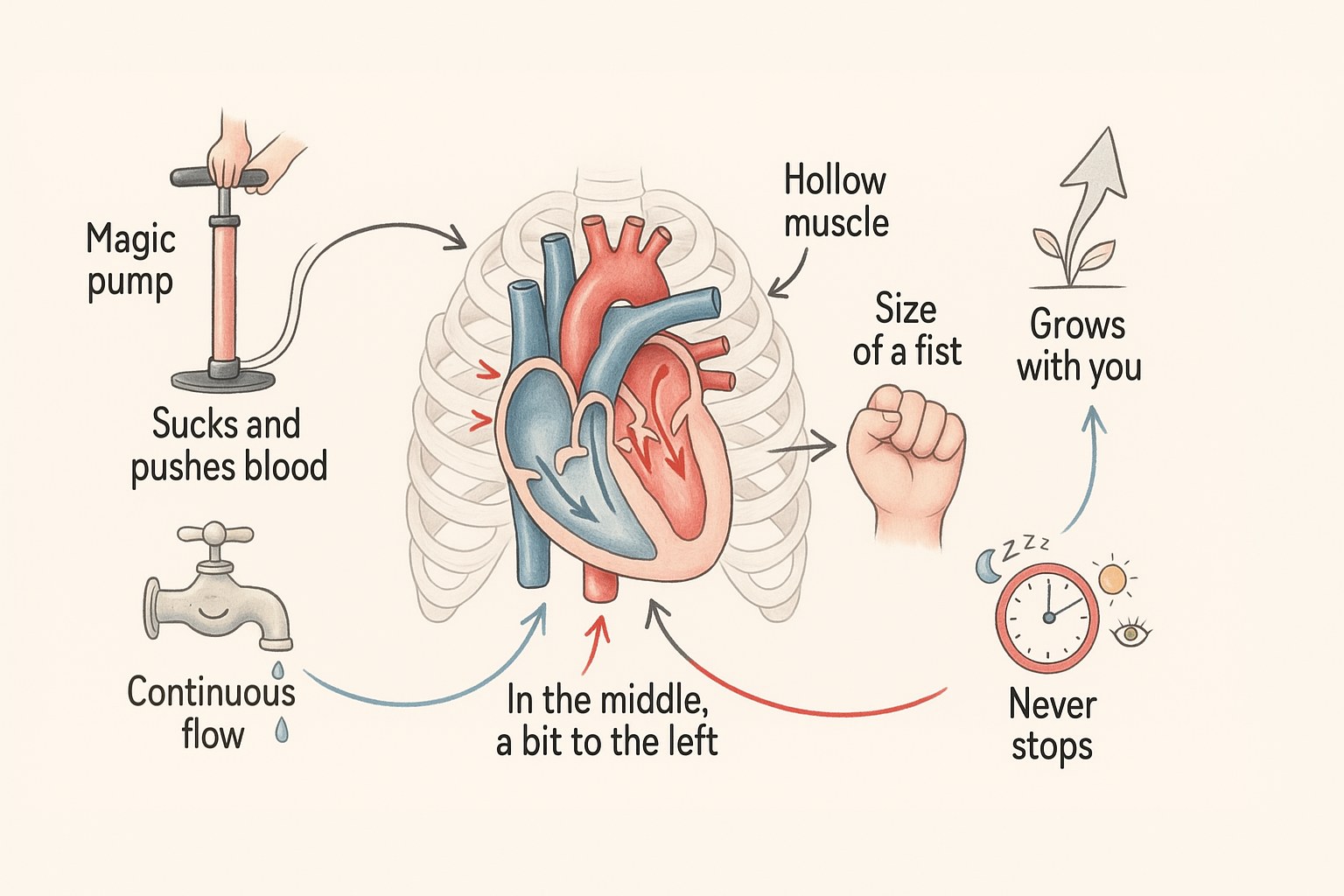
The heart is a one-of-a-kind hollow muscle. It sits right in the middle of your chest. Your ribs wrap around it like a cage to keep it safe.
It’s a vital organ that works all on its own. It never stops, even while you’re sleeping or eating. In fact, it’s the engine of life.
Without it, the whole body would shut down. It’s a real hard worker.
✨ The body’s magic pump
You can picture it like a bike pump. The heart draws blood in. Then it pushes it out hard so it travels everywhere.
It’s a bit like a tap opening and closing. This movement creates a steady flow through all our blood vessels.
The heart is an amazing pump that keeps blood moving all around the body without ever getting tired.
✊ Fist-sized and well hidden
A child’s heart is about the size of their closed fist. It’s a really simple trick for picturing how big it actually is.
It sits in the centre of the chest. Even so, it leans a little to the left. That’s where you can feel it beating.
It grows along with the child. The bigger you get, the more this muscle becomes strong and sturdy to keep up with you.
🏠 The four rooms of the heart house
Now that we know what the heart is, let’s step inside to see how it’s laid out like a little house.
🏠 Atria and ventricles: the flatmates
Picture four separate rooms inside this muscle. There are two small rooms upstairs, the atria. Just below them sit two bigger rooms called the ventricles.
A very solid wall separates the right side from the left side. This wall stops the blood from the two sides mixing together. It’s a brilliantly precise set-up that keeps everything running smoothly.
Think of them as flatmates who work as a team. Each room has its own job. They all spring into action together to keep the blood moving without ever stopping.
🚪 Doors that only open one way
Inside, you’ll find valves, little magic doors. They open to let the blood through. Then they snap shut again. This stops the blood from flowing backwards.
It’s a bit like a safety flap. Thanks to these doors, the red liquid always travels in the right direction. There’s no risk of taking a wrong turn in this maze.
Without these flaps, the pumping would be useless. Everything would be in total chaos.
⬆️ The collecting job of the upper chambers
The atria do a big job of receiving blood. They gather up the blood as it comes back from its travels. It arrives either from the lungs or from the rest of the body.
Next, the blood drops down into the ventricles. These rooms are far more muscular. That makes sense, because they have to send the blood a very long way, with plenty of force.
| Chamber | Main job | Pumping force |
|---|---|---|
| Right atrium | Receive the blood | Weak |
| Left atrium | Receive the blood | Weak |
| Right ventricle | Send it to the lungs | Strong |
| Left ventricle | Send it to the body | Strong |
And there you have it: now you know what goes on behind the scenes of this incredible machine beating away in your chest.
🩸 The journey of red blood and blue blood
The blood doesn’t stay in the heart — it sets off on a great adventure through the whole body.
🫁 Off to the lungs to fill up
The blood first travels to the lungs. It goes there to pick up oxygen. It’s a bit like pulling into a station to fill up with petrol.
We often use colours to keep track. The blood is called blue when it’s tired. It turns bright red the moment it’s nicely filled with oxygen.
This colour change happens in an instant. It’s exactly what goes on when we breathe in air. It’s quick and really effective.
🚚 An express oxygen delivery to the organs
The red blood then races off to the brain and the muscles. It brings the energy they need to think clearly and run about. Some organs have a big energy demand to keep working every single day.
Every tiny cell in the body waits eagerly for its delivery. The heart sees to it that everything is shared out without delay. It’s surely the fastest delivery driver in the whole world.
Thanks to this oxygen, our organs work properly. It’s our natural fuel.
🧹 Clearing out the waste through the veins
The veins have an important job too. They bring back the blood loaded with carbon dioxide. This gas is actually the waste the body needs to get rid of.
It’s an endless loop that never stops. The blood comes back to the heart. It sets off again straight away towards the lungs to begin its cleaning and refuelling cycle once more.
Here are the steps of this great journey:
- The start from the heart
- The stop at the lungs
- The delivery to the organs
- The return through the veins
⚡ The heartbeat and the electrical circuit
For this pump to keep a steady rhythm, it needs a conductor and a little electrical energy.
🥁 Systole and diastole: the inner drum
The heart squeezes to push the blood out — that’s systole. Then it relaxes to fill back up — that’s diastole. This movement creates the famous lub-dub sound.
Even while you sleep, the muscle keeps on working. This rhythm is completely automatic. It’s our brain that handles it without us ever thinking about it.
You can compare this cycle to a very steady drum. It sets the beat that’s needed. That’s what keeps life going throughout our whole body.
🔋 A natural battery to set the tempo
The heart has its own discreet built-in pacemaker. It’s like a little battery hidden inside the muscle. It sends out invisible electrical sparks. These signals trigger each beat all on their own.
It works rather like the electrical wiring in a house. Wires carry the order to contract. The message travels all around the chambers this way to push the blood along.
It’s a precise system. Everything is perfectly in sync.
🏃 Why the rhythm changes with activity
The heart suddenly speeds up when you run. The muscles are working hard. They then call for a lot more oxygen to keep moving properly.
So the pump has to work faster. It’s a bit like shifting up a gear on a bike. The blood then flows around more quickly.
The rhythm slows down as soon as you rest. Calm returns naturally. The effort is over and the heart goes back to its normal speed.
📊 Taking your pulse and watching it change
The heart doesn’t always beat at the same rhythm — it depends on our age and what we’re doing.
👂 Listening to a heart that beats very fast
The heart rate changes a lot over time. A baby’s heart beats far faster than an older child’s. Adults have a slower rhythm too.
A newborn reaches around 200,000 beats a day. That’s an incredible record for such a tiny muscle. This engine works without ever stopping to send blood everywhere.
The smaller the body, the more the heart races. It has to feed every cell very quickly. That’s perfectly normal to fuel a growth spurt full of energy.
🤰 From mum’s tummy to the playground
The heart starts its mission very early in life. It’s already working while the baby is still growing inside its mum’s tummy. It’s the very first visible sign of life.
Everything changes at birth. With that first cry, the circuit to the lungs opens up completely. The baby then starts to breathe outside air to add oxygen to its blood.
It’s a magical transformation. The heart adapts straight away.
🫀 Learning to feel your own rhythm
It’s easy to find your pulse for a bit of fun. Just place two fingers on your wrist. You can also try the side of your neck, just under your jaw.
Jumping on the spot for a minute is a fun experiment. You’ll feel the rhythm racing away under your fingers. The muscle pumps harder to help your legs keep moving.
Here’s how to do the activity:
- Sit down quietly
- Place your fingers
- Count the beats
- Try again after running
💪 Keeping a strong heart for life
To finish, let’s look at how we can help our heart stay the champion of our body.
⚽ Sport to build up your inner pump
Moving about is essential for your health. Running, swimming or cycling thickens the walls of the heart. This makes the muscle far more powerful day to day.
A well-trained heart really takes it easy on itself. It sends out more blood with every squeeze. That way, it gets much less tired while feeding our organs.
Moving about every day is the best gift you can give your little heart muscle.
🥗 The foods that your arteries love
Eating well protects our precious vessels. Colourful fruit and vegetables keep the blood pipes perfectly clean. It’s a bit like looking after the plumbing in a lovely house.
Too much sugar or fat clogs up the little blood pathways. This can end up blocking them. It’s better to go for balance on every plate you make.
A healthy life helps the muscle keep beating for a long time. It’s easy and natural.
👨⚕️ When the heart needs a little doctor
Sometimes, nature makes small mistakes. A child can be born with a tiny hole between the chambers. A little door can also struggle to close.
Modern medicine works miracles these days. Doctors fix these problems with targeted medicines. They also use expert procedures to put everything back in order.
The heart is still an incredibly tough organ. Despite a small hiccup at the start, it shows enormous courage to help us grow.
This tireless muscle, no bigger than a fist, pumps oxygen to feed every cell. By moving about and eating a balanced diet, we protect this magic engine that beats all on its own. Take good care of this precious treasure so it keeps powering your adventures with strength and energy!
❓ FAQ
📍 Where exactly is the heart in our body?
The heart is tucked safely in the middle of the chest, right between the two lungs. It’s protected by the ribs, like in a sturdy little cage.
Even though it’s in the centre, it leans just a tiny bit to the left. That’s why we often feel its beats more strongly on that side.
📏 How big is a child’s heart, really?
Here’s a fun trick for picturing it: the heart is about the same size as the child’s closed fist. So it grows right along with them!
It’s a hollow muscle that gets stronger and sturdier over the years to keep up with the whole body as it grows.
✨ Why do people say the heart is a magic pump?
We use this image because it draws blood in and then pushes it out hard into all the vessels. It’s a bit like a bike pump sending out air, except here it’s to keep life flowing.
This pumping movement never stops. It carries oxygen and energy to every tiny cell, from the tips of your toes to the top of your head.
😴 Does the heart stop beating when we sleep?
Not at all! The heart is a tireless muscle that works all on its own, automatically. It never takes a holiday, not even during a nap or at night.
It’s the brain that manages its rhythm without us needing to think about it. It simply slows down a little when we’re nice and calm and resting.
🔊 What’s that “lub-dub” sound we hear?
That drumming sound comes from the little doors inside the heart closing — we call them valves. They open to let the blood through and snap shut quickly to stop it flowing backwards.
This steady rhythm has two stages: the systole, when the heart squeezes, and the diastole, when it relaxes to fill up again.
🏃 Why does our heart beat faster when we run?
When we make an effort, our muscles work hard and need more oxygen, like an engine asking for more fuel. So the heart shifts up a gear.
By beating faster, it delivers oxygen-rich blood express to the whole body. Once the effort is over, it calmly goes back to its normal rhythm.
🤲 How can we feel our own pulse?
It’s really simple to try with kids! Just place two fingers on the side of the neck or the inside of the wrist. You’ll feel a small, steady throb.
You can have fun counting the beats at rest, then try again after jumping on the spot for a minute to see the difference.
🏋️ Can we build up our heart to keep it fit?
Absolutely — sport is the heart’s best friend! Running, swimming or cycling makes its walls stronger and more efficient.
A balanced diet with plenty of fruit and vegetables also helps keep the blood “pipes” nice and clean so the heart gets less tired.
