
Do you dread the moment when your youngest has to get ready without your help, or cross the road on their own? Teaching your child to be independent is a test of patience that builds up step by step, from the flying spoon to those first trips to school. This practical guide shows you how to turn every stage into a win for their self-confidence, with gentle tips suited to their own pace of growth. 🌱
- A child’s independence by age: the early days (0-3 years)
- Preschool and setting up routines
- Primary school and managing schoolwork
- Outdoor safety and first moments alone
- Money matters and digital life
- Practical tools and the parent’s role
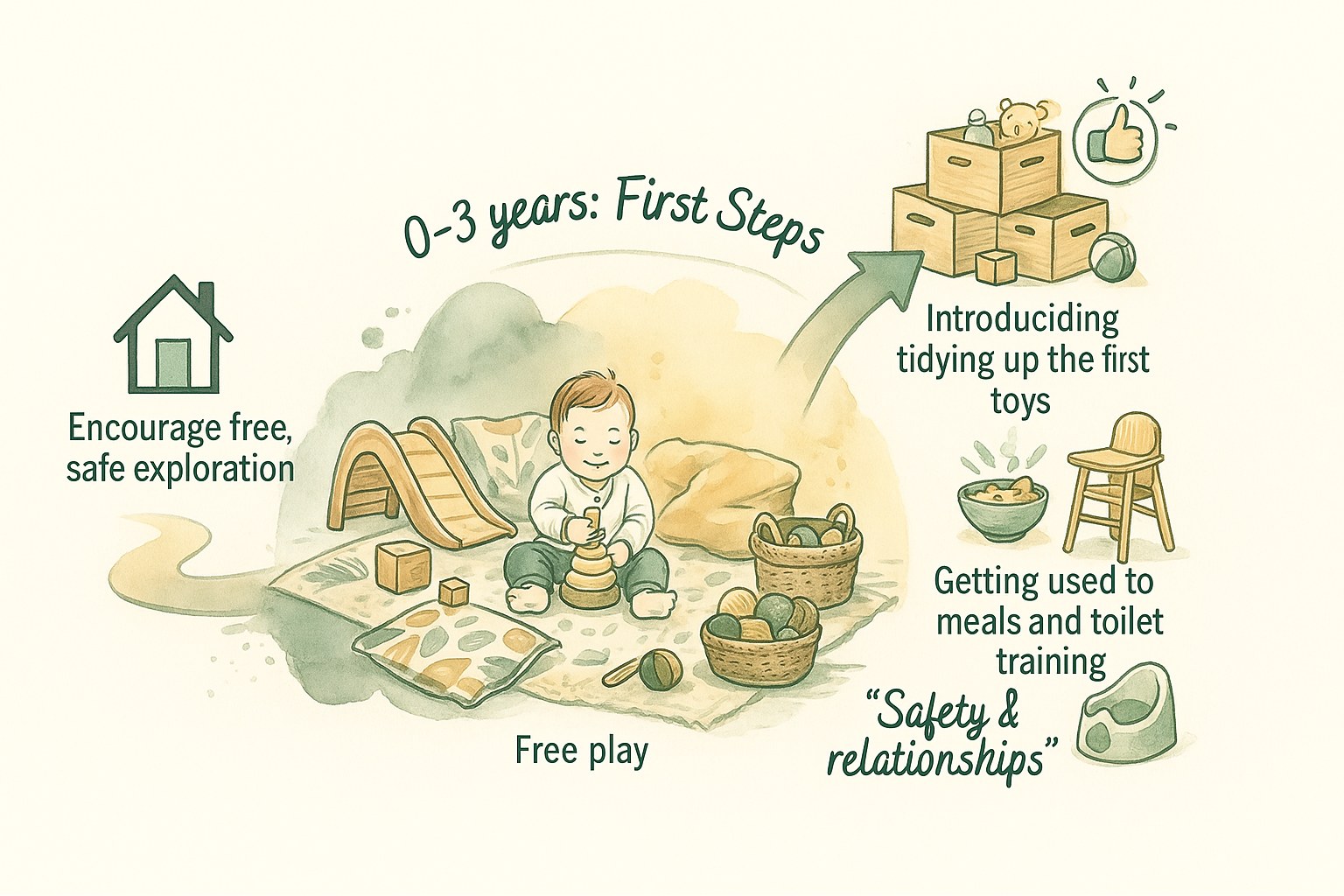
👶 A child’s independence by age: the early days (0-3 years)
We often imagine independence starts with a schoolbag on the shoulders. Yet it all begins much earlier, right from those first moments on the play mat.

🧭 Encouraging free, safe exploration
A suitable space lets a child move around freely. Free movement builds real self-confidence. It’s the foundation of everything.
The parent watches without stepping in too quickly. Letting a child experience free play is essential. You support them, you don’t do it for them.
Handling simple objects helps a lot. A child tests their physical limits this way.
🍽️ Getting to grips with meals and toilet training
Discovering textures and the spoon takes patience. Accepting a bit of mess is an unavoidable stage. That’s how fine motor skills sharpen up.
Toilet training is a biological rhythm, not a performance. Gentle little rituals help enormously. Forget the pressure of the stopwatch.
Research highlights how much wellbeing matters. Independence is never a lonely race.
Independence in the earliest years depends above all on the quality of relationships with those around the child and on a feeling of security.
🧸 Introducing them to tidying up their first toys
Open, easy-to-reach boxes are a game changer. Tidying up should be as simple as getting the toys out. It’s all about visual organisation.
Tidying then turns into a game of copying. The parent shows the action with a smile. The child copies it for the sheer joy of doing things “like the grown-ups”.
Praising the care they take with their space feels good. A little “well done” locks the habit in for good.
🏫 Preschool and setting up routines
Once a child walks and handles objects, preschool opens the door to more complex social and household rituals.

👕 Getting dressed alone to build confidence
Go for clothes without tricky fastenings to make mornings easier. Elastic waistbands and shoes with velcro straps become precious allies. Picking the outfit together the night before avoids stressful dithering in front of the wardrobe.
Sometimes you just need to guide without doing it for them. Simply holding the bottom of a zip often gets things unstuck. The child then finishes the movement alone, proud of their success.
Celebrating a jumper put on the right way round is a huge win. That little success really lifts their spirits.
🧹 Helping with simple chores
Giving real missions, like laying the table, changes everything. The child feels useful and becomes an active member of the home. They love feeling trusted with a concrete responsibility.
Bringing in sorting socks or folding laundry is ideal. These everyday gestures build fine motor skills. You strengthen their sense of responsibility without them even noticing.
The playful side has to stay the top priority here. You’re not after technical perfection, but genuine involvement. Here are a few ideas for little missions to teach your child independence, age by age:
- Putting out the napkins.
- Sorting socks into pairs.
- Clearing their plastic plate after the meal.
- Watering the plants around the house.
💗 Handling the emotions that come with independence
Welcoming the tears when a shoe won’t cooperate is necessary. Frustration is a normal driver of learning. It becomes constructive when the adult helps put into words what the child is feeling in the moment.
Encouraging perseverance without slipping into being too demanding is a subtle balance. Reminding them of their recent progress lifts their spirits. They can then see how far they’ve come since those first hesitant tries.
Positive reinforcement should be a constant for it to work. “You gave it a go” counts just as much as the end result.
📚 Primary school and managing schoolwork
When primary school starts, independence shifts up a level and becomes a matter of mental organisation and time management.
🎒 Packing their things without help
Using a visual checklist helps with the schoolbag. The child checks their exercise books and pencil case every evening. This ritual avoids the stressful morning forgetfulness. It’s a first step towards calmly managing their own kit.
You also need to make them responsible for their sports or music gear. Anticipating tomorrow’s needs becomes a structuring habit. That way nobody’s chasing after trainers at the last minute.
Let the child own a small slip-up. That’s how they grasp why being organised matters.
📓 Organising their homework efficiently
Setting a regular time slot helps create an automatic habit. A child’s brain gets better prepared for the mental effort. The routine is reassuring and cuts down endless negotiations before getting started.
Breaking big exercises into small steps makes the work easier. It makes the task less daunting and easier to begin. You move forward bit by bit, without feeling buried under a mountain of lessons.
Create a calm, uncluttered desk corner. Quiet helps them stay focused without outside distractions.
📵 Filling their free time without screens
Valuing boredom as a source of creativity is essential. It’s in these moments that a child invents their own games. We too often forget that doing nothing sparks the imagination and personal initiative.
Offering hands-on activities they can reach freely works really well. Paper, crayons and modelling clay are often enough. The child picks what they fancy and develops their own art projects.
Set clear rules about screen time. Independence also means knowing how to stop on your own.
🚸 Outdoor safety and first moments alone
Independence finally crosses the threshold of the front door to face the outside world and being home alone.
🚸 Doing the school journey safely
Walking the route together several times really helps. You need to spot the pedestrian crossings and the trickier junctions. Then you explain the safety rules calmly. The idea is to reassure without ever frightening your little walker.
Studies note that the average age for travelling to school independently is now around 11. Today’s parents often wait a year longer than the previous generation did.
You let go of their hand in stages. The child first walks a few metres ahead, then finishes a short stretch on their own.
🏠 Staying home alone for a little while
Start with very short absences of around ten minutes. This is the time to set clear instructions about the cooker or the door. You explain that they mustn’t open up to anyone, even if someone has an appointment.
Learning to make an emergency call is a vital step. The child must know exactly who to contact on their list. A neighbour or a relative should stay available in case a small problem comes up while you’re away.
You increase the length as each attempt goes well. Confidence is truly built one step at a time.
⚖️ Telling theoretical ability apart from real-life action
Knowing how to do something doesn’t always mean wanting to do it in the moment. Tiredness or a bit of passing stress can sometimes block skills they’ve already learned. A child who can dress themselves may suddenly need help after school.
It’s helpful to look at the emotional blockers of the moment. Sometimes, refusing to act alone is simply a way of asking for attention. It’s a gentle signal sent to parents to ask for a little presence.
You then adjust your expectations to the overall situation. A tired child sometimes needs to be little again for a moment.
💰 Money matters and digital life
As adolescence approaches, independence becomes intangible, touching on budgets and online interactions.
💵 Discovering how to manage pocket money
Handing over a fixed sum at regular intervals helps a lot. It teaches them to prioritise what they want. The child discovers that money is a limited resource. It’s a concrete first step towards managing it.
Letting a child make spending mistakes is useful. It’s by regretting a pointless gadget that they learn the value of things. That way you avoid handing out too many theoretical lessons.
Encourage saving up for a specific project. That builds patience and the ability to plan ahead.
💻 Using digital tools wisely
Guiding their first searches on the web is necessary. Explaining how to check a piece of information helps avoid the classic traps. You build a more clued-up, careful mind this way.
Raise their awareness of personal data and social media. Digital independence calls for guided protection. It’s an essential safeguard.
Develop a critical eye towards retouched images. Not everything that glitters on a screen is real.
🐶 Looking after a pet to build responsibility
Trusting the child with the daily feeding is an excellent idea. Caring for another living being strengthens empathy and rigour. It’s a commitment that calls for consistency.
Learning to respect the animal’s needs is essential. The dog or cat isn’t a toy that’s always available. The child then understands other beings have limits.
Take part in care such as regular brushing. These concrete tasks ground a child in reality. Teaching your child independence, age by age, runs through these gestures too.
🧰 Practical tools and the parent’s role
For these stages to work, the parent has to move from being the conductor to being a caring mentor.
📋 Creating visual aids for routines
Make a chore chart with drawings on it. Pictograms help a child find their way without being able to read. It’s a reassuring guide for their day.
Use an hourglass for timed activities. That makes the idea of time concrete and less stressful for little ones.
Display the steps in the bathroom. Brushing teeth becomes a signposted journey.
| Age range | Key action | Recommended tool |
|---|---|---|
| 0-3 years | eating alone | ergonomic spoon |
| 3-6 years | getting dressed | sorting boxes |
| 6-10 years | homework | visual weekly planner |
| 10+ | budget | compartment money box |
👀 Adopting the supervised-independence method
Show the action slowly before letting go. Imitation is the first lever of learning in human beings.
Stay a reasonable distance away so you can step in if needed. The child should feel supported but not watched under a microscope.
Wait for the child to ask for help in so many words. Not getting ahead of their difficulties helps build up their resourcefulness.
🧘 Practising letting go within a fixed framework
Accept that the bed is badly made. The result matters less than the effort put in by the child to succeed alone.
Keep firm rules to make the experience safe. Independence without limits turns into insecurity for a young child.
Value the ground covered each day. A calm parent raises a confident child. Teaching your child independence, age by age, calls above all for patience.
Encouraging a child’s independence takes patience and rituals suited to each age. By offering a safe framework and concrete tools, you boost their confidence for the future. Don’t wait any longer to turn every little mistake into a win towards their independence. A child who tries today is a free adult tomorrow. ✨
❓ FAQ
👶 At what age does a child really start to become independent?
Independence isn’t a sudden switch but a lovely path that begins very early. From around six months, your baby lays the first stones by exploring their surroundings and grabbing their toys. It’s the start of a great adventure that unfolds in stages, from holding the first spoon alone around age one to managing homework in primary school.
Every child moves at their own pace. The key is to offer them challenges suited to what they can do right now, without rushing them. A child who feels safe and encouraged will naturally build the confidence to try new things on their own.
🚽 How do I know if my child is ready for toilet training?
There’s no magic age, even if it often happens between 18 months and 3 years. Watch for the little signs: your child takes an interest in the potty, their nappy stays dry for several hours, or they climb onto furniture by themselves. If they start telling you they’ve done a “wee”, they’re becoming aware of their body.
The important thing is to respect their biological rhythm without putting them under pressure. You can start by putting the potty in the bathroom and reading stories about it. If the child refuses or seems stressed, you take a little break and try again later, quite simply.
🧸 What part does free play have in developing independence?
Free play is a real pillar of independence. It’s a time when the child decides on their own activities, without an adult directing the session. This boosts their creativity and their ability to solve problems. By building a tower or making up a story, they learn to take the initiative.
As parents, our role is to set up a safe space and stay available if needed. We watch from a distance, encourage with a smile, and only step in if the child is truly stuck. That’s how they build up their resourcefulness and confidence in their own ideas.
📚 What responsibilities can you give a primary-school child?
At this age, independence becomes more about organisation. You can encourage them to pack their schoolbag in the evening using a little visual list, or to manage their own hygiene. It’s also the ideal time to trust them with real missions around the house, like laying the table or sorting socks into pairs.
From around age eight, they can even start making their own snack or organising their time for homework. The idea is to let them face the small consequences of forgetting things, like an exercise book left at home, so they understand why being well organised is useful.
💰 How can I help a child manage their pocket money independently?
Pocket money is an excellent teaching tool in the run-up to secondary school. By giving them a small fixed sum regularly, you help them understand that resources are limited. They learn to prioritise what they want and to wait before treating themselves to something they really care about.
Let them make their own mistakes, even if they buy a gadget that ends up broken in two days. It’s by regretting a pointless purchase that they learn the value of things. You can also encourage them to put some aside in a money box for a bigger project, which develops their ability to plan ahead.
