
Struggling to hold your little one’s attention when a page is crammed with text or the pictures look dull? 📚 When you’re choosing a book for a 3-to-5-year-old, the secret lies in the length of the text and the quality of the illustrations: go for short stories and expressive images that spark the imagination gently. Discover our favourite interactive gems and sensory picture books to turn every bedtime read into a magical, funny moment of closeness.
- How to choose the right book for a 3-to-5-year-old
- 4 kinds of picture books to boost language and imagination
- Using books to support emotions and life’s big moments
- 3 playful formats to captivate curious little ones
- 3 secrets to reading aloud beautifully at bedtime
- Building a wonderful library on a small budget
📚 How to choose the right book for a 3-to-5-year-old
Now that we understand why reading matters so much, let’s look at how to pick the very book that will win over a young child.
📏 Why text length matters at this age
A 3-year-old can only concentrate for so long. Go for short stories. Each session should last no longer than ten minutes.
Look at how dense the sentences are on each page. Too much text quickly discourages a young reader. The layout needs room to breathe. That stops your child from giving up before the end of the story.
Match the reading to how tired your child is at night. A light text helps them drift off peacefully.

🖼️ The role of illustrations in visual understanding
The drawings should support the written story directly. Children rely on the picture to follow the action. It’s a key part of how they learn to read images.
Check that the facial expressions are clear. The characters should show readable emotions. That helps a child decode feelings without any help.
Mix up the art styles to train the eye. Offer watercolour, collage and digital drawing.
⚖️ Balancing your child’s independence and attention
Spot the books your child can handle alone. Board-book pages are perfect for avoiding tears and rips. The object needs to be sturdy and safe.
Choose formats that suit little hands. A book that’s too heavy soon becomes awkward and hard to flick through.
Judge how complex the plot is against your child’s maturity. A simple, linear story works best at first. Avoid tricky time jumps that lose a young listener.
To unearth a real treasure, a good selection of the best books for 3-to-5-year-olds relies on variety. Between pop-up books that fire up curiosity and fact-filled titles about animals or the human body, there’s plenty to choose from. The idea is simply to feed their imagination gently.
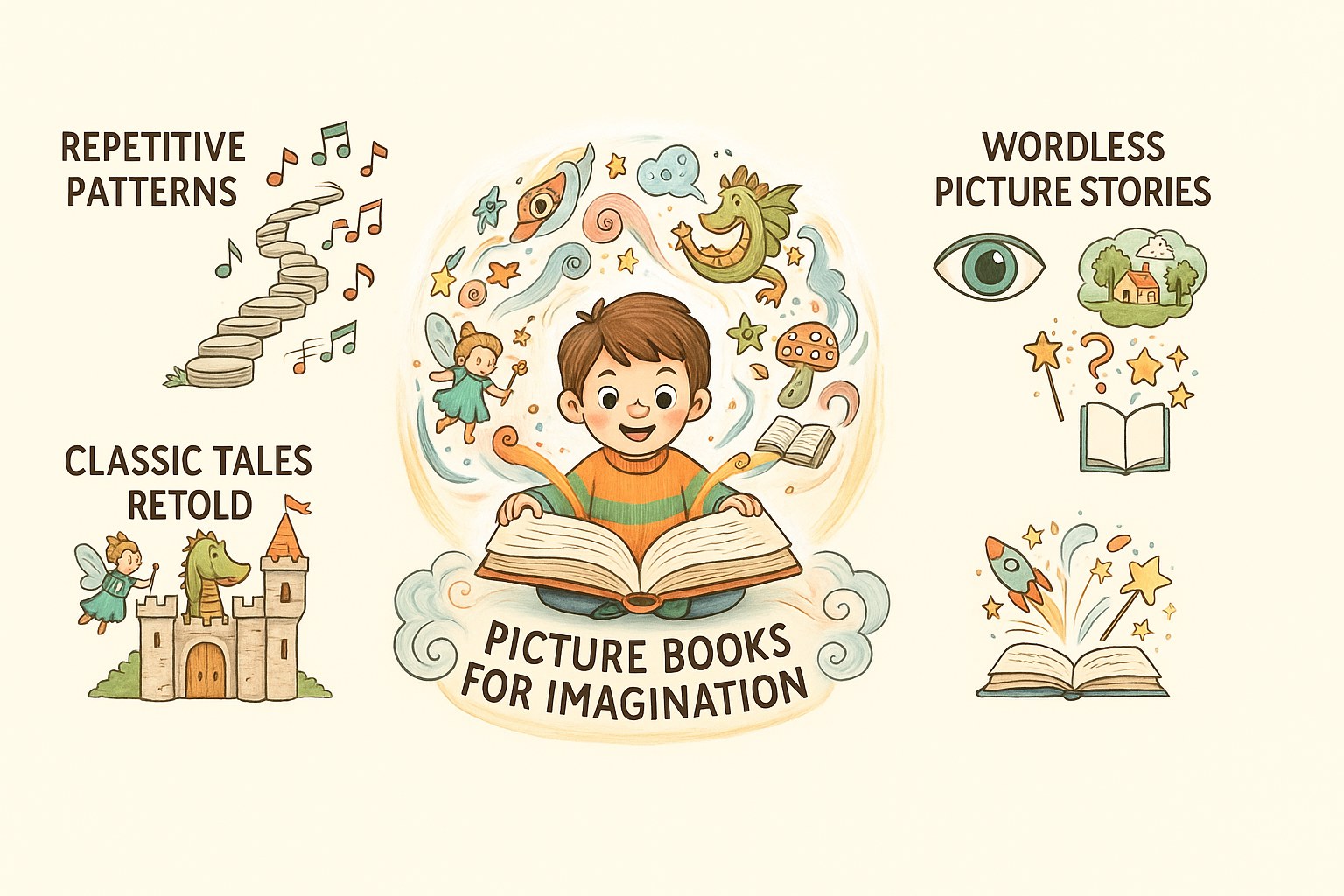
💬 4 kinds of picture books to boost language and imagination
Once you’ve settled on the format, it’s time to look at the learning and creative content inside the stories.

🔁 Repetitive patterns that help vocabulary stick
Cumulative, repeating stories make it so much easier to guess what comes next. Your child predicts the next part thanks to the steady repetition. That builds their confidence in their own understanding of what’s happening.
Encourage your child to finish the recurring lines. Let them complete the rhymes or the famous catchphrases from the book with delight.
Lock in new words through sound. Alliteration and onomatopoeia stay in the mind for a long time. It’s a playful way to grow their everyday vocabulary effortlessly.
🖼️ The power of wordless picture stories
Let your child tell their own version of the story. With no words, they become the main narrator. Their creativity flows freely, with no limits set by a grown-up.
Spark observation by hunting for the hidden details. Every page holds little visual secrets to discover together, calmly.
Build spoken sentence skills with no pressure. Your child puts sentences together naturally as they describe the action. It’s a brilliant exercise for becoming a fluent, confident speaker.
🏰 Classic fairy tales retold for a great escape
Offer modern versions with simpler morals. Old tales can be reshaped for today’s world. That makes the final message far more accessible to little ones.
Bring in whimsical characters to feed their dreams. Dragons and fairies are as captivating as ever. These figures stir a child’s boundless imagination. They easily see themselves in the brave, clever heroes.
Pass on a piece of cultural heritage, made age-appropriate. These stories create an essential bedrock of shared references.
💗 Using books to support emotions and life’s big moments
Beyond imagination, a book becomes a precious tool for steering through the big changes of everyday life.
😡 Naming anger and fear through a story
The hero goes through the same frustrations as your child. By seeing themselves in those bursts of anger, your young reader feels less alone. It takes the drama out of their own inner storms.
Use the story as a springboard for chatting after the read. Ask questions about how the character feels. The book then acts as a gentle go-between for you and your child.
Fiction offers real, practical solutions. It shows how to breathe or calm down to find peace again.
🎒 Easing into the first day of school and potty training
Take the fear out of new places through familiar situations. Starting school becomes a positive, joyful adventure. Your child pictures the place before ever setting foot there.
Follow the daily life of a hero facing the same challenges. Whether it’s the potty or school, the example reassures. Your little one grows in confidence.
Reassure your child about their own ability to succeed. Celebrate every small step they take along the way.
👶 Welcoming a new family member without stress
Talk about a new baby honestly and kindly. Explain the changes ahead without hiding anything. The book prepares the emotional ground with plenty of gentleness.
Celebrate the role of the older sibling through the pages. Show them the upside of growing up and sharing with a smaller one.
Soothe any worries about sharing attention. Reassure them of their parents’ unconditional love. The story always ends with a reassuring group cuddle.
🎁 3 playful formats to captivate curious little ones
To keep the most active children interested, some books turn reading into a real sensory experience.
🤲 Sensory wonder with touch-and-feel and sound books
Varying textures is a great way to stimulate touch. A cat’s silky fur or a tree’s rough bark surprises your child. This hands-on element naturally strengthens their bond with the object.
Pairing real sounds with pictures makes things much easier to recognise. Animal calls or the whoosh of the wind aid learning. Your child then remembers the concrete ideas far better.
Handling the book at last makes reading really active. Pressing little sound buttons becomes a rewarding game. It’s a brilliant pick among the best books for young children.
🎉 The surprise effect of pop-ups and flaps
Holding attention calls for raised, three-dimensional elements. Pop-ups create an instant surprise. Your child stays focused on the page coming alive before their eyes.
Playing on curiosity with lift-the-flap windows is great fun. Hunting for what hides behind a board flap is a real treat. It’s a constant, joyful visual quest.
Here are the main strengths of these books:
- Visual stimulation
- Fine motor skills
- Playful engagement
- Spatial memory
🌱 First discoveries about nature and the human body
Explaining how the world works calls for simple words. Science then becomes accessible from the earliest age. You just need to avoid jargon that’s too technical or complex.
Clear diagrams help answer your child’s questions. The illustrations should be precise but uncluttered. That helps a child picture the inside of the body. Their natural curiosity is then fully satisfied.
Introducing the cycle of the seasons and animal life is fascinating. It’s a real first step towards caring for the planet.
🌙 3 secrets to reading aloud beautifully at bedtime
You’ve chosen the book, but the way you tell it changes everything for your child.
🗣️ Vary your voices and play finger games
Give each character a distinct voice. It helps your child follow the plot more easily. They become fully swept up thanks to your performance.
Add gestures to bring key moments to life. Use your hands to mime the rain or a little animal. Your child will copy your movements with glee.
Give the reading rhythm by pausing for dramatic effect. Silence matters as much as words for holding attention.
🛏️ Creating a calming, comforting bedtime ritual
Set up a quiet space that’s right for rest. Dim the light and settle in comfortably. This moment signals to your child that the day is ending.
Choose stories with a soft, reassuring ending. Steer clear of tales that are too exciting before sleep. Calm should come first.
The reading ritual is a peaceful bridge between the bustle of the day and the calm of the night.
❤️ Strengthening the parent-child bond through shared reading
Make the most of this moment for special, close physical contact. Snuggled up together, you deepen your bond. Reading becomes a tender act of love.
Swap spontaneous thoughts about the twists and turns. Let your child ask questions right in the middle. These off-the-cuff chats are the richest of all.
Build shared memories around an imaginary world. These stories will stay etched in their adult memory.
💰 Building a wonderful library on a small budget
Putting together a varied collection doesn’t have to cost a fortune if you know the right tricks.
📬 Subscriptions to children’s book clubs
Getting expert-picked titles every month is a real joy. It’s your guarantee of quality without searching everywhere. The surprise in the letterbox is a big hit.
You also enjoy better prices than buying one by one. A subscription spreads the cost across the year. It’s an affordable, genuinely handy solution day to day.
It lets you discover authors and styles off the beaten track. It broadens the whole family’s cultural horizons effortlessly.
🎧 Mixing activity books, workbooks and audio stories
Switching between formats helps keep boredom away. Your child never tires when the offering is varied. Change format regularly to keep your young reader interested.
Using audiobooks helps build careful listening. It’s a great alternative to screens. Your child pictures the scenes with no images imposed, which fires up their creativity.
| Format | Main benefit | Rough price |
|---|---|---|
| Illustrated picture book | Language development | From £5 |
| Audiobook | Alternative to screens | From £8 |
| Activity workbook | Sensory and hands-on play | From £5 |
| Interactive book | Interactive reading | From £7 |
♻️ Finding second-hand gems for endless variety
Browsing book fairs and charity shops is a brilliant idea. You’ll find treasures for just a few pennies. It’s a green choice for the planet too.
Check the bindings carefully before you buy. A sturdy book lasts far longer in little hands. Avoid pages that are too scribbled on or even torn.
That way you can refresh your stock regularly without denting the family budget. Rotating the books keeps your child’s curiosity perfectly intact.
Giving the best books to 3-to-5-year-olds boosts their language and imagination thanks to rhythmic stories and magical pop-ups. Mix it up between picture books and fact-filled titles to feed their curiosity, starting tonight. Every page you turn together is building their bright future as a young reader, right now.
❓ FAQ
📏 What’s the ideal length for a story for a 3-to-5-year-old?
For our little ones in preschool, the ideal is to choose books of around 1,000 words. That’s the perfect measure for building a lovely plot without losing their attention along the way. At this age, their concentration is still a little fragile, so it pays to keep things snappy!
🎯 How do I choose a book that grabs a young child’s attention?
The secret often lies in the opening lines and the title. They should be short and plunge your child straight into the action. Expressive illustrations that help them follow the story matter too, along with familiar themes like friendship or feelings that echo their daily life as mini-adventurers.
🎉 What are the benefits of pop-up and lift-the-flap books?
These books are real little treasures of interactivity! They turn reading into a unique tactile and visual experience. As well as grabbing attention, they build fine motor skills and curiosity. They’re also a great alternative to screens, because nothing beats the joy of lifting a flap to find a hidden secret.
💗 How do books help children manage their emotions?
A book works as a magical go-between. By meeting characters who feel the same anger or fear as they do, children learn to name what they’re feeling. It takes the drama out of their little inner storms. A soft, reassuring ending is also essential to ease worries before sleep.
🔁 Why go for stories with repetition and rhythm?
Repetitive patterns are wonderful for boosting language. Your child predicts what’s coming, memorises vocabulary without realising it, and grows in confidence to speak aloud. It’s a bit like a gentle song that helps shape their thinking while having fun with sounds.
😊 How do I encourage a love of reading at home without forcing it?
The trick is to create a cosy little reading nook and keep books within easy reach. You can mix it up between picture books, fact-filled titles about animals or even audiobooks. The key is to show that reading is a source of joy and sharing, not a school chore.
💰 Can I build a quality library on a small budget?
Absolutely! You can dig up gems at book fairs or charity shops for just a few pennies. Subscriptions to book clubs are also a great option for receiving expert-picked titles at a gentle price. The idea is to rotate your stock regularly to keep your young readers’ curiosity perfectly intact.
