
Do you feel like your memory is overloaded by the endless flow of screens? ✍️ The value of handwriting in the digital age lies in this unique connection between hand and brain that boosts concentration. Discover how this simple gesture fires up your neurons, soothes your stress and helps your children structure their thinking better every day.
- Why the brain prefers the pen to the keyboard
- Handwriting helps children grow
- Structure your thinking with a simple notebook
- An effective remedy for digital stress
- Rediscovering the joy of writing as an adult
- Facing the difficulties and the myths
🧠 Why the brain prefers the pen to the keyboard
After decades ruled by the keyboard, science is rediscovering that our neurons light up far more strongly when we pick up a pen.
⚡ Switching on specific neural zones
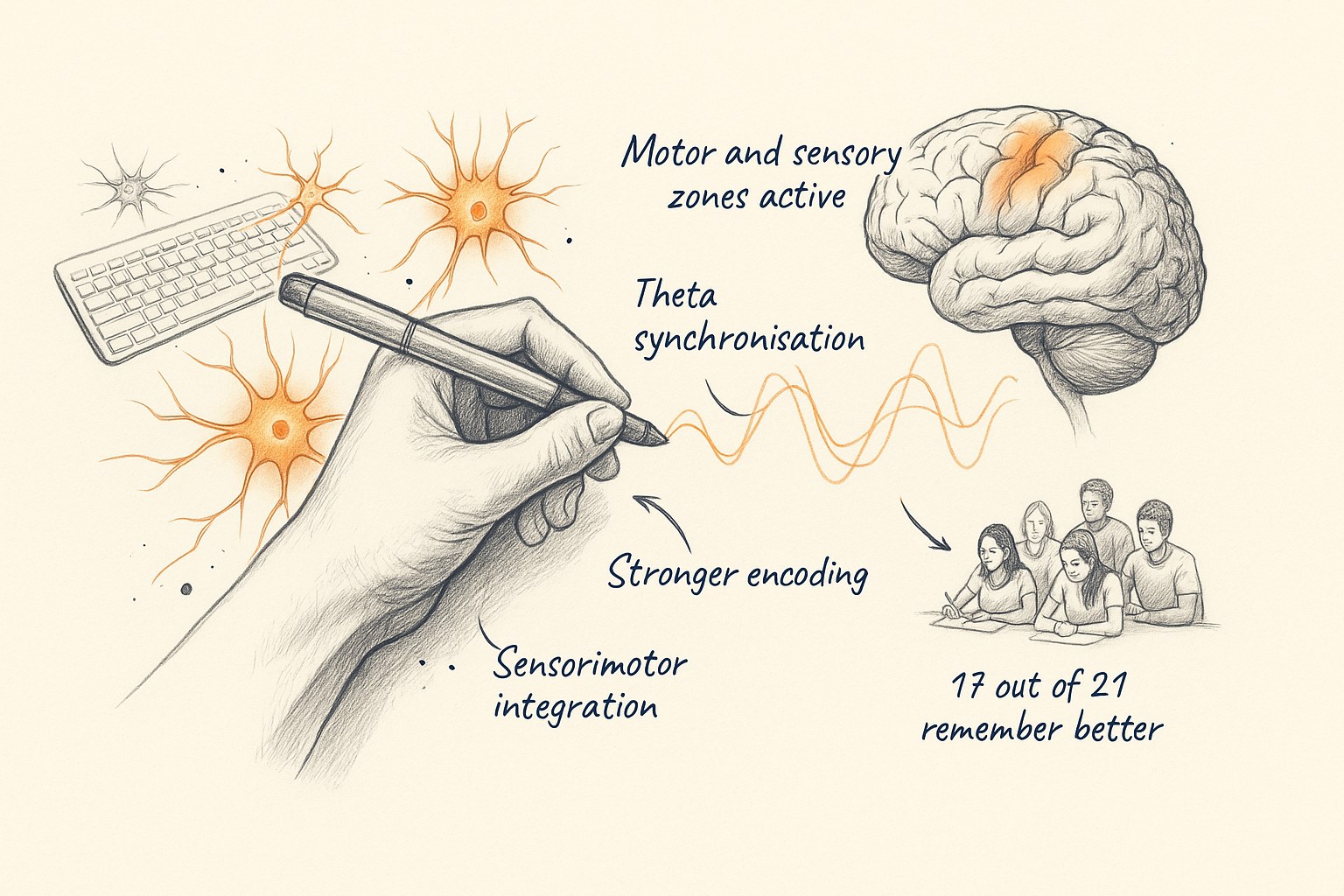
Forming letters by hand strongly engages the brain’s motor and sensory zones. The keyboard is far too uniform. The body truly gets involved in each precise stroke.
Handwriting encourages an optimal theta synchronisation for encoding information. These brain waves greatly support deep learning. Neural connections then become much stronger and more active.
The sensorimotor integration is rich. The brain works harder, but better.
💡 Memory boosted by the act of writing
The physical movement carves a lasting trace into our memory. This precise gesture creates a real bodily anchor. Holding on to information then becomes far more natural.
A study of primary-school pupils shows striking results. Out of 21 children, 17 remember better when writing by hand. Paper wins the match.
The number of mistakes drops sharply with handwriting. The figures are clear-cut against the digital approach.
⌨️ Why typing fast makes you forget faster
Pressing a key is exactly the same gesture for every letter. So the brain doesn’t tell the characters apart through movement. This passive typing limits cognitive engagement.
On a keyboard, we tend to copy word for word without thinking. We no longer process the information. It’s a sterile shorthand for the mind that doesn’t help understanding.
Taking notes by hand forces you to reword and process information, rather than simply copying it word for word.
Sometimes you have to slow down. Speed is the enemy of deep understanding.
🌱 Handwriting helps children grow
While for us it’s a comfort, for children it’s a pillar of their neurological and motor development.
✋ Fine motor skills, far more than a simple exercise
Holding a pencil calls for surgical precision. This hand-eye coordination builds up the fingers. The brain then works at the same time to guide each stroke with care.
Writing makes up 30% to 60% of the time children spend on school activities. It’s the main sport of their little grey cells. It stimulates an essential brain maturation.
The child comes to life in their own handwriting. The gesture is a real presence.

📖 Learning to read by learning to write
Tracing a loop helps you remember it visually. Cursive writing links sounds together. This greatly helps letter recognition from a very young age.
The movement memorises the structure of the word. It’s a precious muscle memory for spelling. The direction of the stroke shapes the form in the child’s mind.
Without a pen, reading becomes more abstract and fragile. Paper remains superior for solid literacy.
📱 Managing the appeal of screens at home
Offer colourful notebooks or magic pens. The surface should become an object of desire again. You need to make paper as fun as a tablet app.
Touch the paper, smell the ink. It’s a sensory experience that the tablet will never replace. The value of handwriting in the digital age lies in this unique tactile pleasure.
Here are a few simple ideas to practise without even noticing:
- Leave a sweet note on the fridge
- Keep a holiday diary
- Draw the letters in the sand
📓 Structure your thinking with a simple notebook
Beyond learning, paper is the architect of our ideas.
📊 Summing up information against the digital flow
Paper forces you to pick out the essentials. You can’t write everything down by hand. So it calls for an immediate effort of understanding to sort the information.
Thinking about the role of writing helps reflection. Sorting ideas as you write avoids mental overload. It’s a natural filter against digital noise. You remember better because the brain handles each word with sustained attention.
Writing less actually means thinking far more intensely. The value of handwriting in the digital age lies in this deliberate selection.
🗺️ Using mind maps for your projects
Handwriting is perfect for brainstorming. The free format completely frees creativity. You link concepts with instinctive arrows, without any technical or software constraint.
Divergent thinking much prefers paper. There are no rigid frames. The mind wanders and connects ideas together smoothly and very naturally.
One scribbled mind map is worth ten typed lists. It’s a powerful visual tool for finally seeing clearly.
📔 The diary as a tool for clarity
Keeping a diary empties your head every evening. It’s a healthy clearing-out of daily worries. You organise your day simply by putting the words on paper.
You then see your problems from a new angle. Writing turns emotional chaos into a logical sequence. It reduces stress by externalising the thoughts that keep going round in circles. It’s almost a little personal therapy.
Putting words down is already starting to solve. You take back control of your own emotions.
🧘 An effective remedy for digital stress
As well as building up the mind, the pen soothes the heart in a world that’s shouting.
🖋️ Reducing anxiety through the slow movement of the pen
Taking the time to write calls for real slowness. This particular rhythm acts directly on us. This tempo calms the nervous system almost instantly.
The pleasure of leaving your mark boosts self-esteem. You find a space of freedom and release in it. Putting words down clears up blurry thoughts. It’s a pure and simple act of creation.
Writing lets you structure the inner chaos. The paper takes everything in without ever judging.
The pleasure of leaving your mark and the handling of difficulties both play an important role in the writing process.
🔌 A life-saving digital disconnection
The notebook becomes a space of mindfulness. You forget the screens for a moment. No notifications here. Just you, the paper and your thoughts.
The silence of writing offers a real refuge. It’s a necessary protective bubble. You pull yourself out of the endless flow of social media to breathe.
Giving yourself this daily break is a game changer. Ten minutes are enough to find your inner calm again. It’s free and powerful.
🎨 Self-expression through your own personal touch
Handwriting is a reflection of identity. Your hand draws curves that are unique in the world. It tells your story, your mood, your energy of the moment.
A handwritten message holds an immense emotional value. A letter by hand touches you more than an email. You can feel the physical presence of the other person between the lines.
It’s the very essence of the human side of the gesture. The digital world flattens everything; the pen gives us back our uniqueness. The value of handwriting in the digital age lies in this rediscovered authenticity.
✍️ Rediscovering the joy of writing as an adult
It’s never too late to take the reins of your writing again and savour the gesture.
🖊️ Choosing the right tool between fountain pen and ballpoint
Let comfort guide your choice. The fountain pen glides, the ballpoint grips. Try several tools to find your ideal companion.
It’s worth explaining the importance of paper texture. A thick grain changes the whole experience. The pleasure comes through the touch and the resistance of the surface.
| Tool | Main advantage | Feel | Ideal for |
|---|---|---|---|
| Fountain pen | Smoothness | Refined | Letters and signatures |
| Ballpoint pen | Convenience | Steady | Everyday notes |
| Fine-liner | Precision | Sharp | Drawing and outlines |
| Pencil | Softness | Supple | Drafts and sketches |
📝 Simple exercises to get a nice hand back
Try some improvement methods. Do loops and bridges every morning. It’s a gentle retraining for your forgotten muscles.
Set up daily routines. Copy out an inspiring quote. Take the time to form each letter with care and attention.
Be patient with yourself. Your hand will loosen up bit by bit. The pleasure will come back with the fluency you’ve regained.
💺 The importance of good posture at your desk
Let’s describe how to hold the pen properly. Don’t clench your fingers around the barrel. The movement should come from the elbow and the shoulder.
Let’s explain how to position your body. Keep your back straight and your feet flat. Good postural stability ensures effective, pain-free handwriting.
Remember the health side too. Writing well also means respecting your body in the long run.
💪 Facing the difficulties and the myths
Despite its virtues, writing raises doubts it’s time to clear up so we can move forward calmly.
⏱️ Is writing speed a real problem?
Writing by hand seems slow compared to the keyboard. Yet this slowness acts like a quality filter. You write more slowly, but you remember the important information far better.
Slowing down lets the brain handle each word with care. It’s not a speed race, but a real-time reflection. The act of writing gives you the time to understand the idea properly. It’s a genuinely useful cognitive effort.
One page understood is worth more. Ten forgotten pages are useless.
🔍 Spotting the signs of dysgraphia in little ones
Certain warning signs in handwriting teaching should speak to us. Illegible writing or pain in the hand are signs. Around 6% of children have real dysgraphia.
A professional helps the child find the joy of writing again. Retraining works wonders for confidence. Some innovative projects even use companion robots to motivate the little ones.
Early diagnosis changes everything. Don’t let a disorder spoil their schooling. Solutions exist for every child.
📋 The clever blend of paper and tablet
It’s smart to mix the tools today. Use paper to think and digital to store. It’s the best of both worlds for getting organised without stress.
Using a stylus on a screen is an interesting modern compromise. You keep the essential act of writing while enjoying the digital side. You don’t lose the benefits of the value of handwriting in the digital age.
What matters is keeping up the gesture. The tool should stay flexible.
- Take notes with a stylus
- Scan your paper notebooks
- Use handwriting-recognition apps
Practising handwriting every day boosts your memory and soothes your mind. By picking up your pen tomorrow, you give your brain a unique and lasting connection. Rediscover this simple pleasure soon, to structure your thoughts and cultivate your uniqueness in the face of screens. Your hand draws your future. ✨
❓ FAQ
🧠 Why choose the pen over the keyboard for the brain?
Writing by hand is a real high-wire act for our neurons. Unlike the keyboard, where every key feels the same, manual writing switches on very specific sensory and motor zones, creating a deep connection between the body and the mind.
This activity stimulates theta waves in particular, which are essential for encoding information. By calling on more neural connections, handwriting allows a finer understanding and far more intense reflection than simple mechanical typing.
💭 Does the act of writing really help you remember better?
Absolutely; the movement of the pen literally anchors information in our memory. This complex cognitive-motor process creates a lasting trace thanks to the physical involvement of the gesture, which helps you hold on to information in the long term.
Studies show that pupils remember their lessons better and make fewer mistakes when they use paper. Slowing down to form each letter forces the brain to process the information rather than simply copying it passively.
🌟 What are the benefits of writing for children’s development?
For our little ones, holding a pencil is a pillar of fine motor skills and hand-eye coordination. It’s valuable training that takes up a large part of their school time and supports a harmonious brain maturation.
Handwriting is also reading’s best friend. By tracing the letters, the child memorises their shape and sound more easily. This strengthens their spelling and helps them structure their thinking, while affirming their own personality through their handwriting.
⚠️ How do I know if my child has dysgraphia?
It’s important to stay alert if writing becomes a source of suffering or excessive tiredness. Signs such as badly formed letters, marked slowness or a poor pen grip can be a warning, especially if it affects the child’s self-confidence.
Dysgraphia affects around 10% of schoolchildren, but solutions exist. An assessment with a professional makes it possible to set up playful retraining. Innovative projects even use robots to help children rediscover the joy of gliding across the paper.
⚖️ Can you combine paper and digital tools day to day?
It’s not about choosing a side, but rather about finding a kind balance. You can absolutely use the notebook for brainstorming or deep reflection, and keep the computer for storing or finalising your projects.
A stylus on a tablet is also an excellent modern compromise. It lets you keep the benefits of the act of writing while enjoying the flexibility of digital. The key is to preserve this precious link between the hand and thought, whatever surface you choose.
😌 Can handwriting really reduce stress?
It’s an incredible bubble of disconnection in our busy days. The slow rhythm of the pen naturally soothes the nervous system. It’s a moment of mindfulness, far from the endless notifications, that lets you get things off your chest and clear up your emotions.
Putting your worries down in a diary helps turn mental chaos into a logical, soothing sequence. This creative, personal gesture boosts self-esteem and gives a very welcome sense of control in the face of the digital whirl.
