
Explaining the solar system to kids without getting tangled up in the order of the eight planets can feel like a real space puzzle. This handy guide breaks down what our galactic neighborhood is made of and shares simple memory tricks to remember it all. You’ll uncover the secrets of the gas giants, the quirks of the rocky worlds, and fun size comparisons so you can finally picture the vastness of the universe with a smile. 🚀
- What exactly is the solar system?
- The order of the 8 planets and tricks to remember
- The four small rocky planets close to the Sun
- The gas and ice giants of the solar system
- Movements of the planets and natural cycles explained
- The case of Pluto and other small space bodies
- Activities and jobs for little astronomers
🌌 What exactly is the solar system?
After gazing up at the stars, we often wonder what really makes up our immediate corner of space.
☀️ A big family that orbits the Sun
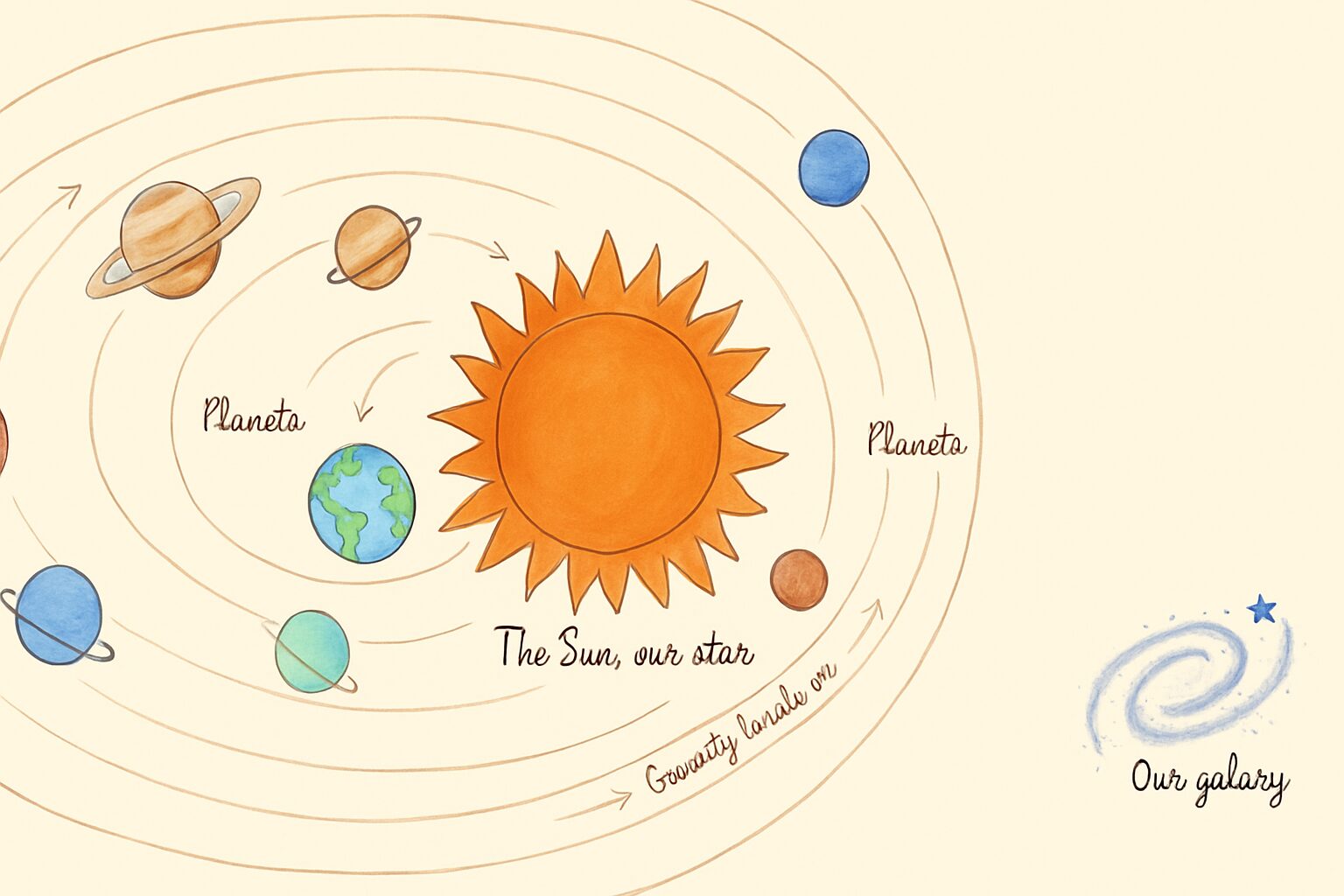
The solar system is a group of space objects held together by the force of gravity. This big cosmic family includes eight planets, moons, and asteroids traveling through the emptiness of space.
At the center, the Sun works like a powerful engine. Its huge mass creates an invisible pull. It keeps all of its companions on precise orbits thanks to this steady gravity.
This patch of space is our close-up neighborhood. People often say that the solar system is made of the Sun and its companions, forming one neat and fascinating whole.
⭐ The difference between a star and a planet
There’s a big difference between space objects. Stars make their own light through reactions deep inside them. Planets, on the other hand, are quiet bodies that work like simple mirrors.
Picture the Sun as a giant light bulb switched on in the living room. Earth, meanwhile, is like a little mirror that just bounces back the glow of that central source of energy.
Without this sunlight, our nights would be pitch black forever. Planets have no shine of their own and depend entirely on their star to be seen from space.
The Sun is a giant star that makes its own energy, while the planets simply travel around it.
🌌 The Milky Way: our address in the universe
Our galaxy looks like a giant spiral lost in the vastness. It’s home to billions of stars that swirl together in a cosmic ballet we humbly take part in.
The solar system doesn’t sit at the center of this great whirlpool. We live out on an outer arm called the Orion Arm, far from the busy, super-dense galactic core.
On the scale of the universe, our system is just a grain of sand in an endless desert. That picture helps us grasp the dizzying size of space all around us.
🪐 The order of the 8 planets and tricks to remember
Now that we know our galactic address, let’s see how our closest neighbors line up.
📋 A neat line stretching out from the Sun
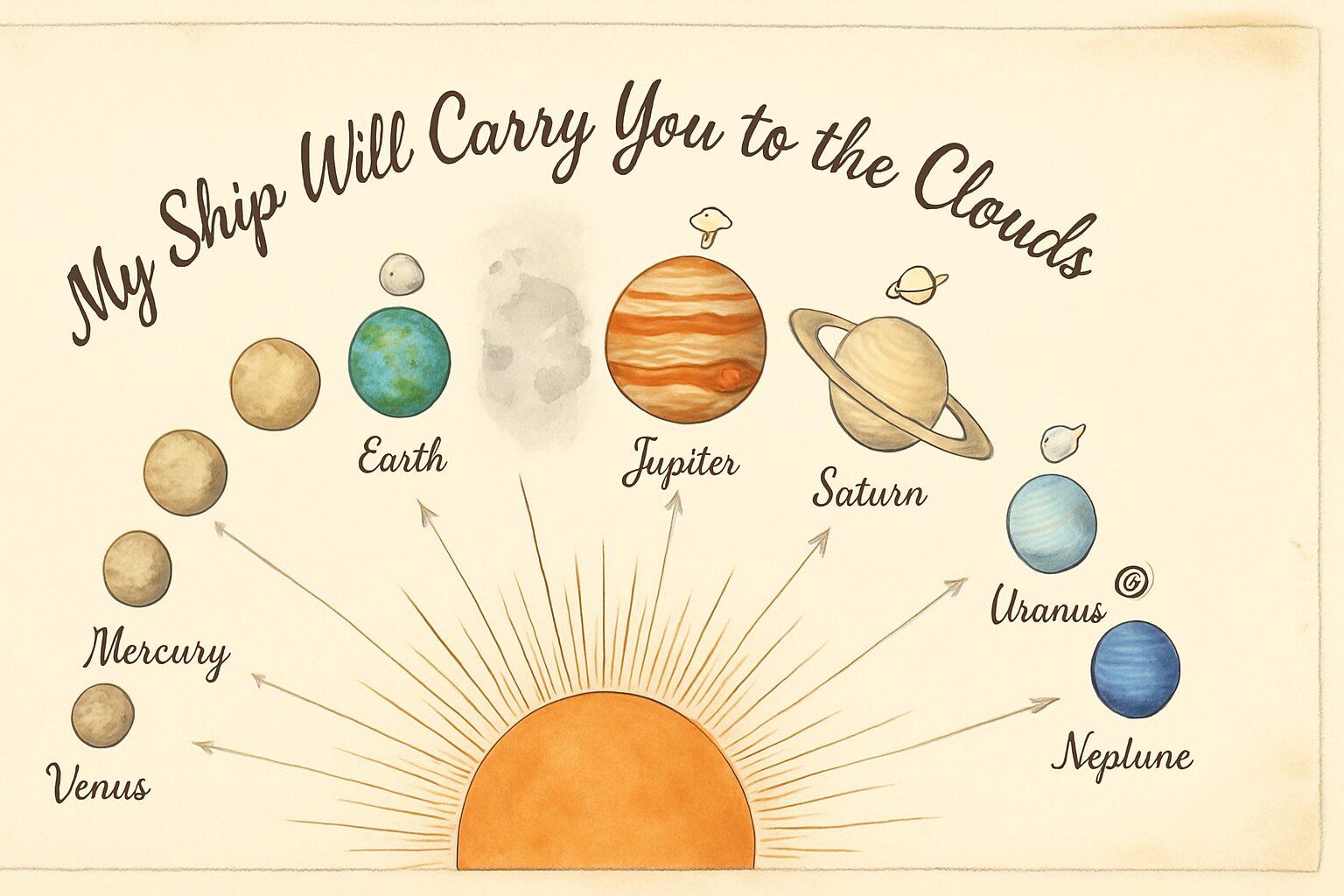
Here’s the official order of the eight planets. First come Mercury, Venus, Earth, and Mars. Then come Jupiter, Saturn, Uranus, and Neptune.
This order goes back to the birth of the system. The materials sorted themselves out naturally long ago. That’s how the Sun shaped its whole neighborhood.
The distances between them are truly enormous. Neptune sits incredibly far away. It gets almost no heat from the Sun at all.
✨ Magic sentences so you never get it wrong
Have you heard the sentence “My Very Eager Mother Just Served Us Noodles”? It’s a brilliant little secret. All you have to do is remember the first letters.
M stands for Mercury and V for Venus. Earth and Mars come next. It’s a piece of cake for the little ones.
You can also use a fun version of your own. “My Very Easy Method Just Speeds Up Naming.” It works like a charm.
🪨 Two different groups: the rocky ones and the gassy ones
There’s a split between the small hard ones and the big soft ones. The asteroid belt marks the line. It’s a border made of stone.
The Sun’s heat is the big reason why. It pushed the gases out toward the edges. The rocks stayed close to the central fire.
That changes everything. You simply can’t walk on gas.
🪨 The four small rocky planets close to the Sun
These two groups have very distinct personalities, so let’s start by exploring the solid worlds where you could actually set foot.
🔥 Mercury and Venus: the very hot neighbors
Mercury is a little gray ball. This planet looks a lot like our Moon, with all of its craters. It’s the smallest planet and the closest to the Sun.
Venus is like a climate nightmare. Its thick clouds trap heat in an extreme way. It’s hotter there than inside a kitchen oven.
It’s worth noting that they have no moons at all. These two planets travel alone around the Sun. They have no company on their orbital journey.
🌍 Earth: our blue and one-of-a-kind home
Liquid water covers most of the surface. That’s the great secret of life on our blue planet. Without it, we wouldn’t be here.
The atmosphere also plays a protective role. It lets us breathe every single day. This layer of gas shields us from the dangers of space.
It’s the only home we know of in the universe. We have to take very good care of it. It’s a precious treasure for every living thing.
🔴 Mars: the famous red planet and its secrets
The ground has a surprising rusty color. It’s the iron in the dust that gives it that reddish tint. The wind spreads this color everywhere.
You’ll find truly giant volcanoes there. Traces of ancient, now-dry rivers also mark the landscape. Water once flowed there, a very long time ago.
Explorer robots are rolling across its surface right now. They’re searching for proof of ancient life. These machines dig into the soil to find us answers.
💨 The gas and ice giants of the solar system
Past Mars, the scenery changes completely and gives way to worlds of gigantic proportions.
🪐 Jupiter and Saturn: the queens of size and rings
Jupiter is truly enormous. It’s the biggest planet in the system. You can spot a famous red spot on it, which is a giant storm.
Saturn has gorgeous rings. They’re made of ice and shimmering dust. It’s a one-of-a-kind sight in space.
These planets have no solid ground. You’d sink into the gas forever. It’s impossible to ever land on them.
🧊 Uranus and Neptune: the faraway ice balls
These worlds are extremely cold. They show off a striking blue color. That comes from special gases in their atmospheres.
Uranus has a very strange spin. It rolls on its side like a ball. It’s the only one that does this.
Neptune is famous for its extreme weather. Its winds are the fastest in the whole solar system. It’s a very stormy planet.
📏 A size comparison to picture space better
We can use fruit to compare them. Earth would be a small cherry. Jupiter would then be like a huge watermelon.
It’s a truly mind-boggling size. Imagine that 1,300 Earths could fit inside Jupiter. Suddenly you feel very tiny.
Yet the Sun is still the boss. It’s far bigger than everything else put together.
| Planet | Type | Size (fruit comparison) | Special feature |
|---|---|---|---|
| Mercury | Rocky | Marble | Small and hot |
| Venus | Rocky | Cherry | Very bright |
| Earth | Rocky | Cherry | Home to life |
| Mars | Rocky | Big marble | The red planet |
| Jupiter | Gas | Watermelon | Biggest planet |
| Saturn | Gas | Big melon | Visible rings |
| Uranus | Ice | Apple | Rolls on its side |
| Neptune | Ice | Apple | Very strong winds |
🔄 Movements of the planets and natural cycles explained
All these planets don’t sit still — they follow a very precise ballet that we feel every single day.
💃 The dance of spinning and orbiting
Earth spins on itself like a top. This movement is called rotation. It’s this little merry-go-round turn that creates the switch between day and night.
Next, our planet takes a huge trip around the Sun. We call this its orbit. This long journey through space lasts exactly one whole year for us.
Still, the length of a year is different on each world. The farther a planet is from the Sun, the longer its path. The trip then takes a lot more time.
🍂 The mystery of the seasons and Earth’s tilt
You should know that Earth is a little tilted. Its axis isn’t straight up like a fence post. So it travels while keeping this tilted position.
This changes the way we get the light. Depending on the month, one side of the planet gets more of the Sun’s rays. The days then grow longer.
This is exactly what creates summer. It’s not because we’re closer to the Sun, but thanks to this magical tilt.
🌙 The Moon and its changing shapes in the sky
In reality, the Moon never changes shape. It’s just the shadow and light that move. We only see the part lit up by the Sun.
These are the moon phases we watch. The crescent or the full moon depend only on its position. It keeps circling around our Earth.
Let’s not forget its role with the tides. It pulls the ocean water like a magnet. That’s what makes the sea level rise or fall.
❄️ The case of Pluto and other small space bodies
Beyond the eight great ladies, space is full of little travelers with surprising stories.
❌ Why Pluto is no longer a planet like the others
In 2006, the rules changed for our faraway friend. Pluto became a dwarf planet because its size was judged too small. It no longer meets the official rules of today.
The biggest issue is its crowded orbital path. It hasn’t managed to clear away the space debris around it. So it shares its road with way too many neighbors.
Other bodies like Ceres and Eris are in the same boat. They now belong to this new category. You can even read more about the reclassification of Pluto as a dwarf planet.
☄️ Asteroids, comets, and the Kuiper Belt
Asteroids are like big lonely, rocky boulders. Most of them prefer to stay grouped together. You’ll mainly find them between the orbits of Mars and Jupiter.
Comets are more like very dirty snowballs. They come from the coldest, darkest zones. They visit us after a very long, icy journey.
Their bright tail appears when the ice starts to melt. The Sun’s heat turns this matter into gas. That creates a gorgeous streak visible in the dark sky.
- Asteroids: rocks between Mars and Jupiter
- Comets: dirty snowballs
- Kuiper Belt: an icy zone beyond Neptune
🛡️ The protective role of natural satellites
A moon is a faithful, precious natural companion. It keeps circling around its parent planet. This duo never breaks apart in the vastness of space.
Jupiter actually holds records with more than a hundred moons. They form a real mini solar system, complex and miniature. It’s a never-ending ballet of satellites around this giant.
These moons also work as effective shields. Sometimes they take violent hits. They protect the planets from outside impacts.
🔭 Activities and jobs for little astronomers
All this knowledge often makes you want to get involved and look at the sky with fresh eyes.
👨🚀 Space jobs, from astronauts to engineers
Astronauts live an incredible adventure. Sometimes they live up in the space station. Up there, they run scientific experiments to better understand our universe and its secrets.
Down on the ground, engineers keep an eye on everything. They drive the robots rolling across Mars. Without their technical know-how, no machine could work properly on another planet.
The rocket builders deserve a big cheer too. It takes huge genius to build machines that can leave Earth. These experts are what finally make space exploration possible.
🔭 Hands-on activities to watch the night sky
Using an app like Sky Map is a great idea. It’s magical for spotting Venus or Mars in a flash. Your phone then becomes a real window opening onto the stars.
It’s better to get away from city centers. City lights sadly hide the Milky Way. A really dark spot lets you enjoy the sparkling show of the night sky.
A drawing notebook is the perfect tool. Noting the Moon’s changes each evening is exciting. That way you’ll watch its face shift over the weeks.
- Download a sky map
- Get away from streetlights
- Keep a moon log
🚀 How long it takes to travel between worlds
The distances in space are staggering. Getting to Mars takes long months of travel. Even with a very fast rocket, the trip is a true human expedition.
The speed of light is beyond imagination. And yet, space is even bigger than that. The planets seem close on a map, but they’re actually very far apart.
The vastness of our system stays a challenge. There’s still so much left to discover for future explorers. The next generations may go even farther than we have.
Space is so huge that even light takes eight minutes to travel from the Sun to us.
Remembering the order and size of the eight planets becomes child’s play thanks to our memory tricks. Look up at the sky tonight with your little explorers and try to spot Venus or Mars. Give them this wonderful journey to the stars to spark their endless curiosity. ✨
❓ FAQ
☀️ Why does the Sun shine while the planets stay dark?
That’s a wonderful question kids ask all the time! The Sun is a star, a kind of giant energy factory that makes its own light and its own heat. Planets, like our Earth or Mars, are not stars. They don’t make any light on their own.
If we see the planets shine in the night sky, it’s only because they act like mirrors. They simply reflect the Sun’s light as it travels all the way to them. Without our central star, the whole solar system would be plunged into total darkness.
🧠 What’s the trick to never forgetting the order of the eight planets?
To easily remember the planets lined up out from the Sun, people often use a magic sentence. My favorite is: “My Very Eager Mother Just Served Us Noodles.” Each first letter matches a planet: Mercury, Venus, Earth, Mars, Jupiter, Saturn, Uranus, and Neptune.
You can also have fun with a sillier version like: “My Very Easy Method Just Speeds Up Naming.” It’s a little memory game that turns an astronomy lesson into an easy rhyme to remember for kids and grown-ups alike.
🤔 Why did we decide that Pluto was no longer a planet?
For a long time, Pluto was the little ninth member of the gang. But in 2006, scientists changed its category and made it a “dwarf planet”. The reason is simple: it’s really very small, and it isn’t strong enough to have cleared its own path around the Sun.
Pluto shares its orbit with lots of other debris and small icy objects. To be a “real” planet, you have to be the one big master of your own path. Still, it remains a star of our sky, right alongside its other dwarf-planet buddies like Ceres and Eris.
🔍 Do all the planets look the same on the inside?
Not at all, and that’s what makes our corner of space so varied! We split the planets into two very distinct groups. First there are the four rocky planets, like Earth, which are solid and which you could walk on. They sit closer to the Sun.
Then, beyond the asteroid belt, you find the gas and ice giants. Jupiter and Saturn have no solid ground. They’re enormous balls of gas and ice. If you tried to set foot on them, you’d just sink inside without ever stopping!
⏱️ How long does it take to travel to the other planets?
Space is so vast that journeys are often counted in months or years. For example, even with a very fast rocket, it takes about seven to nine months of travel just to reach Mars. That’s quite a trek and it takes a lot of patience.
For the most distant planets like Neptune, it would take years of travel. Even light, which is the fastest thing in the universe, takes eight minutes to cross the distance between the Sun and us. That shows just how vast our solar system really is.
