
Explaining why the sky is blue to a curious kid can feel like a real brain-teaser for parents. This article unpacks the mystery of light and the atmosphere to give you a clear answer to that famous question. You’ll discover how the molecules in the air bounce sunbeams around like balls in a giant game of pool. 🌈
- Why the sky is blue: the secret hidden in sunlight
- Earth’s atmosphere filters the rays
- The pool game of sunbeams
- Why our eyes see blue and not violet
- The changing show of the sunset
- The surprises of clouds and other planets
💡 Why the sky is blue: the secret hidden in sunlight
We’ve all heard this question on a Sunday afternoon at the park. Why is the sky blue — a simple explanation for kids? The answer is actually hiding inside the light itself.
⚪ The surprising mix inside white light
Sunlight looks pure white to us. Yet it keeps a well-hidden secret. It actually contains every color we know.
Picture one magic paintbrush. This brush holds many colors mixed together. To the naked eye, you only see bright white. It’s a very surprising natural optical illusion.
This blend of colors is the basis of everything. Without it, no shade would exist around us, because the makeup of light shapes everything we see.
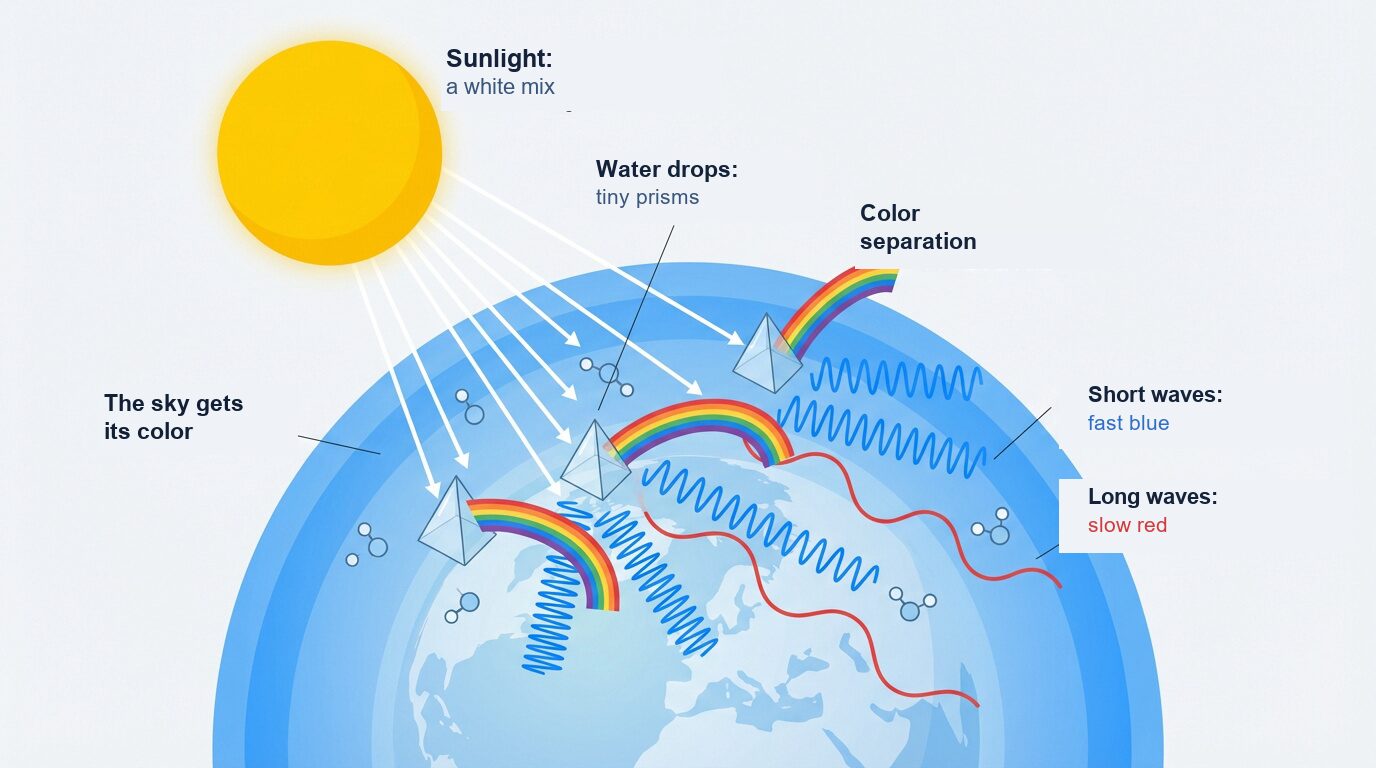
🌈 Rainbows show us the truth
Rain plays the part of a detective. Water drops act like tiny prisms. They physically split the colors that were hiding inside the sun.
Each color travels in a different way. Red doesn’t bend as much as blue. It’s this gap that paints that beautiful colored arc across the sky.
The rainbow is the visible proof of that mix. It’s the scientific truth on display at last, right before our amazed eyes.
〰️ Wavelength explained for little ones
We can compare colors to waves rolling across the ocean. Some waves are very big and slow. Others are small and really restless.
Blue hops along in quick little bounces. Its waves are short and tightly packed. That’s its main trait as it travels through space.
Red is quite different. It moves in big, calm waves. It’s far less restless than its little blue cousin.
🌍 Earth’s atmosphere filters the rays
If light is the painter, the atmosphere is the canvas it paints on, changing what we see.
💨 Invisible gas molecules everywhere
Air wraps around Earth like a soft layer of protection. It’s filled with tiny gas beads. We can’t see them, but they’re definitely there.
These molecules of nitrogen and oxygen are truly minuscule. They float all around us. They form a very effective invisible shield through the role of gas molecules.
Still, these beads are about to block the path. Sunlight will have to squeeze through to reach us.
☀️ When the rays meet the air
Here comes the clash between the rays and the gas. When the light arrives, it slams into these obstacles. The air acts like a selective barrier. Some colors pass through, while others bounce off wildly in every direction.
Without the air, our sun would look very different. It would be just a plain white ball. The sky would then have no special color at all.
It’s this exact meeting that creates the magic. Everything happens in the air.
⬛ Why space stays completely black
Now let’s compare Earth’s sky with the emptiness of space. Out in space, there’s no air. Nothing can stop the sunlight on its journey.
There’s no bounce possible. Without an atmosphere, light travels in a straight line. It doesn’t scatter to color the vast emptiness.
In the absolute void of space, light travels without ever meeting an obstacle to scatter it, leaving the darkness to rule despite the Sun’s blaze.
So the sun shines there intensely. Yet all around it, total darkness takes over. It’s a striking contrast, isn’t it?
🎱 The pool game of sunbeams
Now that the scene is set with air and light, let’s see how they play together, like a real game.
🎱 A game of pool up in the air
Picture light as little balls fired at top speed. They strike the air molecules along the way. Each beam then bounces off in every direction like a runaway ball.
Blue turns out to be the most nimble of the bunch. It’s the color that scatters most easily here. It ricochets everywhere because of its small size. It ends up filling the whole sky.
So blue floods our field of view. It wins the game hands down.
💡 Rayleigh scattering explained simply
There’s a scientific name for this effect: Rayleigh scattering. It’s a fancy word for a really simple thing. The molecules mostly bend the short waves.
The other colors stay far calmer along the way. Red and yellow go straight through without bending. They aren’t bothered by the molecules they meet.
Only blue is small enough to get deflected. It comes down to a simple matter of size and rhythm.
🔵 Why blue always wins the match
Blue rules because it’s everywhere at once. It bounces so much that it seems to come from every direction. So our eyes catch it from every corner of the sky.
That all-over scattering is what colors our pretty ceiling. Without this swirling chaos, the sky would look completely empty. Blue reigns thanks to this organized mess.
That’s why blue comes out the winner. It’s the most “bounceable” color of all the shades we can see.
👁️ Why our eyes see blue and not violet
If blue wins because it bounces around, another color should logically be even more present — but our eyes decide otherwise.
🟣 The mystery of the missing violet
Violet has an even shorter wave than blue. That trait lets it scatter even better. In theory, our sky should be violet.
Yet the sun sends us very little violet light. The natural supply of this color is too small to take over. It runs out quickly in the atmosphere.
Blue is simply more plentiful to start with. This color has a much bigger stock. So it takes up all the available room before our eyes.
👁️ How our little visual sensors work
The human eye has its own special sensitivity. Our biological sensors aren’t built to see everything perfectly. They clearly prefer blue over violet when we look.
The brain then receives a complex blend of blue and violet. It has to sort it out fast. So it chooses to show us mostly pure blue.
Our eyes act like a final filter. They simplify the light show to make life easier for us.
🤔 The difference between reality and perception
Violet isn’t missing — it’s just invisible to us. It’s still up there, hidden in the huge sky. We’re simply not equipped to detect it.
Every animal has its own kind of vision. A bird or an insect might see a completely purple sky. Our vision is a simplified version of the world. It’s our own colored reality.
Nature is richer than we think. Our eyes are making choices all the time.
| Color | Scattering (strength) | Amount in sunlight | Human perception |
|---|---|---|---|
| Blue | Strong | Plentiful | Excellent |
| Violet | Very strong | Low | Poor |
| Red | Weak | High | Good (but barely scattered) |
🌅 The changing show of the sunset
But this blue doesn’t last forever, because as soon as the sun goes down, the rules of the game change completely.
📏 A much longer trip for the light
In the evening, the sun drops very low on the horizon. The light then has to cross a much thicker layer of air. So it travels a much longer distance.
This trip is like a tiring obstacle course. There are ten times more molecules for the rays to get past. It’s a true marathon for the sunlight.
The rays naturally wear out along this rough path. The light loses its strength as it keeps moving forward.
🔵 The slow fading of the blue tones
Sadly, blue runs out of steam very fast. It bounces everywhere off the molecules until it’s completely lost. It can’t reach our eyes anymore at all.
This color ends up disappearing completely during its long journey. It’s totally scattered well before it arrives. So the blue sky slowly fades away. The short waves have finished their work.
Blue finally clears the stage. Other colored shades then take over.
🟠 The arrival of reds and oranges
Red turns out to be really tough. It crosses the air without any special effort. Nothing truly stops it, not even this very long trip through the atmosphere.
These warm shades are the only ones left to see. Orange and red are the great survivors. They finally color our whole horizon.
The final picture turns warm and blazing. It’s the beautiful victory of the long waves over the coming darkness.
In the evening, the sky gives us its last breath of red light, because that’s the only color able to cross the thick barrier of the horizon.
🪐 The surprises of clouds and other planets
To finish, let’s step a little outside the usual frame to see how other things, or other worlds, shake up these rules.
☁️ Why clouds stay all white
Water drops change the game. They’re much bigger than the gas molecules. As a result, they don’t sort out the colors of the light at all.
This is where Mie scattering comes in. Every color gets sent back together, no exceptions. This total mix recreates pure white. That’s why clouds have that fluffy, cottony look.
No sorting happens. Blue doesn’t win. Everything comes back together.
🔴 A pink or yellow sky on Mars
Let’s take a look over at the planet Mars. Its atmosphere is very different from ours. It’s constantly filled with super-fine dust.
This dust plays a major part. It colors the sky pink or yellow. The colors flip completely compared to what we know here on Earth.
The sunset there is even blue. It’s a truly surprising upside-down world.
⛰️ How altitude changes the colors
Altitude also changes what we see. High up in the mountains, the air gets thinner. So there are far fewer molecules to scatter the sunlight.
The sky then turns darker. It quickly shifts toward navy blue or even black. Less air simply means less scattered light.
Pollution plays a part too. It often makes the sky white and rather dull day to day.
- Altitude: darker sky because there are fewer molecules.
- Pollution: whitish sky because of the big particles.
- Humidity: paler sky because of the tiny water droplets.
The secret of the blue sky lies in sunlight and its journey through the atmosphere. The air molecules scatter the short blue waves in every direction, while our eyes do the rest of the work. Watch the next sunset closely: it’s the proof that light stretches out. Nature gives us its most beautiful science show every single day. ✨
❓ FAQ
🔵 Why is the sky blue if sunlight is white?
It’s a lovely trick of nature! Sunlight looks white to us, but it actually hides every color of the rainbow. When this light reaches our atmosphere, it bumps into the tiny molecules in the air.
These molecules love to scatter the colors in every direction. Since blue travels as small, very restless waves, it bounces around much more easily than the other colors. The result: it fills up all the space, and our eyes see it everywhere.
🟣 If violet scatters even better, why isn’t the sky violet?
That’s a great question from a little explorer! Scientifically, violet is even more “bounceable” than blue. Still, the sun sends us much less violet light than blue light to begin with. So the supply of violet is just a bit too short to color the whole ceiling.
On top of that, our eyes do a little selective sorting. Our visual sensors are far more sensitive to blue than to violet. Our brain prefers to simplify the show by showing us a nice, clear blue rather than a slightly blurry purple mix.
🌅 Why does the sky change color in the evening?
At sunset, the light has to make a much longer trip to reach us because the sun is very low. It’s a true marathon for the rays as they cross a much thicker layer of atmosphere.
During this long trip, blue ends up running out of steam and disappears completely from bouncing around too much. Only the toughest colors, like red and orange, manage to cross the finish line without being deflected. That’s what gives us this gorgeous blazing show.
☁️ Why are clouds white and not blue like the sky?
Clouds don’t play by the same rules. They’re made of big water drops, much larger than the gas molecules in the air. These drops don’t bother sorting: they send back all the colors of the light at the same time, without separating them.
When you mix all the colors of the sun equally, you get pure white. This is called Mie scattering. If a cloud turns gray or black, it’s simply because it has grown so thick that the light struggles to get through it!
🚀 What does the sky look like from space or on other planets?
In space, it’s complete darkness! Since there’s no atmosphere to bounce the light around, the rays travel in a straight line without ever coloring the void. The sun shines there like a giant lamp against a totally black background.
On Mars, it’s a whole different mood. The air there is loaded with dust that colors the sky pink or yellow during the day. Strangely, over there it’s the sunset that turns blue. A real upside-down world that reminds us that every atmosphere creates its own scenery.
