
Do your kids fire off questions the moment the sky lights up, and you find yourself stuck trying to explain what a shooting star actually is? This fun little guide lifts the lid on these specks of comet dust that catch fire at breakneck speed as they tear through our atmosphere. You’ll learn how to tell a plain meteor from a dazzling fireball, plus the best tips for not missing a single shower of light this year. 🌠
- What exactly is a shooting star?
- Meteor or meteorite: let’s sort it out
- The secret origin of this space dust
- The year’s big meteor showers
- Planning a stress-free stargazing night
- Photographing them and helping space science
- Why do these lights make us dream?
🌠 What exactly is a shooting star?
Forget giant fireballs or stars dropping out of the sky. Despite their poetic name, these streaks of light have absolutely nothing to do with the distant stars.
🪨 A tiny bit of debris dropping in on us
A meteoroid is simply a small rocky or metallic body. These objects drift quietly through space. Sometimes they end up crossing the Earth’s path.
They’re often minuscule, about the size of a grain of sand. They usually come from comets or shattered asteroids.
They’re leftovers from the birth of the solar system. Scientists call these specks of space dust micrometeoroids. They float all around us.
Space is full of this debris. It stays completely invisible to the naked eye.
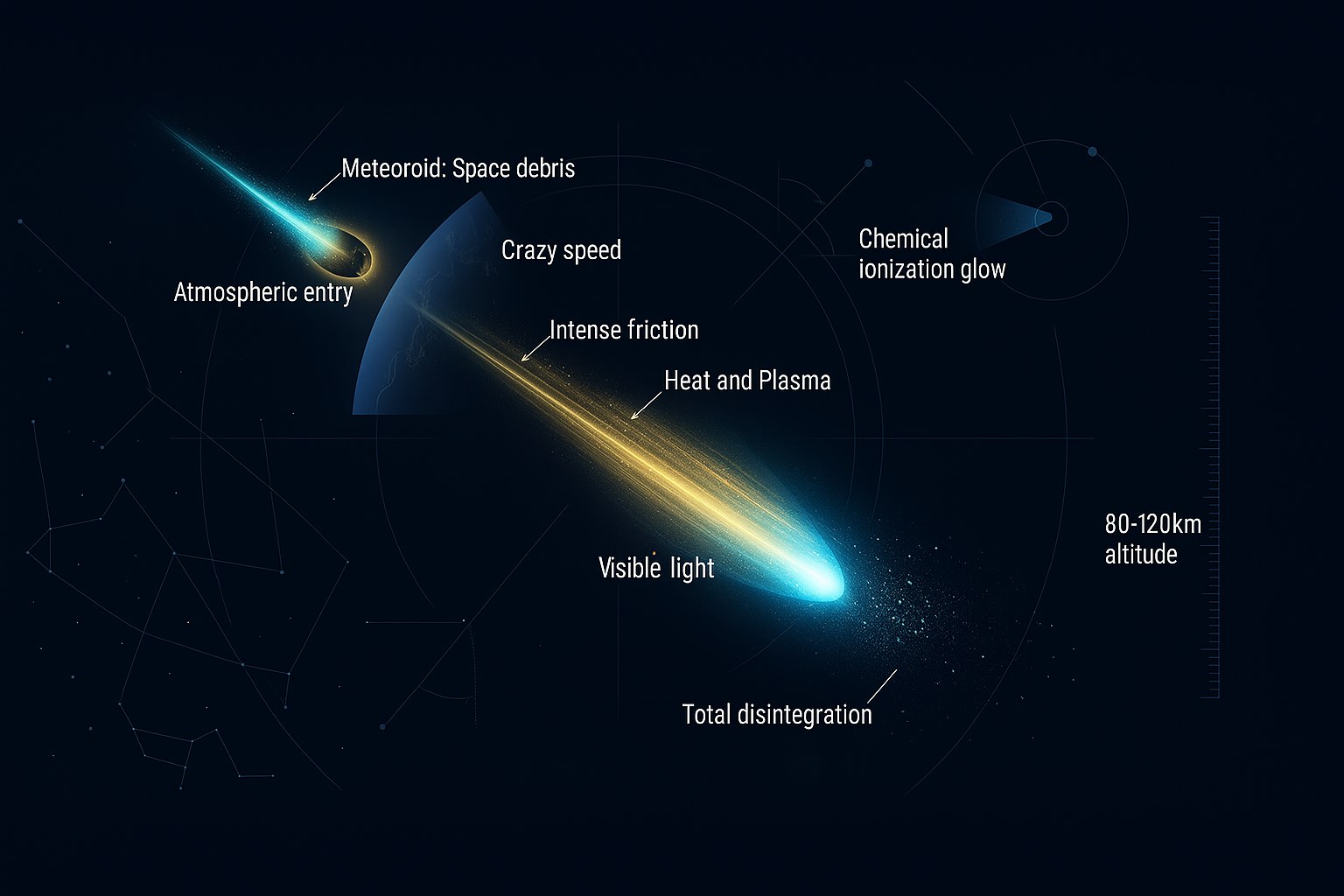
🔥 How rubbing against the air makes the light
Entering the atmosphere is brutal. The air in front of the debris is squeezed so fast that it heats up in an instant. This isn’t ordinary fire. It’s pure, raw physics.
The material vaporises through intense friction with the air molecules. That creates plasma. It’s this scorching, ionised gas that glows.
The light comes from the ionised air around it, not from the object itself. The glowing trail is the visible signature of this fierce heat.
💥 Complete break-up high in the sky
It all happens between 80 and 120 kilometres up. That’s where the atmosphere gets thick enough to slow the intruder down. So the action takes place very high above our heads.
The impact happens at a wild speed, somewhere between 30 and 72 km/s. At that pace, a speck of dust turns into a real energy bomb. So what is a shooting star? It’s this head-on crash.
In most cases, nothing reaches the ground. These little visitors vaporise entirely. They end up as gas or microscopic dust.
A shooting star is a beautiful cosmic farewell. It glows brightly, then vanishes forever.
☄️ Meteor or meteorite: let’s sort it out
Now that the mechanism is clear, it’s time to stop mixing up the technical terms, because each word marks a precise stage of the journey.
🌑 The meteoroid before the big leap
The meteoroid is the object travelling through the void. It follows a quiet orbit around the Sun. It’s an anonymous space pebble.
Its size is somewhere in between. It’s bigger than a molecule but far smaller than an asteroid or a dwarf planet. It’s a lone wanderer.
As long as it doesn’t touch the air, it stays invisible. It’s a show still waiting to happen.
Once its path crosses the Earth’s, its fate changes completely.
🎆 The fireball, for the spectacular flashes
A fireball is the “heavyweight” version of the phenomenon. It shines brighter than the planet Venus in the night sky. It’s a flash that sticks in your memory for a long time.
Sometimes you hear an explosion several minutes after the light has gone by. Those are powerful shock waves.
A fireball is an especially intense meteor, caused by a large body entering the atmosphere and shining brighter than Venus.
🌍 The meteorite that ends its journey on the ground
The meteorite is the survivor. It’s the chunk of rock that wasn’t completely vaporised. It ends its fall on solid ground.
These objects are rare. Most pebbles burn up entirely.
That’s what makes them so exciting for scientists. These stones are time capsules billions of years old. They tell the story of where we come from.
Finding a meteorite is an extraordinary stroke of luck for a researcher.
✨ The secret origin of this space dust
These pebbles don’t come from nowhere. They’re the crumbs left behind by far more impressive travellers: comets.
☄️ Comets and their icy trails
The Sun plays a big part. As a comet draws closer to it, its ice melts. This violent outgassing then releases a whole cloud of dust into space.
These grains stay on the comet’s orbit. They form a long trail of crumbs. This wake sometimes stretches millions of kilometres behind the comet.
It’s these comet leftovers that feed our yearly showers. The comet is the mother source of the whole show.
The ice evaporates. The little pebbles, though, stay floating in the void.
🔄 When the orbits cross
It’s a true cosmic rendezvous. Every year, the Earth passes through these dense clouds of dust. You can picture it like a car driving through a swarm of midges.
The Earth’s orbit is fixed, so the meeting happens on a near-certain date. It’s a perfect astronomical clock for stargazers.
The thickness of the cloud changes from one pass to the next. Some years are more spectacular than others. It all depends on how fresh the debris is that the comet left behind.
🎨 The chemistry behind the colours
The secret of the colours lies in chemistry. Sodium gives off a typical orange-yellow. Magnesium and iron lean more towards blue and green.
The air joins in too. Oxygen and nitrogen molecules get excited and add their own shades to the palette.
| Chemical element | Colour produced | Likely source |
|---|---|---|
| Sodium | Orange / Yellow | Meteoroid |
| Magnesium | Green | Meteoroid |
| Calcium | Purple | Meteoroid |
| Nitrogen / Oxygen | Red | Earth’s atmosphere |
Every flash is a chemical analysis. It’s a live laboratory in the night sky.
🌧️ The year’s big meteor showers
To make sure you don’t miss the show, you need to know the key dates when the sky lights up in a predictable, intense way.
📅 The August Perseids and the winter Geminids
The Perseids are the real stars of our summer evenings. They peak around 12 August. It’s the perfect time to settle in comfortably outdoors.
In December, the Geminids take over in style. They’re often far denser than their summer cousins. Still, the bitter cold regularly puts off amateur observers.
There are other dates too, like the Leonids in November. Each shower has its own character. Their speed depends on the swarm the Earth is passing through.
- Perseids (August)
- Leonids (November)
- Geminids (December)
📍 The radiant, or the illusion of a fixed origin
The radiant is a fascinating idea in astronomy. It’s the exact vanishing point the glowing trails seem to shoot out from. It’s just an optical illusion created by perspective.
A shower is named after the constellation where this point sits. The famous Perseids, for example, seem to come from the constellation of Perseus. It’s a very handy landmark.
And yet the stars in those constellations are infinitely farther away. They simply serve as a distant backdrop to this pretty atmospheric show. So what is a shooting star? Just a bit of debris catching fire right next to us.
🧮 Working out the hourly rate for forecasts
Astronomers use the ZHR, or Zenithal Hourly Rate. This number tells you the number of meteors you could see per hour under perfect conditions. It’s the go-to figure for enthusiasts.
You do need to take forecasts with a pinch of salt, though. In town, you’ll spot far fewer trails than the maths predicts. Light pollution often spoils the fun.
Sightings usually pick up in the early hours. That’s when the Earth faces into its orbit and ploughs into the dust, like a car windscreen.
Don’t expect a heavy downpour. Look forward instead to steady, regular flashes.
🔭 Planning a stress-free stargazing night
Seeing a shooting star takes a little patience and, above all, the right surroundings to let your eyes do their job.
🏙️ Escaping the light pollution of cities
To see well, get away from the streetlights. The countryside or the mountains offer the best contrast. A really dark sky is essential here.
Your eyes need time to adjust. Give yourself about twenty minutes in the dark to switch on your night vision. Be patient and turn off every source of light.
You absolutely must ban phone screens. Blue light instantly wrecks your precious sensitivity to the dark. So tuck your smartphone deep in your pocket.
Go for a red light if you really need to see where you’re walking. It’s the ideal choice.
🛰️ Telling a satellite from a meteor
Learn to spot the human-made intruders in the sky. A satellite moves slowly and at a steady speed. It never leaves a trail behind it. It’s a regular white dot.
You can recognise a meteor by how fast it is. It crosses the sky in a fraction of a second. Its flash is sudden, and it disappears just as quickly.
Watch out for satellite trains like Starlink. Their perfect alignment can take you by surprise. They aren’t natural events, but very much artificial objects.
☁️ How the weather affects what you can see
Keep a close eye on the cloud cover. The thinnest veil can hide the faintest meteors. Check the satellite maps.
You also need to think about the Moon. Its glow can act like a giant spotlight and wash out the stars. Moonless nights are therefore best.
Remember to wrap up warm. Even in August, sitting still at night chills the body quickly. Bring a good blanket and a comfy seat for the wait.
Comfort is the key. It’s the secret to staying alert for several hours without getting tired.
📷 Photographing them and helping space science
Beyond the simple joy of watching, capturing these moments can become a real tool for the researchers who study space.
📸 Nailing your first night-time shots
A tripod really is a must. Without rock-steady support, your photos will be blurry because of the long exposure. It’s the number one accessory for your nights under the stars.
The whole idea rests on long exposure. Leave the shutter open for 10 to 30 seconds. That lets you gather the faint light of the sky and bring out details you’d never see otherwise.
Go for a wide-angle lens. The more sky you capture, the better your chances of catching a glowing trail. It’s just maths: you cover more ground.
Set the focus to infinity. That’s how you guarantee razor-sharp points of light.
📡 Joining in with meteor radar tracking
There are some very serious automatic detection networks out there. Cameras watch the sky around the clock to triangulate falling objects. Amateurs can set these systems up at home. This is what we call citizen science.
This data is priceless for scientists. These observations let them work out the original orbit of the space debris. We then understand the overall structure of our solar system far better.
Platforms like fireball-reporting networks are brilliant for this. They let you report exceptional fireballs you happen to spot. Your account has real scientific value for researchers.
⚡ How debris ionises the upper atmosphere
A passing meteor leaves a trail of electrified gas behind it. This tunnel of ionised air forms as the object breaks apart. The wake can linger for a few seconds after the light has gone.
This makes it possible for radio waves to bounce. Meteor trails reflect distant signals in surprising ways. Radio amateurs use this trick to talk across very long distances.
It’s also a way to study the upper atmosphere. This debris acts as a natural probe to measure the density of the air. It’s a huge help in understanding the sky’s invisible layers.
Even when it’s invisible, the impact leaves its mark. Radars physically measure each passage.
💫 Why do these lights make us dream?
Even though science explains it all, that takes nothing away from the magic and the poetry these sights have stirred since the dawn of time.
🙏 Where the wish-making tradition comes from
In ancient Greece, people imagined that the gods would sometimes lift the dome of the sky to watch over us. Shooting stars were then seen as sparks falling through this divine opening. It was the perfect moment to send a request up to the watching gods.
This falling light was a sign sent straight to people about their destiny. The belief is found everywhere and has lasted for thousands of years. Even today, we still see in it a special link between the sky and our fate.
There’s a fun little challenge tied to how fast it all happens. You have to make your wish before the glowing trail fades away completely. It’s a real race against the clock.
These days, we play along with a smile. Yet the feeling stays just as strong at every sighting.
📜 Ancient myths about falling fire
Interpretations have changed over time. For some peoples, these glimmers were souls rising to the heavens. Others saw them as warnings of famine or war. Every culture has its own reading of these celestial fires.
Catholics often speak of the “Tears of Saint Lawrence” for the August Perseids. The name honours the martyr who was put to death on 10 August. Religion turned this natural show into a symbol of devotion.
Despite all our modern knowledge, the instinctive bond with these lights lives on. They still connect us to the vastness of the universe. It’s a feeling that science doesn’t replace.
⭐ The clear difference from the distant stars
Remember that real stars are massive, blazing suns. They stay fixed within a single human lifetime. Physically, they simply cannot fall onto our planet.
The difference in distance is staggering. A meteor catches fire at only about 100 km up. The nearest star, by contrast, is light years away from us. It’s a truly colossal gulf of space.
The term “shooting star” is still a beautiful poetic mistake. We’ve chosen to hold onto it. You have to admit it’s far more charming than the word “meteoroid”.
So let’s keep our eyes turned to the night sky. The next streak of light is probably never far away.
This comet dust, far from being real stars, puts on a magical show from as low as 80 km up. Grab your blanket and escape the city lights to enjoy this cosmic ballet. The next meteor shower will soon light up your sky, so keep your eyes wide open! 🌟
❓ FAQ
🌠 Is a shooting star really a star that’s falling?
Not at all, despite the poetic name! What we admire in the sky isn’t a distant sun in free fall, but a meteoroid. It’s a tiny bit of rocky or metallic debris, often no bigger than a grain of sand, that crosses our planet’s path.
As it enters the atmosphere at a wild speed, this little pebble rubs against the air and heats up until it vaporises. It’s this intense physical reaction that creates the glowing trail we see from our garden. A real star, on the other hand, stays neatly in its place, light years away from us.
🔍 What’s the difference between a meteor and a meteorite?
It’s a question of how far the journey goes! “Meteor” is the scientific name for a shooting star: it’s only the glowing show we watch in the sky. If the debris is big enough and doesn’t burn up entirely on the way down, it ends up reaching the ground.
The moment it lands on Earth, that fragment becomes a meteorite. Most shooting stars are so minuscule that they disappear completely high up, sometimes turning into invisible dust called micrometeorites.
🌈 Why do shooting stars sometimes have different colours?
The sky sometimes treats us to a real chemical firework display! The colour mainly depends on what the little bit of debris is made of. Sodium, for example, creates an orange glow, while magnesium leans towards blue-green. Iron often adds a yellow or golden touch.
The atmosphere plays the painter too. Oxygen and nitrogen, as they ionise in the heat, can add green or red shades to the trail. So every passage is a unique chemical analysis carried out live before our eyes.
📊 What exactly is the ZHR during a meteor shower?
The ZHR (Zenithal Hourly Rate) is the figure astronomers use to estimate how active a meteor shower is. It stands for the maximum number of shooting stars you could see in one hour if conditions were absolutely perfect: an inky-black sky with the meteors’ origin point right above your head.
In reality, you’ll often see a few less because of light pollution or the glare of the Moon. Even so, it’s a brilliant tool for knowing whether the evening promises plenty of wishes or whether you’ll need a bit more patience.
💭 Why do we make a wish when we see one?
This lovely tradition comes to us from ancient Greece. People said the gods would sometimes open up the dome of the sky to watch over humans, letting a few stars slip out along the way. It was the sign they were listening, making this the perfect moment to slip in a little request.
Today, we still do it for fun and for the magic of the moment. Whether it’s the “Tears of Saint Lawrence” for Catholics or a sign of good fortune for other cultures, the feeling stays the same in the face of this fleeting connection.
🌃 What are the best times of year to watch the sky?
Some dates are a must, because every year the Earth passes through the same clouds of comet dust. The Perseids are the stars of August, perfect for summer evenings. In winter, December’s Geminids often put on an even more intense show for those brave enough to face the cold.
The Leonids in November are worth a mention too. To make the most of them, the trick is to get away from city lights and let your eyes adjust to the dark for about twenty minutes. And above all, put the phone away so you don’t spoil your night vision!
