
Explaining how the body’s inner organs work without losing a child’s attention can feel like a real challenge for parents. This guide breaks down the human body for kids using simple comparisons and playful activities, like making a life-size cardboard outline. You’ll learn how to turn digestion into a hands-on experiment and present the brain as a conductor, giving your young explorers everything they need to understand their amazing living machine.
- Naming body parts with little ones
- Bones and muscles for growing up strong
- What the internal organs do, explained simply
- The five senses for exploring the world
- The brain and the language of emotions
- Looking after yourself and respecting your bubble
👤 Naming body parts with little ones
Once you’ve sparked a child’s natural curiosity, it’s time to put the right words to what they see in the mirror every morning.
👶 Naming the head and limbs from age 3
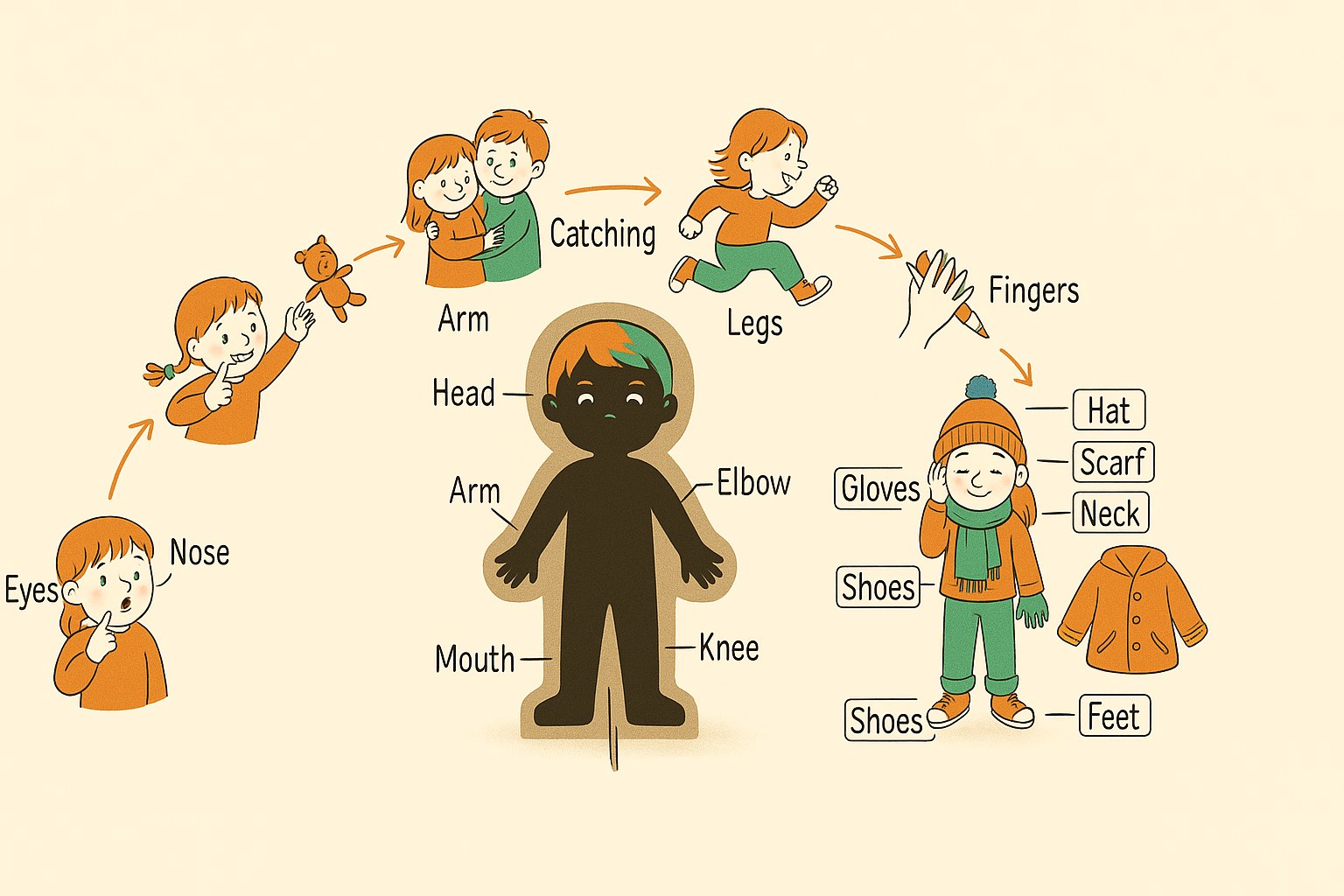
Start with the face by pointing to the nose, the eyes and the mouth. This is the foundation of identity and of showing emotions. The human body explained to kids, organs and functions, begins right here.
Explaining what limbs are for helps a lot. Arms are for grabbing toys or giving cuddles. Legs let you run and jump all over the place. This is where independence finally begins.
Finish with the cleverness of the hands. Fingers are magical tools for drawing.
👕 Linking clothes to parts of the body
Using the morning get-dressed routine as a lesson works wonders. A hat goes on the head to keep the ears warm. Shoes wrap around the feet for walking outside.
Connecting gloves to fingers is good fun. It’s a great way to remember the body’s far ends. You slide each finger into its own cosy little woolly house.
A coat covers the chest and the arms. It plays an essential protective role for the skin.
- Hat -> Head
- Scarf -> Neck
- Gloves -> Hands
- Shoes -> Feet
📦 Making a giant cardboard outline
Offering a hands-on craft activity changes everything. Lay the child down on a big piece of cardboard and draw around them. It’s an instant way to grasp their own real and one-of-a-kind size.
Add labels to spot the joints, like the knees or the elbows. This shows how the body bends. It’s visual and really helps with learning the body map.
Personalise the drawing with their eye or hair colour. Every child is unique, and their drawing should show that off proudly.
🦴 Bones and muscles for growing up strong
Beneath this skin and these clothes lies a sturdy structure that holds the whole thing up: our bony framework.
🦴 Understanding bones as a framework
The skeleton is like the walls of a house. Without our bones, we’d be all floppy like jelly. They keep us standing nice and straight.
The ribs form an effective protective cage. They shield the heart and the lungs from knocks. It’s a natural suit of armour that’s really very strong.
Bones are living tissue. They need calcium to stay strong. This matters all through life.
📏 Watching height and weight change
Tracking growth with a height chart on the wall is great fun. Kids love seeing that they’ve gained a few centimetres. It’s proof their body is working hard.
The body changes a lot with age. The way it works varies a great deal throughout the whole growing-up period, from baby to teenager.
Growing is a non-stop process where every centimetre gained shows the amazing energy of a child’s cells.
Bones lengthen mostly during sleep. Sleeping well is therefore essential for growing well every day.
🎵 Singing to remember the names of bones
Using music makes memorising so much easier. Simple rhymes let you name the femur or the finger bones effortlessly. The beat helps the brain store the information.
Matching specific actions to the words works well. You touch your knee or your elbow as you sing. Moving your body strengthens the link between the word and the spot.
The human body explained to kids, organs and functions, becomes a game. Encouraging children to make up their own rhymes lets them make their anatomy their own while having loads of fun.
❤️ What the internal organs do, explained simply
If the bones are the structure, the internal organs are the engines that keep the whole human machine running.
💓 Listening to the heartbeat and breathing
The heart works like a tireless pump. It sends oxygen-rich blood everywhere. You can hear it beat by pressing your ear to the chest.
Breathing uses the lungs. They puff up like balloons when you breathe in. This oxygen gives us all our strength.
The rhythm changes after you’ve been running. The heart beats much faster. The body is simply asking for more energy to move quickly.
🍽️ Following food’s journey into the stomach
Food is our fuel. The stomach turns every meal into bits the body can use. This is where the great adventure of digestion begins.
The intestines then sort the nutrients. They keep what’s good for the muscles. The rest leaves the body completely naturally.
Chewing well is worth it. The teeth do the first important job. This helps the stomach with the rest of the mixing.
🛍️ Recreating digestion with a plastic bag
You can run a science experiment at home. Put some bread and water in a bag. Then squash it with your hands.
This movement copies the way the stomach works. The mixture turns into a runny mush. It helps the child picture what they can’t see.
Talk about the results together. It’s hands-on, a bit messy and gripping for a curious young mind. Here’s a summary of the vital functions.
| Organ | Main function | Simple comparison |
|---|---|---|
| Heart | Pumps the blood | Central pump |
| Lungs | Filter the air | Air purifiers |
| Stomach | Digests | Processing plant |
| Brain | Gives the orders | Control tower |
The human body explained to kids, organs and functions, becomes clear with these pictures. Every part works as a team so we can play.
🖐️ The five senses for exploring the world
To interact with the world around them, the body has amazing sensors we call the senses.
👁️ Using sight and hearing to find your way
The eyes work like little cameras. They catch light and colours to show the way. They’re the main guide for getting around every day.
The ears are there to pick up every sound. They warn us of danger, like a car coming. Sound simply travels through the air until it reaches us.
You can have fun naming familiar sounds with your eyes closed. It builds focus. You then see that our senses always work together to help us.
👃 Discovering flavours and smells
The tongue can tell sweet, salty or sour apart. It’s a real festival of sensations at mealtimes.
There’s a close link between the nose and taste. When your nose is blocked, you can’t taste a thing. Smells often set up the pleasure of eating.
Smelling herbs or flowers is a one-of-a-kind experience. Smell-based memory is the most powerful for making lasting memories in little ones.
✋ Recognising textures by touch
Handling all sorts of objects lets you test the skin. Cotton is soft, while a sponge is a bit scratchy. Hands stay our favourite tools for discovery.
The skin covers the entire body. It protects us from germs and also feels heat or cold. It is, in fact, our largest sensory organ.
You can set up a guessing game with an opaque bag. The child has to identify a hidden object. They use only its shape and texture to guess.
🧠 The brain and the language of emotions
Above all of this, the brain oversees every movement and every feeling, turning our experiences into emotions.
🧠 Presenting the brain as a command centre
The brain is like a lightning-fast computer. It takes in all kinds of information non-stop. Then it decides what to do. It’s the conductor of all our body parts.
It sends very quick electrical messages everywhere. To lift your arm, the brain gives the order instantly. It’s a truly fascinating internal communication network that never stops.
Rest at night is an essential step. The brain uses sleep to tidy away memories. It also cleans itself to be ready the next morning.
💛 Linking physical sensations to moods
It’s worth learning to listen to the body’s signals. You sometimes feel butterflies in your tummy when you’re stressed. It isn’t an illness, just an emotion.
Warm cheeks often show up during anger. The body is getting ready to react physically. Spotting these signs helps you manage your reactions better.
Joy is easy to spot from a spontaneous smile. The body always shows what we feel.
🧘 Practising movements to calm the body
Slow breathing helps you find your calm again. You breathe in through the nose as if smelling a flower. You breathe out gently as if blowing out a candle.
Gentle stretches help loosen tight muscles. Doing the stretching cat helps release tension. It lifts your mood too, quite simply.
Pair a colour with each feeling. Blue for calm or red for excitement. It’s a simple, very visual code.
🛁 Looking after yourself and respecting your bubble
Understanding your body also means learning to protect it from outside threats and to respect your own space.
🧼 Chasing germs away by washing your hands
Invisible germs hide everywhere. They love dirty hands for getting around. A good wash with soap and water is enough to get rid of them.
Scrubbing everywhere with energy makes it work. Don’t forget between the fingers or under the nails. It’s a vital health habit.
Setting up routines before every meal helps a lot. This habit protects the whole family from illness. You feel so much more at ease.
🥗 Choosing the right foods for energy
Colourful fruit is packed with precious vitamins. They act like little protective soldiers. Eating a variety of foods keeps you in great shape for the long run.
Drinking water regularly is a vital need. The body uses it to work well. It’s the best drink for our inner machine, without a doubt.
Cutting back on sweets and sugar is a great idea. Too much sugar tires the body out. It also damages the teeth over time.
- Fruit and vegetables for vitamins
- Dairy products for the bones
- Water for staying hydrated
- Sleep for recovery
🔒 Explaining privacy and your secret garden
The body belongs to the child alone. Nobody has the right to touch it without their agreement. This is a basic safety rule to remember.
Your personal bubble is an invisible space. You can say no if a touch makes you uncomfortable. Plenty of social ideas exist, but consent always comes first.
“Teaching a child that their body is their own sacred territory is the first step towards strong, lasting self-confidence.”
Encouraging children to talk to their parents is essential. If something feels wrong, they need to speak up. A trusted grown-up will always listen.
Your little explorer now knows their organs and their muscles, that magical framework that helps them grow. To lock in these discoveries, draw their outline on cardboard or play at naming their bones in song. This journey into the heart of the human body promises a future full of confidence and energy!
🎬 Watch the video
❓ FAQ
👶 Which body parts can a 3-year-old already name?
At this age, curious little ones are starting to find their bearings nicely. They can usually name the features of the face, like the eyes, the nose, the mouth and the ears. It’s also the time when they easily name the head, the tummy, the back, plus the arms and legs right down to the fingers and toes.
Some more observant children even enjoy pointing out finer details, like the knees, the elbows or the ankles. The learning happens very gently, often through song or during the fun of bathtime.
👕 How can I help my child match their clothes to the right body parts?
Getting dressed in the morning is a perfect playground for learning without realising it. You can have fun asking questions the wrong way round: “Does the hat go on the feet?” It makes children laugh while cementing the logic: a hat protects the head, gloves wrap around the hands and shoes go on the feet.
Using different textures, like soft wool or light cotton, also helps them become aware of their skin. It’s a brilliant routine for building independence and vocabulary in a very hands-on way.
❤️ What are the main jobs of our internal organs?
To explain it simply to kids, you can compare the body to a team of superheroes. The brain is the conductor that commands everything, the heart is a tireless pump that delivers the blood, and the lungs work like balloons that puff up to give us oxygen.
The stomach and intestines, for their part, take care of turning the meal into energy, a bit like the fuel in a car. Every organ has its own special mission so we can run, jump and grow up well every day.
🛠️ Are there craft activities for discovering anatomy while having fun?
Oh yes, and cardboard is our best ally! One brilliant activity is to draw around the child on a giant sheet of cardboard to create their life-size outline. It’s really impressive for them to see how much space they actually take up.
You can also make puppets with paper fasteners to understand how joints let us move. Creating a little organ puzzle or a cardboard skeleton lets them picture what’s hidden under the skin in a playful, not at all scary way.
🧼 How can I explain the importance of hygiene and self-care to little ones?
The idea is to introduce germs as tiny invisible guests that love to hide on dirty hands. A good wash with soap while singing a little song is enough to chase them away. It’s a protective habit for the whole family, especially before sitting down to eat.
Looking after yourself also means choosing good foods to give your muscles strength and respecting your “secret garden”. You explain kindly that their body is their own and that they have the right to say no if a touch makes them uncomfortable.
