
Explaining the mysteries of space to kids can feel like a tall order when you don’t have simple landmarks to lean on. This complete guide to Mars, the Red Planet, turns those tricky ideas into an adventure your little explorers can actually follow as they get to know our rocky neighbour. Together you’ll discover its record-breaking volcanoes, its robot explorers like Perseverance, and the secret behind its rusty colour — everything you need to become real experts on the solar system. 🚀
- Where is Mars hiding in space?
- Why does Mars wear an all-red outfit?
- Mars and Earth: spot the differences
- Giant volcanoes and endless canyons
- Water and little green men on Mars?
- The robot explorers rolling across the Martian soil
🔴 Where is Mars hiding in space?
Once you’ve looked up at the stars, you often wonder exactly where our red neighbour sits among all those points of light.
🌌 A prime spot in the solar system
Mars is the fourth planet from the Sun. It’s a small marble that belongs to the family of rocky planets. It’s solid, unlike the huge gas giants.
It sits right next to Earth. It’s our neighbour on the same landing in space. In fact, we class it as a rocky planet, just like our own world.
It’s fairly modest in size. It’s much smaller than Earth. It’s a little one.
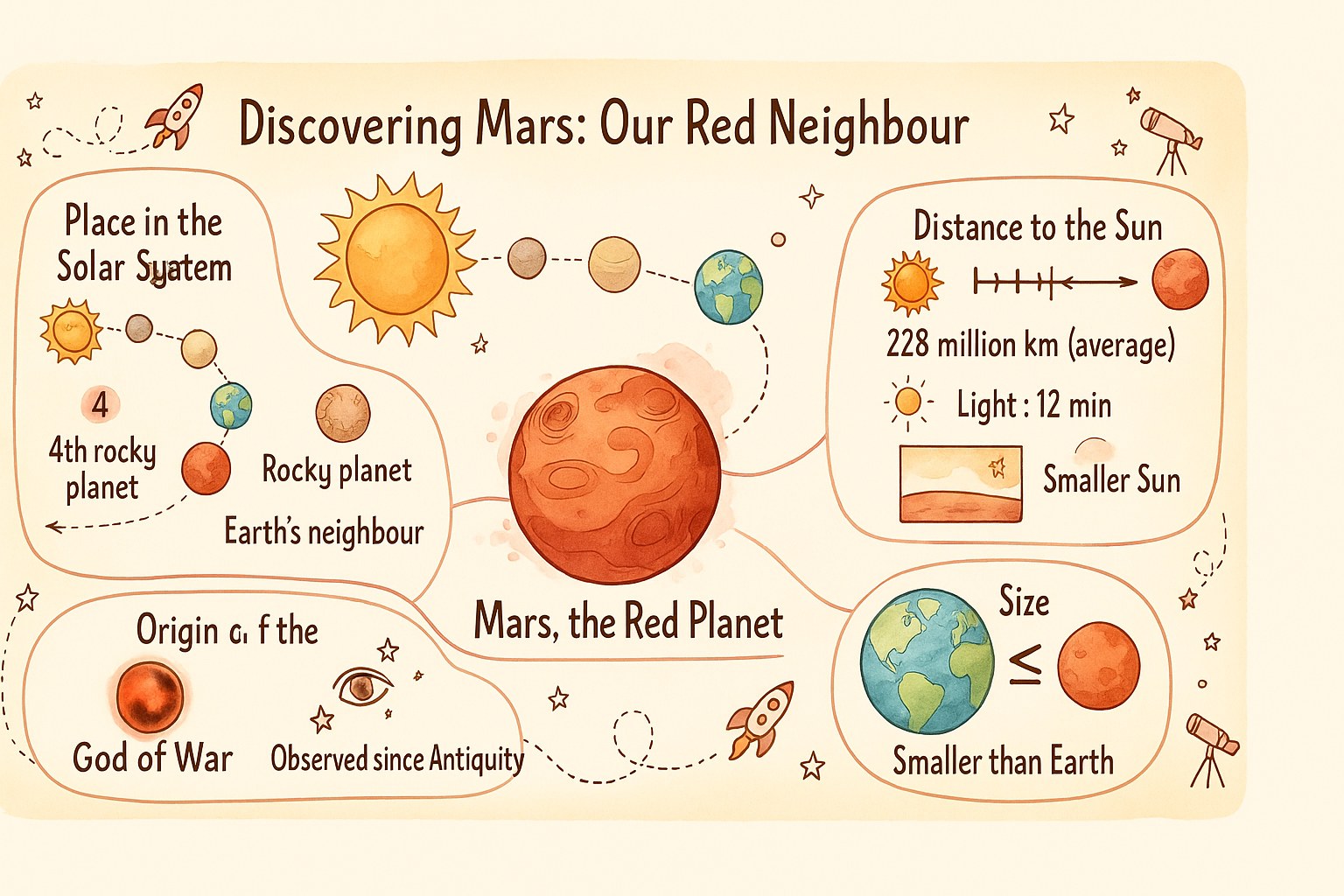
☀️ The distance between it and the Sun
On average, 228 million kilometres separate it from the Sun. That distance changes all the time. That’s because its orbit traces an oval.
Light takes longer to get there too. The Sun’s rays need about 12 minutes to reach it. That’s a little slower than for us here on Earth.
The Sun then looks very far away. From the Martian ground, it appears much smaller in the sky. So warmth is harder to come by.
⚔️ The warlike origins of its name
Its name comes straight from the Roman god of war. The ancients picked this guardian because of its blood-red shade. It’s a very old tradition.
Egyptian and Babylonian astronomers were already watching it long ago. It moved across the stars in a way all of its own. Its red glow intrigued them no end.
This mythological heritage has carried down through the centuries. That warrior’s name still sticks to it today.
🎨 Why does Mars wear an all-red outfit?
If its name brings war to mind, it’s really its blazing coat that fires the imagination the moment you spot it through a telescope.
🧪 The secret of Martian rust
The soil of Mars holds a huge amount of iron oxide. It’s precisely this chemical substance that creates that very special shade. You find it absolutely everywhere, in the rocks and in the sand alike.
It’s a bit like an old bike you left out in the rain. Martian dust is really a very fine rust. It coats every centimetre of the surface.
Seen from above, the sight is striking. The planet looks like a vast desert of fully rusted metal.
🔬 An easy experiment to understand the colour
You can try leaving some wet steel wool outside. After just a few days, the grey turns orangey-brown. That’s exactly what happened on this faraway planet.
The photos sent back by the probes confirm this. The landscapes show rocks the same colour as rusty steel. The result is identical to your little home experiment.
The colour of Mars isn’t just an optical illusion — it’s the result of a giant chemical transformation on the scale of an entire world.
🌪️ The pink sky of the dust storms
On the surface, the wind stirs up the dust without a break. The grains, which are really very fine, fly off with astonishing ease. In the end this creates a permanent haze drifting along the horizon.
This effect completely changes the colour of the sky. On Earth it’s blue, but on Mars the rust particles tint it pink or orange. It’s a truly strange sight for us.
Sometimes giant storms break out too. They can even wrap around the whole planet for several months.
🌍 Mars and Earth: spot the differences
It’s often called Earth’s “little sister”, but when you take a closer look, the differences are glaring.
😴 A short sleeper’s day on Mars
Scientists use a special word for the Martian day: the “sol”. This term takes the place of our usual day. It turns out to be a little longer than ours.
In practice, a sol lasts 24 hours and 40 minutes. So you gain a small extra moment for sleeping. Even so, a full year runs to 687 Earth days. That’s almost double what we have at home.
The seasons do exist. But they last a really long time.
🪂 The superpower of low gravity
On the surface, gravity is only 38% of ours. So you’d feel much lighter there. It’s a sensation astronauts love to picture for their future missions.
Take a concrete example. A child weighing 45 kg would weigh only 17 on the red soil. You could lift very heavy objects with no effort. Your muscles would work far less.
The jumps would be incredible. You’d bounce three times higher.
🔄 A visual comparison of the two neighbours
You should know that Mars is two times smaller than our planet. It’s a little world next to ours. Its total surface is only as big as Earth’s continents.
Picture an orange to stand for Earth. Mars would then be a little marble set right beside it. This image helps you picture the real sizes of these two worlds.
| Feature | Earth | Mars |
|---|---|---|
| Size | 12,742 km (diameter) | 6,779 km (diameter) |
| Length of a day | 24 hours | 24 hours 40 minutes |
| Length of a year | 365 days | 687 days |
| Average temperature | 14°C | -63°C |
| Gravity | 100% | 38% |
🌋 Giant volcanoes and endless canyons
Despite its small size, this planet boasts natural landscapes that beat every record on our own world.
🌋 Olympus Mons: the king of volcanoes
Do you know the tallest volcano in the solar system? It’s called Olympus Mons. It’s a stone monster, asleep for a very long time, that towers over the Red Planet.
It stands 22 km high — three times the height of Mount Everest. Its base is as wide as the whole of France. You couldn’t even see the summit from the foot of the volcano because it’s so vast.
It’s a shield volcano. Its shape is very broad with a really gentle slope.
🏔️ Valles Marineris: a record-breaking canyon
Picture a huge gash across the surface. It would slash Europe from one end to the other. It’s a giant scar visible from deep space, far more impressive than our valleys on Earth.
Valles Marineris is ten times longer than the American Grand Canyon. It’s much deeper too. It formed when the planet’s crust cracked open. It’s an absolutely unique geological sight.
Did you know? Sometimes fog forms at the bottom of these vast valleys.
🧊 The ice caps at the poles
Look at the polar caps. They shine bright white at both ends of the planet. You can even see them with a good amateur telescope from your garden on a clear night.
There’s water ice, just like at home. But watch out — there’s also very cold dry ice. It’s a surprising mix you won’t find on Earth.
These poles change all the time. They grow in winter and shrink in summer. It’s an endless cycle.
👽 Water and little green men on Mars?
These spectacular landscapes may hide the greatest mystery in the universe: the presence of life somewhere other than Earth.
💧 The traces of ancient vanished rivers
The robots are turning up clear geological evidence. You can see dried-up riverbeds and deltas. Water flowed in great abundance billions of years ago.
The atmosphere grew too thin and the cold set in. Today, water evaporates or freezes instantly. Yet radar has detected lakes beneath the ice. So liquid water has deserted the surface.
Mars once looked far more like our blue Earth. It was a very different world.
🦠 The hunt for microbes and aliens
Forget the little green men from science-fiction films. We’ve found no city and no clever Martian. For now, far-off civilisations remain a pure invention of the movies.
Scientists are looking for traces of tiny, ancient life. They study the rocks to find organic molecules. It’s a thrilling investigation that’s been going on for decades. Perseverance is searching for signs of microbes.
The habitable zone lets life appear. It’s the ideal region around a star.
🌑 Phobos and Deimos: the two pocket-sized moons
Mars has two small natural satellites that are very unusual. Their names mean “Fear” and “Terror” in ancient Greek. They’re the Red Planet’s faithful, permanent companions.
They look like lumpy potatoes full of holes. These moons aren’t round like ours. Their bumpy surface is marked by many deep craters.
They’re most likely asteroids captured by the gravity of Mars. They were passing by and stayed. A massive collision could also explain how they were born.
🤖 The robot explorers rolling across the Martian soil
Since we can’t go there ourselves just yet, we’ve sent mechanical envoys to explore this hostile world.
🚗 The adventures of Curiosity and Perseverance
Curiosity and Perseverance are real rolling laboratories. They travel kilometres through the sand and the rocks. These sophisticated machines study the geology of Mars.
The little Ingenuity helicopter joined the adventure too. It proved that you can fly in very thin air. It was a historic first in space exploration. These robots send back beautiful images every day.
- Rover names: Curiosity and Perseverance.
- Size: roughly a car.
- Power: a nuclear source (MMRTG).
- Instruments: high-resolution cameras and lasers.
🤖 Working as a robot on another planet
The driving is done from Earth, with plenty of patience. Engineers send commands with a delay of several minutes. So the robot has to be able to think a little for itself.
The instruments call for incredible precision. The lasers are used to vaporise rock to work out what it’s made of. The cameras take 3D photos to dodge obstacles. It’s painstaking daily work.
Collecting samples is a key mission. Little tubes of rock are left on the ground for the future.
👨🚀 Challenges for future astronauts
Space travel is a test of patience. It takes about seven months to reach the destination. It’s a long, very tiring trip inside a small pressurised capsule.
Once there, self-sufficiency is a matter of survival. You have to bring all the oxygen, water and food. Nothing is on hand to keep you alive naturally in this frozen desert.
Finally, you have to watch out for invisible dangers. The Sun’s radiation is very strong without protection. It’s the biggest challenge to the explorers’ health.
Between its rusty soil, its giant volcanoes and its low gravity, the Red Planet holds no more secrets for your little explorers. Start getting them ready for their future space journey now by watching the starry sky together. This fascinating neighbour still promises us wonderful scientific discoveries.
❓ FAQ
🔴 Why is Mars called the Red Planet?
It’s a question every curious kid asks! Mars gets this lovely nickname because of its rusty colour, which is easy to see even from Earth. That shade comes from iron oxide, a substance found everywhere in its rocks and soil. It’s a bit as if the planet were coated in a fine dust of old, rusted metal.
On top of that, during the great dust storms, the colour spreads everywhere. The atmosphere of Mars then takes on a reddish or orange tint, turning the landscape into a huge blazing desert.
📜 Where does the name Mars come from?
Our neighbour’s name comes from Roman mythology. As the ancients watched this red dot in the sky, which reminded them of the colour of blood, they linked it to Mars, the god of war. He was a very important deity for the Romans, as he was also the father of Romulus and Remus, the founders of Rome.
Did you know, by the way, that the month of March is also named after him? It was the time when the fine days came back and life got going again. Even its two little moons, Phobos and Deimos, have names drawn from that warlike mythology.
📏 How far is Mars from the Sun?
Mars sits on average 228 million kilometres from the Sun. It’s the fourth planet in our solar system, just after Earth. Because its orbit isn’t a perfect circle but more of an oval, this distance keeps changing: it varies between 206 and 249 million kilometres.
Because it’s so far away, the Sun’s light takes longer to reach it than it does us. It needs about 12 minutes to arrive on the Martian ground. From there, the Sun actually looks much smaller in the sky than the one we see from our garden.
💧 Is there water on the planet Mars?
It’s the great mystery scientists are trying to crack! We now know that water flowed in abundance on Mars billions of years ago, because we can still see the marks of ancient rivers. Today there’s water ice at the poles, a bit like our polar caps, but also very cold dry ice.
These days, liquid water can’t last long on the surface because it’s too cold (around -63°C on average) and the air is too thin. Even so, recent discoveries suggest that very salty water might sometimes flow as small seasonal trickles.
⚖️ How much would a child weigh on Mars?
This is where it gets fun: on Mars, you’d feel like a superhero! Gravity there is much weaker than on Earth, about 38%. If a child weighs 45 kg on Earth, they’d weigh only 17 kg on Mars. You could take gigantic leaps, three times higher than usual!
🏔️ What are the biggest natural landmarks on Mars?
Mars loves breaking records. It’s home to Olympus Mons, the tallest volcano in the entire solar system! It stands 22 km high, three times the size of Mount Everest. It’s a sleeping giant whose base is as wide as France.
You’ll also find Valles Marineris, a huge canyon that looks like a giant scar across the planet. It’s ten times longer and much deeper than the famous Grand Canyon in the United States. It’s a truly spectacular landscape that would make any explorer dream.
🚀 How long does it take to travel to Mars?
To visit the Red Planet, you have to be very patient. With our current rockets, the journey lasts about 7 months. It’s a very long trip in a small space capsule, and you have to bring everything you need: oxygen, food and water, because none of it is there to keep you alive.
