
It’s tricky to explain to children why the Moon changes shape without getting muddled between shadow and light. This article 🌙 decodes the cycle of the Moon’s phases so you can finally understand how our satellite’s orbit and the reflection of the Sun create this nightly show. You’ll discover foolproof visual tricks to tell a waxing crescent from a waning one and shine on your next family stargazing session.
- The Moon’s phases explained by the position of the Sun
- 4 key stages to follow the lunar cycle
- How to tell if the Moon is waxing or waning
- The Moon’s look changes with where you are on Earth
- 3 real effects on tides and living cycles
- Practical tips for stargazing with your kids
🌒 The Moon’s phases explained by the position of the Sun
After looking up at the sky, we often wonder why this object changes its face; in reality, it’s all a question of perspective and sunlight.
🪞 The mirror role of the Moon’s surface
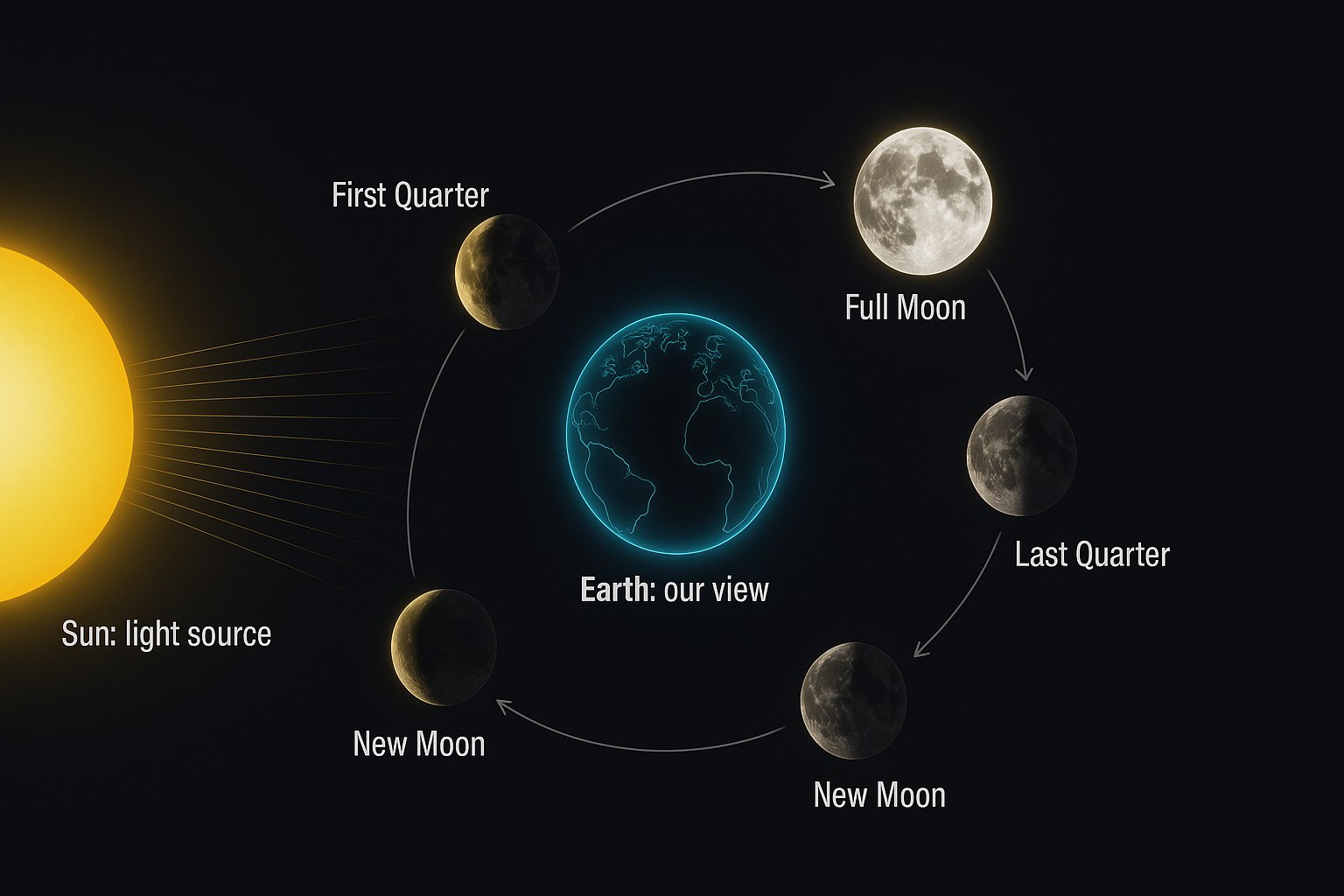
The Moon doesn’t produce its own light. It acts like a giant mirror in the night sky. The Sun remains the only source of light in our system.
The Sun’s rays bounce off the lunar rock. So one half of the Moon is always lit up. The other half stays in total darkness. It’s an unchanging law of physics.
It all comes down to the reflection of sunlight. That’s how its glow reaches us.
💃 A three-way dance between Earth and Sun
The Moon makes one full trip around our planet. This journey takes about 29.5 days. This movement constantly changes our viewing angle on its lit-up part.
Synchronous rotation always shows us the same face. Yet the lit portion we see changes every night. It all depends on its exact position along its orbit.
This celestial machinery is perfectly predictable. Astronomers work out these positions with pinpoint accuracy. We always know which crescent to admire tomorrow.
🌑 The myth of the Earth’s shadow
The Earth’s shadow is not responsible for the phases. They depend only on the relative position of the bodies. It’s a classic beginner’s mistake to clear up.
The Moon’s phases aren’t caused by the Earth’s shadow, but by our changing perspective on its lit-up face.
It’s all about how it looks to us. The shape changes because we see more or less of the lunar day. Why does the Moon change shape? The lunar phases are simply a game of geometry.
🌖 4 key stages to follow the lunar cycle
To really grasp this ballet, we need to break the month down into four pivotal moments that set the rhythm of our nights.
🌚 The total discretion of the new moon
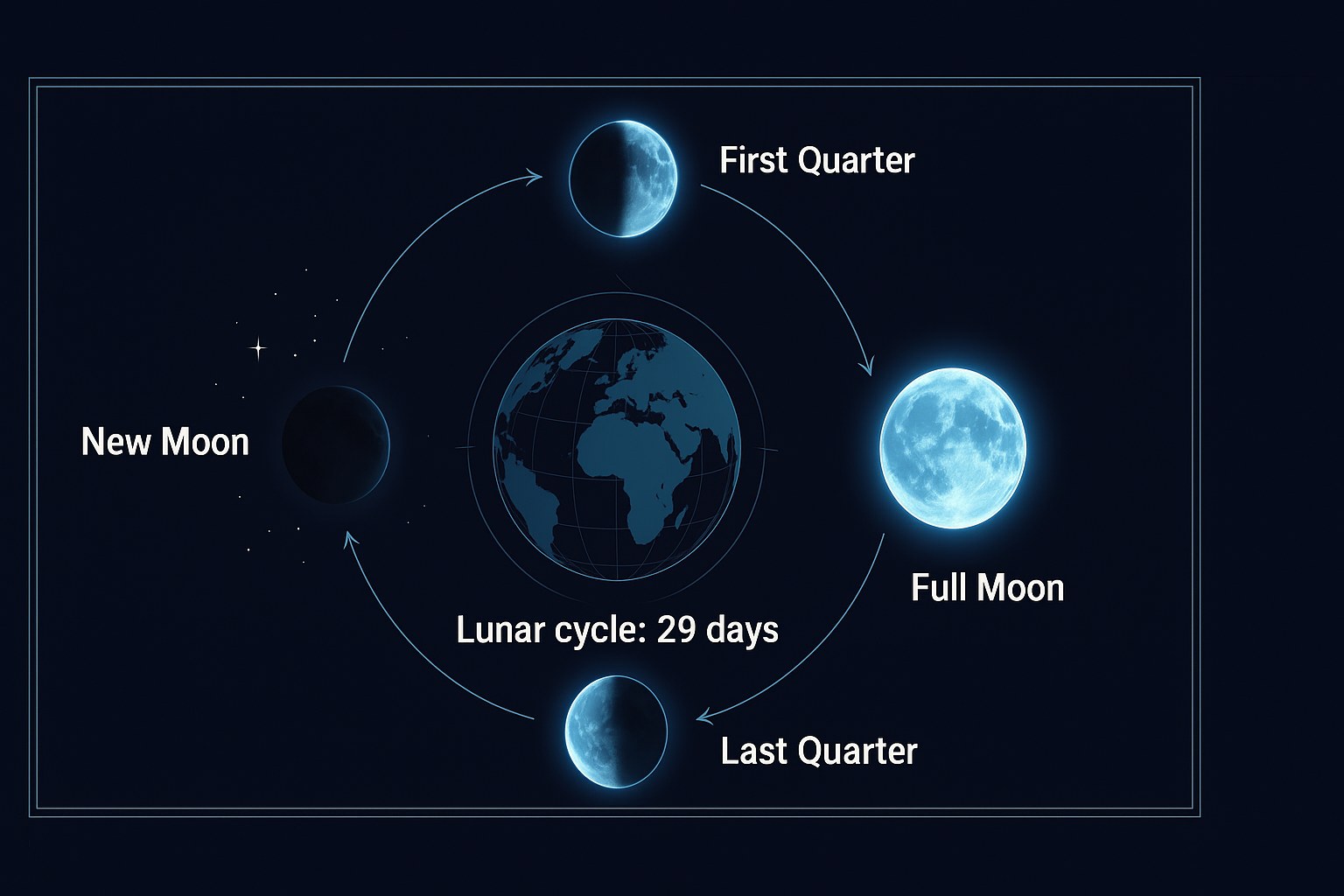
During this phase, the Moon becomes invisible. It sits between us and the Sun. Its lit-up face then turns completely away from us, staying hidden.
We often wonder where it goes. In fact, it rises and sets with the Sun. So it is absent from the sky during the dark night.
This is the perfect time to observe distant stars. With no lunar light pollution, the deep sky finally reveals itself to curious eyes.
🌗 The first and last quarter
The Moon then draws a clean half-circle. The three bodies form a perfect right angle. This is called quadrature in astronomy. It’s a striking visual transition.
We need to tell the two moments apart. The first happens a week after the new moon. The last announces the imminent end of the current cycle.
- First quarter (visible in the evening)
- Last quarter (visible in the morning)
🌕 Maximum brightness at the full moon
Here, the Earth sits in the middle. The Sun then lights up the entire visible face. It’s the dazzling climax of the cycle, which lasts about twenty-nine days.
Why does the Moon change shape? The lunar phases depend on this geometry. You can check the complete cycle of phases to confirm this exact duration.
Let’s not forget that this phase strongly influences the tides. The alignment of gravitational forces reaches its peak here. It’s a fairly powerful natural spectacle.
🌓 How to tell if the Moon is waxing or waning
Working out the current phase takes a little practice, but a few visual tricks make the task far easier.
🔤 The visual trick of the letters
To tell whether the Moon is growing, picture an imaginary bar. The crescent then forms a recognisable letter shape.
In English, a backwards “C” shape (rounded on the right) means a waxing Moon that is growing. A “C” shape (rounded on the left) means a waning Moon that is shrinking. A handy reminder: think “light on the right, getting bright.” Once you know it, you’ll never get it wrong again when you look up at the sky.
Simply use the straight edge of the crescent to picture your shape. The Moon then becomes a perfectly readable clue.
📖 The vocabulary of the gibbous moon
The word “gibbous” comes from a word meaning hump. The Moon then looks far bigger than a simple half-circle, without being quite full yet.
We can tell two precise phases apart. The waxing gibbous follows the first quarter. The waning gibbous comes before the last quarter. It’s an important detail for astronomy fans.
Think of the rugby-ball comparison. Its shape is oval and very rounded. It also takes up a large part of the night sky.
✨ The poetic phenomenon of earthshine
Have you heard of earthshine? Our planet also reflects sunlight. This glow then reaches the dark part of the Moon.
We can make out the full disc despite the thin crescent thanks to this greyish effect. It’s a magnificent sight, visible just after the new moon.
This phenomenon highlights how connected the worlds are. The Earth isn’t just a passive spectator in this nightly ballet.
🌍 The Moon’s look changes with where you are on Earth
What you see also depends on where you plant your feet on our globe.
🌐 The visual flip between the two hemispheres
The visual reversal often comes as a surprise. In the south, the Moon seems to be upside down. The crescents point the opposite way to our northern habits.
It’s a shock for unwary travellers. They then discover the flipped appearance between the hemispheres. The perspective changes radically depending on where you are. The light simply seems to swap sides.
Here’s a mental guide. Imagine looking at the same object from the opposite pole.
📐 The tilt of the crescents by latitude
People sometimes talk about the Moon that smiles. Near the equator, the tips of the crescent point upwards. The path of the Sun is almost vertical compared with the horizon.
Yet the phase stays the same everywhere. Only the angle of the picture rotates. It’s a matter of pure and simple spherical geometry.
| Region | Crescent orientation | Name of the effect |
|---|---|---|
| Northern Hemisphere | Letter-like shape | Northern view |
| Equator | Smile shape | Horizontal Moon |
| Southern Hemisphere | Flipped shape | Southern view |
⏱️ Synodic period versus sidereal period
We need to tell the two measurements apart. The real orbit takes twenty-seven days. But the cycle of phases needs two more.
This gap makes sense. The Earth also moves along its orbit. So the Moon has to travel a little further to find the same alignment again.
The synodic revolution lasts 29 days and a bit, setting the rhythm of our lunar calendars.
🌊 3 real effects on tides and living cycles
Beyond the visual show, these changes of position have real consequences for our environment.
🌊 The mechanism of tides and gravity
The Moon exerts an invisible but powerful force. It literally pulls on the oceans. This creates a bulge of water that faithfully follows its journey around us.
The tides vary with the phases. At full moon, the forces add up. We then talk about spring tides. By contrast, the quarters produce calmer neap tides.
It all depends on the Sun’s position. Its gravitational backup changes the game.
🌿 The influence on wildlife and plants
The animal world is very sensitive to these cycles. Some corals spawn only at full moon. They use this night-time light as an essential synchronised signal.
Science stays cautious about gardening, though. The direct influence on sap isn’t proven. Often, the everyday evidence sorely lacks scientific rigour to draw conclusions.
Here are a few examples of species concerned:
- The reproduction of sea turtles.
- The migration of migratory birds.
- The cycles of certain night-time insects.
😴 The scientific truth about human sleep
Serious research is looking into our rest. Some studies show a real drop in melatonin. We may sleep a little less well on full-moon nights.
The impact of light also plays a part. Our ancestors were more sensitive to this brightness. Today, artificial lighting often masks this natural effect in our cities.
We do need to keep things in perspective, though. The myths about madness remain statistically unfounded.
🔭 Practical tips for stargazing with your kids
To finish, nothing beats a little night-time expedition to put this new knowledge into practice.
🔭 Gear up for a successful astronomy evening
Simply grab a pair of binoculars. This tool beats complicated telescopes for beginners. You can already clearly make out the major craters and the dark seas.
Aim for the right window. The full moon flattens the relief too much. Prefer the quarters, where the stretched shadows literally sculpt the lunar mountains.
Flee light pollution. Set up far from city street-lamps. The contrast will be far more striking for little curious eyes.
🌝 Watching out for supermoons
Perigee is the moment when the Moon comes closest to us. It then looks enormous. Its brightness also becomes much more intense.
For photos, use a steady tripod for sharpness. Avoid digital zoom, which ruins everything. Include a tree or a roof to give a sense of scale.
It’s a magical moment. Children are often left speechless in front of this huge silvery disc.
📅 The legacy of cultural lunar calendars
Ancient civilisations were already scanning the sky. The lunar month served as a basis for measuring time. It’s the direct origin of our idea of a month.
Great festivals like Easter or Ramadan follow this rhythm. Why does the Moon change shape? This link between sky and traditions is fascinating.
The solar system took over. Our modern calendar eventually broke away from the pure lunar cycle to favour the Sun.
In short, the Moon’s face depends on its orbital position and the reflected sunlight. Plan your family outings around the lunar calendar to admire these cyclical changes. Tonight, look up: this free celestial show will amaze young and old at every lunar month.
❓ FAQ
🌙 Why does the Moon change its appearance from day to day?
This change is only a matter of perspective. The Moon orbits the Earth and, depending on its position, the Sun doesn’t always light up the same part of the face we see. What we call “phases” is simply the lit-up portion of the surface visible from our garden.
It’s important to remember that the Moon doesn’t shine by itself. It acts like a giant mirror that reflects the Sun’s light. Its real shape stays an unchanging sphere; it’s only the lit part that seems to grow or shrink during its 29.5-day cycle.
❓ Is it the Earth’s shadow that creates the Moon’s phases?
This is a very common mix-up, but the answer is no. The Earth’s shadow only comes into play during lunar eclipses, a much rarer event. The monthly phases depend only on the angle between the Sun, the Earth and the Moon.
The Moon’s phases aren’t caused by the Earth’s shadow, but by our changing perspective on its lit-up face. It’s the natural geometry of its orbit that draws the crescents and quarters we love to watch in the evening.
🌒 How can I tell whether the Moon is waxing or waning?
There’s a simple little trick so you never get it wrong. By picturing an imaginary line against the edge of the crescent, you can form a shape. In the Northern Hemisphere, if the Moon is lit on the right and rounded like a backwards “C”, it is waxing and growing. If it’s lit on the left, it is waning and shrinking.
A handy phrase is “light on the right, getting bright.” You can also remember that the word “gibbous” describes the period when the Moon is more than a half-circle, but not quite full yet. It then looks like a nicely rounded little rugby ball.
👁️ Why do we always see the same side of the Moon?
This is what astronomers call synchronous rotation. The Moon spins on itself at exactly the same speed as it orbits the Earth. This perfect timing means it always shows us the same face, as if it never wanted to take its eyes off us.
Even though the lit portion changes every night, the lunar landscapes, seas and craters we see stay the same. It’s a reassuring landmark in our night sky.
😊 Why does the Moon sometimes seem to “smile” in the sky?
The look of the crescent depends a lot on where you are on the globe. Near the equator, the Moon seems to lie on its back, with the tips pointing up, creating that famous “smile.” It’s a matter of latitude and viewing angle compared with the horizon.
If you travel to the Southern Hemisphere, you might be surprised: everything seems flipped! The crescents point the opposite way to our northern habits. The phase is the same for everyone, but the picture tilts depending on where you are.
🔄 What is the difference between the synodic period and the sidereal period?
The sidereal period is the real time the Moon takes to make one full trip around the Earth, about 27.3 days. However, because the Earth also moves along its orbit around the Sun, the Moon has to travel a little longer to find the same lit-up alignment again.
It’s this little extra stretch that creates the synodic period of 29.5 days, the one that sets the rhythm of our lunar calendars.
The synodic revolution lasts about 29 and a half days, setting the rhythm of our lunar calendars.
