
Do your children fire off question after question the moment the sky rumbles, and you don’t know what to say to reassure them? ⛈️ This article explains why we get thunderstorms: lightning and thunder explained simply to lift the lid on this weather mystery. You’ll discover how a simple dose of heat and moisture makes giant sparks, and why the sound always arrives after the light.
- The right ingredients for a storm to form
- The three ages of a cumulonimbus cloud
- Why lightning flashes and thunder rumbles
- Small and large storm-cell formats
- Hail and wind under storm clouds
- Working out the distance and staying safe
⛈️ The right ingredients for a storm to form
After a day of dead calm, the sky suddenly darkens, but this show owes nothing to chance. Here’s the physics recipe that turns a peaceful afternoon into a storm.
🌡️ Heat and moisture near the ground
The sun warms the Earth’s surface during the day. This stored energy heats the air touching the ground. That’s the starting point of the whole weather process.
Moisture is the essential fuel. Without water vapour, there’s no cloud. Evaporation from soils and forests fills the lowest layers. This mass of air then becomes an energy bomb ready to explode.
The cocktail is ready. All it needs now is a spark to launch the climb.
💨 An unstable mass of air
Warm air is lighter than cold air. If it meets an icy layer high up, it climbs fast. This is what we call atmospheric instability.
The sharper the difference in temperature, the more powerful the storm will be. Buoyancy does all the work here. The air rises like an invisible hot-air balloon.
This imbalance is the main engine. Without that temperature difference, the sky would stay hopelessly blue.
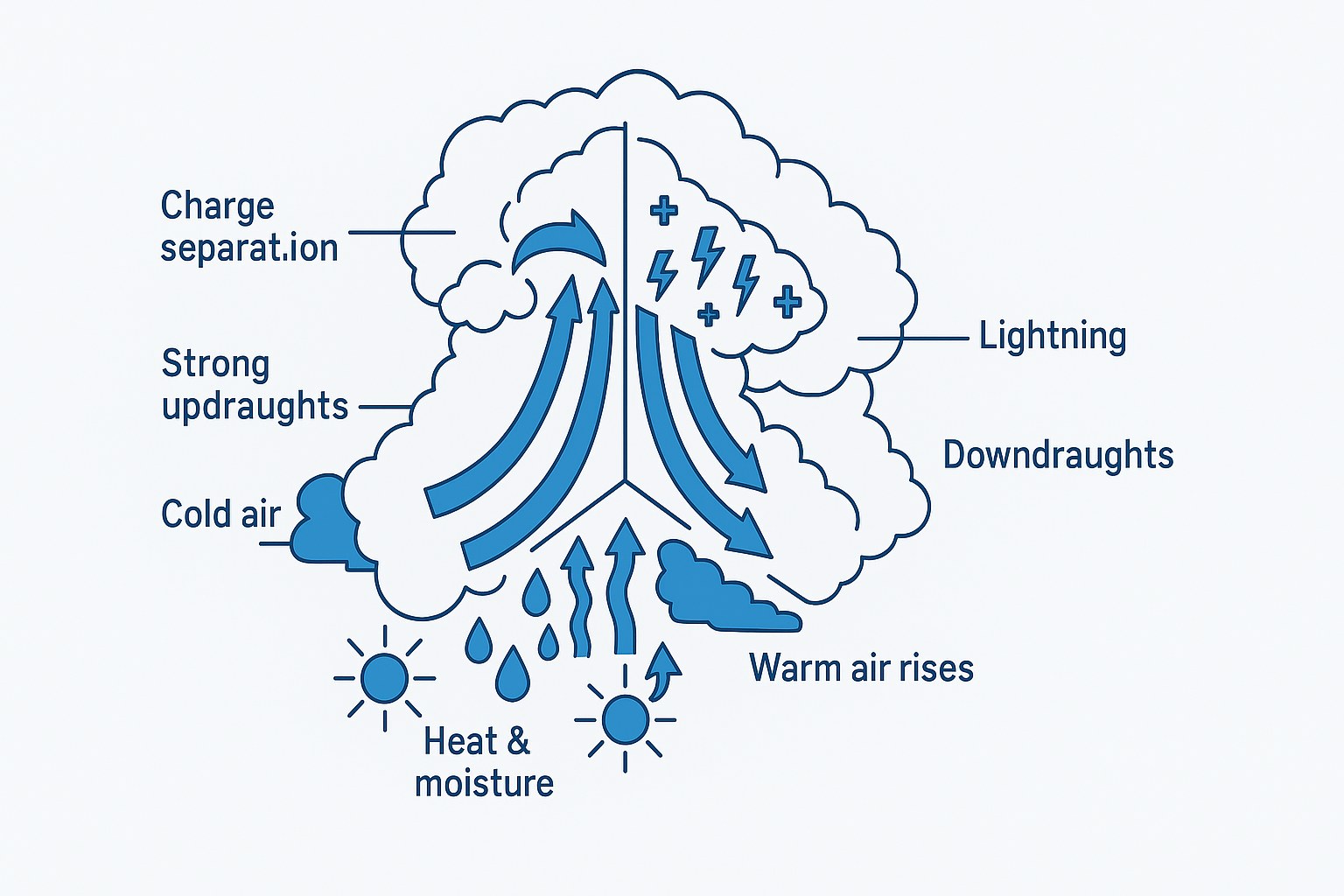
⬆️ The role of rising currents
Natural convection creates real columns of rising air. These currents carry heat up to the top. They suck up everything in their path.
As it rises, the water vapour condenses. This releases even more hidden heat. The process feeds itself and grows stronger.
The rising current is the real lung of the storm, able to lift tonnes of water at speeds of over 100 km/h.
So why do we get thunderstorms, with lightning and thunder? It all starts with this sudden climb that ends up creating the cumulonimbus, the giant cloud that can reach 15 km high.
☁️ The three ages of a cumulonimbus cloud
Just because a cloud looks like cotton wool doesn’t mean it’s harmless. The cumulonimbus follows a precise life cycle, from its shy birth to its final collapse.
🌱 The growth and budding phase
It all begins with a simple cumulus. At first it looks like a nice white cauliflower. But its edges quickly become bubbling and restless.
The vapour turns into droplets. This change of state warms the inside of the cloud. The growth then becomes vertical and very fast.
The top climbs several metres per second. The cloud devours the space on its way up to the stratosphere.
💪 The mature stage and peak activity
The cloud reaches the top of the lower atmosphere and spreads out. It then takes on its typical anvil shape. This is the moment when the storm is most dangerous. Rain and hail start falling hard.
Rising and sinking currents exist side by side. This inner struggle creates intense friction. Electrical activity then kicks off throughout the cloud.
The sky turns ink-black. The thunder finally begins to rumble.
🌤️ Fading away and the end of the downpour
The sinking current finally wins. It cuts off the supply of warm air at ground level. The storm then loses its vital source of energy.
The rainfall runs out of breath and grows lighter. The cloud tears apart and loses its structure. All that’s left are scraps of high cirrus cloud.
Bear in mind that modelling these processes is still complex. Knowing why we get thunderstorms, with lightning and thunder explained simply, helps us better understand these giants of the sky.
⚡ Why lightning flashes and thunder rumbles
We see the light before we hear the crash, but both happen at the very same instant. It’s all a matter of pure physics and icy friction.
⚡ The separation of electric charges
Inside the cloud, ice crystals smash into each other. These collisions rip electrons off the particles. The cloud turns into a gigantic battery.
The top of the cloud becomes positive. The base builds up negative charges. The ground below, by influence, becomes positive. The voltage climbs to several million volts.
The air finally cracks. The giant spark can then leap out.
🌩️ The bright discharge and the lightning strike
An ionised channel carves out a path. It’s the leader that comes down towards the ground. When the connection is made, the arc flashes.
Most flashes stay inside the cloud. Only some reach solid ground. These are what we call lightning strikes.
Liquid water is crucial for these ground strikes. Without it, there’s no discharge.
🔊 The shockwave and the sound of thunder
The lightning heats the air to 30,000 degrees. That’s hotter than the surface of the sun. This heat is instant and brutal.
The air expands explosively. This creates a shockwave of sound. That crash is what we call thunder. The sound then travels much more slowly.
The long rumbles come from echoes. The landscape bounces back the first bang.
📊 Small and large storm-cell formats
Not all storms are alike: some are loners, while others organise themselves into real weather armies.
☁️ Single-cell and multi-cell storms
The single-cell storm is often brief. It lasts about thirty minutes. It’s the classic shower at the end of a summer’s day.
Multi-cell systems are more complex. Several cells take turns to keep going. When one dies, another takes over. This sometimes forms long squall lines.
These structures cover whole regions. They bring lasting rain.
🌪️ The power of supercells
The supercell is the queen of storms. It has a spinning heart. We call this phenomenon a powerful mesocyclone.
This weather monster stands out for its unique supercell structure, which lets it live for several hours. It rules the sky with fearsome force.
These monsters often spawn tornadoes. They can flatten a whole landscape.
💨 The influence of wind shear
The wind changes speed with altitude. This shift tilts the column of air. It’s the secret of a long-lived storm.
By tilting the cloud, the rain falls to one side. It no longer smothers the rising current. The storm can then breathe without destroying itself.
| Type of storm | Average duration | Tornado risk | Organisation |
|---|---|---|---|
| Single-cell | 30 minutes | Low | Isolated cell |
| Multi-cell | Several hours | Moderate | A run of cells |
| Supercell | Several hours | Very high | Single rotating current |
Understanding why we get thunderstorms, with lightning and thunder explained, also means watching the winds that sculpt the clouds. It’s amazing how a simple draught of air changes everything, isn’t it?
🌨️ Hail and wind under storm clouds
Beyond the lightning, a storm unleashes an impressive arsenal of projectiles and violent gusts that hit the ground with a crash.
🧊 Hail and downbursts
A hailstone bounces up and down inside the cloud. It freezes and thaws several times. Each cycle adds a layer of ice.
Downbursts are cold currents. They slam into the ground like water. The wind can top 120 km/h.
These events cause local damage. Roofs and crops suffer terribly.
🏙️ The effect of landscape and cities
Mountains force the air to rise. It’s the well-known orographic effect. Storms are more frequent there.
Cities create heat islands. The tarmac overheats the surrounding air. This helps cells form above towns. Pollution can also play a minor role.
The terrain often dictates the weather. Every landscape has its own climate.
🏜️ Rare phenomena and dry storms
Dry storms are fearsome. The rain evaporates before it touches the ground. But the lightning still strikes hard.
Above the clouds, strange phenomena glow. We see sprites or elves. These red lights are very brief.
Sometimes, the cold joins in too. There are even thundersnow storms, a surprising mix of snowflakes and electricity.
📏 Working out the distance and staying safe
To avoid being struck, you need to read the signs in the sky and have the right reflexes at the right moment.
📐 Tips for measuring how far away it is
Light travels far faster. The sound of thunder lags behind it. That’s the key to the calculation.
Count the seconds between the flash and the bang. Then divide that number by three. You get the distance in kilometres. If the gap gets shorter, the storm is coming dangerously close.
The rule is simple and reliable. It often saves lives.
🛡️ Safety rules and protection
Never stay under a tree. It’s lightning’s favourite target. Keep away from any metal structure too.
A car is an excellent shelter. Its shell forms a Faraday cage. It carries the electricity down to the ground.
- Don’t go swimming
- Unplug electrical appliances
- Avoid the landline phone
- Keep away from high points
📱 Weather alerts and climate change
An amber warning calls for great care. It signals violent, frequent events. Never ignore these official alerts.
Climate change is shifting the picture. Warmer air holds more moisture. This could make storms more intense. Hail events are becoming more destructive too.
Tomorrow’s weather will be electric. Stay informed for your safety.
Understanding why we get thunderstorms helps you better anticipate the dance between warm air, moisture and electricity. Keep your distance by working out the gap between the flash and the thunder, then unplug your devices for the best safety. Stay safely sheltered to enjoy this electric show with peace of mind!
❓ FAQ
⛈️ How exactly does a storm form?
A storm is born when warm, moist air rises quickly from the ground to form a cumulonimbus. As it climbs, this air cools and the water vapour condenses into droplets, creating that big anvil-shaped cloud you can spot from far away.
Inside, it’s a real energy factory: violent air currents make ice crystals and soft hail smash together. This friction creates an electric charge, with positive charges at the top and negative ones at the base, turning the cloud into a giant battery.
⚡ What’s the difference between a flash and a lightning strike?
It’s a very common mix-up, but the difference is simple: the flash is the burst of light. It can stay inside a single cloud or travel between two different clouds to rebalance the electric charges.
We use the term lightning strike only when this electric discharge reaches the ground. A strike is therefore a specific, especially impressive kind of flash, which seeks the shortest path to the earth, often through high or conductive points.
🔊 Why does thunder rumble after the flash?
Thunder is simply the noise made by the flash. The electric discharge heats the air instantly to 30,000 °C, which is hotter than the surface of the sun! This sudden heat makes the surrounding air explode, creating a shockwave of sound.
If we hear it after seeing the light, that’s because light travels much faster than sound. The long rumbles we sometimes hear are caused by the sound’s echoes bouncing off the landscape or layers of air.
📏 How can we tell whether the storm is close to us?
There’s a very reliable little trick: count the number of seconds between the flash and the sound of thunder. Then divide that number by three to get the distance in kilometres. For example, if you count 9 seconds, the storm is about 3 kilometres away.
If that gap shrinks between two flashes, the storm is getting closer to you. That’s the signal that it’s time to bring everyone inside to safety and unplug fragile devices such as the television.
🛡️ What are the right reflexes to protect yourself from lightning?
The most important thing is never to shelter under a tree, because it’s a prime target for lightning. If you’re outside, keep away from metal structures and high points. A car remains an excellent shelter, because it forms a Faraday cage that carries the electricity down to the ground without touching you.
At home, a few simple precautions are a must to stay calm:
- Avoid taking a shower or a bath.
- Unplug electrical appliances.
- Don’t use a landline phone.
- Keep away from windows.
🌈 Why do some flashes have different colours?
The colour of a flash actually gives us clues about the local weather. A red flash often means there’s rain about, while a blue tinge can signal hail. If you see yellow flashes, there’s probably a lot of dust in the air, whereas pure white means the air is very dry.
