
The sea fascinates every child. 🌊 Acrobatic dolphins, hundred-year-old turtles, giant whales, mysterious seahorses, colourful clownfish: so many creatures fill a child’s imagination. Our free sea animal colouring pages to print let your child step into this underwater world through creativity.
This selection offers seventeen varied drawings: big panoramic scenes with divers and mermaids, identification boards for recognising sea creatures, kawaii sheets for the youngest, and more realistic illustrations for older children. From the little crab to the great dolphin by way of the octopus, your child is sure to find the sheet that speaks to them.
🌊 Why the sea fascinates children
🐠 A hidden world full of mystery
The ocean covers 70% of our planet and is home to thousands of species your child will never bump into in the street. This hidden dimension feeds curiosity from a very young age. This natural fascination makes sea colouring pages especially motivating. The child invents a diver character exploring the deep.
🐬 The sea heroes of children’s culture
Nemo, Dory, Ariel, Flipper, Willy: the sea brims with iconic characters that speak to all children. Finding Nemo, The Little Mermaid, Moana: films that have rooted these worlds in the collective imagination. Colouring these animals naturally links your child to their favourite films.
🤿 An invitation to explore
The sea evokes adventure, discovery and travel. Sea colouring pages speak to every child who has seen a diver or dreamed of exploring the deep. Each colouring page becomes a little imaginary expedition. Your child builds an emotional bond with the marine world and its protection.
🐟 Our 17 sea animal colouring pages to print
Our selection of sea animal colouring pages to print offers seventeen varied drawings, from the big educational board to the ultra-detailed seahorse. Each sheet reveals a different corner of the oceans.
🐳 The big board of 9 sea animals
This big board brings together nine emblematic sea animals on a single page: the whale, the seahorse, the turtle, the crab, the shell, the ray, the shark, the starfish and the octopus. It is our most educational sheet for learning to recognise the inhabitants of the ocean. Your child can colour one animal a day to make the fun last.

🐬 The two dolphins, the octopus and the seahorse
Four sea friends meet in this underwater scene full of bubbles. Two smiling dolphins, a playful octopus and a dainty seahorse make up the picture. The seaweed on the floor and the water bubbles add to the setting. This square-format sheet is perfect for children aged 4 to 8 who love busy scenes.

🤿 The child divers with the whale and the turtle
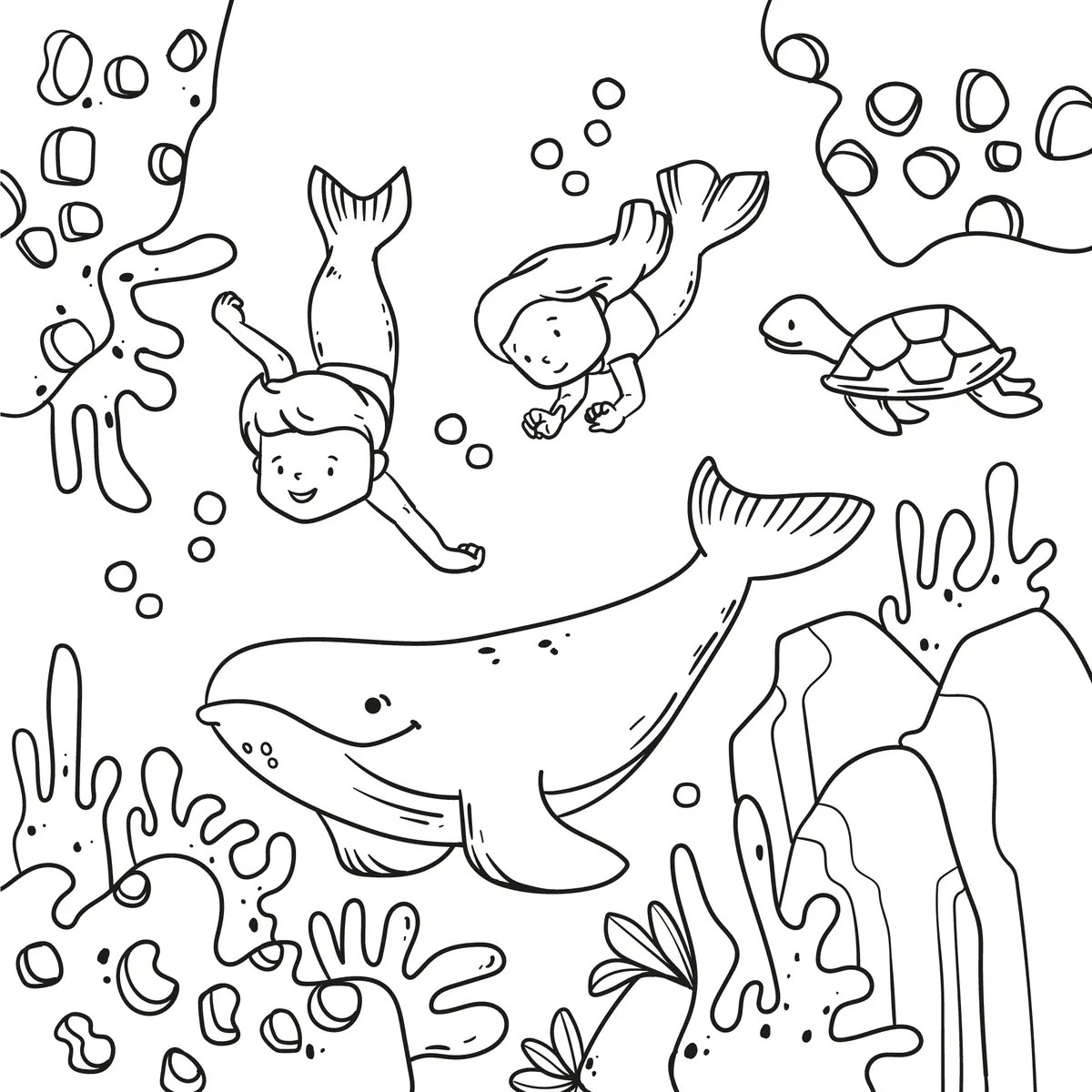
Two children wearing flippers dive into the ocean to meet a majestic whale and a little turtle. The corals and rocks complete this marine adventure setting. This sheet makes every child who loves diving and travel dream. It also lays the groundwork for respecting the oceans.
🧜♀️ The little mermaid surrounded by fish
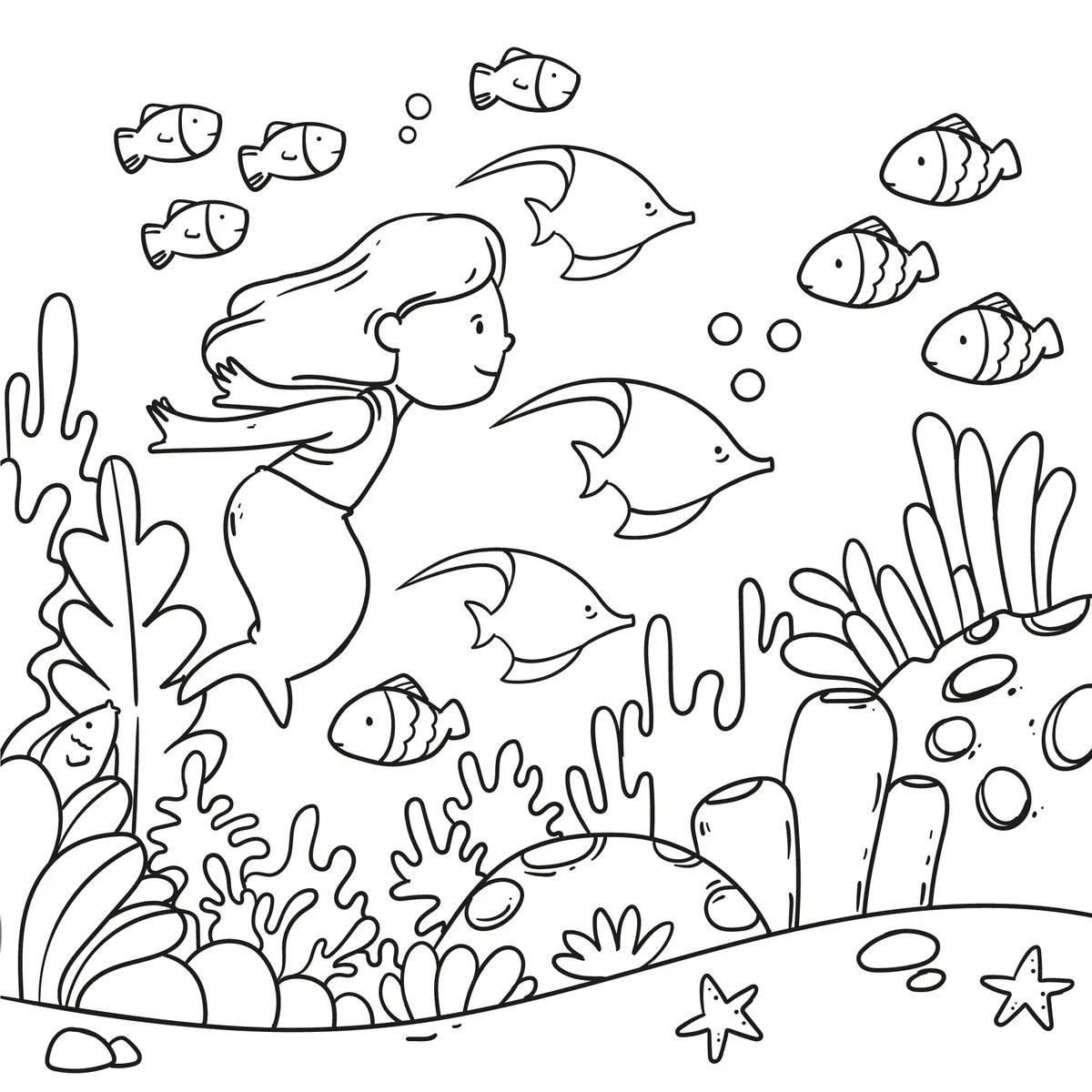
A pretty long-haired mermaid swims among a shoal of colourful fish above a thriving coral reef. This fairy-tale scene is hugely popular with children from age 4. The corals and seaweed offer a lovely challenge of colouring in distinct areas. Your child can imagine a whole sea-princess story.
🐋 The kawaii whale and its little fish friends
This kawaii-style whale swims gracefully among a few little fish and a coral reef down below. Its big round eyes and its smile make it instantly lovable. This portrait-format sheet prints perfectly on A4 vertical. It is just right for children aged 3 to 6 who are starting out.

🐬 The dolphin leaping among the fish and the crab
A big acrobatic dolphin puts on a show among a shoal of striped fish, joined by a starfish and a crab. The seaweed on the seabed completes this lively scene. The square format is perfect for felt-tips and colouring pencils. A very full sheet for a long colouring session.

🌊 The dolphin leaping out of the water
A happy dolphin bursts out of the water in a big splash, while a little sailing boat passes on the horizon and gulls fly over the scene. This sheet captures all the magic of a summer’s day at the seaside. The waves offer a lovely chance to work on gradient blues.

🐢 The sea turtle among the corals
This beautiful sea turtle swims among the bubbles, above a seabed rich in plants and corals. Its shell, neatly divided into compartments, offers an excellent geometric colouring challenge. This sheet suits children from age 6 who love detail. The patterns on the flippers add to the fun.

🌴 The little turtle on the beach
An adorable little turtle wanders across the sand of a paradise beach. The rocks, shells and the sea in the background make up a very summery scene. This portrait-format sheet evokes summer holidays at the seaside. Children aged 3 to 6 love it.

🐙 The kawaii octopus and the tropical fish
A funny octopus with big round eyes dances among striped tropical fish. The corals, seaweed and rocks on the floor add a lovely setting. The kawaii style makes this octopus instantly adorable. This sheet is perfect for talking about sea invertebrates and how clever they are.
🦑 The big octopus among the seaweed
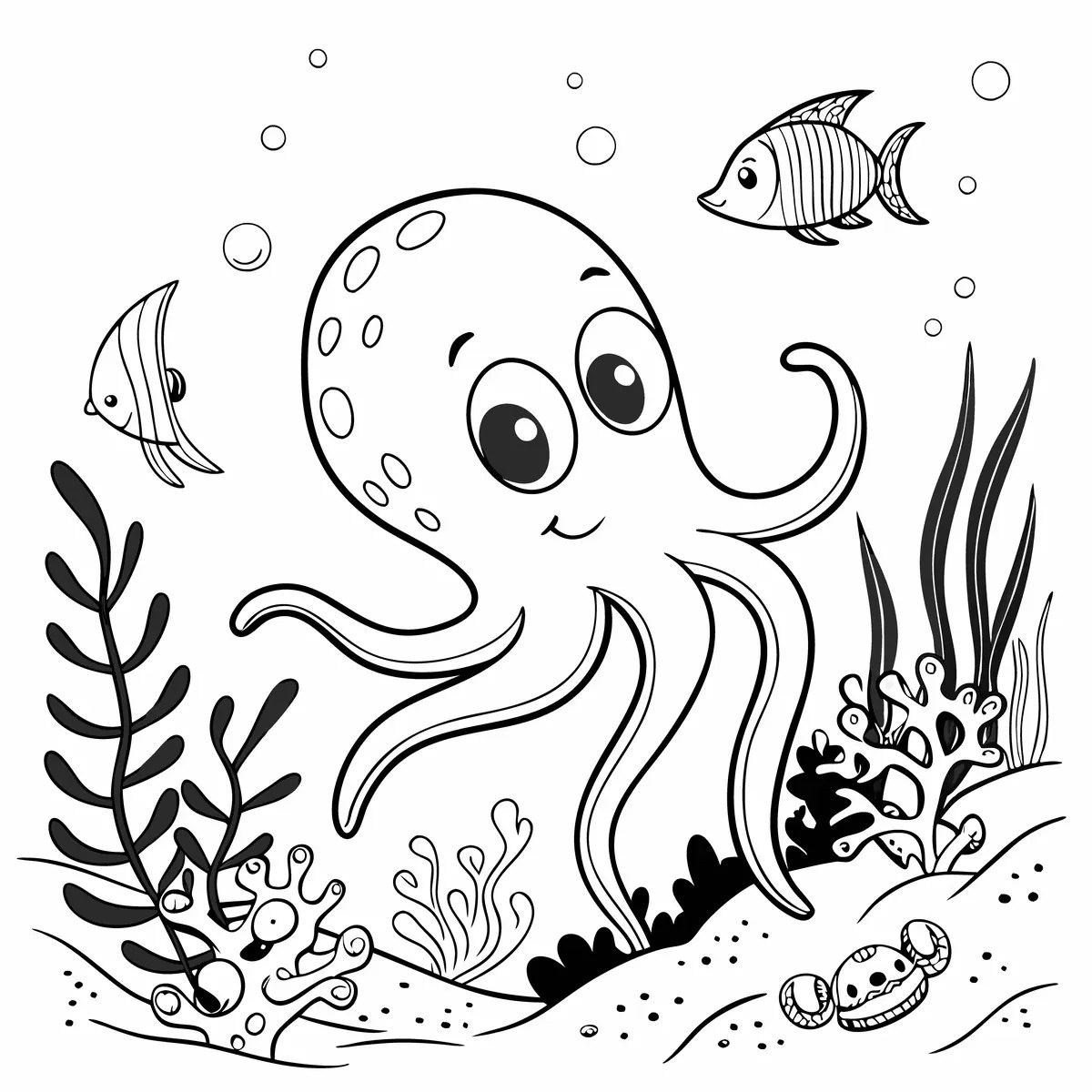
This plump octopus sits at the heart of the seabed, surrounded by decorative seaweed and round rocks. The water bubbles above complete the magical scene. The long tentacles offer plenty of space to colour. Your child can have fun giving each sucker a different colour.

🪼 The seahorse and the kawaii jellyfish
A magnificent long-snouted seahorse poses in the centre of the scene, joined by two smiling jellyfish with wavy tentacles. Seaweed and shells decorate the seabed. The seahorse’s details call for patience and precision. This sheet suits children from age 6.

🦀 The kawaii crab with big eyes
This funny crab with huge round eyes and a wide smile sits on a rock surrounded by seaweed and bubbles. Its speckled body offers a lovely pattern to colour. The very simple, expressive style appeals especially to the youngest. This sheet is just right for children aged 3 to 6 who are starting out.

🐠 The tropical fish on the seabed
This pretty tropical fish swims calmly above a seabed covered in seaweed, shells and little pebbles. The waves at the surface complete the setting. This portrait-format sheet evokes the coral reefs of warm seas. The fish’s scales offer an interesting challenge for children from age 7.

🐟 The board of clownfish, ray and starfish
This board brings together several inhabitants of the coral reef: a striped clownfish, a butterflyfish, a kawaii ray, a smiling starfish, a coral and a shell. It is a great chance to learn the names of these fish. The striped fish patterns instantly call to mind the world of Nemo.

🦭 The spotted seal
This seal, drawn in a more realistic style, poses elegantly, its body dotted with little black spots. Its long whiskers and expressive eyes make it a lovable character. This more realistic sheet suits children from age 7. The white background lets your child invent an ice-floe or beach setting.

🐡 The round pufferfish
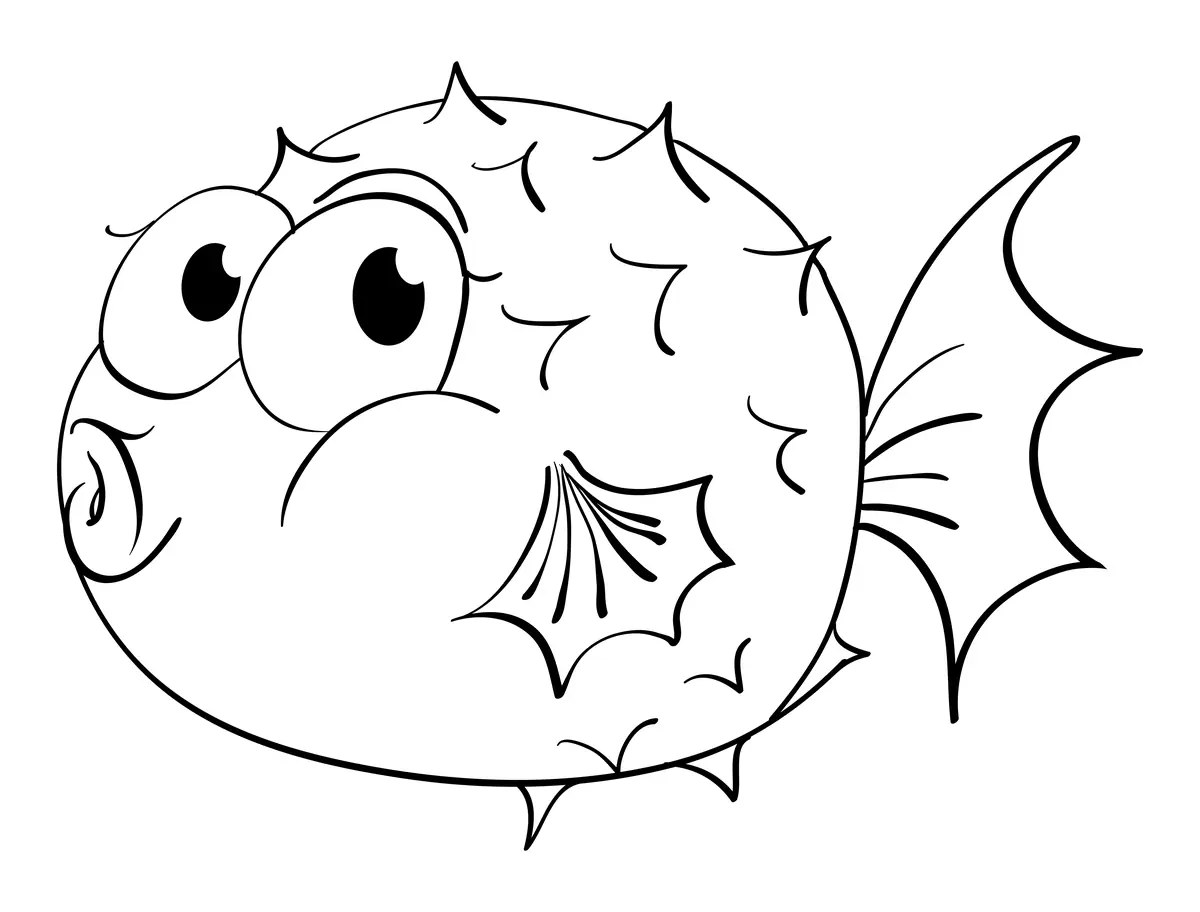
This round little pufferfish, bristling with spikes, opens wide, surprised eyes. Its round body and decorated scales offer plenty of space to colour. It is a great chance to explain to your child how this fish defends itself by puffing up like a balloon. An original sheet that curious children love.
🌟 The benefits of sea-themed colouring
🐋 Discovering the biodiversity of the oceans
The oceans are home to an absolutely extraordinary diversity of life forms. Colouring these animals opens the door to simple explanations about this marine richness. These conversations build a positive, wonder-filled picture of the ocean. Your child naturally develops a feeling for protecting marine habitats.
🎯 Building precision on rich patterns
Sea patterns are great to colour: fish scales, the compartments of a turtle’s shell, the stripes of the clownfish, the suckers of the octopus. These exercises directly prepare your child for the demands of handwriting. Fine pencil control is built session after session.
🗺️ Feeding geographical curiosity
Sea animals live in every ocean of the globe: the Atlantic, the Pacific, the Indian and the Arctic. This diversity opens the door to marine geography. Coral reefs, the deep abyss, the polar regions: so many habitats to discover after colouring. A globe or a marine atlas enriches these moments even further.
🎨 Which colours to choose for the sea
💙 Blue in all its shades
Blue is the queen of sea colours, but it comes in endless shades. Light blue for shallow waters, turquoise for tropical lagoons, navy blue for the great depths. Encourage your child to use several different blues. This shading gives underwater scenes a very effective sense of depth.
🌈 The bright colours of tropical fish
Reef fish are among the most colourful animals on the planet. Bright orange for the clownfish, vivid yellow for the butterflyfish, electric blue for the surgeonfish. Encourage your child to dare every colour. Total creative freedom is not only allowed but recommended for the reef’s inhabitants.
🎨 The bonus: corals and seaweed
Coral reefs offer a palette all their own: soft pinks, bright oranges, dark purples, olive greens. This range of colour turns a simple seabed into a visual spectacle. Corals are among the most rewarding subjects to colour. The contrast with the blue of the water always works beautifully.
🖨️ Practical tips for printing the sheets
📄 Paper and resolution for crisp detail
Sea colouring pages often have fine patterns: scales, bubbles, the lacework of seaweed, the suckers of the octopus. To keep these elements crisp, set your printer to “normal” or “high” quality. Paper of 90 or 100 gsm holds up better to felt-tips and avoids warping.
⚫ Printing in greyscale
Our files are black and white, but check that your printer prints in greyscale to save your colour ink cartridges. Simply open and print each sheet straight from your browser. The image opens up large and prints directly.
🖼️ Making a big collage aquarium
An original idea is to print several colouring pages and put them together on a big sheet of blue card to create a giant aquarium. Your child can arrange the fish, octopuses and turtles, add drawn corals and seaweed, and create a real underwater panorama. This larger project fills several sessions.
📺 Extending the activity with a trip to the seaside
🏖️ Exploring rocks and pools at low tide
At low tide, rock pools teem with little crabs, starfish, periwinkles and sometimes even stranded jellyfish. A family walk along the shore lets your child see the very animals they have coloured. This hands-on experience after colouring often makes for lasting childhood memories.
📚 Reading books and documentaries about the ocean
Finding Nemo, Moana, classic seaside stories: children’s literature brims with sea tales. Picture books, illustrated documentaries and Jacques Cousteau’s films enrich your child’s world. These resources are a perfect companion to colouring.
🌱 Raising awareness of ocean pollution
The oceans are seriously threatened by plastic pollution, overfishing and climate change. From age 6 or 7, you can simply explain that litter left in nature often ends up in the sea and harms the animals. Sorting rubbish, picking up paper on the beach: simple gestures your child can adopt.
❓ FAQ
🐳 From what age should I offer these sea colouring pages?
These colouring pages suit children from age 3 for the simple sheets such as the kawaii whale or the funny crab. More detailed scenes like the board of nine animals or the sea turtle among the corals are better from age 6 or 7. Your child will instinctively choose the sheet that speaks to them most.
🐬 Is the dolphin really a fish?
No, the dolphin is a marine mammal, not a fish. It breathes air at the surface with its lungs and gives birth to its young just as we do. Whales, orcas and porpoises are marine mammals too. This distinction is a great chance for a lovely zoological discovery for your child.
🐙 How many arms does an octopus have?
The octopus has eight arms, called tentacles. Each tentacle is covered in suckers that let it grab its food or cling to the rocks. The octopus is also a very clever animal: it can solve problems, recognise humans and even use tools.
🐢 Why do sea turtles lay their eggs on the beach?
Sea turtles come out of the water to lay their eggs in the warm sand of the beaches. Once hatched, the little turtles dash towards the sea. It is a very dangerous moment, because predators such as crabs or birds lie in wait. Only a few turtles out of a thousand reach adulthood.
👶 Can I take a toddler to the aquarium?
From age 2 or 3, children react with great wonder to the sight of fish in a public aquarium. The underwater tunnel, the glowing jellyfish, the sharks gliding past: so many highlights. Get ready for the visit by colouring the drawings in the collection together beforehand.
🌳 How can I explain plastic in the sea to a child?
From age 5 or 6, you can simply explain that a bottle dropped on the ground can be carried by the rain to the river, then to the sea. There, fish may mistake it for food and fall ill. Throwing rubbish away properly and turning down plastic straws are real, concrete ways to protect the sea.
