
The garden is one of the most magical worlds for a child 🌻: everything moves, everything grows, everything invites you to look closer. A ladybird climbing a leaf, a bee gathering nectar, a bird landing on the watering can, and a child can happily watch for a whole hour. Whether you want to fill a rainy afternoon, stretch out a trip to the park, or gently get ready for the summer holidays ahead, here is a selection of 6 garden colouring pages to print for free.
This gallery covers the whole world of the flower garden, from ages 3 to 12, with a different level of detail in every drawing: a springtime garden corner with its watering can, a simple flowerpot for the littlest ones, sunflowers in front of a birdhouse, a sunny field of flowers, a flower-lined path leading to a house, and a big, beautifully landscaped garden packed with detail for fans of intricate colouring. 🖍️ Get out the felt-tips and the coloured pencils, and let your child turn these drawings into imaginary gardens. At the end of the article, you will also find ideas for activities to do outdoors, plus our best colour tips for a realistic finish.
🌷 My 6 garden colouring pages to print
Here are the 6 drawings. To print, open each image and use your browser’s print option, or save the picture and print it from your computer. A4 format works without any special settings on most home printers.
🌼 1. The springtime garden corner
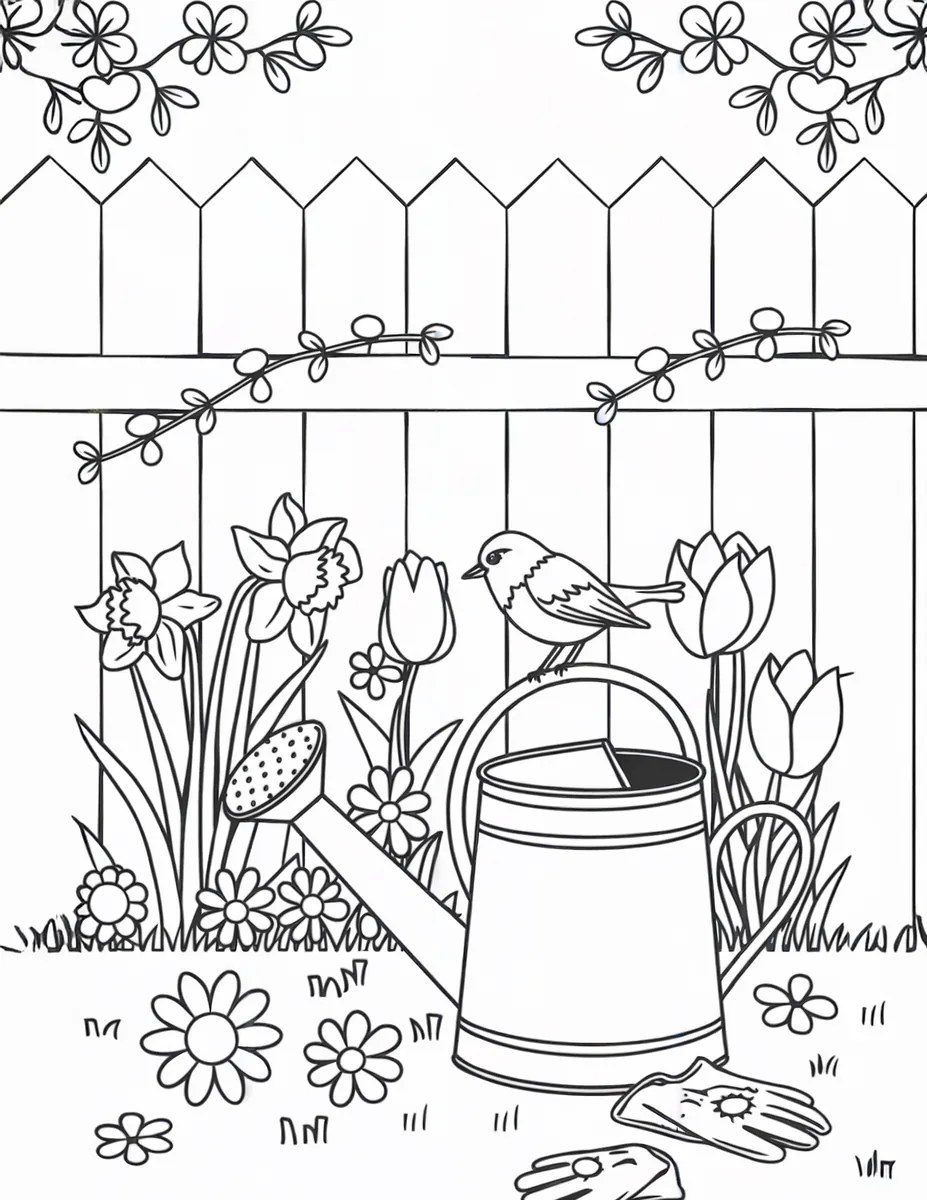
A pretty spring garden scene: a wooden fence, a watering can resting among the flowers, a little bird perched on top, daffodils and tulips pushing up from the soil, and a pair of gardening gloves left in the grass. It is a balanced, charming colouring page, perfect from age 5 thanks to its clearly outlined areas. Colour tip: bright yellow for the daffodils, red and pink for the tulips, vivid blue for the watering can and a warm brown for the fence planks.
🐞 2. The flowerpot and its little creatures
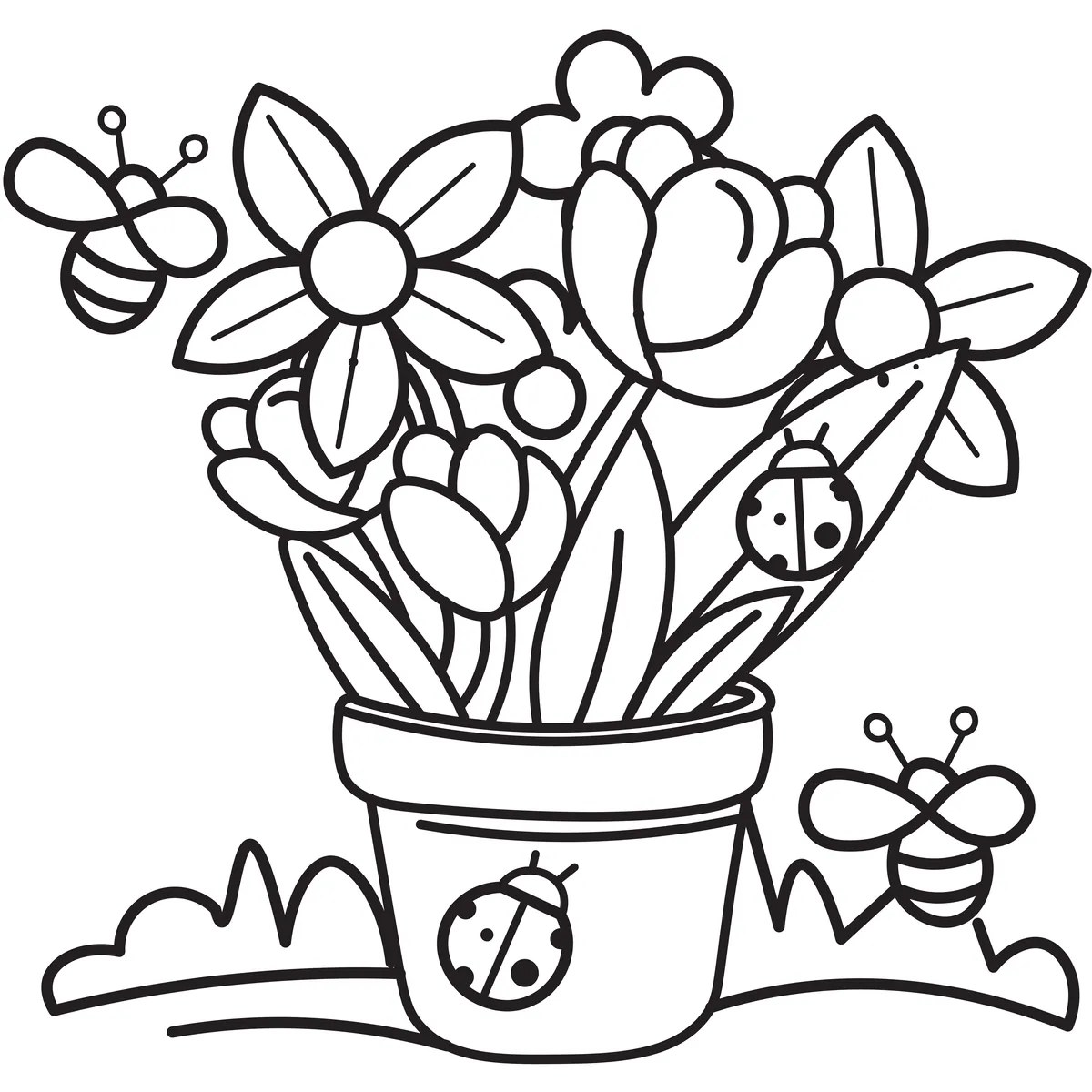
A big flowerpot overflowing with tulips and daisies, surrounded by two plump bees and a few ladybirds wandering about. With its thick, bold lines and large areas, it is the ideal drawing for toddlers from ages 3-4 who are just starting to colour. The little creatures add a fun touch and are a great way to talk about the helpful insects in the garden. Suggest red with black spots for the ladybirds, yellow and black for the bees, and every bright colour for the flowers.
🌻 3. The sunflowers and the birdhouse

Tall sunflowers standing in front of a wooden fence, with a lovely birdhouse in the background. This drawing, with its clean shapes, suits children aged 5 to 9 well. It is a great chance to explain how a sunflower follows the sun throughout the day. Colour-wise: golden yellow for the petals, a dark brown heart at the centre of each flower, green for the big leaves and light wood for the birdhouse.
☀️ 4. The sunny field of flowers
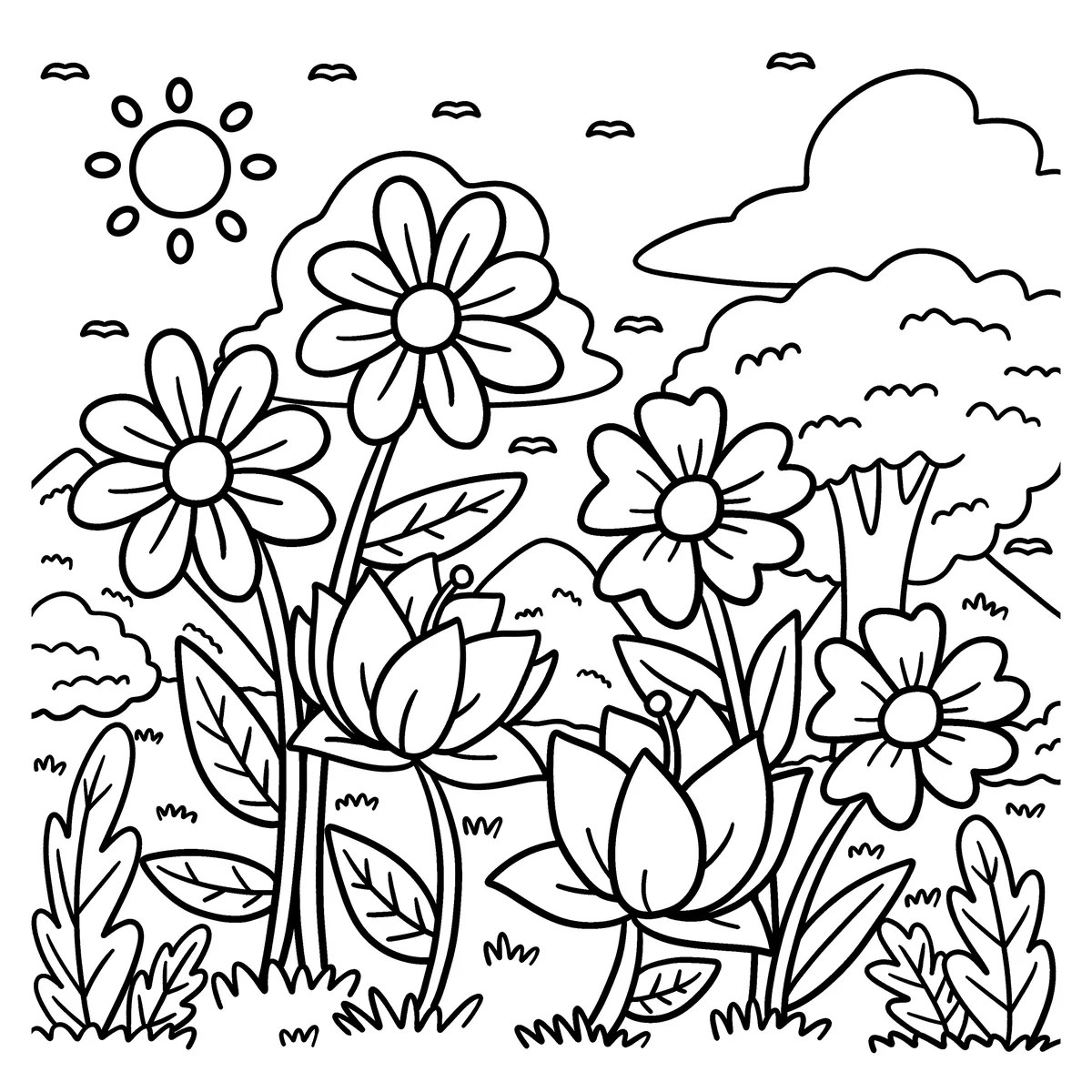
A field of flowers beneath a big sun and a few clouds: daisies, tulips and wildflowers all mingle in the grass. A bright, cheerful drawing, suitable from age 5 and ideal for 6 to 9 year olds. It invites your child to mix colours without worrying about getting it “wrong”, since in a real field every shade lives side by side. Picture a big yellow sun in the sky and several different colours for the flowers to create a realistic “meadow” effect.
🏡 5. The flower-lined path to the house

A paved path bordered by tall flowers (poppies, daisies, wildflowers) leading to a pretty country house, with a butterfly fluttering above the roof. This more detailed drawing is recommended for children aged 8 to 12 who enjoy taking their time. It lets them work on a whole scene and the perspective of the path. Vary the flower colours, use a soft grey for the paving stones and warm tones for the house.
🌳 6. The big landscaped garden
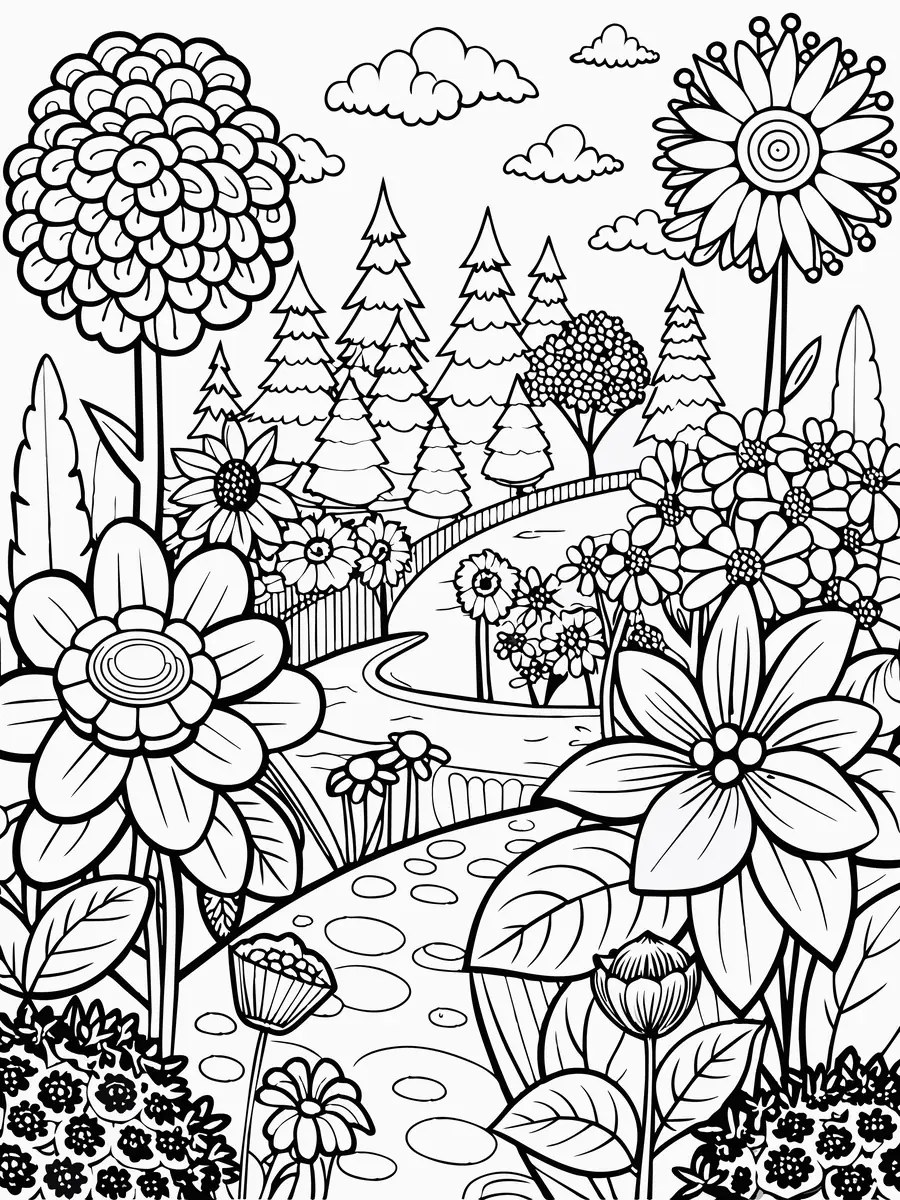
The richest colouring page in the selection: a large garden bursting with giant flowers, a winding path, fir trees in the distance and clouds in the sky. Highly detailed, it is aimed at children aged 9 and up, teenagers and even adults who love stress-relieving colouring. Take your time, flower by flower, mixing as many colours as you can: it is the joy of an intricate colouring page that reveals itself little by little.
🌻 Why does the garden fascinate children?
The garden is not just a backdrop: it is a true living laboratory at a child’s eye level. Far more than a place to store the outdoor toys, it is a space that brings together science, observation and wonder.
- Everything grows, everything changes. A seed planted in May becomes a plant in June, then a flower, then a fruit. This chain of living things is one of the first lessons in natural science that a child can truly touch.
- Biodiversity is everywhere. Ladybirds, bees, ants, earthworms, snails, butterflies: a single square metre of garden is home to dozens of species. For a child, that is more exciting than any documentary.
- The garden engages all the senses. The smell of wet earth, the taste of a freshly picked strawberry, the buzzing of a bee, the softness of a petal, the bright colour of a flower. The very senses a screen never calls upon.
- It teaches patience. A sunflower takes several weeks to bloom. For a child in a hurry in the 21st century, it is a wonderful counter-model: you plant, you wait, you admire. And it is deeply satisfying.
🪴 Activities to do in a garden with your child
Once the colouring is finished, keep the moment going by moving on to the “real life” version. Here are four simple ideas that need neither a big garden nor a lot of equipment.
- Sow an easy seed. Sunflower, radish or a magic bean: three seeds that grow quickly and make a lasting impression. A small pot, a little compost, two weeks of watering, and you are there. Ideal for ages 4-7.
- Go on a bug hunt. Armed with a magnifying glass and a notebook, explore the garden (or a park, or a flowery balcony) to spot ladybirds, bees, ants and butterflies. Count them, draw them, compare them.
- Make a mini herbarium. Gather a few different leaves and flowers, dry them between the pages of a big book for a week, then stick them into a notebook and write the name of each plant. A calm activity, perfect for the summer holidays.
- Build a bug hotel. A wooden box, some hollow stems, a few pine cones, and you have a shelter for the garden’s helpful insects. A longer activity, ideal for the weekend or the holidays.
🎨 Colour tips for a realistic garden
A few simple tips to help your child move from basic colouring to real little garden scenes.
- Vary your greens. A garden is never just one green. Soft green for young shoots, dark green for mature leaves, khaki green for the grass. Having three different greens changes the whole look of the stems and foliage.
- Take care with the centre of the flowers. A dark brown heart at the centre of a sunflower, a yellow heart in a daisy, a gradient from light to dark on the big flowers: these little details are what bring the drawing to life.
- Think about the colourful little creatures. Red with black dots for the ladybird, bold yellow and black stripes for the bee, brightly coloured wings for the butterfly. The insects deserve just as much attention as the flowers.
- Don’t forget the sky and the ground. Many children leave the background white. A pale blue sky, a big yellow sun, soft grey paving stones and a light brown for the soil are enough to give the scene an instant “real” feel.
- Print the same drawing more than once. The field of flowers can be coloured in a “spring” version (pastel tones) or a “high summer” version (bright, saturated colours). It is also a great way to talk about the seasons.
❓ Frequently asked questions
👶 From what age can a child colour the garden?
From ages 3-4 for the simplest drawing, the flowerpot and its little creatures, which has thick lines and large areas. The springtime garden corner, the sunflowers and the field of flowers are suitable from age 5. The flower-lined path to the house and the big landscaped garden, far more detailed, are better suited to children aged 8-9 and up, and will also delight teenagers and adults who love intricate colouring.
🎨 Which colours should I choose for a realistic garden?
Vary your greens (light green for young shoots, dark green for mature leaves, khaki green for the grass), use a clear brown for the soil and the wooden fences, golden yellow for the sunflowers and the sun, red with black spots for the ladybirds, yellow and black for the bees, and bright colours for the petals and the butterflies’ wings. And don’t forget a pale blue sky to bring the scene to life.
📄 What paper should I print these colouring pages on?
A standard 80 gsm A4 sheet is perfect for felt-tips and coloured pencils. If your child uses watercolours or felt-tips heavily loaded with ink, go for paper of 120 gsm or more, which will not warp and will limit smudging.
🌸 What is the best time of year for these garden colouring pages?
From May to September, when the garden is alive and your child can make a direct link with what they see outside. But these drawings also work very well in autumn, to get ready for the next season, or in winter, to dream of spring arriving. They are also ideal for filling a rainy afternoon or a day of the summer holidays.
🪟 My child doesn’t have a garden, is that a problem?
Not at all. A balcony with two pots, a nearby park, a community garden, or even a simple tray of herbs on a windowsill are enough to observe living things. The colouring pages are there precisely to create a green imaginary world even when you live in a flat, and to get ready for a real nature outing in a park or in the countryside.
