
Space fascinates children like nothing else. 🌟 Twinkling stars, rockets blasting off in a cloud of smoke, planets in unbelievable colours, astronauts floating weightless: everything up in the sky seems made to spark their imagination. Here is a selection of 10 free space and planet colouring pages to print, perfect for a rainy afternoon or for keeping the magic of a planetarium visit alive. Download the sheets, grab the felt-tips and colouring pencils, and let your child travel all the way to the edge of the galaxy.
Each colouring page is designed for children aged 4 to 12, with bold outlines and a range of detail levels. The youngest will pick the smiling rocket or the little astronaut, while older ones will tackle the complete solar system or the dance of the ringed planets. At the end of the article, you will also find a few surprising facts about the planets and a guide to realistic colours for each one.
🚀 My 10 space and planet colouring pages to print
Here are the 10 drawings. Each one prints beautifully in A4 portrait format with no special settings on most home printers, so just open the image and send it to print.
🪐 1. The complete solar system

The Sun at the centre, surrounded by its eight planets lined up on their dotted orbits: Mercury, Venus, Earth, Mars, Jupiter, Saturn, Uranus and Neptune. It is the most complete page in the selection, ideal for children aged 8 to 12 who want to picture the order of the planets. Tip: have your child learn the order while colouring, it is a foolproof way to remember it.
💍 2. Saturn and its rings
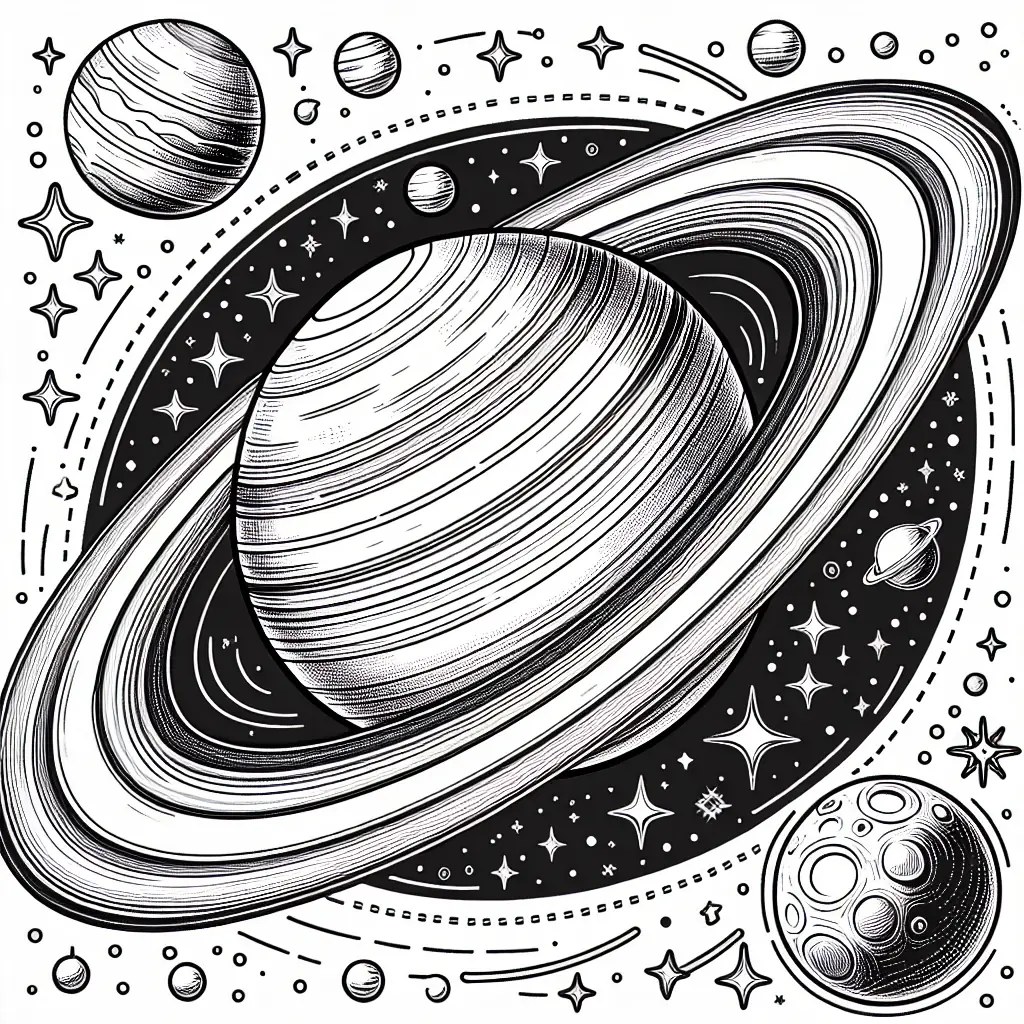
A close-up of children’s favourite planet: Saturn and its spectacular icy rings. A few stars dot the background. This page is easy from age 6 thanks to the large central area. Take the chance to explain that those rings are actually made of billions of blocks of ice and rock orbiting the planet.
🌌 3. The dance of the ringed planets
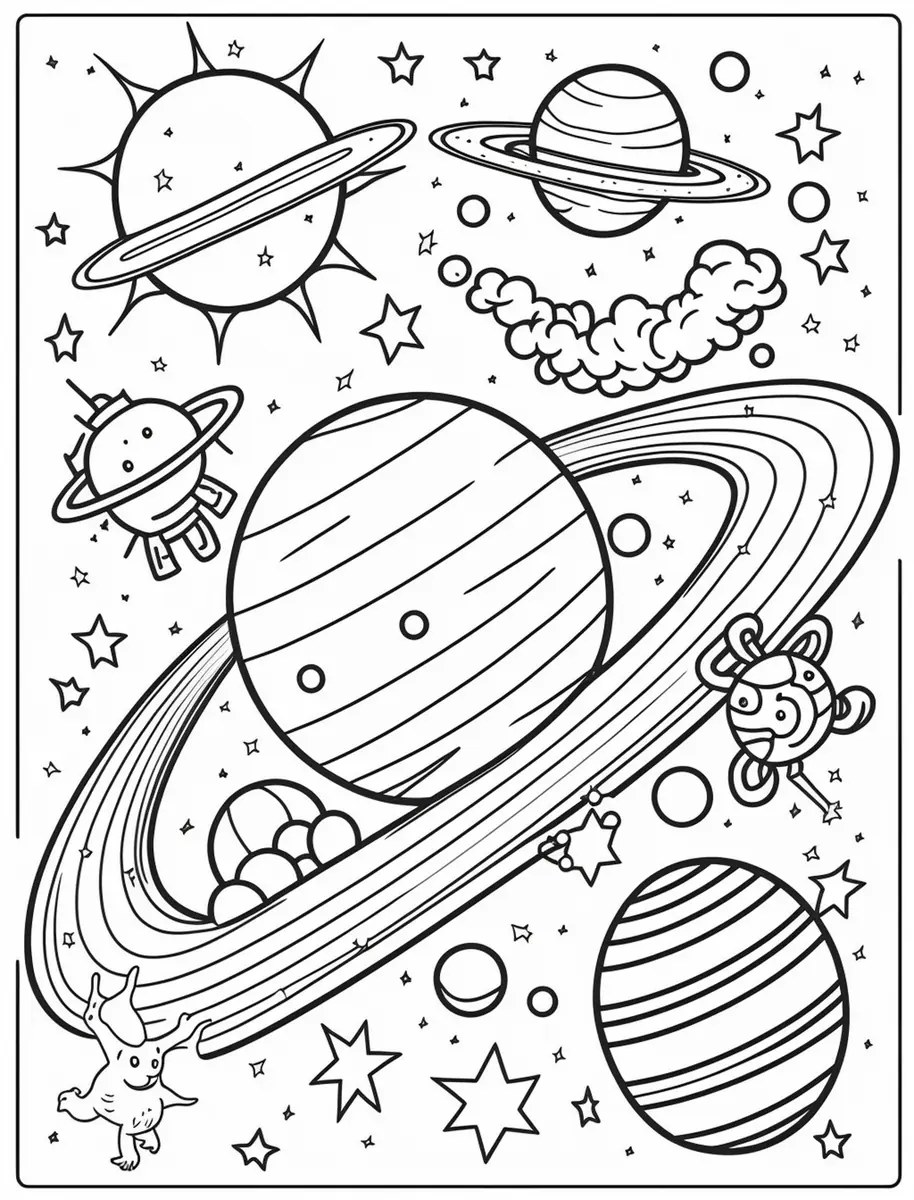
Several ringed planets dance around one big central Saturn, watched over by a beaming Sun and some funny little moons. It is the busiest page in the selection, ideal for children aged 8 to 12 who love filling every corner. The many bands and rings are perfect for practising colour gradients.
🪐 4. Saturn and the space base
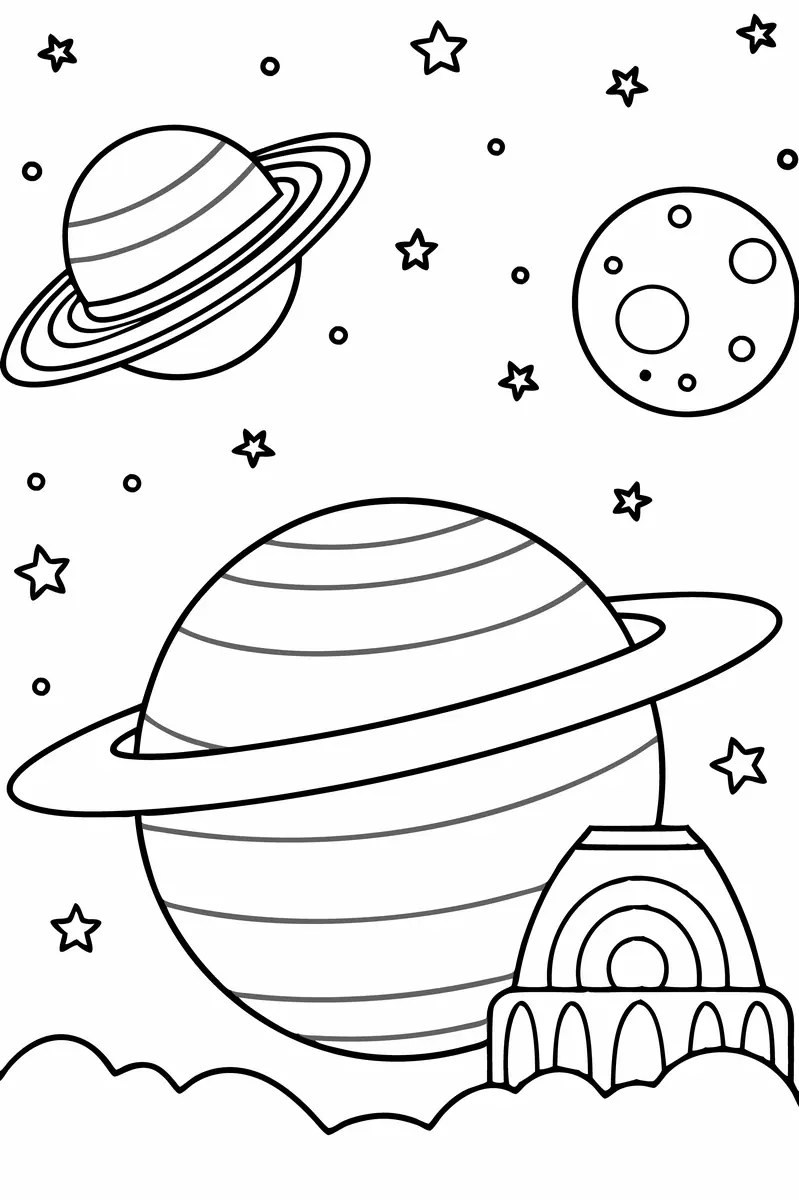
A majestic Saturn takes the centre of the page, joined by a second ringed planet, a crater-covered moon and a small dome-shaped space base resting on the clouds. This page is easy from age 6 thanks to its large surfaces. Use it to tell your child that Saturn has the most beautiful rings in the solar system.
🚀 5. The rocket’s big lift-off

A rocket full of detail soars up into the sky in a great burst, leaving the rocky surface of a faraway planet. All around, giant planets, a comet and a shower of stars complete the scene. It is the most spectacular page, recommended from age 7. Ideal for working on the contrast between the bright metal of the rocket and the deep black of space.
🌙 6. The rocket and the smiling Moon
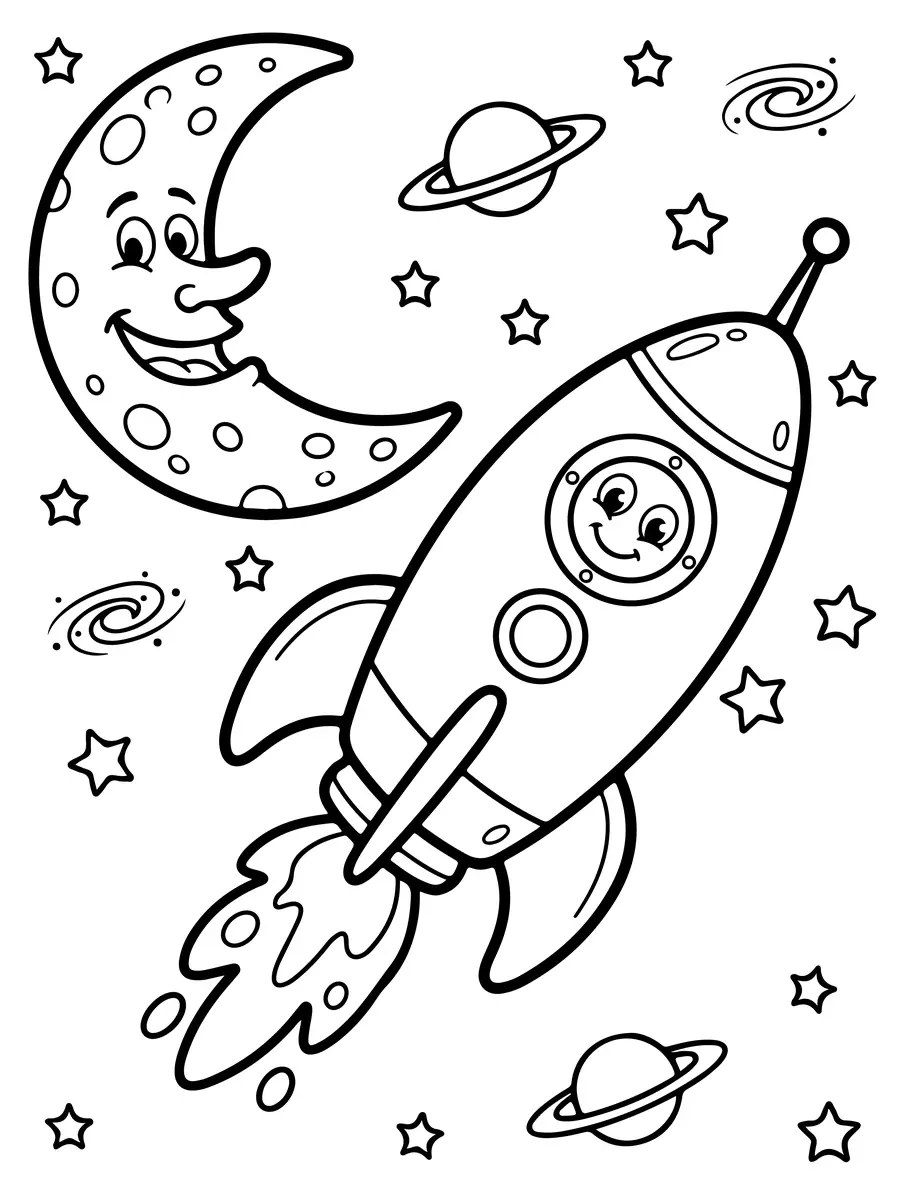
A pretty cartoon rocket zooms across the sky beneath the smile of a round crescent Moon. Saturn, galaxies and stars round off this gentle picture. It is the sweetest page in the selection, perfect from age 4 thanks to its big simple shapes and funny little faces. A real treat for the youngest.
🧑🚀 7. The little astronaut floating weightless

A little astronaut, all smiles, floats happily between Saturn, a cratered moon and a mini-rocket. The areas are large and clearly outlined, which makes this an ideal page for children aged 4 to 8. Ask your child to imagine how the astronaut feels floating weightless, way up there in space.
🛸 8. The astronaut, the rocket and the flying saucer
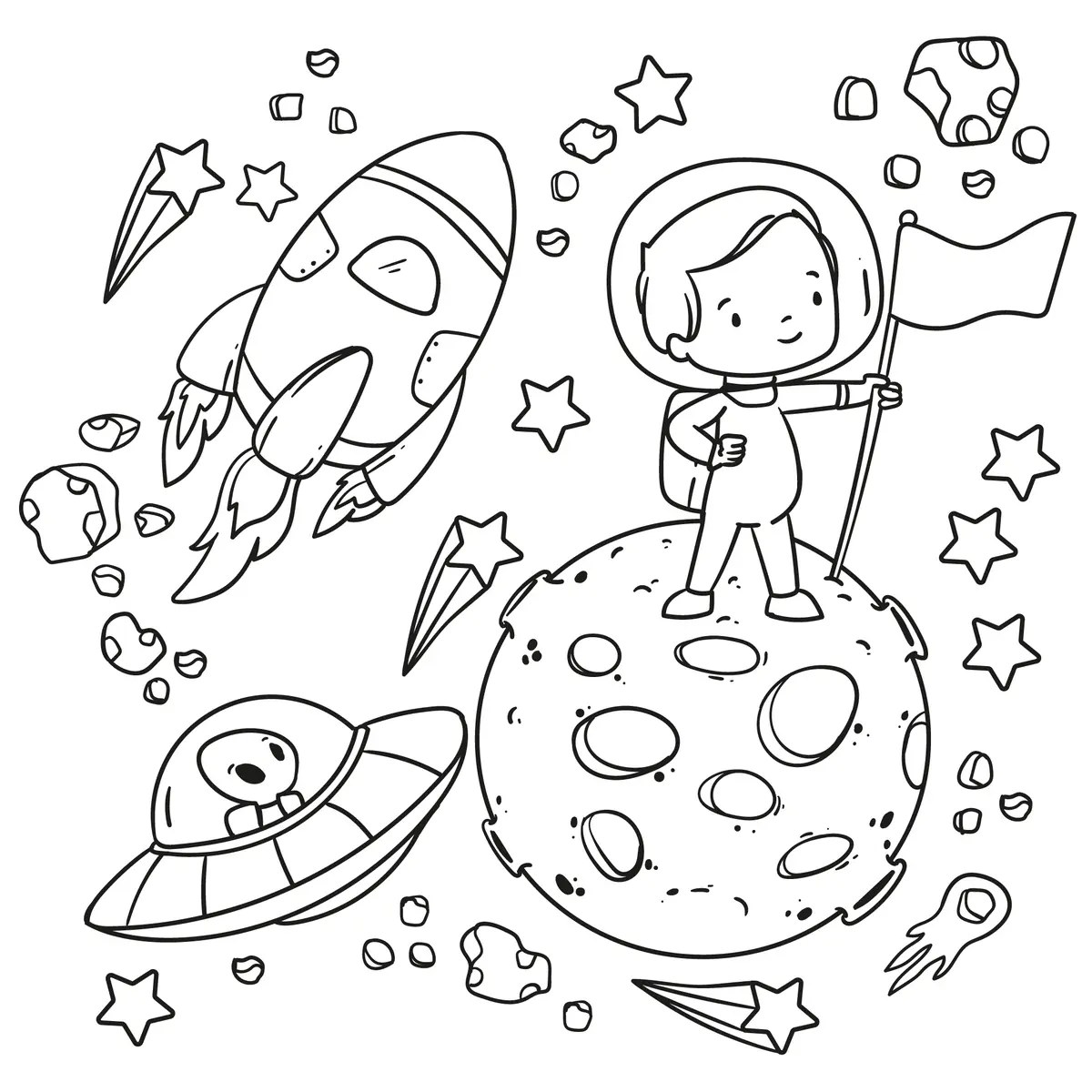
A rich, cheerful scene: a child astronaut plants a flag on a cratered moon, while a rocket zooms across the sky and a little alien watches from its flying saucer. Comets and asteroids rain down all around. A very narrative page, perfect for children aged 5 to 10 who love inventing stories as they colour.
🚩 9. The astronaut and the flag in space

An astronaut proudly waves a flag, linked by a cable to the rocket, above a big moon full of craters. A comet streaks across one corner and Saturn keeps watch in the distance. The fine, even lines suit children aged 6 to 10 who are already good with small details. Tell them about the real spacewalks that astronauts go on.
🌍 10. The astronaut on the Moon facing the Earth
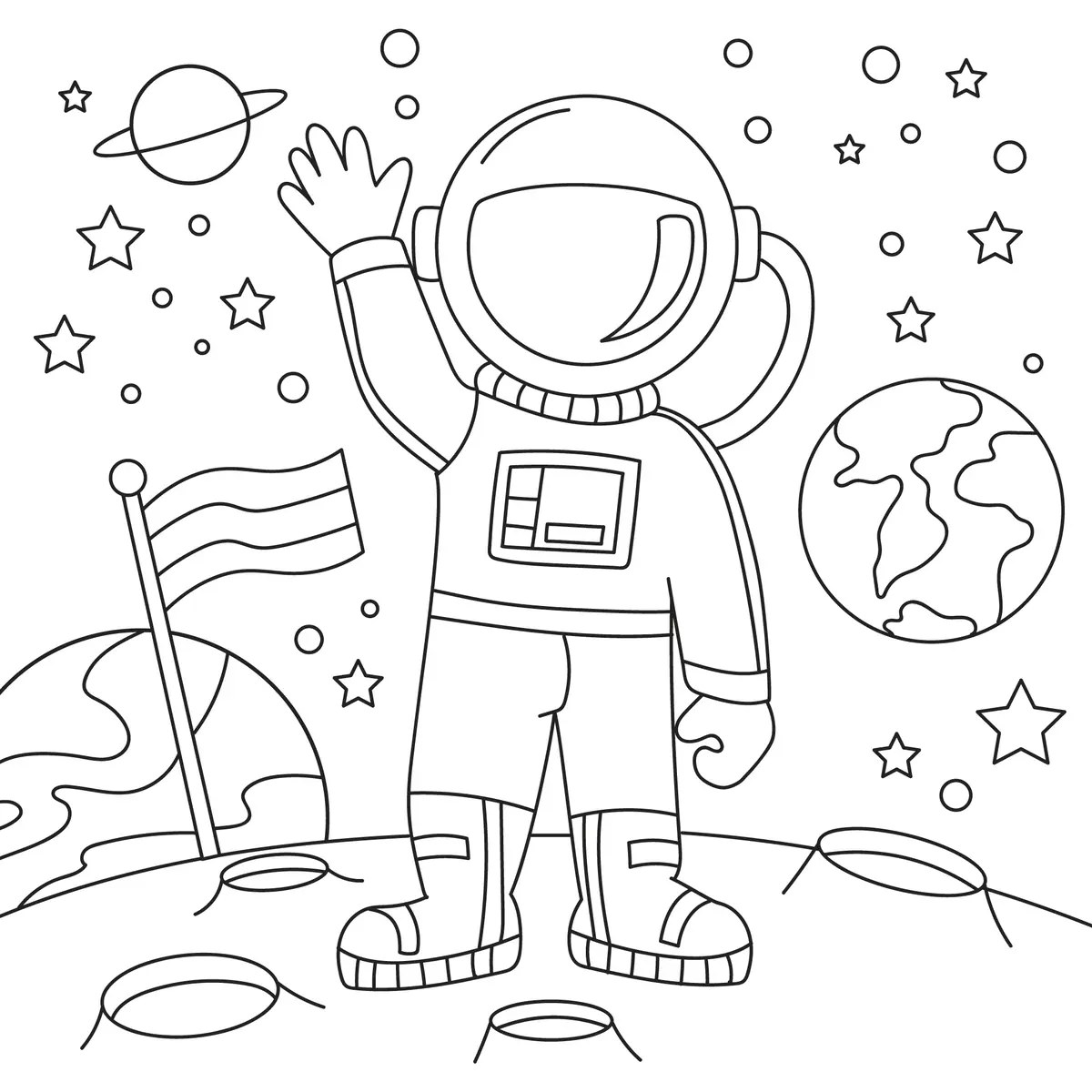
Standing on the Moon, an astronaut waves, with the flag planted next to them, while the blue Earth shines in the starry sky. Saturn and lots of stars complete the scene. A clear, easy-to-read page, recommended for ages 5 to 9. The perfect moment to talk about the first time humans walked on the Moon.
💡 Did you know? 5 facts about space
Before or during colouring, share these little scientific gems with your child. It is a great way to grow their vocabulary and general knowledge while having fun. 🌠
- The Sun is not a planet, it is a star. In fact, it is the closest star to us. All the other stars you see at night are distant suns, sometimes far bigger than ours.
- Mars is red because of rusty iron. Its surface is covered in iron oxide, the very same substance that rusts old nails. That is what earns it its nickname, the red planet.
- Jupiter is the biggest planet in the solar system. It is so huge that it could hold more than 1,300 Earths inside it. Its famous red spot is actually a storm more than 350 years old.
- Saturn’s rings are made of ice. They are not solid discs but billions of pieces of ice and rock in orbit, some as small as a grain of sand and others as big as a house.
- Pluto has not been a planet since 2006. Astronomers reclassified it as a “dwarf planet” because it is too small and its orbit crosses that of other icy objects in the solar system.
🌌 More activities on the space theme
Once the colouring pages are finished, keep the space adventure going with these simple ideas the whole family can enjoy. 🚀
- A model solar system in modelling clay. One ball of clay per planet, roughly matching the sizes. Brilliant for anchoring ideas of proportion in children.
- Watching the Moon with binoculars. On nights of a full moon or first quarter, the craters show up with surprising sharpness. No telescope needed to get started.
- A trip to the planetarium. Most big cities have one, with special sessions for children. An unforgettable and affordable experience.
- A space book for their age. Children’s non-fiction is full of spectacular pictures and clear explanations. Ask your bookseller or librarian for advice.
- A night watching shooting stars. The Perseids in August and the Geminids in December are the most visible meteor showers of the year.
🎨 Colour tips for realistic planets
For those who want a result true to the real colours of the planets, here is the palette to follow for each one. Of course, your child can absolutely invent their own colours: imagination comes first! ✨
- The Sun: bright yellow in the centre, fading to a blazing orange at the edges.
- Mercury: light grey with a few touches of beige, like a dusty pebble.
- Venus: pale yellow leaning towards ochre, because of its acid clouds.
- Earth: blue for the oceans, green for the continents, white for the clouds and the poles.
- Mars: orangey red, sometimes mixed with touches of rusty brown.
- Jupiter: beige, orange and brown in horizontal bands, with a red spot on the side.
- Saturn: pale yellow for the planet, very light grey for the rings.
- Uranus: pale blue-green, almost turquoise, very even.
- Neptune: deep blue, darker and more intense than Earth.
❓ Frequently asked questions
👶 From what age can a child colour space?
From age 4 or 5 for simple drawings like the smiling rocket and the little astronaut, which have large, clearly outlined areas. The more detailed pages, such as the complete solar system or the dance of the ringed planets, suit children aged 8 and up better.
🔢 How many planets are there in the solar system?
There are 8 official planets: Mercury, Venus, Earth, Mars, Jupiter, Saturn, Uranus and Neptune. Pluto, long considered the 9th, was reclassified as a dwarf planet in 2006 by the International Astronomical Union.
☀️ Is the Sun a planet?
No, the Sun is a star. It is a huge ball of burning gas that makes its own light, unlike the planets, which only reflect the Sun’s light. It is even the closest star to Earth.
🔴 Why is Mars called the red planet?
Because its surface is covered in a thin layer of iron oxide, in other words rust. Seen from Earth, Mars looks like an orangey-red dot in the night sky, which earned it its nickname back in ancient times.
📄 What paper should I print the colouring pages on?
Standard 80 gsm A4 paper works perfectly for felt-tips and colouring pencils. If your child uses watercolour or very ink-heavy felt-tips, go for 120 gsm paper to stop the back of the sheet from getting stained.
🔬 Where can I find more science-themed colouring pages?
Browse our coloring pages section and our science and nature category, which gather hundreds of activities sorted by theme. There is always something new to discover for curious young minds.
📚 Going further
Did your children love this journey across the stars? Keep their curiosity alive with more space activities and colouring pages, sorted by age and theme. Everything is designed for children from nursery to the end of primary school, and each drawing downloads and prints in just a few seconds. 🌟
