
Explaining stars to children can feel as tricky as catching the Moon when you run out of simple words. This guide to stars explained for kids: birth, life and death ✨ lifts the veil on these glowing balls of gas and turns your stargazing evenings into precious shared moments. You’ll discover how gravity lights up these cosmic night-lights, and why every one of us is, scientifically speaking, recycled stardust.
- What exactly is a star?
- How are these lights born in the sky?
- Why does the Sun shine all the time?
- The end of life of small stars
- The great show of giant stars
- Why are we made of stardust?
- Having fun with astronomy at home
⭐ What exactly is a star?
After admiring the night sky, we often wonder what those bright dots really are; let’s begin by simply defining these celestial objects.
🔥 A big ball of gas that heats up
A star is a giant, scorching-hot ball of gas. It’s a true natural energy factory. It transforms its own matter to shine brightly in the dark.
It produces its own natural light thanks to reactions deep inside. This energy spreads intense heat across space. That’s why these dots twinkle so strongly above our heads.
It’s a bit like a giant campfire. It lights up everything around it.
🌍 The difference between a star and a planet
A star makes its own light, while a planet only reflects it. Think of a switched-on lamp. A planet simply acts like a mirror.
Planets are often solid or gassy, but stay cold on the surface. They orbit calmly around stars. Stars remain the true leaders of the system.
- Star: a source of light, intense heat, fixed in place
- Planet: a reflection of light, mild temperature, on the move
☀️ The Sun, our brightest neighbour
The Sun is an ordinary star, but it sits very close to Earth. That’s why it looks so big to us. The others are simply extremely far away.
Its role is vital for our everyday lives. Without it, our planet would be a dark, lifeless block of ice. It also lets plants grow.

The Sun is the engine of life on Earth, giving us every day the warmth we need to exist.
✨ How are these lights born in the sky?
Now that we know what a star is, let’s travel to the mysterious place where they take their very first steps.
🌌 Nebulae, those giant nurseries
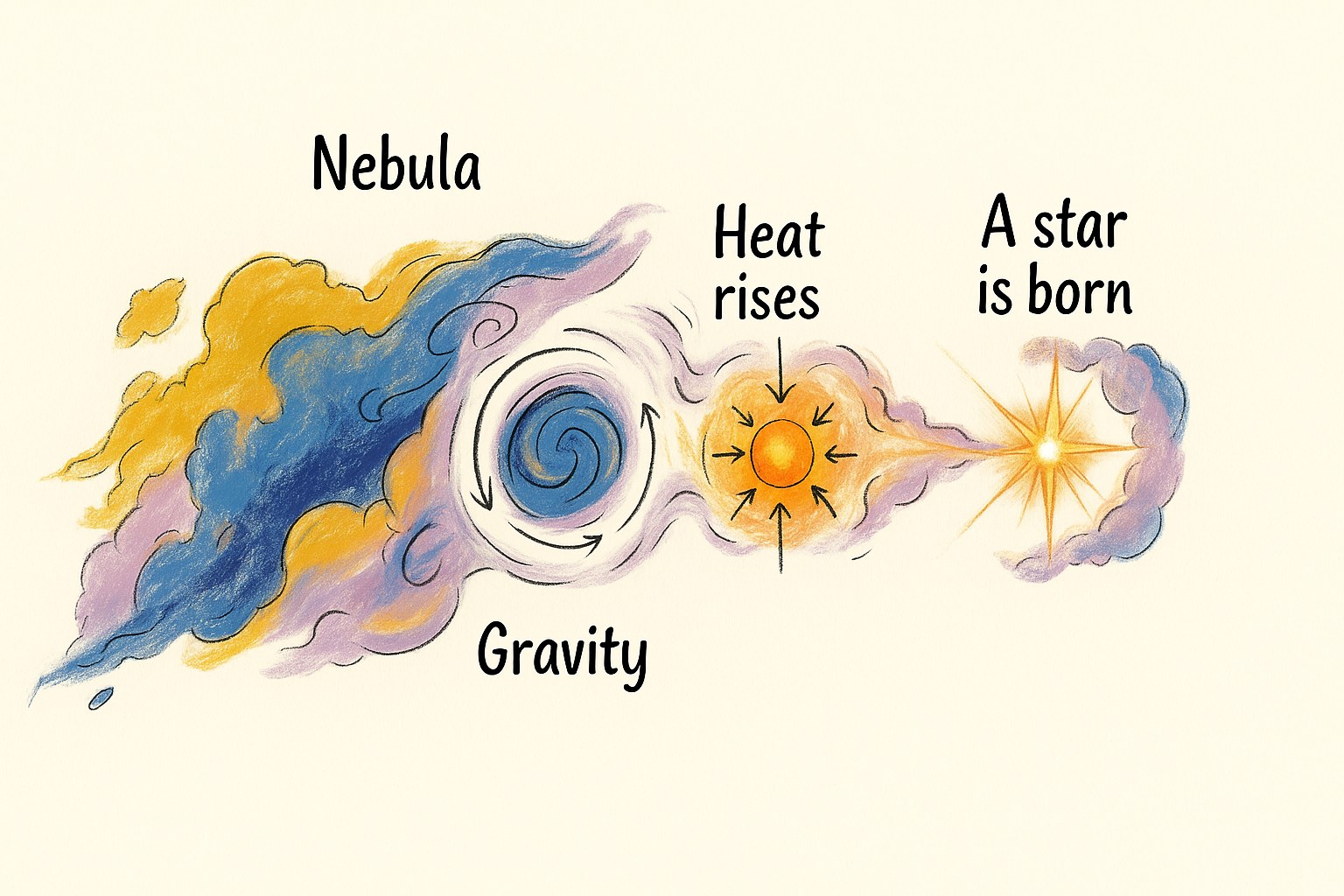
Nebulae look like enormous, colourful clouds. They are filled with gas and dust. This is the secret cradle of future stars.
These clouds float peacefully in the emptiness of space. They stretch across light-years. This is where everything truly begins.
They look like smoke or cotton wool. These clouds are the basic ingredients of the Universe.
🧲 When gravity steps in
Gravity pulls everything towards the centre of the cloud. The matter then gathers into a dense ball. The bigger it grows, the more gas it sucks in. It’s a real snowball effect.
The pressure rises at the heart of the ball. The particles smash into one another violently. The temperature then climbs dizzyingly high.
The place becomes incredibly tight. The heat is unbearable.
⚡ The moment the spark bursts out
At millions of degrees, the magic finally happens. The star switches on suddenly. It goes through the protostar stage before becoming a grown-up.
A first light appears all at once. This powerful flash pushes the surrounding clouds away. The star is born and shines proudly.
This process lasts millions of years. Yet for the Universe, it’s a very short moment.
☀️ Why does the Sun shine all the time?
Once switched on, a star has to find a way not to go out, and its secret lies in its inner engine.
⚛️ Nuclear fusion explained simply
Picture a giant, super-hot kitchen. The hydrogen atoms are the basic ingredients. They crash into each other with great force to form helium.
This crash releases an incredible amount of energy. This is what we call nuclear fusion. It’s far more powerful than a stick of dynamite exploding. It’s the star’s real fuel.
This reaction happens billions of times every second. It never stops.
⚙️ An engine running at full throttle
This energy then turns into photons. These are the tiny grains of light. They take a long time to escape the Sun.
Once at the surface, they finally fly off into space. They reach our eyes in about eight minutes. This is what lights us up every day.
| Engine step | What happens | Visible result |
|---|---|---|
| Fusion | Hydrogen becomes helium | Intense heat |
| Energy’s journey | Photons travel through the star | Inner flow |
| Emission | Light escapes | Sunlight |
⚖️ An invisible balance of forces
There’s a tug-of-war between gravity squeezing inwards and heat pushing outwards. It’s a permanent draw. This keeps the star stable.
This balance gives the star its round shape. If one side wins, the star changes size. For now, our Sun is truly perfect.
It’s like a blown-up balloon you squeeze. The air pressure pushes back against your fingers.
🕯️ The end of life of small stars
Nothing lasts forever, not even stars; let’s see how the calmest ones, like the Sun, get ready for retirement.
🔴 Becoming a red giant
The hydrogen eventually runs short in the core. The star then starts to swell enormously. It becomes an impressive red giant.
These stars can grow so gigantic that they swallow up Mercury and Venus during their expansion. This is the fate awaiting stars similar to our Sun. The core then becomes scorching hot.
Its colour changes. Its surface cools down. It turns a deep red.
⚪ The white dwarf and its gown of gas
The star finally throws off its outer layers. This forms a magnificent planetary nebula. At the centre, only the burning-hot core remains.
This leftover is incredibly compact. A small amount of white-dwarf matter weighs 100 tonnes. It’s a truly dizzying density.
It is now about the size of Earth. It’s a white dwarf.
⚫ Eternal rest as a black dwarf
The white dwarf no longer produces energy. It uses its leftover heat to shine. It cools down very slowly.
After billions of years, it goes out completely. It becomes an invisible black dwarf. This is the final stage of rest.
The Universe is still too young to have any. It’s a theoretical stage of the far-off future.
💥 The great show of giant stars
While small stars leave quietly, the most massive ones prefer to exit the stage with a memorable bang.
💥 The incredible explosion of a supernova
Giant stars suddenly collapse in on themselves. This triggers a colossal explosion called a supernova. It’s the fireworks display of space.
A supernova can shine brighter than its whole galaxy for a week. The energy released is simply phenomenal. The outer layers are then blasted away violently.
The light is visible from millions of light-years away. It’s a rare event.
💫 Neutron stars and pulsars
Sometimes, a tiny, ultra-tight core is left behind. This is a neutron star. It spins on itself at top speed.
If it sends out beeps of light, we call it a pulsar. It’s like a cosmic lighthouse. Its signals are very regular.
A teaspoon of this star would weigh as much as a mountain. Its density is beyond human imagination.
🕳️ The mystery of black holes
For the biggest stars, the core collapses endlessly. It creates a black hole. Gravity there is infinite.
Nothing can escape it, not even light. That’s why we can’t see them directly. They suck in everything.
A black hole is like a space vacuum cleaner whose pull is so strong that even time seems to stop.
🌠 Why are we made of stardust?
These spectacular explosions aren’t just endings; they’re also the beginning of our own story.
🏭 Factories that make ingredients
Deep in their cores, stars build complex elements. Carbon and oxygen are created there. They are the building blocks of life.
Without these stellar factories, the Universe would hold only simple gas. The iron in your blood comes from there. It’s a very ancient inheritance. These chemical ingredients are precious.
Every atom in your body has travelled through space. You are a little miracle.
♻️ The magical recycling of the universe
When a star dies in a supernova, it scatters heavy elements like iron and oxygen. These materials then go on to form new rocky planets.
This dust floats around and then gathers together again. It forms worlds like ours. It’s a never-ending recycling.
- Carbon: for our cells
- Oxygen: for breathing
- Iron: for our blood
- Calcium: for our bones
🔗 Our direct link with the cosmos
Saying that we are “children of the stars” isn’t just a pretty image. It’s a proven scientific reality. We carry the sky within us.
This connects us to the vastness of the Universe. Every child is a piece of galaxy. What a wonderful thought.
We are literally made of stellar matter, recycled for billions of years across the emptiness of space.
🔭 Having fun with astronomy at home
To end this journey, here are a few handy tools for watching these giants from your own garden.
📖 A little glossary to talk like a pro
A light-year measures the distance light travels in one year. It’s the unit used for these giants. Space is truly immense.
The Milky Way is our big family of stars. It holds billions of stars. The Sun is just a tiny dot.
A galaxy is like a great city of stars. They all live together in the dark.
📊 Sorting stars with the H-R diagram
We can sort stars by colour. Blue means they are very hot. Red means they are cooler.
Size matters a lot too. You can draw a simple chart with your children. It’s the simplified H-R diagram. Dwarfs go at the bottom, giants at the top.
It’s like sorting marbles by how shiny they are. We understand their life cycle better.
🔭 Tips for successful stargazing
Move away from the city street-lamps to see better. Total darkness is your best friend. Wait for your eyes to adjust.
Use a free app on your phone. It shows the names of the constellations live. It’s magical and very educational.
Here are a few simple habits to enjoy the evening:
- Bring a blanket
- Use a red torch
- Look towards the North
- Be patient
Understanding stars, explained for kids, reveals that we are all linked to the cosmos. From the colourful nebula to galactic recycling, this journey shows that every atom of our body is a stellar treasure. Head outside soon to watch the night sky and admire this eternal, brilliant show together.
❓ FAQ
🪐 What is the difference between a star and a planet?
This is a great question to ask children! To keep it simple, a star is a huge energy factory that makes its own light and its own heat. It’s like a giant lamp in space. A planet, on the other hand, is like a mirror: it doesn’t shine by itself, it just reflects the light of its star.
We can also look at their size and behaviour. Stars are much bigger and stay fixed relative to one another, while planets are smaller and travel calmly along their orbit around their favourite star.
✨ How do stars form in space?
It all begins in magnificent clouds of gas and dust called nebulae. Under the pull of gravity, these clouds gather and form balls that grow denser and hotter. It’s a bit like a snowball getting bigger as it rolls!
When the heart of this ball reaches an incredible temperature of 10 million degrees, a magical spark happens: nuclear fusion begins. The star finally “switches on” and starts shining proudly in the emptiness of space for billions of years.
💀 Why do stars eventually die?
Even stars aren’t eternal, because they eventually use up their fuel, which is hydrogen. Depending on their size, they prepare their departure in different ways. The small ones, like our Sun, swell into red giants before gently going out, leaving a white dwarf behind.
For giant stars, it’s far more spectacular! They collapse in on themselves and explode in a huge firework called a supernova. This moment is very important because it releases into space all the ingredients needed to make new planets and, why not, life.
🌟 Why do we say we are made of stardust?
It’s not just a pretty image, it’s a scientific reality! Stars are true cosmic kitchens that make elements like carbon, oxygen and iron. When they explode or go out, they scatter these ingredients everywhere across the Universe.
So the iron flowing in our blood and the calcium in our bones were made long ago in the heart of a star. When we look in the mirror, we are in a way gazing at a piece of the sky’s history that has been recycled for billions of years.
