
Have you ever had to reassure a child who panicked at the sight of their blue veins, explaining that their blood is in fact bright red? That simple question about the colour of blood hides a fascinating mechanism, where haemoglobin and its iron atoms play the part of painters whenever they meet oxygen. Here you’ll discover how this vital pigment changes shade depending on its journey, and why your skin loves to play surprising optical tricks.
- The secret behind this red colour
- The tiny soldiers of oxygen
- Why does the red change shade?
- The truth about how veins look
- Blood isn’t red for everyone
- When the colour varies a little
🔴 The secret behind this red colour
We spot this shade at the slightest little scrape without really knowing what lies behind it. Far from being a simple surface colour, the reality is far more technical.
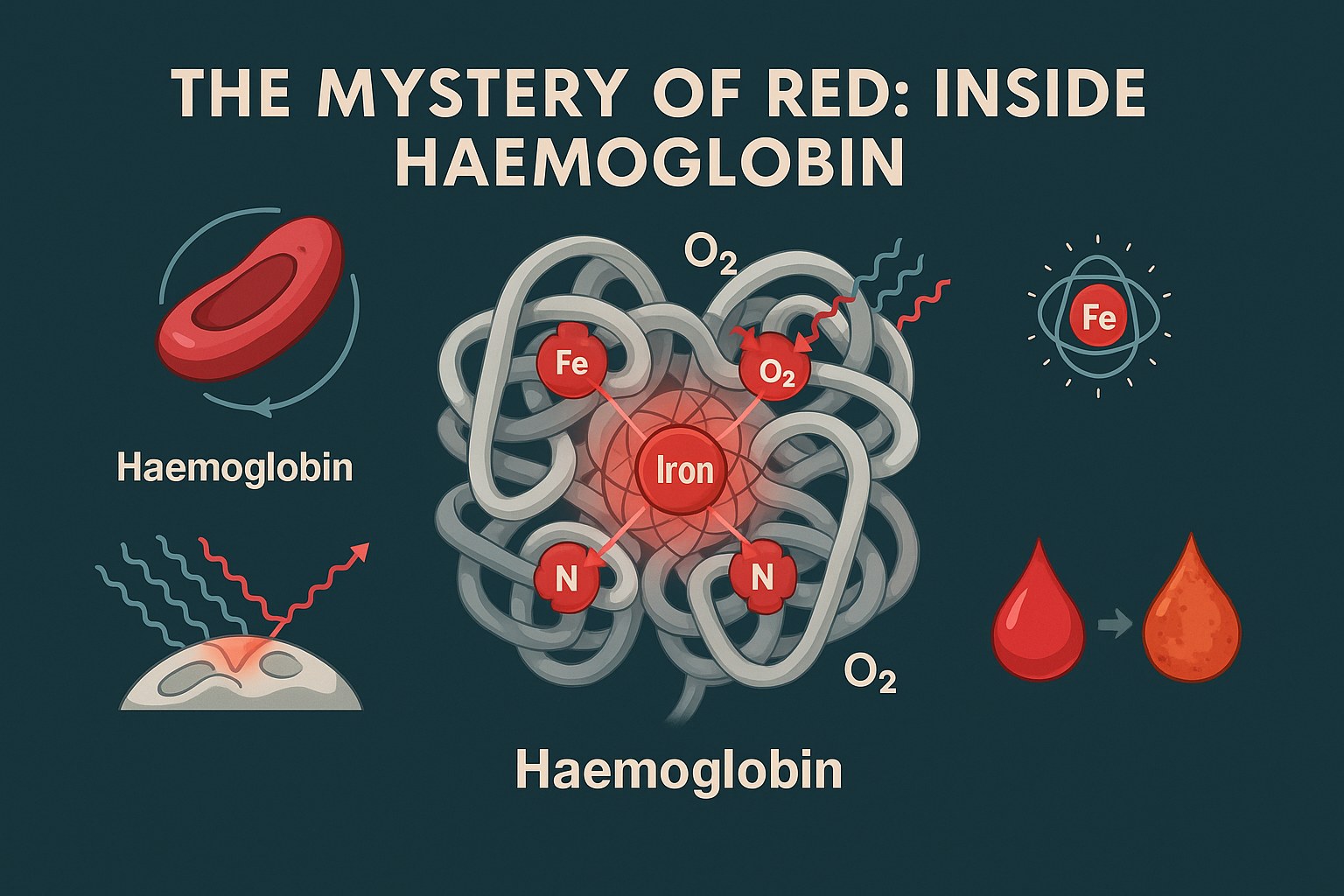
🔬 Haemoglobin, the star pigment
Haemoglobin is the star of our circulation. This complex protein carries oxygen around the body while giving blood its instantly recognisable red glow.
Without it, our vital fluid would lose its familiar look. It acts like a natural pigment tucked away inside every red blood cell travelling through our veins.
There’s an excellent definition of haemoglobin out there that helps explain its job as a carrier. It’s one of the pillars of our everyday health.
Blood gets its red colour from haemoglobin, an iron-rich protein found inside the red blood cells.
⚙️ Iron sitting at the heart of the molecule
Let’s zoom in on the iron atom nestled inside the heme group. This metal is the central pivot. It interacts with light in a very precise way to bounce back the colour red.
Each molecule has four binding sites. The iron waits there for oxygen. This setup is essential for the biochemical journey of our vital gases through the body.
Light is absorbed everywhere except in the red part of the spectrum. That’s the technical secret of our biology.
🛠️ The rust comparison to understand oxidation
Picturing rust helps you see oxidation. When iron meets oxygen, it changes colour. It’s a chemical process close to what you see on a piece of metal.
Blood “rusts” in a way that can be reversed. This reaction creates that vivid shade. So why is blood red? It comes down to exactly this meeting between iron and oxygen.
It’s a slow burn, managed by biology. The visual result is instant and striking to the eye during a test.
No need to worry, it’s perfectly healthy. Your blood is simply nicely oxygenated.
🩸 The tiny soldiers of oxygen
To understand why blood is red, picture a huge city delivery network where every courier knows their route by heart. Once they leave the heart, these couriers set off on their rounds.
🔴 Red blood cells working for the body
Red blood cells are little sacs packed with haemoglobin. They’re also called erythrocytes. Their mission is unique and vital for every single cell in our body, without exception.
Their shape looks like a disc squeezed in on both sides. This structure boosts the contact area. It’s nature’s perfect bit of fine-tuning to get the most out of gas exchange as the blood passes through the lungs.
They’re very flexible and bend easily. That lets them squeeze through the tiniest capillaries in our organs without ever getting stuck.
💨 Oxygen’s journey to the organs
Inside the tiny air sacs of the lungs, the capture of oxygen begins. The iron grips the O2 molecules tightly. The blood then turns bright red. From there it spreads this vital energy through the whole network of arteries, out to our muscles.
Once it reaches its destination, the oxygen is released. The iron then shifts its electronic state. The colour gently slides towards a darker tone, marking the end of the delivery. It’s fascinating to watch this change of shade.
It’s a never-ending cycle. The heart keeps the beat of this constant dance.
For this transport to work, the body’s iron levels have to be spot on, as research into the way the body handles iron makes clear.
💧 The part plasma plays in the blood mix
Blood isn’t made only of cells. Plasma is the liquid part. It’s a yellowish fluid made mostly of water, salts and a range of essential proteins.
This liquid carries all sorts of things along:
- Water as the main solvent
- Nutrients such as glucose
- Hormones to carry messages
- Metabolic waste on its way out
The colour red wins the eye over. Yet plasma stays the indispensable base.
🎨 Why does the red change shade?
You might think our blood always wears the same coat, but it’s a real chameleon. Its shade shifts depending on its journey and its cargo of oxygen.
❤️ The brightness of well-oxygenated arterial blood
Arterial blood is a scarlet red. It has just left the lungs, brimming with oxygen. This full saturation gives it a brightness and clarity you can easily spot when someone gets hurt.
Light bounces off the oxyhaemoglobin perfectly. It’s the sign of efficient energy transport. This is the “fresh” blood, ready to feed the brain and the muscles.
It’s the shade you see drawn in bright red on diagrams. It stands for active life.
🩸 The depth of gas-laden venous blood
Venous blood is different. It has already handed its oxygen over to the tissues. Now it carries carbon dioxide instead. Its colour turns to a dark red, almost burgundy, because the structure of the haemoglobin has shifted slightly.
This blood travels back up to the heart to be refreshed. It is never blue, despite a stubborn old belief. It’s simply a deeper red, with less visible light bouncing off it.
It’s the blood you see in medical samples. Sometimes it looks almost black.
📊 Saturation as the colour dial
| Type of blood | Oxygen level | Shade you see | Direction of flow |
|---|---|---|---|
| Arterial blood | Rich in O2 | Bright red | Towards the organs |
| Venous blood | Low in O2 | Dark red | Towards the heart |
The amount of oxygen works like an intensity dial. The more there is, the more the red blazes. The less there is, the more the colour fades into darker tones.
But careful — the pigment is still there. The red never disappears completely.
💙 The truth about how veins look
Let’s tackle the most famous optical illusion of the human body head-on to understand why our eyes deceive us.
🚫 The end of the blue-blood myth
Let’s be clear: your blood is never blue. Not in your veins, not anywhere. It’s a misreading of medical diagrams, which use blue purely as a contrast convention.
Even when it’s low on oxygen, the fluid stays red. If you cut a vein, the blood that comes out will be burgundy. The idea of royal blue blood is a pure urban legend.
Human blood is always red, whatever its oxygen level or wherever it sits in the body.
👁️ The optical filter of our layers of skin
So why do we see blue through the skin? It comes down to the physics of light. Skin, fat and the surrounding tissues act like a filter. They soak up the red light waves, even though those are very powerful.
The blue waves, which are shorter, don’t go as deep. They bounce off the vessels and travel back to your eye. It’s this bounce of light that creates that bluish or purplish tint.
It’s a surface illusion. Your skin is playing visual tricks on you.
🌈 How we see different wavelengths
Red light travels far into the tissues but gets lost along the way. The haemoglobin itself absorbs it. The contrast with the pale surrounding tissues makes the blue stand out even more.
The deeper the vein, the stronger the effect. A vessel near the surface will look more red or pink. It’s the depth that decides the colour we see, in the brain’s eyes. Here, physics wins out over the real biology of the fluid inside.
In short, your veins are distorting mirrors. The red is hiding just beneath.
🦑 Blood isn’t red for everyone
Stepping away from human anatomy lets us discover that nature has invented other colour palettes for carrying oxygen.
🦀 Haemocyanin in sea creatures
Some animals really do have blue blood. That’s the case for horseshoe crabs, octopuses and many crustaceans. They don’t use haemoglobin but a molecule called haemocyanin to breathe.
This protein is dissolved straight into their circulating fluid. It does exactly the same job as our red pigment. It’s a different evolutionary solution, but just as effective for their world.
The result is spectacular. Their blood looks like an alien, sky-blue liquid.
⚙️ The difference between copper and iron
It all comes down to the metal used. For us, it’s iron. For these sea creatures, it’s copper that binds the oxygen. Oxidised copper doesn’t turn red, but a characteristic blue or green instead.
It’s the same chemistry as the bronze statues that turn green. Nature reuses the properties of whichever metals are around. Copper works better in cold waters that are low on oxygen.
Iron versus copper. It’s the colour showdown of the animal kingdom.
🟢 The greens and purples of living things
The palette doesn’t stop there. Some sea worms have green blood thanks to chlorocruorin. Others show off purple shades with haemerythrin. It’s a real underwater festival of colour.
- Haemocyanin for the blue of octopuses
- Chlorocruorin for green
- Haemerythrin for the purple of brachiopods
- Haemoglobin for the red of mammals
Life is inventive. It colours its fluids to suit its needs.
🌈 When the colour varies a little
Having explored the big biological mechanisms, let’s come back to everyday life to see how outside or time-related factors change the look of our blood.
🌸 The particular shades of the menstrual cycle
During a period, blood changes its look. It can go from bright red to a very dark brown. This isn’t a sign of illness, just a reflection of its age.
A slow flow gives the blood time to oxidise in contact with the air. It then turns darker, heading towards brown. It’s a completely normal chemical reaction.
Mixing with the lining of the womb also changes its overall texture and shine.
🟤 How blood changes once it dries
Take a look at a scab on a cut. The bright red fades to leave brown behind. Haemoglobin breaks down once it’s outside the body. It loses its oxygen and its structure falls apart in the surrounding air.
The iron then oxidises for good. The blood dries and thickens, which darkens the shade. It’s the natural process of healing and protection.
The red fades away. Biology gives way to tissue repair.
⚠️ The warning signs of unusual discharge
Sometimes the colour should alert us. Greyish or yellowish discharge isn’t normal. It can point to an infection or an imbalance worth keeping a close eye on.
- persistent bright red outside the cycle
- greyish, which can suggest an infection
- yellowish, linked to pus
- very dark, smelly black
If in doubt, see a doctor. Your body uses these colour codes to talk to you.
In short, haemoglobin and its iron grab hold of oxygen to colour our blood bright or dark red. This vital reaction keeps your daily energy flowing. Keep an eye on these natural shades to look after your health with peace of mind. Your body is a marvel of precision, glowing with life!
❓ FAQ
🔴 Why is our blood red?
It comes down to some beautifully made natural chemistry. The one responsible is haemoglobin, a protein housed in our red blood cells. It contains iron which, on meeting the oxygen we breathe, takes on that famous red shade. It’s a bit like an oxidation reaction, but a perfectly healthy one that’s essential to life.
💙 Is it true that blood turns blue inside the body?
Not at all — that’s a little legend that just won’t die! Human blood stays red in every situation. When it’s well oxygenated in our arteries, it’s bright red, and once it has handed out its oxygen, it turns dark red or burgundy. But it never turns blue, promise.
💙 If blood is red, why do my veins look bluish?
It’s a magic trick performed by our skin. It acts like an optical filter with light. The tissues soak up the red waves but let the blue waves through and reflect them back. So it’s this blue light that travels back to your eyes, creating that optical illusion even though the fluid underneath is very much red.
🦑 Are there creatures with a different colour of blood?
Nature is full of surprises! In some animals, like octopuses and crustaceans, the blood really is blue. That’s because they use copper instead of iron to carry oxygen. You’ll even find green or purple blood in certain sea worms. It’s a real festival of colour in the animal world.
🌸 Why is period blood sometimes brown or very dark?
There’s nothing to worry about — it’s simply a matter of time and oxidation. When the flow is slower, the blood stays in contact with the air for longer or takes more time to leave the body. The haemoglobin then changes its structure and the colour darkens to brown. It’s a completely normal process.
🧪 What is blood made of besides red blood cells?
Blood is a very rich mixture. Alongside the red blood cells, you’ll find white blood cells that defend us against germs. All of these float in the plasma, a yellowish liquid made of water, salts, nutrients and hormones. Even though red wins the eye over, plasma is the essential base of this vital flow.
