
Seeing a baby tooth that won’t fall out while the new one is already poking through can be worrying, but don’t panic: this switch from baby teeth to permanent teeth is a perfectly natural stage of growing up. This article explains how the body manages the changeover and why those double rows are usually nothing to fear for your child’s future smile. You’ll find gentle tips to help a wobbly tooth on its way, plus the real warning signs that mean it’s time to book a quick check-up.
- Why baby teeth make way for permanent teeth
- The surprising shark teeth phenomenon
- The hidden process of root resorption
- Gentle tips to help a tooth fall out
- The signs that call for a dentist visit
- Keeping the new permanent teeth aligned
🦷 Why baby teeth make way for permanent teeth
Losing those first teeth is a big milestone. It marks the move towards a tougher, longer-lasting adult set of teeth.
🦷 What those first twenty baby teeth are for
Baby teeth are there first and foremost to chew solid food. They’re also essential for learning to speak. Without them, getting words out clearly is a real challenge for a child.
These little teeth set the stage for what comes next. They act as handy guides for the permanent teeth to follow. That’s the key job of baby teeth in lining everything up properly.
In all, twenty teeth fill the mouth during early childhood. They stay put for a few years before the big change begins.
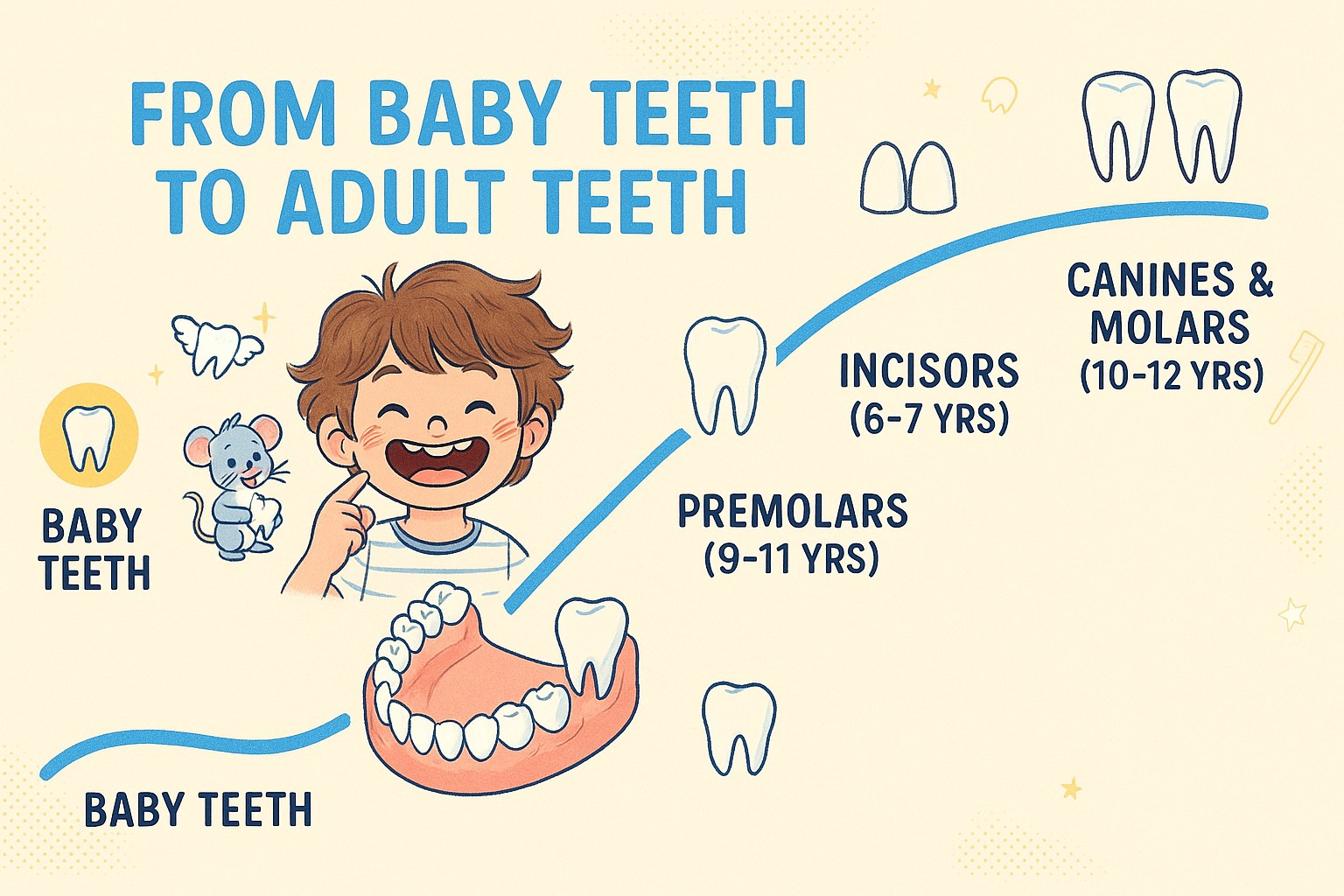
🦷 The first permanent molars arriving at age six
Around the age of six, some newcomers show up. People often call them the six-year molars. They grow in without ever replacing a baby tooth.
They come through very quietly at the back of the mouth. They settle just behind the last baby molars. You don’t always notice them straight away.
These molars need watching closely for cavities. They’re permanent, but they’re still fragile when they first appear. So careful brushing is a must.
📅 A rough timetable for losing teeth
The incisors usually go first, around the age of six. That’s the cue for the tooth fairy. Gap-toothed smiles start popping up everywhere.
The whole process often wraps up around age twelve. The canines and second molars are the last to fall. By then, the adult mouth is almost complete.
Still, every child follows their own natural pace. Genes have a big say in this timetable. There’s no need to worry if friends are a bit ahead.
- Incisors: 6-7 years
- Premolars: 9-11 years
- Canines and second molars: 10-12 years
🦈 The surprising shark teeth phenomenon
Sometimes, though, this handover doesn’t go in a tidy line, leaving behind a rather curious double row of teeth.
😬 A double row of teeth that often looks alarming
The permanent tooth sometimes appears right behind the baby tooth that’s still in place. You then end up with two rows stacked on top of each other. The sight often startles parents who weren’t expecting it.
Calling it a “shark” tooth helps take the worry out of the situation for little ones. The playful name makes children giggle and calms their fears. It’s a fun way to picture a perfectly natural process.
This stacking mostly affects the lower incisors in the jaw. That’s the spot where this little traffic jam crops up most often. The top teeth can be caught up in it too.
📍 Where the permanent tooth usually sits
The bud of the permanent tooth starts out tucked further back. It waits patiently for its turn inside the jawbone. It’s getting ready to take its predecessor’s place.
Normally, the upward push dissolves the root of the baby tooth. Sometimes the new tooth misses its target and comes through just behind. It then breaks through the gum without ever shifting the first tooth.
The tooth almost always ends up edging towards its ideal spot. It naturally seeks out its final place along the arch. Patience is usually your best ally here.
😌 Why this situation is nearly always harmless
Most cases sort themselves out with no outside help at all. The human body is wonderfully well made for these transitions. There’s generally no rush to step in straight away.
The pressure of the tongue plays a key driving role. It keeps nudging the tooth forward, again and again. This natural movement helps the permanent tooth line up properly, ever so gently.
Give it one to three months and you’ll see a change. The wait stays short for most children. The baby tooth will end up falling out on its own.
In 80% of cases, the shark tooth sorts itself out thanks to the natural push of the tongue.
🔬 The hidden process of root resorption
To understand why a baby tooth finally falls out, you need to look at a biological mechanism hidden under the gum.
🌱 How the baby tooth root slowly disappears
Root resorption is the natural nibbling away of the root. It’s a kind of dissolving the body plans in advance. It lets the tooth come loose gently.
The permanent tooth causes this wear with its upward push. Its pressure switches on certain special cells. These literally “eat” the root to clear the space.
With no root left, the tooth has nothing to hold it. It ends up wobbling like a shaky little fence post. That’s the sign that the changeover is coming.
🔄 The signs of perfectly normal tooth wobble
Feeling a tooth wobble is a classic stage. It’s often funny, or a bit annoying at mealtimes. Children love poking it with their tongue.
A little bleeding can show up now and then. That’s completely normal as the tissue comes away. There’s no reason to worry about it.
You do need to tell normal wobble apart from an accidental knock. A tooth that moves after a fall needs a check-up. The dentist will then make sure all is well.
⏳ The patience a natural fall calls for
It’s better to let nature take its course quietly. Forcing a tooth out can damage the gum for nothing. Patience really is the best ally for a lovely smile.
Protecting the surrounding tissue is genuinely the wiser choice. A natural fall is cleaner and less painful. The body knows exactly when the tooth should go.
The permanent tooth simply needs room to come through. Once the space is clear, it settles in fast. Explaining baby teeth and permanent teeth to children helps take the drama out of this big change.
💡 Gentle tips to help a tooth fall out
If the tooth is taking its time, a few simple, painless tricks can give it a nudge.
🥕 Go for crunchy foods to get the tooth moving
Offer a nice firm apple or a crust of bread. These foods take a bit of chewing effort. The crunch then helps gently loosen the little baby tooth.
Chewing creates natural mechanical movements. That encourages the tooth to come loose bit by bit. It’s a really effective way to help the process along without being rough on your child’s gum.
Encourage your child to bite right on the area in question. Working the wobbly tooth speeds up its fall. It helps clear the space for the future permanent tooth.
👅 Use the tongue as a gentle little lever
Get your child to play calmly with the wobbly tooth. The tongue is a perfect tool that’s always to hand. It’s a very gentle way to test how firm the tooth still is.
Repeated tongue movements work a treat. It’s a light but steady kind of pressure. Little by little, the tooth finally gives way under this natural, everyday nudging.
Turn this habit into a little game of patience. It’s a fun way to handle the wait for the tooth fairy. Your child then becomes part of their own big change, with no stress at all.
🚫 Why you should never pull a tooth out yourself
You have to watch out for the risk of mouth infections. Hands that aren’t always clean carry dangerous germs. Touching an open wound with your fingers can cause real trouble.
Pulling a tooth risks snapping the root. If it hasn’t fully dissolved yet, it stays stuck. A forgotten fragment in the gum often leads to painful swelling.
Forcing it brings needless pain and upset. It’s far better to wait and let nature finish the job in peace. Patience makes for a smooth, calm move to grown-up teeth.
🩺 The signs that call for a dentist visit
Even so, in a few specific cases, a professional does need to step in to get things moving again.
⏰ Three months with no real change
Setting a time marker helps you know when to see someone. Three months with no movement is a reliable sign. That’s the moment to book an appointment.
Watch how high the permanent tooth has come. If it rises above its neighbour while the little tooth holds on, it’s time to act. The dentist will check things over.
Take note if the baby tooth simply isn’t moving. If it stays put despite the push behind it, get it checked. A professional nudge will come in handy.
🩹 Dealing with pain or a gum that’s too red
Spotting troublesome inflammation is a priority. A red gum can get in the way of proper brushing. That risks germs building up around the area.
Look out for unusual swelling in the tissue. Pus or sharp pain is a clear warning sign. These need checking quickly.
Act if your child shows real discomfort. Their day-to-day comfort comes first, every time. An exam reassures everyone and sorts out the problem.
🪑 Having the tooth removed as a last resort
A local anaesthetic is a very simple thing. It’s a quick, painless step for the child. The area is numbed so the visit stays calm.
Reassure little ones about how fast it is. The dentist takes the baby tooth out in seconds. Often, the child doesn’t notice a thing.
It’s worth flagging the orthodontic point of this step. It helps avoid crowding later on. The permanent tooth can then find its ideal spot.
| Situation | Recommended action | Urgency |
|---|---|---|
| Tooth barely wobbling | Wait | Low |
| Very red gum | See a dentist | Moderate |
| Permanent tooth out for 4 months | See a dentist | Advisable |
| Pain when brushing | See a dentist | Top priority |
📐 Keeping the new permanent teeth aligned
Once the baby tooth has fallen out, it’s still vital to keep an eye on overall growth to ensure a lovely, balanced smile.
💨 How breathing and the tongue make a difference
Breathing through the mouth changes how the face grows. It can warp a child’s palate. Breathing through the nose is the healthier option.
How the tongue rests matters a lot too. The tongue should sit against the palate. It shouldn’t push against the front teeth.
Thumb-sucking puts strong pressure on from the outside. These bad habits shift the teeth around. Tooth alignment often ends up changed for good as a result.
🪥 Keeping up careful hygiene during the changeover
Brushing the overlapping areas is essential. Plaque builds up there very easily. You need to scrub gently but precisely.
Using a fluoride toothpaste helps protect the enamel. There are clear guidelines on sugar and fluoride to keep the risks down. An amount suited to your child’s age is plenty.
New teeth are still fragile and porous. Regular brushing keeps early cavities at bay.
🦷 Why preventive orthodontic check-ups matter
A visit at around seven is strongly advised. It’s the perfect age for a first all-round check. The dentist takes a look at the first permanent molars.
The dentist checks whether the arch is wide enough. They keep an eye on the room left for future teeth. That helps avoid crowding.
Spotting things early often makes later treatment simpler. Planning ahead for any braces means acting gently. It’s a precious time-saver.
The move from baby teeth to permanent teeth is a key stage, guided by nature. Just keep an eye on the new molars coming through and encourage your child to bite into apples to help wobbly teeth along. Careful brushing will ensure a bright smile for years to come.
❓ FAQ
👶 At what age do children start losing their baby teeth?
Generally, the great tooth fairy adventure begins around age 6. That’s usually when the incisors decide to make way for the grown-up teeth.
The full changeover of the teeth then carries on gradually until about the age of 12. But don’t worry — every child moves at their own pace!
🤔 Why does a permanent tooth sometimes grow in behind a baby tooth?
This is what’s nicely known as the “shark teeth” phenomenon. It happens when the permanent tooth starts coming through while the baby tooth is still firmly in place.
In 80% of cases, this situation is completely harmless. The natural push of the tongue is usually enough to put everything back in order within one to three months.
⚙️ How does the mechanism that makes teeth fall out work?
It’s a hidden process called root resorption. As the permanent tooth pushes up, it gently nibbles away the root of the baby tooth sitting just above it.
Once the root has gone, the baby tooth has nothing solid holding it. It then starts to wobble like a shaky little fence post before falling out naturally.
💪 Can you help a wobbly tooth fall out faster?
You can give it a little nudge by encouraging your child to wiggle the tooth with their tongue or bite into nice firm foods, like an apple or a crust of bread.
That said, you should never force or pull a tooth out yourself. That could snap the root if it hasn’t fully dissolved yet, or set off a small infection.
⚠️ When should you worry and see a dentist?
A quick check-up is advised if the baby tooth isn’t moving at all after three months alongside the permanent tooth, or if the new tooth looks very out of place.
You should also book an appointment if you notice a very red gum, any swelling, or if your child is in real pain that gets in the way of eating or brushing.
🦷 Which permanent teeth appear first?
Around age 6, on top of losing the incisors, the first permanent molars make their appearance. They’re often called the “six-year molars”.
One important quirk: they grow in right at the back of the jaw without replacing any baby tooth. So you need to brush them well from the moment they appear, because they’re there for life!
