
Explaining why rain falls or where the puddles go can sometimes feel like a real brain-teaser for parents. This guide to the water cycle, with a printable worksheet for kids, turns these natural events into a fun, visual adventure made for little ones. 💧 You’ll find colourful diagrams and simple experiments, like rain in a bag, to watch the magical journey of a water drop between earth and sky — completely stress-free.
- Understanding the water cycle for little ones
- The key stages of the great natural journey
- The path of water above and below the ground
- The three forms of water in nature
- Fun activities and printables to download
- From the tap to the river: the home cycle
💧 Understanding the water cycle for little ones
Have you ever seen your children’s faces as they watch a puddle dry up in the sun? That’s the start of a big investigation into a fascinating planet-wide machine.
💧 The endless journey of a water drop
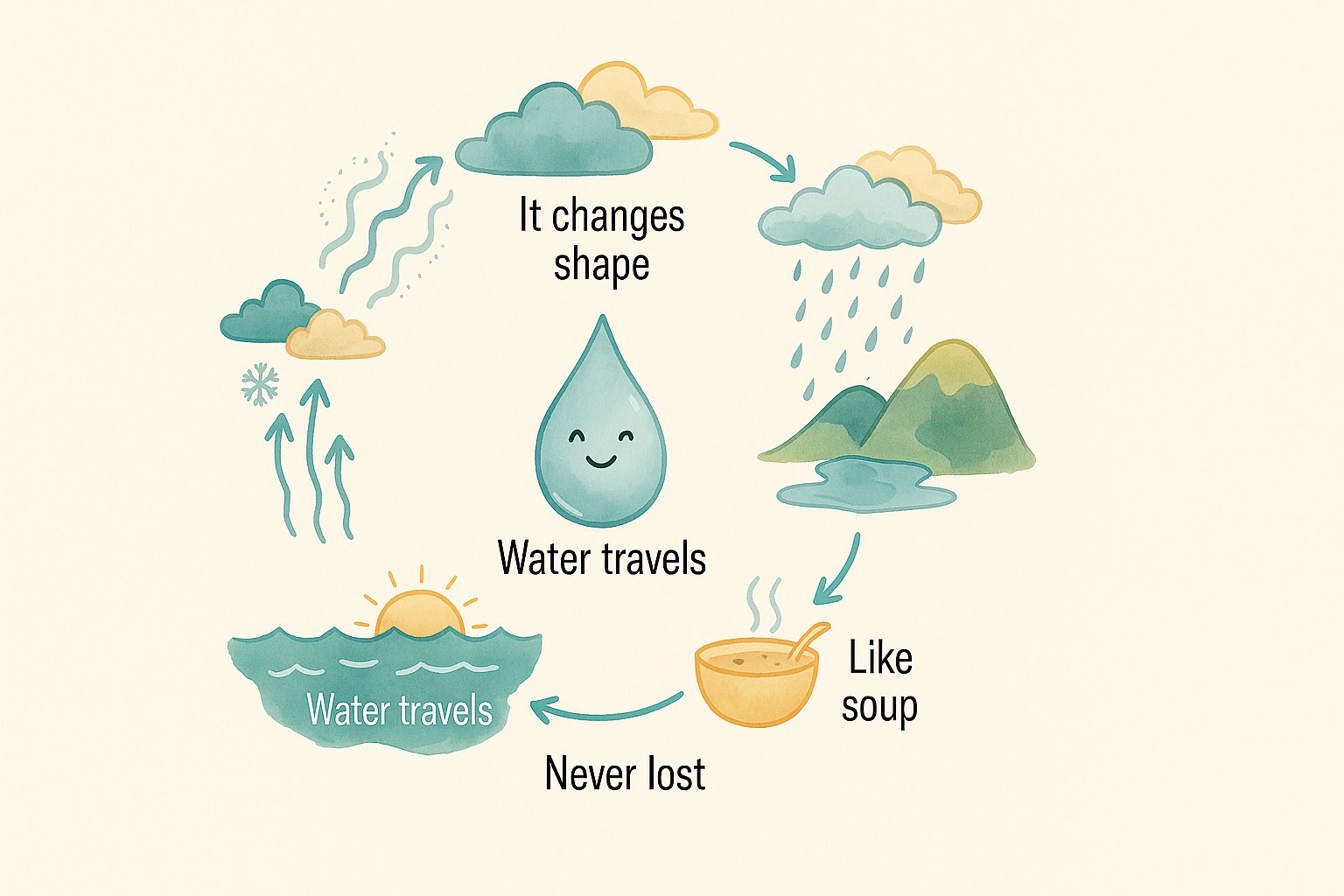
Water on Earth never stays still. It travels everywhere, from the oceans up to the sky, then comes back down to the ground. It’s a never-ending motion that keeps our blue planet alive.
Imagine a little drop changing costume. Sometimes it’s invisible, sometimes it’s hard as ice. But it never really disappears from the world — it transforms.
Water transforms again and again. This journey is called the natural water cycle.
🌍 Why water always stays on Earth
The amount of water on our planet has stayed the same for billions of years. The dinosaurs were already drinking the very same water we drink today. It’s a fixed and precious supply.
The Earth works like a huge closed bubble. Nothing is lost — everything is recycled thanks to the sun and the wind that keep the molecules moving.
The water cycle is the continuous movement of water through the solid, liquid and gas states.
👶 Explaining the idea to nursery-age children
For the youngest, you need concrete words. Talk about “the home of water” or “the water that flies away”. Avoid words that are too technical at the start.
Use the picture of the steam above the soup or the mist on the window. This helps the child picture the invisible water. Keep the approach very hands-on and playful.
Show simple, colourful pictures. Drawing is the best tool for understanding this great invisible journey. A printable water-cycle worksheet for kids is ideal for this.
🔄 The key stages of the great natural journey
Now that we understand water travels, let’s look at exactly how it lifts off the ground to reach the clouds.
☀️ Evaporation under the power of the sun
The sun is the engine behind it all. By heating the surface of the oceans, it turns liquid water into gas. This is called evaporation, a completely invisible process.
The water vapour then rises very high into the sky. It comes from the seas, but also from lakes and rivers. It’s the start of the great lift-off into the atmosphere.
Without the sun’s heat, water would stay still. The cycle could never begin.

☁️ Condensation and the birth of clouds
As it rises, the vapour meets colder air. It then turns into tiny water droplets. It’s exactly like the mist on a bathroom mirror.
These billions of droplets gather together to form the clouds. The gas becomes liquid again because of the cold at high altitude.
🌧️ Precipitation in all its forms
When the clouds get too heavy, the water falls. Gravity pulls the drops down towards the ground. This is called precipitation, the return to earth.
Depending on the temperature, water changes its look. If it’s very cold, it falls as snow or hail. Otherwise, it’s ordinary rain watering nature.
Here are the forms water takes as it falls:
- Rain (liquid)
- Snow (solid)
- Hail (ice)
To help your little explorers remember everything, do look for a resource like a printable water-cycle worksheet for kids to illustrate these stages.
🌊 The path of water above and below the ground
Once water has touched the ground, it doesn’t stay there; it begins a new race towards the depths or the rivers.
🏞️ Run-off towards rivers and oceans
Water slides over the ground, especially if the soil is hard. It forms little trickles of water that join together. This is the natural process of run-off.
The streams become rivers, then great waterways. This whole network ends up flowing into the ocean. That’s how water finds its way back to where it started.
We call the whole area that drains water towards a river a drainage basin.
⛲ Infiltration and the role of groundwater
Some of the water sinks into the ground. It travels through the rocks and the sand to go deep down. This is called infiltration, a slow underground journey.
Beneath our feet lie huge natural reservoirs. These are the underground water tables. They store fresh water in a way that is invisible but essential for what we drink.
🌿 Evapotranspiration, or the breathing of plants
Plants take part in the water cycle too. Their roots draw water from the soil to feed themselves. Then they release vapour through their green leaves.
It’s as if the forests were “sweating” moisture into the air. This process is called evapotranspiration. It helps create new clouds.
Forests are therefore rain factories. They keep the air around us fresh and damp.
❄️ The three forms of water in nature
To really understand this journey, you need to watch how water changes its look depending on where it is.
🌊 The liquid water of seas and rain
Liquid water is the one we know best. We find it in the salty oceans and the freshwater rivers. It’s the form that life depends on, for animals and humans alike.
It flows and takes the shape of its container. Most of the water on Earth is liquid and salty. Fresh water is much rarer.
| Form of water | Natural place | Physical state |
|---|---|---|
| Liquid | Oceans / Rain | Liquid |
| Solid | Glaciers / Snow | Solid |
| Gas | Atmosphere / Vapour | Gas |
🧊 The solid water of glaciers and snow
When it gets very cold, water becomes solid. It turns into ice or snowflakes. It’s a very important store of fresh water for the planet.
Glaciers and ice caps store this frozen water. If the temperature rises, this ice melts and becomes liquid again. This shows that water simply changes state.
Ice is hard and cold to the touch. It melts as soon as the heat comes back.
💨 Invisible water vapour in the air
Water vapour is a gas we can’t see. Yet it’s all around us in the air. It’s what creates the moisture in our surroundings.
We can only see it when it starts to cool down. It then forms fog or mist. It’s the step just before the making of clouds.
Even though it’s invisible, this vapour is essential. It carries water everywhere thanks to the wind. A printable water-cycle worksheet for kids helps you picture this journey through the air.
🎲 Fun activities and printables to download
There’s nothing like hands-on practice to fix this knowledge in children’s minds with real experiments.
🧪 Making a water cycle in a bag
Take a clear plastic bag and draw a sun and some clouds. Pour a little water into the bottom. Tape the bag onto a sunny window.
With the heat, the water will evaporate and form drops on the sides. You’ll then see the “rain” fall back to the bottom of the bag. It’s a perfect demonstration and very quick to watch.
- Zip-lock bag
- Permanent marker
- Water
- Tape
🖍️ Using the illustrated diagram and the colouring version
Download our free diagram to print at home. It has clear drawings for each important stage. It’s an excellent visual aid for the bedroom or the classroom.
We also offer a colouring version. The child can colour in each arrow and each cloud. This helps them remember the direction of water’s journey while having fun with their crayons.
A good drawing is worth a thousand words. Print a water-cycle worksheet for kids in A4 format.
🎯 Testing their knowledge with the quiz and games
After reading, ask the child a few simple questions. “Where does the water go when it evaporates?” or “How are clouds born?”. It’s a good way to check understanding.
You can also use themed crosswords about water. Looking for words like “Rain” or “Sun” builds up scientific vocabulary. Games make learning far more effective and motivating.
Independence is the key. Let the child explore the materials at their own pace.
🚰 From the tap to the river: the home cycle
Beyond wild nature, water also follows a special path to arrive right inside our homes.
🚰 The journey of drinking water and wastewater treatment
Tap water often comes from rivers or underground reserves. It passes through a plant to be cleaned and made safe to drink. Then it travels through big pipes.
Once it’s been used, the dirty water goes off into the sewers. It reaches a treatment plant to be filtered again. Finally, it returns to nature, clean, to start its great cycle all over again.
This is called the small water cycle. It’s managed by humans.
💚 Learning the right habits to save water
Fresh water is a precious resource we must protect. We can teach children to turn off the tap while brushing their teeth. Every little drop saved really counts.
A full set of teaching materials about the water cycle is available for teachers.
Avoiding throwing rubbish into the water is just as important. Protecting water means protecting all life on Earth.
📚 A selection of books to dig deeper
There are some wonderful children’s picture books on this theme. Some use pull-tabs or flaps to show the water hidden under the ground. It’s very interactive for young readers.
Look for titles like “The Journey of the Water Drop”. These stories help to put poetic images onto scientific ideas. Reading is the perfect companion to hands-on activities.
Giving a book is a lovely way to keep the discovery going. It’s a useful, educational gift.
The journey of water holds no more secrets: from solar evaporation to precipitation, this never-ending motion keeps life going on Earth. Download your printable worksheet quickly to explore this natural cycle with your children. Give them, starting today, the keys to understand and protect our precious blue resource.
🎬 Watch the video
❓ FAQ
🌍 Can the amount of water on our planet shrink over time?
Not at all! It’s one of the most fascinating things about our Earth: the amount of water stays roughly stable and has done for billions of years. Our planet works like a huge closed bubble where nothing is lost.
The water we drink today is the same water the dinosaurs once used. It simply changes costume, moving from the liquid state to the solid or gas state, but it always stays with us on this great never-ending journey.
💧 What different forms can water take in nature?
Water is a real little magician that appears in three physical states. We find it in liquid form in the oceans, rivers and rain. That’s the form children handle most often day to day.
It becomes solid when it’s very cold, turning into snow, ice or imposing glaciers. Finally, it exists in gas form: the invisible water vapour that floats in the air all around us before forming the clouds.
☀️ How can you simply explain evaporation to the youngest?
For nursery-age children, you can compare this to the steam coming off a pot of pasta or the mist on the bathroom window. With the heat of the sun, water becomes very light and “flies off” towards the sky.
It’s a step that’s invisible to the naked eye in nature, but essential. It’s this process that lets the water of the seas and lakes rise up into the atmosphere to start making future clouds.
🔄 What exactly is the “small water cycle” people sometimes mention?
The “small cycle” is the home journey of water, the one managed by humans for our daily needs. Unlike the great natural cycle, this one is man-made and passes through treatment plants to make the water safe to drink.
After being used at home, the dirty water is sent to a treatment plant. There it’s carefully cleaned before being released back into nature, clean, so it can rejoin its great natural cycle without polluting the rivers.
🌱 How do plants take part in the journey of water?
Plants act as very efficient natural pumps. Their roots draw water from the soil, then their leaves release water vapour into the air: this is called evapotranspiration. It’s a bit like the forests sweating.
This process is very important because it helps create moisture and encourages new clouds to form above wooded areas. Trees are therefore real rain-makers for our environment.
🧪 Is there an easy experiment to see the water cycle at home?
Yes, the “water cycle in a bag” experiment is perfect and very visual! Just pour a little water (dyed blue, for a prettier look) into a clear zip-lock bag and tape it onto a sunny window.
With the heat, you’ll watch the water evaporate, condense into little drops on the sides of the bag, then “fall” like rain back to the bottom. It’s a magical demonstration that makes the idea feel concrete right away for curious little ones.
