
Does your child love a challenge and ask for stimulating games for their quiet times? 🧩 Our selection of hard mazes for 7-10 year-olds to print offers seven free challenges suited to this age range. From the classic model to the ultra-dense maze, each sheet pushes concentration a little further.
These mazes download and print from your home printer. They offer a real challenge for confident readers who want to push themselves. Your child develops their logic while having fun for long minutes.
- Why choose hard mazes for 7-10 year-olds
- Our 7 hard mazes to print
- The cognitive benefits of the maze
- Which strategies to solve a maze
- How to print and set up the activity
- Ideas to extend the logic challenge
🧩 Why choose hard mazes for 7-10 year-olds
Between 7 and 10, children look for activities that really challenge them. Puzzles that are too easy bore them quickly and lose their appeal. A hard maze brings that level of challenge they love.
🧠 A challenge suited to their cognitive development
At this age, the child’s brain is actively developing its logical abilities. They learn to plan, anticipate and test different hypotheses. The hard maze stimulates exactly these precise brain functions.
A maze that’s too simple doesn’t call enough on these new abilities. The child finishes in three seconds and moves on to something else. A hard maze really keeps their interest and motivation.
🧘 A calm, focused activity
Children in this age range often need to refocus. Between school, activities and screens, the pace is intense. The maze offers a real settled, attentive moment in daily life.
Solving a maze calls for continuous concentration over several minutes. The child learns to stay focused despite small frustrations. This power of attention becomes precious for all their school learning.
📈 A progression through the selection
Our selection is deliberately spread from the most accessible to the most demanding. Your child starts with the classic black maze, then moves on to the blue models of increasing difficulty. The last ultra-dense maze becomes the real boss to beat.
🖨️ Our 7 hard mazes to print
Here are the seven mazes of the selection, presented from the simplest to the trickiest. Each sheet comes in high definition, ready to print in A4. Print several so your child can start over without hesitation.
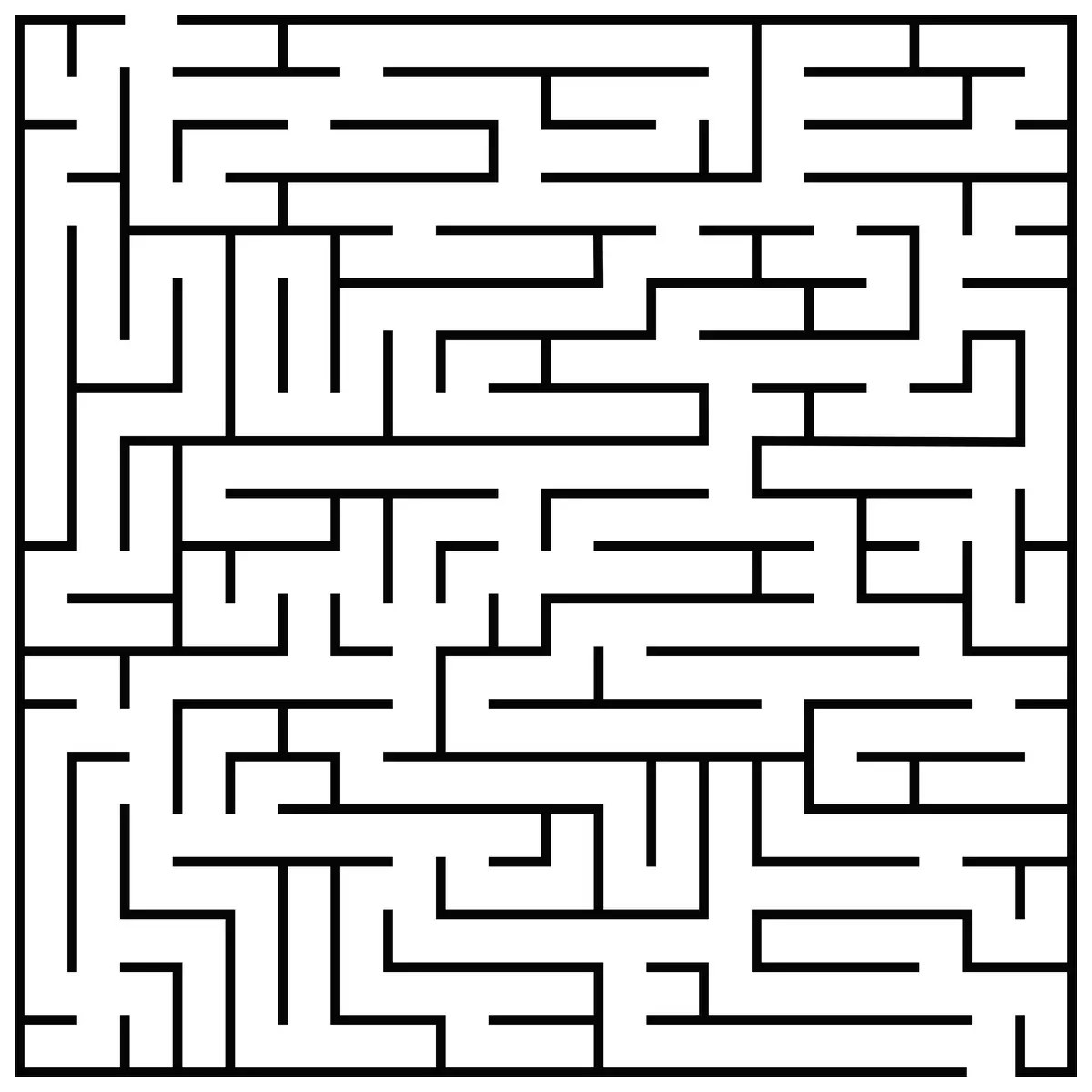
⬜ The classic black-and-white maze
This first model adopts the most traditional style of the square maze. The corridors form clearly readable rectangular blocks, ideal for starting the series with confidence. The thick black lines on a white background are perfect for a pencil or a fine felt-tip.
The difficulty level stays accessible to children from age seven. The dead ends are numerous without being traps, which rewards perseverance. It’s the perfect warm-up before the challenges to come.
🟦 The blue square maze
This second maze has the same square proportions but switches to a bright blue. The softer contrast tires the eyes less for a longer session. The paths are slightly tighter than in the previous one.
The challenge steps up a notch and already calls for real concentration. Your child has to anticipate several intersections before committing. It’s good training in mental planning.

🔵 The dense blue maze
The third maze pushes the density up a notch. The corridors become narrower and the forks more numerous. The strong bright blue keeps the visual clear despite the complexity.
This model suits children aged eight to ten who are already experienced. The finger-following method is still possible but calls for patience. Allow about ten minutes to solve it.

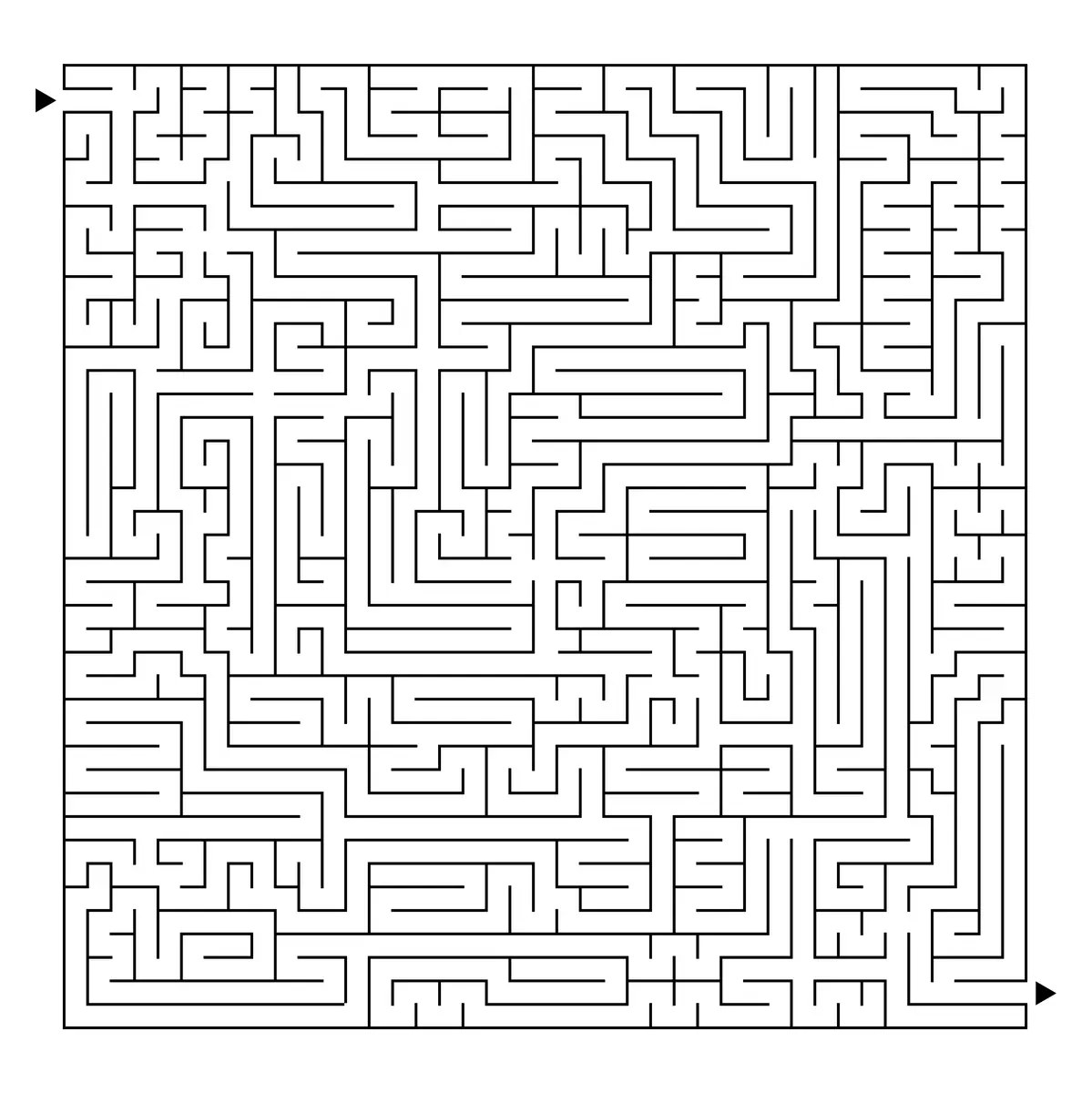
➡️ The big maze with arrows
This maze stands out with its little black triangles that clearly mark the entrance and the exit. No need to look for where to start, the arrow at the top left gives the starting point. The exit is at the bottom right, marked in the same way.
This clear signage really reassures children who are less confident. The dense format offers a real challenge without being disorienting at the start. The narrow corridors encourage careful observation of every junction.
➿ The maze with tight curves
Here is a maze that breaks with the usual right angles. The corridors wind in curved, rounded lines all over the drawing. This more organic geometry asks the eye to adapt.
Reading the path becomes a little more demanding than with a classic maze. Your child thus develops a new way of visualising routes. It’s a good change of pace after several grid-style mazes.

🌀 The winding maze
This maze pushes the organic logic even further. The corridors link together in flowing loops like drawn spaghetti. The graphic look surprises and grabs the attention at once.
Solving it calls for a careful, slow reading of the route. The child learns to follow a continuous path rather than count squares. This approach stimulates concentration in a different way.

🔥 The ultra-dense maze (maximum challenge)
The last in the series is without doubt the most demanding. The tiny corridors fill the image with an extremely fine grid. Allow twenty to thirty minutes of play to get to the end.
This model is aimed at children aged nine to ten who love real challenges. Arm yourself with a well-sharpened pencil so as not to stray into the neighbouring corridors. It’s the final boss of our selection.

🧠 The cognitive benefits of the maze
A hard maze for 7-10 year-olds to print brings much more than entertainment. This activity stimulates several important brain functions at once. Every session builds lasting gains for your child.
💭 Developing logical thinking
Solving a maze calls for mentally testing several hypotheses. The child learns to anticipate the consequences of each choice. This approach is fundamental for all school learning.
Logical thinking strengthens like a muscle with regular practice. The more mazes your child solves, the more efficient they become. This skill will serve them in maths and science later on.
🧭 Spatial awareness and visual tracking
The maze actively works on the child’s spatial abilities. Following a path calls for finding your way in a two-dimensional plan. This skill is essential for reading maps later.
Your child gradually develops their overall sense of direction. They learn to read complex routes more easily. This skill becomes precious for all their future travels.
🧘 Patience and tolerance of frustration
A hard maze isn’t always solved on the first try. Your child learns to handle small failures without giving up. This tolerance of frustration is an essential emotional skill.
🎯 Which strategies to solve a maze
Is your child struggling with some mazes? Here are three proven strategies to help them. These simple techniques give them lasting tools for all challenges.
✋ The right-hand method
This classic technique consists of always following the wall on the right. The child mentally follows this wall with their finger without ever leaving it. The method works very well on our classic mazes with a single exit path.
🔙 The technique of going back from the exit
Sometimes it’s easier to start from the exit than the entrance. Your child visually traces the path backwards to find the start. This reversal often offers the brain a new perspective.
📐 Spotting the main axes
On very dense mazes, it’s better to first spot the main corridors. The child identifies the axes that cross the most surface, then looks for the junctions. This zoom-out strategy works particularly well on the ultra-dense blue maze.
📋 How to print and set up the activity
Printing our sheets takes just a few clicks from any computer. The standard A4 format is perfect for all home printers.
⚙️ Recommended print settings
Choose black-and-white mode if your printer is short on colour ink. The blue mazes stay perfectly readable in greyscale. Go for standard quality, there’s no need to waste ink in photo mode.
🪑 Setting up the maze corner
Settle your child at a well-lit table with a pencil. Avoid felt-tips that soak through the sheet and bleed onto the table. An eraser nearby lets them correct without tearing the sheet.
🔁 Printing several copies
Printing each maze in two or three copies lets them start over several times. Your child can also compare their solving time between two attempts. It’s an excellent way to measure their progress.
💡 Ideas to extend the logic challenge
Once the selection is finished, several paths can extend the experience. The urge for a challenge stays alive and deserves to be fed.
⏱️ Timing the challenges
Start a timer and note the solving time on each sheet. Your child loves seeing their progress in numbers on the paper. It’s extra motivation for competitive children.
✏️ Inventing their own mazes
Give your child a blank sheet to draw their own maze. They thus become aware of the logic of paths and dead ends. The family or friends can then try to solve it.
🎲 Discovering other logic games
Think of our free educational games to print to vary the challenges. Sudokus, spot-the-difference and connect-the-dots go perfectly with mazes. This variety keeps your child’s mental agility going over time.
❓ Frequently asked questions
👶 What is the ideal age for a hard maze?
The mazes in this selection are suitable from age seven with a little help at first. Children aged nine to ten can solve them alone and move on to the ultra-dense maze independently.
⏰ How long does a hard maze take?
Allow five to ten minutes for the classic maze and up to thirty minutes for the ultra-dense one. The time depends a lot on the strategy adopted.
🤝 Should you help the child or let them search?
Let them search alone first for five to ten minutes. Step in only if they really get stuck or get annoyed. Mistakes are part of logical learning.
🔁 Can you print the same sheet several times?
Yes, our sheets are free and free for personal use. You can print each maze as many times as needed for home or the classroom.
