
Does identifying a tree without its leaves feel like mission impossible on your family walks? Our printable sheets for children turn that little frustration into a fun treasure hunt to recognise an oak or a birch in the blink of an eye 🌳. You’ll find realistic colouring pages and naming activities to become real little budding botanists, while making memorable moments out in the fresh air.
- Tree sheets to become a little explorer
- The oak, that giant with lobed leaves
- The beech and its smooth grey trunk
- The birch, the tree with snow-white bark
- The fir, the champion of evergreen needles
- The maple and its hand-shaped leaves
- The pine and its needles in pairs
- The ash and its telltale black buds
- The lime tree, heart leaves and a sweet scent
- Tips for identifying trees all year round
🌳 Tree sheets to become a little explorer
Once you’ve laced up your boots, it’s time to understand why paper stays the best ally of your family outings.
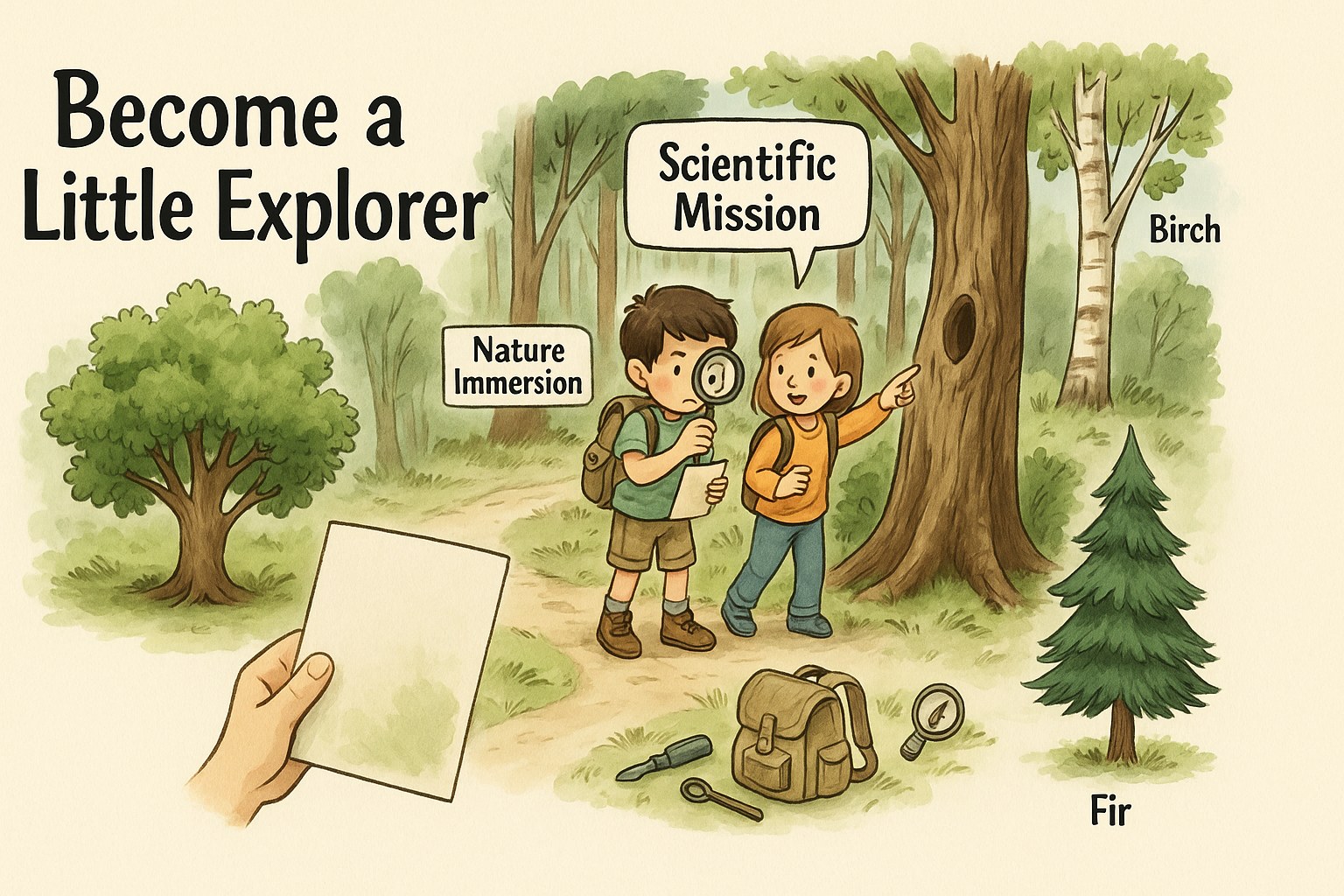
📄 Why use paper materials out in nature?
Printed materials chase away the temptation of screens. They offer total immersion under the canopy. You finally forget the sun glaring on the phone.
Handling a leaf helps you remember the species better. Touching the paper while looking at the bark creates a sensory memory. It’s a tough tool for little hands.
Using paper turns a simple walk into a real scientific mission, where every discovery becomes a tangible trophy for the child.
🥾 How do you plan a woodland outing with children?
Pack a light backpack with the essentials. Slip in a well-sharpened pencil and a magnifying glass. Keep the printable forest tree sheets within easy reach.
To keep the adventure pleasant, here are a few handy tips:
- Use a plastic sleeve to protect the leaves from damp.
- Bring bulldog clips to beat the wind.
- Take a notebook for sketches.
Walk at the pace of the smallest explorers. Observing needs calm and patience. Let them lead the way according to their own finds.
🔍 A visual summary of identification clues by species
Comparing leaves is a crucial step for identification. Look at whether they are toothed, smooth or lobed. The bark also reveals the tree’s age.
| Species | Leaf type | Bark | Fruit |
|---|---|---|---|
| Oak | Lobed shape | Cracked | Acorn |
| Beech | Oval shape | Smooth look | Beechnut |
| Birch | Oval shape | Smooth look | Catkin |
| Fir | Needles | Smooth look | Cone |
Each tree thrives in a very specific habitat. Some prefer damp soil, others dry slopes. Always look at the ground around the trunk.
🌳 The oak, that giant with lobed leaves
Now that we’re equipped, let’s turn to the king of our European forests.
The oak is recognisable from its massive, imposing shape. Its leaves have very distinctive rounded lobes. It’s a tree that can live for several centuries. Its wood is extremely hard and strong.
Look at its fruit, the famous acorns, tucked into a little cup. They feed many animals such as squirrels and jays. It’s a pillar of biodiversity.
Its bark becomes very cracked over the years. It offers an ideal shelter for many insects. The pedunculate oak prefers deep, cool soil.

Historically, its wood was used to build ships. Today, it’s still prized for making quality furniture. It’s a symbol of strength.
Teach children to gather the fallen leaves. They’re perfect for a beginner’s herbarium, especially with our printable forest tree sheets.
The oak often shelters more than three hundred different insect species, which makes it a real living block of flats in the heart of the wood.
🪵 The beech and its smooth grey trunk
If the oak is the king, its neighbour with the silver trunk is just as remarkable.
The beech stands out for its grey, perfectly smooth bark. It almost looks like elephant skin. It hates climates that are too dry or arid.
Its leaves are oval and edged with little silky hairs when young. They turn glossy and leathery in summer. In autumn, they take on a magnificent coppery colour. They often stay on the tree.
Its fruits are called beechnuts. They look like little triangles protected by a bristly husk. Birds love them during the winter.
The beech casts very dense shade in the forest. Few plants grow at its feet. This is what we call a cathedral beech wood.
Explain to children that its wood is used for toys. It’s clean and doesn’t splinter. It’s a very protective tree.
Touch the bark to feel its coolness. It’s a unique tactile experience in the forest.
🤍 The birch, the tree with snow-white bark
Let’s leave the shade of the beeches for the dazzling light of a pioneer species.
The birch is impossible to mistake thanks to its whiteness. Its bark sometimes peels off in thin strips like paper. It grows very fast in open areas. It loves sunlight.
Its leaves are small, triangular and finely toothed. They flutter at the slightest breath of wind. This makes a very soft, soothing rustle.
In spring, it produces hanging catkins. These are its flowers, which release lots of pollen. Bees visit them from the first fine days.
It’s often called the tree of wisdom. In the Far North, people use its bark to make objects. Its sap is also very well known.
To explore other varieties, feel free to look up forestry education sheets from national forest agencies. These resources go perfectly with our printable forest tree sheets.
Look at the black marks on the trunk. They often draw eye shapes.
🌲 The fir, the champion of evergreen needles
After the broadleaves, let’s discover those that keep their finery even in the heart of winter.
The silver fir has flat needles with two white bands underneath. They don’t prick when you touch them. They’re arranged like the teeth of a comb. It’s a major visual clue.
Its cones stay upright on the upper branches. They break apart in place without falling to the ground. You only find their stalks at the foot of the tree. It’s quite curious to watch.
Its trunk is straight and silvery grey. It produces a resin with a very pleasant lemony smell. This substance protects the tree against pests and disease. Nature is well designed.
The fir likes damp and altitude. You often find it in the mountains or in cool valleys. It forms dark, mysterious forests. It’s the perfect place to escape.
Don’t confuse it with the spruce, whose needles prick. Teach children the touch test. It’s a foolproof way to tell them apart. That way you avoid little winces.
Look at the light-green new shoots. They’re tender and very fragrant. A real treat for the senses.
🍁 The maple and its hand-shaped leaves
Let’s come back to broad leaves with a tree children love for its flying fruit.
The maple has leaves with five pointed lobes. They look strangely like the palm of an open hand. It’s an excellent landmark for identification.
Its fruits are double winged seeds. They’re often called helicopters because they spin as they fall. Children love throwing them in the air. It’s a timeless natural game.
There are several varieties, such as the sycamore maple or the Norway maple. Their leaf edges differ slightly in their cut. Look closely at the points to tell them apart.
Its sap is sweet and can be harvested. In autumn, its foliage turns bright yellow or flaming red. It’s a magnificent sight for photographers.
Its wood is pale and much loved for making instruments. People make violins and guitars from it. It’s a tree that literally sings.
Look for the little helicopters on the ground. Try to make them fly together.
To carry this forest discovery further, feel free to use the printable forest tree sheets to turn the walk into a real botanical investigation.
🌲 The pine and its needles in pairs
Let’s change the mood and head for the sandy soils where the cicadas sing.
The pine is recognisable from its long, stiff needles. They’re always attached in pairs on the twigs. Its bark is often thick and split into plates. It takes on orange tones.
Its fruits are the famous pine cones. They protect the seeds, called pine nuts, which some birds eat. They open in the heat of the sun.
The Scots pine has a very colourful trunk towards the top. It copes very well with drought and poor soil. It’s a tough, conquering tree.
For your activities with the printable forest tree sheets, here are a few varieties to watch out for:
- The maritime pine for the seaside.
- The umbrella pine for its shade.
- The Corsican pine for its tall stature.
Its resin is used to make turpentine. It gives off a powerful smell that freshens the air. Breathe in deeply as you pass by.
Pick up a closed pine cone. Put it near a radiator to hear it crackle.
🌿 The ash and its telltale black buds
Near the streams, another giant hides behind some dark details.
The ash is easy to identify in winter. Its buds are a deep black and shaped like a pyramid. They contrast sharply with the grey twigs. It’s a unique distinguishing sign.
Its leaves are made up of several small leaflets. They appear late in spring and fall quite early. They don’t change colour before they drop.
Its fruits are winged tongues that hang in clusters. They’re also called winged seeds, like the maple’s. They often stay on the tree all winter.
Its wood is both supple and very strong. It used to be made into tool handles or bows. It’s a fine, durable material.
The ash likes to keep its feet cool. You often find it along ditches or rivers. It helps hold the banks together.
Look at the opposite arrangement of the branches. They always come out in twos, facing each other.
💚 The lime tree, heart leaves and a sweet scent
Let’s finish our tour with the tree of calm and herbal teas.
The lime tree has leaves in the shape of a perfect heart. They’re soft to the touch and often asymmetrical at the base. It’s a tree much loved in villages. It brings delightful shade.
Its flowers are small, yellowish and extremely fragrant in June. They’re attached to a bract, a kind of little green wing. They attract thousands of bees.
These flowers are gathered to make soothing herbal teas. They help you sleep well and calm the nerves. It’s a very old natural remedy.
Its trunk often becomes hollow over time. It can house owls or bats. It’s a real refuge for nocturnal wildlife.
Since ancient times, the lime tree has been seen as the tree of togetherness, often planted in the middle of squares to shelter conversations.
Crush a leaf between your fingers. Smell that green, fresh scent.
📅 Tips for identifying trees all year round
Nature changes its face, but the clues to understanding it are still very much there.
❄️ Recognise the shapes in midwinter without leaves
In winter, look at the overall shape of the tree. The oak is twisted while the poplar is slender. The shape is your first visual clue.
Examine the buds at the tip of the branches. Their colour, shape and position are revealing. The beech has long, pointed buds. The ash has black ones. It’s a precise signature.
The bark then becomes the main thing to observe. Learn to tell smooth textures from deep ridges. Each species has its own pattern on the trunk.
🌸 Watch the fruits and flowers across the seasons
Spring brings the flowers and the catkins. It’s the awakening of the forest and the pollinators. Watch the colours that appear on the bare branches.
Autumn is the season of fruit and seeds. Look for acorns, chestnuts or winged seeds. It’s the ideal time to understand how trees reproduce. Animals join in actively.
Note the changing shades of the foliage. The shift from green to yellow or red is fascinating. Each species has its own colouring calendar.
🛡️ Safety tips and respect for the forest environment
Always stay on marked paths to protect the plant life. Don’t trample the fragile young shoots. The forest is a delicate balance that needs to be preserved.
Learn to spot stinging plants such as nettles. Avoid touching unknown berries, which can be poisonous. Caution is the rule on every outing. Keep a close eye on the children.
For your herbariums, gather only the leaves that have already fallen. Never break living branches for your collections. Respect the life of every plant you meet.
Ready for the adventure? These tree identification sheets turn your walks into fun scientific missions, from colouring leaves to keeping an autumn notebook. Download your materials quickly so you don’t miss a single detail on your next family outing. Explore, observe and create lasting memories in the great outdoors! 🌿
❓ FAQ
📥 Where can you find printable tree activity sheets?
You’re in the right place! We offer a wide variety of fun resources, from realistic or cartoon-style tree colouring pages to Montessori-style naming sheets. These materials help children learn botany vocabulary while having fun with varied themes such as the tree of life or life-cycle sheets.
🌲 How do you easily identify trees on a forest walk?
Observation is the key. Look at the shape of the leaves: are they heart-shaped like the lime tree, or lobed like the oak’s? The bark helps a lot too, like the birch’s, which is snow-white. For the most curious, our identification sheets help you compare the fruits, such as acorns, beechnuts or the maple’s famous “helicopters”.
❄️ Can you recognise a tree in winter without its leaves?
It’s perfectly possible, and it’s even a great challenge for children! You then need to look at the buds and the twigs. For example, the ash has big black buds that are very recognisable, while the beech has long, pointed buds. Using a little magnifying glass makes the experience even more captivating for little explorers.
🛡️ What precautions should you take on a nature outing with children?
Safety first, so the outing stays a pleasure. It’s important to stay on marked paths and to keep the children in sight. You also teach them not to put anything in their mouths and to respect wildlife: you don’t break branches, and you only gather leaves that have already fallen to the ground for your herbariums.
🌲 How do you tell a fir from a spruce without getting it wrong?
It’s a classic question! A foolproof trick is to touch the needles. The silver fir’s are flat, don’t prick and have two white bands on the underside. The spruce, on the other hand, has needles that prick. You can also look at the cones: they stay upright on the branches on a fir, whereas they hang down on a spruce.
📱 Are there digital tools to help identify plants?
Yes, apps such as plant-identification ones are great allies. By taking a simple photo, they let you identify thousands of species. It’s a very handy modern addition that also gives detailed information on caring for plants and can even help diagnose some plant diseases.
