
Do your kids fire off sticky questions about animal world records, leaving you stumped by their endless curiosity? 🐾 This article gathers nature’s most incredible feats to help you shine at the next snack time. You’ll discover speed champions like the peregrine falcon, sea giants and even tiny creatures capable of utterly jaw-dropping physical stunts.
- Animal world records: the speed aces
- Giants of nature: the heavyweights of life
- Defying time: the elders of the animal world
- Raw strength: when the small ones rule
- Extreme records: from tiny to unbeatable
- Brainpower: the champions of intelligence
🏃 Animal world records: the speed aces
Having skimmed over the vastness of biodiversity, let’s focus on those that turned speed into a ruthless survival strategy, whether in the air, on land or underwater.

🦅 The peregrine falcon’s lightning dive
The peregrine falcon outpaces everyone. It’s the fastest living creature on Earth. It reaches a wild 390 km/h during the dives it uses to hunt its prey.
Its body hides fascinating secrets. Bony bumps inside its nostrils control the pressure. They deflect the powerful airflow. That way its lungs run no risk of internal damage.
It’s a real feat. Physics bows before such natural engineering.
🐆 The cheetah’s top land speed
The cheetah is a pure sprinter. It hits 120 km/h in just a few seconds. But careful: it can only hold that pace over very short distances when hunting.
Its spine is extremely supple. It works like a real spring during each stride. Its non-retractable claws give it perfect grip on the ground, like running spikes.
Stamina isn’t its strong point. After that sprint, the animal absolutely must rest for a long while.
🐟 The sailfish: an arrow underwater
The sailfish is the king of the oceans. It slices through the water at over 110 km/h. Its trademark dorsal fin helps steady its blistering path despite the currents.
Our best swimmers look frozen beside it. Yet water resistance is a major brake. This fish fine-tunes every move to cut down turbulence and glide with fearsome efficiency.
This data is verified by the official Guinness World Records.
🐋 Giants of nature: the heavyweights of life
If speed impresses, sheer size commands a whole different kind of respect, taking us from velocity to the raw power of the colossi.
🐳 The blue whale: a record for tonnage
The blue whale reaches 33 metres long. Its weight nears 190 tonnes. It’s the largest animal that has ever lived on Earth.
It swallows tonnes of krill every day. This food is vital for its metabolism. Without these tiny shrimp-like creatures, this giant couldn’t survive.
Its heart is the size of a small city car. It’s simply mind-boggling.
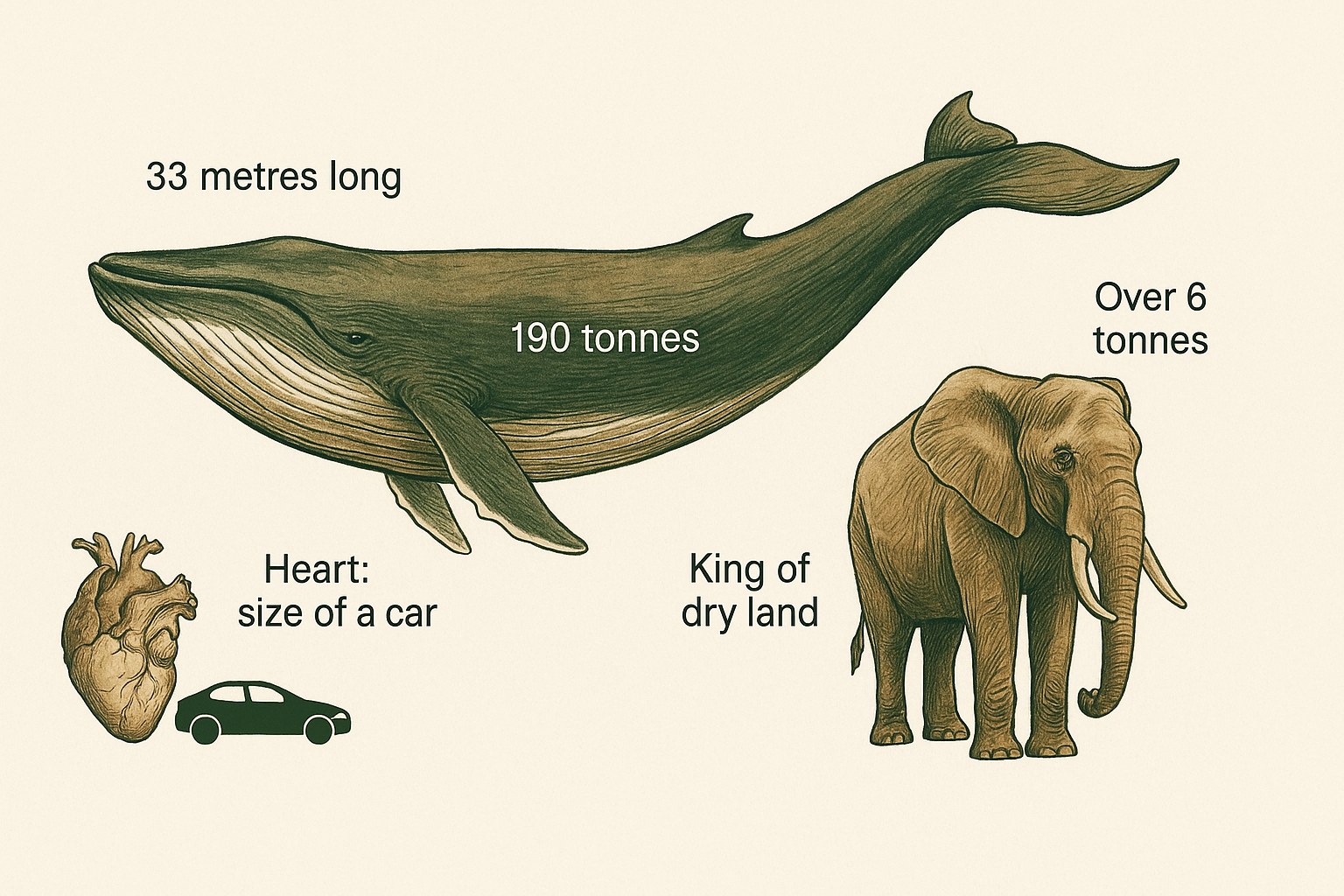
🐘 The African elephant: king of dry land
Spotlight on the African giant. Males can weigh over 6 tonnes. That’s the absolute record for an animal living on solid ground.
Its bones are extremely dense and massive. They have to bear colossal pressure with every step. Its feet have cushioned pads to soften that weight. Nature has thought of everything to prevent collapse.
An African elephant eats about 200 kg of plants a day to keep up its mighty build.
📏 Why does nature limit size?
Here’s the square-cube law. If size doubles, weight triples. The bones would end up snapping under their own mass. It’s an unavoidable physical limit for biology. Gravity lays down the law.
Giants spend huge amounts of energy to move. Small animals are often more efficient at managing heat. Finding food becomes a constant challenge.
That’s why we’ll never see giant film-style insects. Animal world records stop where physics says so.
⏳ Defying time: the elders of the animal world
Having explored the space these giants take up, let’s turn to the dimension of time, where some species seem to have found the fountain of youth.
🦈 The Greenland shark: four centuries of life
This deep-sea predator lives around 400 years. It only becomes an adult at the age of 150. It’s a longevity record for a vertebrate.
Its metabolism is incredibly slow. It lives in waters close to zero degrees. This life in slow motion protects its cells from early ageing. It’s an effective passive survival strategy.
Some individuals were already swimming during the Renaissance. Pretty staggering, isn’t it?
🐚 The Ming clam: a 507-year record
This mollusc was born in 1499. Researchers found it off the coast of Iceland. It belongs to the species Arctica islandica.
Scientists count the rings on the shell. It’s exactly like the rings of a tree. Each line stands for one year of life. This witness to the past crossed the centuries in silence.
- Species: Arctica islandica
- Age: 507 years
- Place: Iceland
- Name: Ming
♾️ The secret of biological immortality
Take the case of the jellyfish Turritopsis dohrnii. It can reverse its life cycle. Under stress, it turns back into a larva.
Its cells transform to start again from scratch. This process is called transdifferentiation. That way it escapes natural death from old age. It’s a unique case of endless rejuvenation.
So immortality really does exist. But it’s tiny and jelly-like. Animal world records have plenty of surprises in store for us.
💪 Raw strength: when the small ones rule
Let’s leave the depths of time and come back to pure physics, where size no longer dictates power, but where the tiny becomes herculean.
🪲 The rhinoceros beetle: the miniature weightlifter
The rhinoceros beetle is a true force of nature. This insect can lift 850 times its own weight. It’s an absolutely stunning relative-strength record for its small size.
Picture a human lifting a tank. That’s the equivalent of this insect’s feat. Its sturdy shell acts as a solid base. Its muscles are tuned for pure pushing, with no wasted effort at all.
An insect’s relative strength far outdoes that of the biggest land mammals.
🐜 Leafcutter ants: muscle engineering
The work of leafcutter ants is always impressive. They carry loads 50 times heavier than themselves. They cover long distances back to the nest with baffling agility.
Their muscles attach straight to the exoskeleton. This creates a highly effective lever system. The strength of their neck is also off the charts. Every muscle fibre is pushed to its limit for the common good.
This strength serves only the survival of the whole colony. It’s total devotion.
⚖️ Absolute strength versus relative strength
A distinction is needed here. The elephant has the greatest absolute strength. It uproots trees effortlessly. But compared with its size, it’s weak. An insect wins the relative-power contest.
Mass grows faster than muscle cross-section. Small animals benefit from this favourable ratio. They defy the laws of human scale with disarming ease. It’s mathematical, but above all fascinating to watch.
Being small is a major advantage for raw power. Nature is cleverly designed.
🔬 Extreme records: from tiny to unbeatable
Strength isn’t everything; surviving in impossible conditions or shrinking to the extreme are records that are just as fascinating.
🔬 The parasitic wasp: smaller than a cell
Have you heard of Dicopomorpha echmepterygis? This male wasp is just 0.139 millimetres long. Incredibly, it’s smaller than some single-celled organisms like the paramecium.
Its miniature complexity is surprising. Yet it has a complete nervous system. Its brain is stripped down to the essentials to work. It manages to fly and reproduce normally. It’s a microscopic miracle of biological engineering.
An astonishing thought: it’s nearly invisible to the human eye.
🛡️ The tardigrade: champion of resistance
Here’s the portrait of the water bear. The tardigrade survives the absolute vacuum of space. It also withstands extreme ocean pressures without flinching.
It all rests on cryptobiosis. It pushes all the water out of its body. It then enters a state of suspended life. It can stay like this for whole decades. It reactivates the moment it finds water again.
| Extreme condition | Tardigrade’s ability |
|---|---|
| Temperature | Near absolute zero and up to 150°C |
| Pressure | Up to 6,000 bars |
| Radiation | 1,000 times the lethal human dose |
| Vacuum | Survives in outer space |
👂 Echolocation: seeing with your ears
This is the mastery of biological sonar. Bats and cetaceans use echolocation. They send out sounds to map their surroundings brilliantly.
Their hunting precision is wild. A dolphin can spot a small coin at the bottom of the water. Sonar is more precise than any kind of sight. It lets them hunt in the total darkness of the deep. It’s a major sensory advantage.
A quick nod to eyes too. The colossal squid also has record-breaking eyes.
🧠 Brainpower: the champions of intelligence
To wrap up this tour of records, let’s leave physical abilities behind and explore the peaks of animal cleverness and cognition.
🐙 The octopus: a genius with eight arms
The octopus has astonishing cognitive skills. It solves complex puzzles in record time. This invertebrate even repurposes objects to use as protective tools.
Its nervous system is decentralised. Two thirds of its neurons sit in its arms. So each tentacle acts on its own. It learns fast by watching and remembers its mistakes.
- Opening jars
- Using coconut shells as shelter
- Changing colour to hide its intentions
- Playing with objects
🐒 Crows and primates: animal culture
Birds and apes shine with their wits. Crows make hooks to grab their food. Chimpanzees, for their part, actively teach their hunting techniques to the young ones.
It’s a real animal culture. Each group has its own local traditions. This shared knowledge saves them starting from scratch. These skills prove a very advanced social and cognitive intelligence.
Social bonds are key. Intelligence often rises with the complexity of interactions.
🔬 How records change with science
Discoveries never stop. New species are identified every year. Our tech tools, like sensors, are also getting much more precise for watching wildlife.
GPS tags sharpen speed records during migrations. Genetics reveals lifespans we never suspected. Science keeps pushing the limits. What seems unbeatable may be dethroned tomorrow.
Nature keeps its secrets. It will always be one small step ahead of our current observations.
From the speed of the peregrine falcon to the strength of the beetle, these animal world records remind us of the magic of nature. Marvel at these feats today to better protect this fascinating biodiversity. What a joy to picture our children wondering tomorrow at such champions! ✨
🎬 Watch the video
❓ FAQ
🦅 What is the fastest animal on the whole planet?
The all-round champion is the peregrine falcon. This incredible bird of prey can reach a wild speed of 390 km/h when it dives to hunt its prey.
To handle such pressure without damaging its lungs, nature gave it tiny bony bumps in its nostrils that deflect the airflow. A real feat of natural engineering, isn’t it?
🐆 Which mammal holds the land speed record?
On solid ground, it’s the cheetah that takes the gold medal. This extreme sprinter climbs to 120 km/h in just a few seconds thanks to an ultra-supple spine that works like a spring.
Careful though: it’s an intense but short effort. After such a run, our feline friend absolutely must take a long break to catch its breath and recover.
🐳 What is the largest animal that has ever lived on Earth?
The record for sheer size goes to the blue whale. At 33 metres long and nearing 190 tonnes, it even beats the biggest known dinosaurs. To give you an idea, its heart is as big as a small city car!
⏳ Are there animals that can live for several centuries?
Absolutely, and some are true elders! The Greenland shark can live around 400 years, moving in slow motion in icy waters. But the prize goes to the Ming clam, a mollusc whose age was estimated at 507 years.
🪲 Which small insect is considered the strongest in the world?
If we look at strength relative to size, the rhinoceros beetle is a true weightlifter. It can lift up to 850 times its own weight. At our scale, that would be like lifting a tank at arm’s length!
🔬 What is the tiniest animal discovered so far?
The record for the smallest organism belongs to a tiny parasitic wasp named Dicopomorpha echmepterygis. The male measures just 0.139 millimetres, which makes it smaller than some cells or single-celled organisms.
🛡️ How does the tardigrade survive extreme conditions?
The tardigrade, or “water bear”, uses a technique called cryptobiosis. It pushes the water out of its body to enter a state of suspended life. This lets it withstand the vacuum of space, colossal pressures and even lethal radiation.
