
Watching your child drag their feet over homework is a frustration we all know. To turn things around, this article shares 15 concrete ideas by age for turning every discovery into pure fun. 🎲 By boosting dopamine and the state of flow, you’ll give your children precious keys to build up their logic and creativity without any conscious effort.
- Why play really helps the brain grow
- 3 ideas to awaken babies under 2
- How to boost the imagination of 3 to 5 year olds
- Activities to build logic in 6 to 8 year olds
- 3 exciting challenges for 9 to 12 year olds
- Engaging teenagers with real projects
- Mum’s tips for a more fun everyday
🧠 Why play really helps the brain grow
Now that we’ve set the scene on how important a child’s development is, let’s see that play isn’t a simple distraction but the very engine of their brain’s architecture.

🧬 The role of dopamine in memory
The pleasure felt during play releases dopamine. This neurotransmitter tags information as important. This greatly helps long-term memory in little ones.
The brain then builds stronger neural connections. Emotional engagement stimulates this natural neuroplasticity. It’s the physiological basis of all successful learning.
A brain stimulated by joy learns much faster. This actively prepares the ground for future success at school.
🌊 Reaching the state of flow for total focus
Flow is a total immersion in an activity. The child then loses all sense of time passing. Learning becomes deep, natural and effortless. Their concentration reaches its peak.
This state of well-being also reduces stress. The child is no longer afraid of failing or getting it wrong. They explore complex ideas with surprising ease.
🎲 The difference between free play and guided play
Free play encourages independence and imagination. The child decides everything without any heavy outside pressure.
Guided play uses the game as a key way to introduce rules. It gently prepares them for the structure of school. Both approaches go hand in hand.
Yet the adult must know when to step back. Too much direction ends up killing the pure joy of play.
❤️ Intrinsic motivation at the heart of fun
Intrinsic motivation comes straight from within. The child acts for the pleasure of the action itself. It’s the most powerful engine for learning through play.
This is the opposite of external rewards like stickers. These rewards end up limiting natural curiosity. It’s better to value the effort made rather than the prize.
To support this desire, ask open questions. Don’t give the answers straight away.
Play builds resilience, adaptability and the ability to handle social difficulties, while stimulating imagination and curiosity.
👶 3 ideas to awaken babies under 2
Now that we understand how the brain works, let’s see how to put it into practice from the very first months of life.
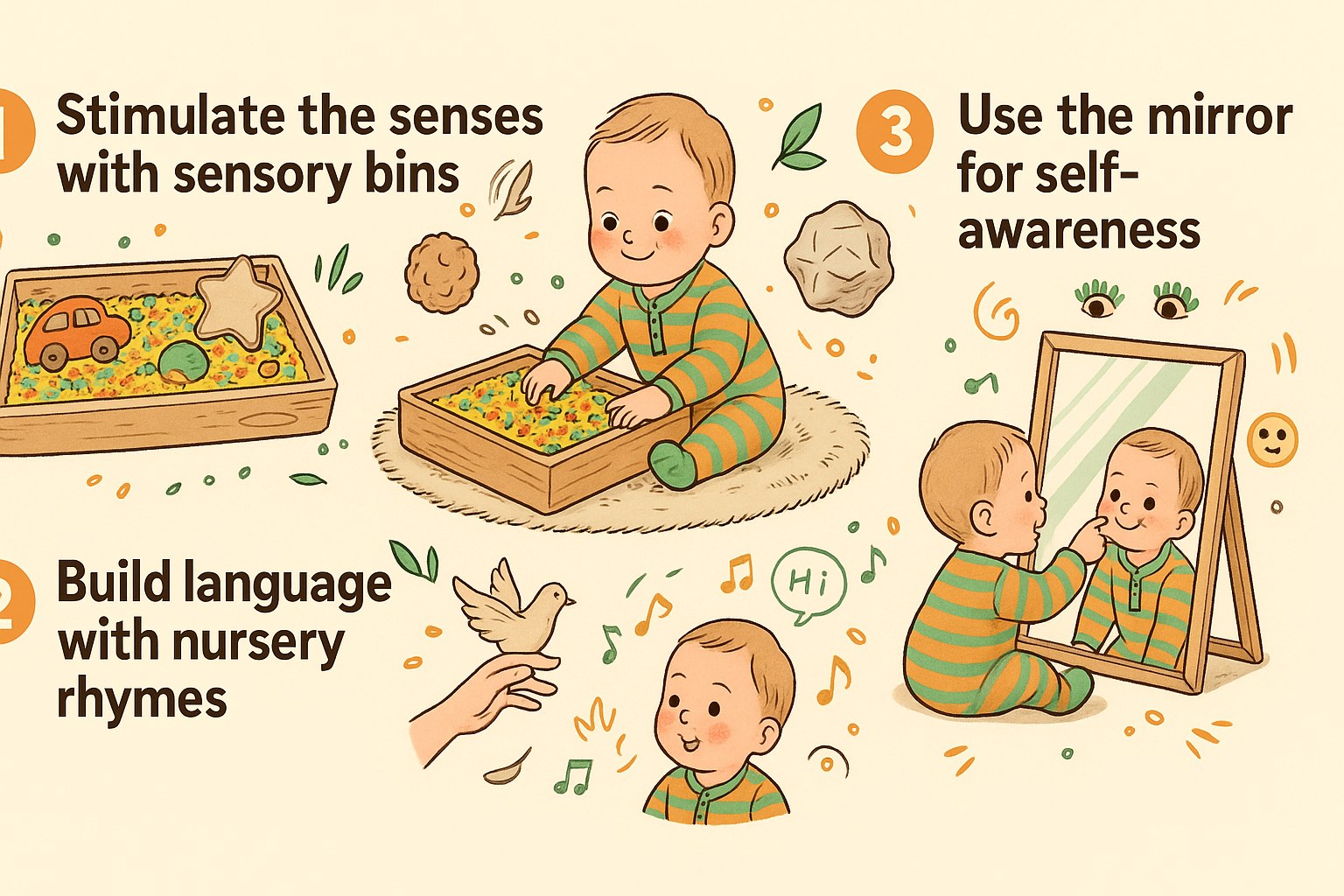
🤲 Stimulating the senses with sensory bins
Fill a bin with rice, pasta or water. Let the baby plunge their hands into it. This raw tactile exploration is crucial for their sensory memory.
Add hidden objects to find. This works on object permanence. The brain processes textures, temperatures and all sorts of rubbing sounds.
Touch activates specific brain areas. The richer the sensations, the more connections multiply. It’s the basis of practical intelligence when learning through play.
🎵 Building language through rhythmic nursery rhymes
Sing simple tunes with strong rhymes. The rhythm helps the baby break speech down into sounds. It’s the first step towards spoken language. Repeat the same songs often to reassure them.
Use your hands to mime the words. Gestures give concrete meaning to the abstract sounds they hear. It’s a great way to strengthen motor imitation before the first words.
Watch their reactions and their attempts to copy you. Every little babble is a victory for their future communication. These shared moments also strengthen your emotional bond.
🪞 Using the mirror for self-awareness
Place an unbreakable mirror at the baby’s height. Let them watch their own reflection and movements. At first, they think they see another child before recognising themselves.
Play at pulling faces together. This helps them identify their own facial expressions. It’s a key step in building their psychological identity and body map.
Touch their nose or ears in front of the mirror. They’ll gradually link their body to their image. By around 18 months, they’ll finally understand that the reflection is them.
🌈 How to boost the imagination of 3 to 5 year olds
The baby becomes a curious little child, and their world now widens to the scenarios they make up from scratch.
🎭 Pretend play to understand social codes
Playing shop or doctor is essential. The child re-enacts scenes from everyday life. They learn to put themselves in someone else’s shoes.
These games build deep empathy. They also help manage certain worries, like the fear of the doctor. The scenario becomes a safe space for experimenting.
Offer simple props like old clothes. Imagination will do the rest without needing expensive toys.
🎨 Fine-motor workshops with modelling clay
Kneading, cutting and rolling the clay builds up the fingers. These precise movements directly prepare them to hold a pen. It’s vital physical training for writing.
Encourage them to make complex shapes. Using suitable scissors strengthens hand-eye coordination. The child gains confidence in their fine, careful movements.
The satisfaction of making a tangible object boosts self-esteem. It’s a concrete, immediate achievement.
🤸 Agility courses for physical balance
Create a circuit in the living room with cushions. Mark lines on the floor with tape. The child has to crawl, jump and keep their balance. These physical challenges shape how they perceive the space around them.
Movement helps the brain organise spatial information. It’s useful for geometry and organisation later on.
Vary the obstacles to keep their interest. A simple box can become a mysterious tunnel to crawl through.
🧩 Activities to build logic in 6 to 8 year olds
As they start primary school, play becomes a powerful tool for taming abstract ideas and scientific rigour.
🔬 Science experiments with cupboard ingredients
Mix baking soda and white vinegar. Watch the instant fizzing reaction with your child. It’s a perfect introduction to fun chemistry.
Ask questions before each step. Get them to guess what will happen. This scientific observation approach builds critical thinking. You no longer just watch the phenomenon, you try to understand it.
Note the results in a little notebook. This values the research work and the care taken.
♟️ Board games for strategic thinking
Get out the Memory games or classic dominoes. They force the child to anticipate their opponent’s moves. Strategic thinking starts with simple choices.
Playing in a group teaches patience and respect for the rules. You accept defeat without too much anger. It’s an excellent lesson in social and emotional life.
- Respecting turns
- Working out a plan of action
- Managing frustration when losing
🔢 Mental maths challenges and word games
Offer short maths riddles during snack time. Handling numbers in their head becomes an exciting challenge. This takes the drama out of a subject often seen as too dry.
Word games strengthen vocabulary and spelling. Make up rhymes or look for synonyms while having fun. Learning happens through natural soaking-in, with no pressure.
Use visual aids like coloured counters. This makes maths concrete and less intimidating, helping their knowledge of mathematics grow.
🎯 3 exciting challenges for 9 to 12 year olds
Towards the end of childhood, the challenges need to step up to meet a growing need for independence and complexity.
🗝️ Homemade escape rooms for problem-solving
Create a mystery investigation in your own living room. Hide clues and lock a box with a code. The child has to show pure logic.
This format strengthens cooperation between siblings. You have to deduce, rule out false leads and listen to each other. Problem-solving becomes a thrilling team adventure. Every solved puzzle brings huge intellectual satisfaction.
Time the session to add a bit of spice. Positive stress helps you stay focused on the goal.
🏗️ Complex building projects for patience
Use technical bricks or detailed wooden models. These projects take hours of careful concentration. Patience then becomes a skill.
Following a complex plan builds three-dimensional thinking. The child learns to anticipate structures and physical forces. It’s an excellent introduction to modern engineering.
Value the final result by displaying it in the house. It’s the reward for a long-haul effort.
✍️ Creative writing and comic-strip workshops
Suggest turning an abstract idea into a little comic strip. Storytelling helps fix ideas in a visual way. It’s a very powerful exercise in summarising.
Inventing dialogue builds command of the language. The child takes on a variety of speech registers. Personal expression becomes a playground with no limits.
Let them choose their favourite themes, even silly ones. Freedom is the key to creative engagement when learning through play.
🚀 Engaging teenagers with real projects
Adolescence calls for a different approach, where play acts as a bridge towards adult skills and more nuanced thinking.
♟️ Strategy games to sharpen critical thinking
Chess or narrative role-playing games are perfect. They force you to weigh up every decision carefully. Critical thinking sharpens game after game.
Show how one choice directly affects the final result. The teenager learns to take responsibility for their actions within a fictional setting. It’s an ideal lab for testing complex social strategies. You analyse your mistakes to bounce back better.
These games also encourage patience and reading the other player’s behaviour. It’s a school of life. Certain games also help unmask cognitive biases brilliantly.
🎬 Digital content creation and video editing
Teach them the basics of photography or video editing. Using technology to create is more rewarding than just consuming it. It’s a useful technical skill.
Personal expression today runs through these modern digital tools. They build a sense of aesthetics and visual storytelling. It’s a hobby that can become a passion.
There are great resources on digital play and discovering coding to turn screens into learning tools. Learning through play also runs through this technical independence.
💬 Debates on current affairs to structure arguments
Start discussions on current social issues. The teenager has to learn to structure their arguments to convince. It’s an exciting and necessary exercise in rhetoric.
Value listening to differing opinions and nuance. The aim isn’t to win, but to exchange ideas. This strengthens social skills and mutual respect.
Ask questions that gently shake up their certainties. That’s how an independent mind is forged. Letting ideas flow without pressure works wonders.
💡 Mum’s tips for a more fun everyday
Finally, building play into the daily routine helps lighten the mental load while educating.
🧹 Turning chores into fun challenges
Turn tidying the bedroom into a race against the clock. Put on some upbeat music to motivate the troops. Chores then become a group game.
In the kitchen, ask them to weigh the ingredients like little chemists. Independence grows naturally through these small, playful responsibilities. You learn maths without even realising it.
Praise the effort made rather than a perfect result. What matters is taking part.
♻️ Making your own learning materials on a budget
Use recycled cardboard to create board games. Make your own naming cards with simple drawings. Homemade materials often have a unique charm. They engage the child from the very first design stage.
It’s an affordable and eco-friendly way to vary the activities. You recycle everyday waste cleverly.
The child is proud to use an object they helped build. This strengthens their attachment to the activity.
⚖️ Balancing screens and physical play
Choose educational apps that call for real interaction. Avoid purely passive games that bring no benefit. Screen time must stay limited and supervised.
Physical movement is essential for the brain to work well. Alternate a calm session with an activity that lets off steam. Balance is the key to good mental health.
Offer simple sporty challenges in the garden or the park. Oxygen boosts cognitive abilities.
📊 Adapting an activity to different ages
Simplify the instructions for the youngest and make them harder for the eldest. The same treasure hunt can have different clues. This lets the whole family play together.
Encourage children to help each other rather than compete. The older one explains the rules to the younger one. It’s an excellent lesson in teaching and patience.
| Age group | Ideal type of play | Main benefit |
|---|---|---|
| 0-2 years | Sensory | Discovering the senses |
| 3-5 years | Pretend play | Imagination and language |
| 6-8 years | Logic | Structured thinking |
| 9-12 years | Strategy | Cooperation and independence |
By boosting dopamine and the state of flow, these activities turn every age into a unique cognitive adventure. Mix free and guided play to anchor what your children learn for good. Adopting these ways to learn through play from today means giving their brains the keys to a bright future.
❓ FAQ
🎲 Why is play so effective in helping my child learn?
The secret lies in dopamine, a little neurotransmitter that’s released the moment your child enjoys themselves. This molecule doesn’t just make them happy, it tags information as important, which greatly helps long-term memory. While playing, the brain creates stronger neural connections because emotional engagement is at its peak.
What’s more, play makes it possible to reach the state of “flow”, a total immersion where concentration is natural and effortless. In this state, the fear of failure disappears, making way for a smooth exploration of sometimes complex ideas. It’s a real engine for future success at school.
🤔 What’s the difference between letting my child play alone and guiding their activity?
Free play is essential for developing independence and pure imagination. It’s a moment when the child decides everything, with no constraints, which fosters their creativity and their ability to solve problems on their own. It’s a pillar of brain development.
Guided play, on the other hand, is an activity with rules and goals set by the adult. It’s very useful for structuring thinking and preparing the child for the school setting. The ideal is to find a balance between the two, while knowing when to step back so as not to break the joy of discovery.
✨ How can I motivate my child to learn without using rewards?
The trick is to nurture their intrinsic motivation, the kind that comes from within. Rather than promising a sticker or a sweet, value the effort and the pleasure of the action itself. External rewards often end up limiting natural curiosity in the long run.
To support this desire to learn, try asking open questions instead of giving the answer straight away. This stimulates their critical thinking and resilience in the face of difficulty. Play naturally strengthens their ability to handle social and intellectual challenges.
🧩 What simple activities can I offer to build logic in older children?
No need to look for anything complicated: the things in your cupboards are enough! A fizzing experiment with vinegar and baking soda is a perfect introduction to the scientific method. Ask them to guess the result before you start, to build up their sense of observation.
Classic board games like Memory or dominoes are also excellent tools. They teach the child to anticipate moves, respect their turn and manage frustration when they lose. There’s a school of life hidden behind every family game.
⏰ How can I fit playful learning into my busy mum routine?
The key is to turn chores into fun challenges. Tidying a bedroom can become a race against the clock with some upbeat music. In the kitchen, turning the cake-making into a “chemistry” workshop lets them handle numbers and weights without even realising it.
You can also make your own materials from recycled cardboard. The child will often be prouder to use a game they helped build. This lets you vary the fun in an affordable, eco-friendly way while strengthening your bond every day.
