
Finding the right activity book for your child’s age can sometimes feel like a puzzle, caught between overflowing shelves and the ever-changing needs of little ones. 😊 This article guides you to track down the perfect option, from high-contrast picture books for babies to logic challenges for older kids. You’ll discover how to boost their fine motor skills and curiosity with practical tips for making progress while having fun.
- Gentle learning for little ones from 12 months to 3 years
- Heading to preschool for ages 3 to 6
- Challenges and logic for big kids aged 6 to 8
- Choosing between the PDF and the bound book
- Supporting progress without ever forcing the pace
- Themed activities for every moment of life
👶 Gentle learning for little ones from 12 months to 3 years
Now that we understand the importance of play in development, let’s see how toddlers approach their first discoveries with sensory tools made just for them.

🤲 Handling first picture books and textures
Picture books grab babies’ attention with simple visuals. The child builds their vocabulary quickly. They link each picture to the word spoken by the grown-up.
Black-and-white contrasts are perfect for newborns. Favour familiar themes. Farm animals or objects from the bedroom work really well.
A picture book isn’t just a book, it’s a bridge between the real world and a child’s budding language.
🔵 Getting to know basic shapes and colours
Learning the primary colours starts here. You play at spotting red, blue or yellow. The idea is to have fun without forcing instant memorisation.
Sorting exercises help a lot. The child groups objects by colour or by simple shape. The circle is often the first one recognised. It’s the foundation of logic.
Next you name the basic geometric shapes. The square and the triangle become familiar visual landmarks. The approach always stays playful and completely relaxed for the child.
♻️ Choosing laminated, reusable materials
Laminated pages offer welcome sturdiness. Velcro systems let children stick and re-stick endlessly. This encourages repeated handling without any risk of damaging the material.
These tools are also very economical. A single booklet works for hundreds of little sessions. Repeating the gesture reassures the child and anchors their first learning.
The feeling of success is immediate. A mistake can be wiped away or repositioned in the blink of an eye. This builds self-confidence from the youngest age.
🎒 Heading to preschool for ages 3 to 6
If the first steps are sensory, starting preschool marks the beginning of fine coordination and a growing intellectual curiosity.
✏️ Mastering pen control and first marks
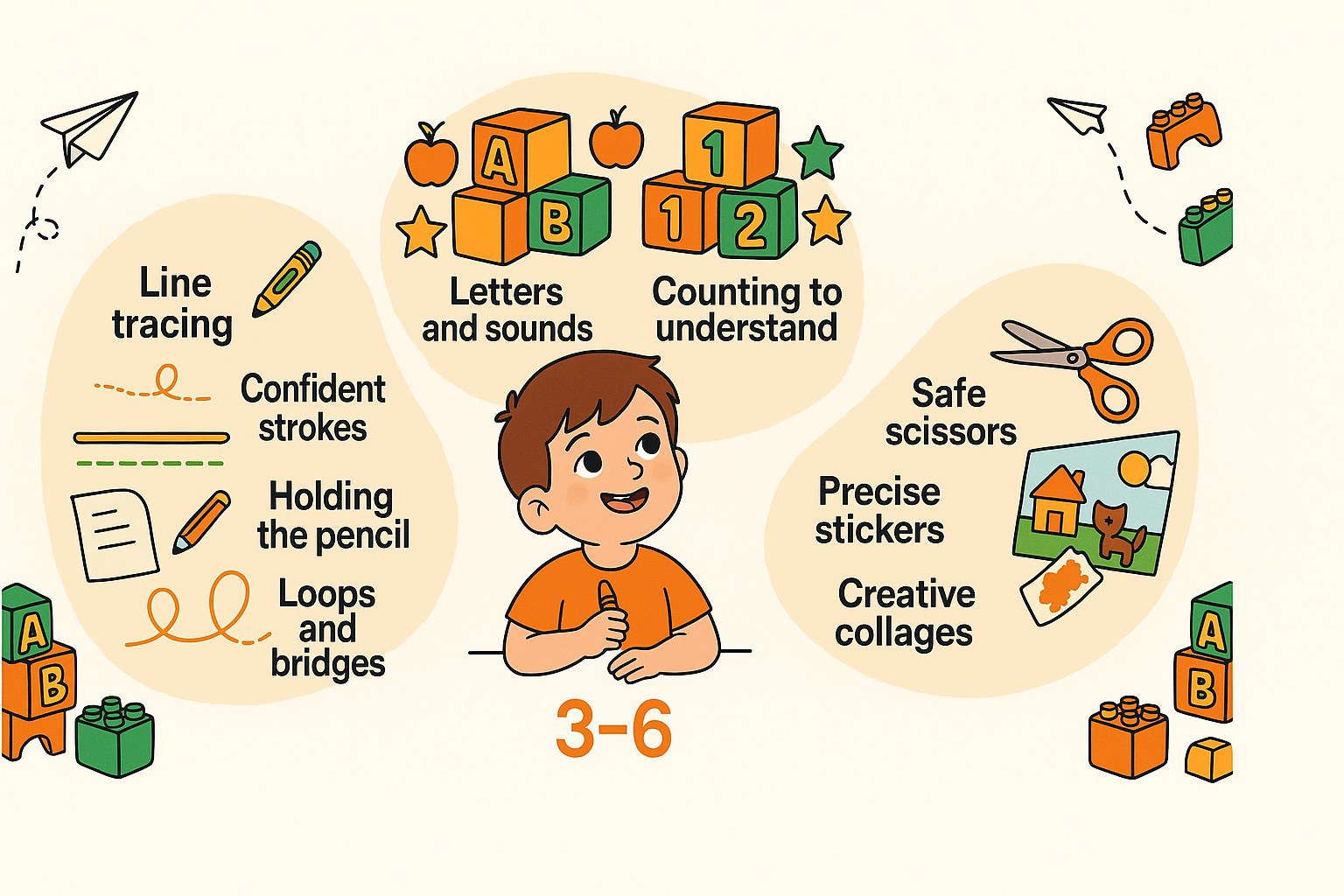
Line-tracing exercises transform the gesture. Dotted lines guide the hand gently. It’s a key step in moving from scribbling to controlled strokes. The child learns to direct their pencil with real intention.
Holding the pen deserves special attention. A good grip avoids tiring the muscles. Encourage drawing regular loops. These repetitive shapes strengthen the wrist without excessive effort.
- Straight lines for structure
- Curves for fluidity
- Dotted lines for precision
- Closed shapes for control
🔤 Playing with numbers and the alphabet
Recognising letters becomes child’s play. You use simple visual associations to memorise the shapes. The alphabet turns into a fun field of discovery rather than a school chore.
Counting takes hold through handling. You count apples or colourful stars. Linking a number to a quantity helps make maths concepts concrete for little ones.
Linking sounds to pictures awakens phonological awareness. The “B” of “Boat” or the “A” of “Apple” stick in their minds. This step gently prepares the ground for learning to read later.
✂️ Cutting and gluing to strengthen the fingers
Using child-safe scissors is an adventure. Safe cutting strengthens the muscles of the hand. It’s a fundamental exercise for building the fine motor skills needed for writing.
Stickers call for precision. You have to peel them off and then place them within a set frame. This activity boosts concentration and hand-eye coordination in a playful way.
Creating themed collages lets children dream. The child puts together different elements to tell their own story. Which activity book should you choose for your child’s age? Fun stays the priority.
🧩 Challenges and logic for big kids aged 6 to 8
Once the preschool basics are in place, the primary-school child looks to test their limits with more complex puzzles and wide-ranging exploration themes.
🧠 Solving riddles and thinking games
Complex mazes become real challenges. They call for planning and patience. Spot-the-difference games push the child to observe details. This analysis demands sustained, careful attention.
Sudoku for children makes its entrance. Sometimes the numbers are replaced with colourful symbols. This develops deduction skills. Mathematical logic progresses without ever feeling like school.
It’s helpful to use online safety resources for this age group. These materials help raise awareness of good digital habits. They’re a great educational complement from this age onwards.
📖 Polishing reading and writing without stress
Linking words to pictures helps a lot. It confirms immediate understanding. The child then feels capable of succeeding. They read simple, direct instructions on their own.
Cursive writing needs regular encouragement. Using short sentence models stays motivating. The goal is to make the technical gesture flow. You put no pressure on visual perfection.
Asking playful questions about short texts works well. It checks overall understanding of the story. The child learns to pick out a specific piece of information. They become more independent in their reading.
🔬 Escaping with scientific or historical themes
Exploring the human body often fascinates. Space is another theme that captivates. The books then become real learning tools. They enrich general knowledge in a fun way.
Using simplified maps is ideal. You learn to place the major continents. It’s an invitation for the mind to travel. It sparks the imagination with very concrete knowledge.
Weaving in historical anecdotes awakens curiosity. Telling tales of life in medieval castles is a hit. The feats of explorers leave a mark. Natural curiosity is fed by real facts.
📕 Choosing between the PDF and the bound book
Beyond the educational content, choosing a physical or digital format is a logistical and budget dilemma for many parents.
🖨️ Enjoying the instant access of printable materials
Get the files instantly after purchase. It’s ideal for a last-minute activity. No need to wait for a parcel to be delivered.
Print the same page several times. If the child makes a mistake, you can start over at no cost. This lets you practise a specific difficulty until success.
Store the resources on a tablet or computer. You save space on the shelves. You print only what’s needed for the day’s session.
📚 Preferring the sturdiness of classic physical books
Value the object that is a book. It’s a great way to unplug from screens. Contact with paper offers an irreplaceable tactile experience.
Relying on tangible materials limits eye strain. It’s worth following health recommendations on screen time and favouring paper. This choice encourages calmer concentration.
Keep the workbook as a precious keepsake. You watch the drawings evolve over the months. It’s a concrete record of the progress made by your little one.
💰 Organising your resources to fit the family budget
Compare the real costs. The price of ink can climb for PDF files. You have to weigh the purchase price against the cost of cartridges.
Bind your printouts yourself. You can use clips or a display folder. This lets you create a personalised workbook at lower cost with the favourite pages.
| Criterion | PDF format | Physical book |
|---|---|---|
| Price | Variable ink cost | Fixed price |
| Availability | Instant | Delivery |
| Durability | Fragile | Sturdy |
| Use | On the go | At home |
Which activity book to choose for your child’s age will depend on how you’re set up. Between the flexibility of digital and the charm of paper, every family finds its own balance.
🐢 Supporting progress without ever forcing the pace
The choice of material is made, but the way you support the child remains the key factor in the success of these educational activities.
🔍 Spotting when an exercise is too hard
Spotting the signs of tiredness is essential. If the child turns away from the workbook or gets annoyed, you need to stop. Fun must stay the main driver.
Simplifying the instruction often unblocks the situation. Sometimes a different explanation is more than enough. You can also do the first example with them to show the logical path without giving the answer.
Valuing the right to make mistakes changes everything. Getting it wrong is an integral part of learning. You encourage the effort made rather than the perfect result to keep their confidence solid.
🧰 Preparing the materials needed for each session
Listing the little learner’s essentials makes concentration easier. Wipe-clean markers for laminated materials and round-tipped scissors are enough. Having everything to hand avoids needless interruptions.
Choosing the right stickers is a small detail that matters. They shouldn’t be too small for clumsy hands. Well-sized materials avoid frustration and encourage successful handling.
Using a work tray is an excellent tip. It marks out the child’s personal space. It’s a visual landmark that helps with concentration and respect for the materials used.
🌟 Encouraging independence with simple instructions
Letting the child choose their activity boosts their personal involvement. They’ll be far more motivated if they feel they’re deciding their own playful programme. It’s rewarding for them.
Setting up tidying-up rituals is a precious habit. You put the markers back in their box together. Learning to take care of their things is an important step towards independence and responsibility.
Staying a kind observer is your finest role. The grown-up accompanies without doing things in the child’s place. Your reassuring presence is often enough to encourage their attempts and their future successes.
🗓️ Themed activities for every moment of life
Finally, activity books aren’t just for home; they adapt to the seasons and to travel to become companions on the road.
🎄 Getting ready for Christmas or Easter celebrations
Offer colouring pages tied to the calendar. It’s a way to mark the passing of time. Themed crafts create a festive, joyful mood in the home.
Use festive counting games. You count the Easter eggs or the Christmas baubles. These themes motivate the child because they echo their excitement for the holidays.
Build playful anticipation. The workbook becomes an educational advent calendar. Each day, a small activity helps them wait for the big event everyone’s looking forward to.
🚗 Managing car or train journeys
Pick compact workbooks. They slip easily into a backpack. Favour lightweight formats that don’t take up space on train tray tables or in the car.
Use water pens. They avoid stains on clothes during the trip. It’s a clean, practical solution for keeping the child busy without parental stress.
Turn the journey into an adventure. The workbook becomes a logbook. The child watches the landscape and records their discoveries on its pages to keep busy in a smart way.
🎁 Personalising notebooks for unique gifts
Put the favourite pages together. You can create a collection of the year’s finest successes. It’s a touching gift for grandparents at a family gathering.
Decorate the cover of the workbook. The child uses glitter or original drawings. This personalisation makes the object unique and precious in the eyes of the one who made it with care.
Celebrate the pride of work accomplished. Showing off their progress boosts self-esteem. The child is happy to share their discoveries and new skills with loved ones.
Choosing the right format, from sensory picture books to logic challenges, boosts confidence and fine motor skills. Alternate between instant PDFs and bound books to vary the pleasures. Quickly give your child the perfect activity book to turn every discovery into a memorable success!
❓ FAQ
👶 When can you offer a baby their first picture book?
It’s never too early for early learning! From the very first weeks, you can show high-contrast black-and-white cards. Since newborns’ eyesight is still developing, these bold visuals catch their attention far better than soft colours.
Around 12 months, the picture book becomes a true language tool. By pointing to everyday objects or farm animals, you help your little one build a bridge between the image and the spoken word. It’s a gentle moment of sharing that enriches their budding vocabulary.
🔵 How can I help my 2-year-old recognise colours and shapes?
The trick is to turn learning into a fun sorting game. You can use a simple egg carton with the compartments coloured in. Your child will have fun dropping pompoms or counters of the matching colour into them. It’s excellent for their logic and fine motor skills.
For shapes, bet on hands-on exercises. Suggest they slot building blocks (circle, square, triangle) into matching holders. The idea is to stay in a sensory approach inspired by Montessori teaching, where the child learns by touching and experimenting at their own pace.
♻️ What are the benefits of laminated activity books with velcro?
These tools are real allies for parents! Thanks to the lamination, the pages are sturdy and stand up to energetic little hands. The velcro system lets children stick and unstick the pieces endlessly, which encourages repeating the gesture without ever wearing out the material.
It’s also a very reassuring solution for the child: if they make a mistake, they can reposition the piece instantly. This wipe-away right to make mistakes builds their confidence. On top of that, it’s an economical choice since a single booklet can be used for hundreds of educational play sessions.
🎒 How can I best prepare for starting preschool with an activity book?
Between ages 3 and 6, the goal is to support growing curiosity. Favour workbooks that offer pen-control exercises with dotted lines to guide those first marks. This gently prepares the hand for holding a pencil and forming future letters.
You can also introduce games around the alphabet and numbers. Learning to recognise the first letter of their name or counting little illustrated stars makes abstract concepts much more concrete. The key is to keep a playful tone so school stays an exciting adventure.
📕 Is it better to choose a PDF activity book or a bound book?
The PDF format is great for instant access: you buy it, you print it and the activity starts right away! It’s ideal if your child wants to redo the same sticker page ten times. It’s also a precious space saver since you only store the files on your computer.
The physical book, for its part, offers irreplaceable tactile contact with paper and helps limit screen time, in line with health recommendations. It’s a lovely object you can keep as a precious keepsake to admire the progress made over the months.
🤔 What should I do if my child seems stuck on an exercise?
Don’t panic, fun must always stay the priority! If you sense annoyance or tiredness, don’t hesitate to take a break and close the workbook. You can try simplifying the instruction or doing the first example together to show the logical path.
Always value the effort and the process rather than the perfect result. Learning to make mistakes is part of the game. By staying a kind observer and encouraging their attempts, you help your child progress calmly, with no pressure for instant success.
