
Explaining the difference between a marine mammal and a fish quickly becomes a headache when children ask a thousand questions. 🐬 Our printable discovery worksheets turn these queries into a fun moment to share thanks to clear, free visual aids. You’ll find secrets about shark anatomy, educational colouring pages and even an illustrated glossary, so you can become an expert on the mysteries of the ocean without leaving your living room.
- Sorting each sea-animal worksheet by family
- 3 secrets about fish anatomy
- How do marine mammals live?
- The diversity of invertebrates in the deep blue
- 3 threats to the balance of the oceans
- Fun activities with our printable worksheets
🐠 Sorting each sea-animal worksheet by family
After exploring the blue immensity, it becomes necessary to bring some order to this abundance of life using simple scientific criteria.
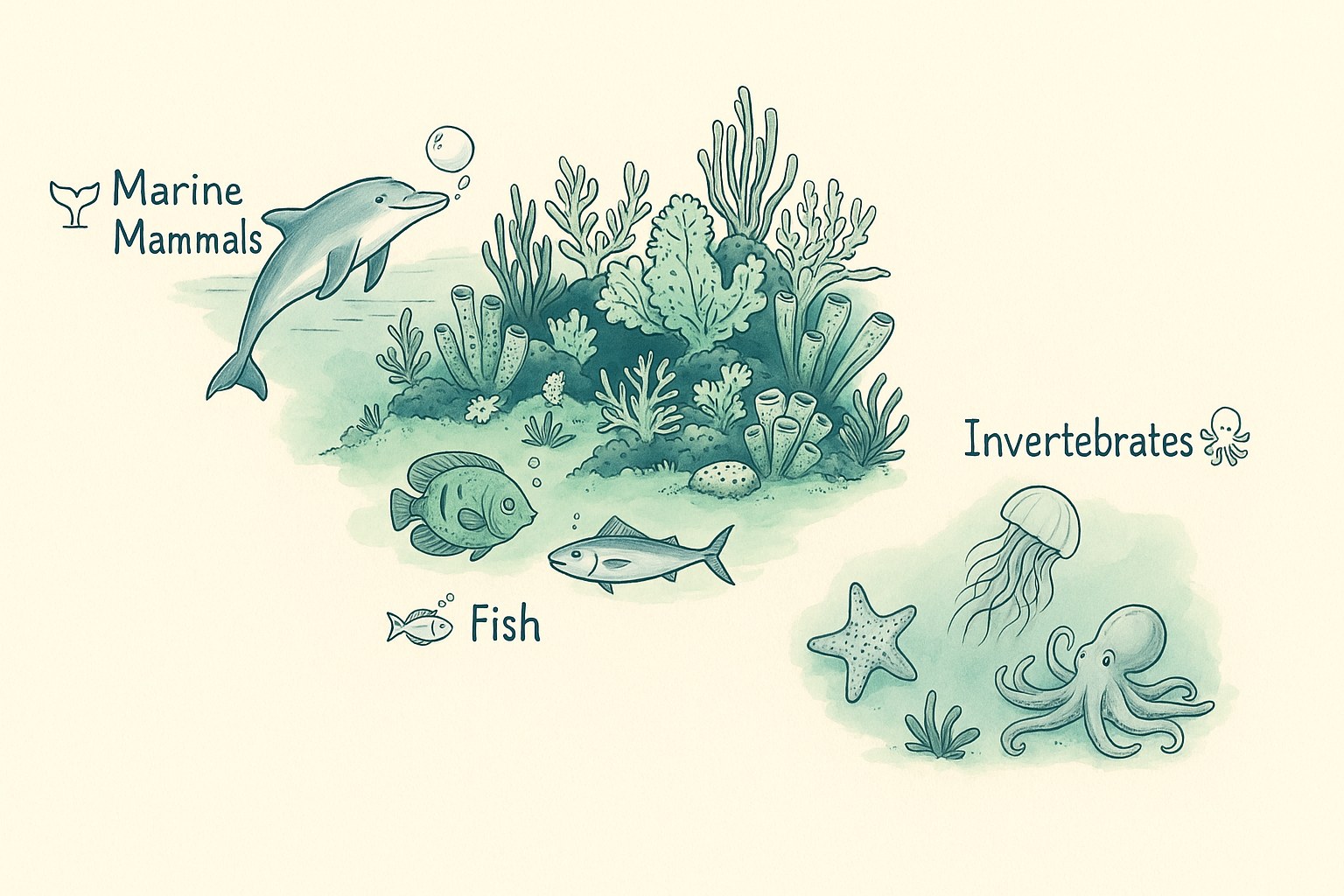
🐬 Marine mammals and breathing air
Marine mammals have smooth skin and nurse their young. They are warm-blooded animals. They thus keep a constant internal temperature despite the chill of the ocean.
Their breathing is done with lungs. They absolutely must come up to the surface to take in air. Whales use their blowhole to breathe out, just like dolphins, always so playful between two breaths.
Marine biodiversity is full of surprises, and there’s always plenty more to discover about it. It really is fascinating.
🐟 Fish and life beneath the surface
Fish are easily recognised by their protective scales. Their fins ensure perfect stability. These natural tools allow them to steer with great precision.
Thanks to their gills, they capture the oxygen dissolved in their environment. They never put their head out of the water to breathe. That’s a major difference from whales or seals.
We often tell the residents of colourful reefs apart from the great swimmers of the open sea. The diversity of shapes depends directly on their habitat. Each species has a silhouette suited to its way of life.
🦑 Invertebrates with surprising structures
Marine invertebrates are animals with no internal skeleton. We often come across clever octopuses or familiar crabs on our coasts. They make up a huge part of ocean life.
Their diversity is striking, as with the echinoderms, which include the starfish. There are also cnidarians, like the transparent jellyfish that float gracefully in mid-water.
Their movements vary a great deal. Some crawl slowly along the bottom. Others simply let themselves be carried by the sea currents.
🐟 3 secrets about fish anatomy
To really understand how these creatures rule the oceans, let’s take a look at the hidden details of their anatomy.
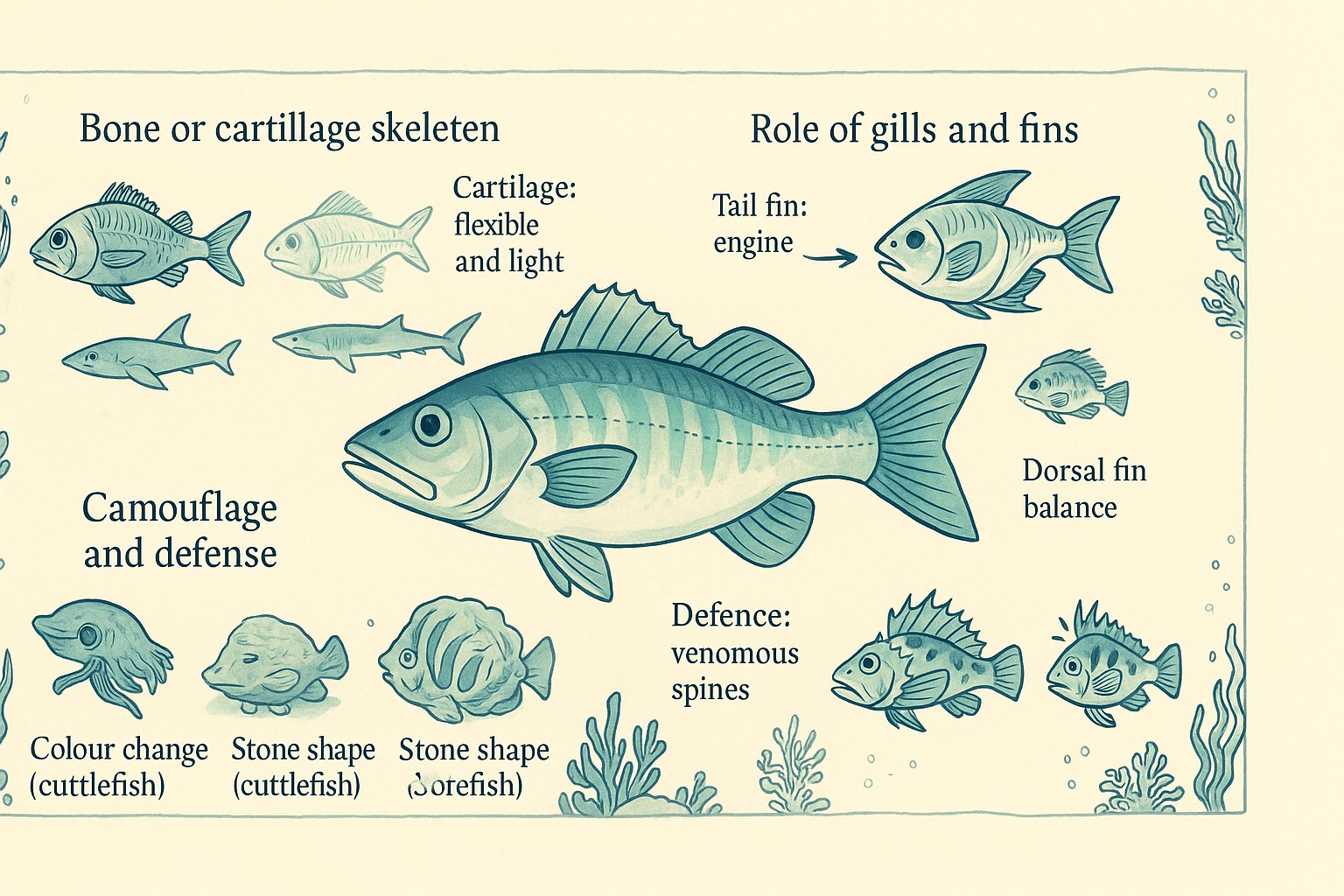
🦴 A skeleton of bone or cartilage
Nature offers two distinct structures. Bony fish have a rigid, hard frame. By contrast, cartilaginous species enjoy a far more flexible build.
The shark is a perfect example of this second group. Its skeleton made of cartilage turns out to be extremely light. This feature gives it formidable agility for hunting down its prey.
This difference directly affects buoyancy. Bones are heavier than cartilage in water. The structure therefore determines how the animal moves.
🐠 The role of gills and fins
Underwater breathing relies on a precise mechanism. Water flows through the gill slits. The blood then captures the oxygen.
The fins provide mobility and stability. The tail fin acts as a powerful engine for thrust. The pectoral fins steer the direction while the dorsal fin keeps a constant balance.
The adaptation to the marine environment is complete. These vital organs guarantee effective survival. They are quite simply indispensable.
🐡 Camouflage and defence in a hostile environment
Mimicry is a common protection strategy. Several species change their colour. They then blend in perfectly with the surrounding rocks or sand.
Defence can also become active. The scorpionfish, for example, uses venomous spines. Others display visual patterns designed to scare off overly curious predators.
Hiding remains an invisible and effective weapon. It lets them observe their surroundings without being spotted. Here are a few concrete examples:
- Colour change (cuttlefish)
- Stone shape (stonefish)
- Disruptive stripes (angelfish)
If you’d like to explore this world with your children, look for sea-animal discovery worksheets to print to find illustrated teaching resources.
🐳 How do marine mammals live?
If fish are the kings of staying underwater, marine mammals show fascinating social and family behaviours.
🐋 Nursing and caring for whale calves
Birth takes place out at sea. The young often arrive tail first to avoid drowning. They must quickly reach the surface to breathe.
Their diet relies on an incredible milk. This drink contains between 35% and 50% fat. This allows the calf to grow at a record pace every day.
The bond with the mother stays very close. The mother watchfully protects her calf from predators. She patiently teaches it the long migration routes towards the poles.
🔊 Communicating with sounds and clicks
Echolocation guides dolphins with precision. They send out clicks that bounce off their prey. It’s a real natural sonar for hunting.
The song of a humpback whale can last twenty minutes and be heard hundreds of kilometres away by other whales.
The songs of whales are real feats. These complex melodies travel for kilometres underwater. They mostly serve to attract a mate or to gather together.
Intelligence rules their social life. Individuals help one another to catch fish. They even have languages of their own for each group, like dialects.
🗺️ The great yearly migration routes
Their journeys follow the rhythm of the seasons. Whales leave the cold poles as soon as winter arrives. They then head for the much warmer tropical waters.
The purpose of this journey is vital. They migrate to breed in complete safety. They then return north to feed on krill.
Their physical endurance is exceptional. These giants travel thousands of kilometres. It’s a colossal effort made faithfully every year.
🦀 The diversity of invertebrates in the deep blue
Let’s leave the giants behind to observe the tiny, strange world of the boneless creatures that inhabit the seabed.
🦞 Crustaceans and shelled molluscs
Here, external protection is the golden rule. Lobsters and crabs have a solid shell. It protects them against knocks and predators.
The process of moulting turns out to be essential. To grow, the animal has to shed its skin. It abandons its old armour that has become too tight.
These bottom-dwelling species actively dig through the sand. They play the role of essential cleaners. Their presence balances life on the seabed.
⭐ Echinoderms and starfish
The shape of starfish is surprisingly regular. They often have five jointed arms. Their skin is covered with small hard plates.
Their way of moving is unique. They use thousands of tiny suckers. This lets them climb easily over the rocks.
Sea urchins and starfish keep the biological balance. They prevent invasive algae from spreading. This ecological role is a major one.
🪼 Cnidarians and gelatinous jellyfish
Jellyfish are made mostly of water. They have neither a brain nor a real heart. Their body structure is therefore simplified to the extreme.
Their tentacles inject a venom to paralyse. That’s how they capture plankton. These stinging cells are formidable weapons.
They don’t actively swim towards a destination. They simply travel with the movements of the ocean. They drift along with the currents.
| Group | Example | Main feature | Habitat |
|---|---|---|---|
| Crustaceans | Lobster | Shell | Seabed |
| Molluscs | Octopus | Soft body | Reefs |
| Echinoderms | Sea urchin | Spines | Benthos |
| Cnidarians | Jellyfish | Tentacles | Open sea |
To explore this world, use sea-animal discovery worksheets to print. They’re a great way to learn the names of dozens of species while having fun.
⚠️ 3 threats to the balance of the oceans
All this biological richness is today fragile and depends on a balance that humans sometimes upset without meaning to.
🔄 The food chain and ecological roles
The relationships between species shape marine life. The big eat the small with mathematical precision. Every link turns out to be vital for the overall survival of this blue world.
The disappearance of a predator changes everything. Without sharks, the plant-eating fish swarm and devour everything. The coral reefs end up suffering and weaken quickly.
A balanced ecosystem copes better with disease. Biodiversity is our best life insurance. It provides half of the oxygen we breathe every day.
🌊 Habitats from the coast to the great depths
The ocean has distinct life zones. The light fades with the depth of the basin. The pressure rises and radically changes the forms of life.
Coral reefs overflow with incredible richness. They are real nurseries for small fish. They also protect the coasts from the force of the waves during storms.
The ocean depths remain mysterious places. Strange creatures live there with no light at all. They withstand extreme conditions, as you can see on teaching worksheets about deep-sea animals.
💚 Simple actions to protect species
Reducing plastic waste is a priority. Bags often end up in the stomachs of sea turtles. Picking up your litter on the beach is an essential everyday gesture.
Global warming weighs heavily on the seabed. Warmer water bleaches the fragile corals. We need to limit our carbon footprint right now to save these precious habitats.
Respect during outings remains crucial. Don’t touch the wild animals you come across. Observe from a distance so you don’t stress them needlessly.
🎲 Fun activities with our printable worksheets
To turn these discoveries into lasting memories, nothing beats a hands-on, fun approach with the children.
🏖️ Quizzes and coastal observation games
Testing your knowledge becomes child’s play. Ask questions about how whales breathe. Check whether the child can clearly tell a fish from a marine mammal with our resources.
Set visual challenges on the beach during your walks. Look for signs of marine life in the sand. Identify the shells left behind by the tide. Use our worksheets so you don’t miss a thing. It’s a natural treasure hunt.
Play makes learning memorable. Children love taking on these little daily challenges.
🖍️ Colouring pages and drawings to complete
Memorising through drawing is a technique that works wonders. Colouring a jellyfish helps to understand its transparency. It’s a calm and very educational activity for the afternoon.
Offer sketching exercises for the most curious. Ask the child to draw the fins precisely. This fixes the anatomical details in their head without any tedious effort.
Let them imagine the colours of tropical fish. Art supports scientific understanding in a smooth way. Here are a few ideas to mix things up:
- Shark anatomy
- The life cycle of a turtle
- Octopus camouflage
📖 A little illustrated glossary for children
Defining technical terms helps to grasp the ocean better. Explain simply what an echinoderm is. You need to use words the youngest children understand without any particular difficulty.
The link between the image and the word is crucial. A photo of a gill instantly clarifies the concept. The child remembers the information better with a clear, colourful visual aid.
Building up vocabulary helps to name nature precisely. This naturally strengthens respect for the environment in little ones.
Ready for the adventure? Between fascinating mammals, agile fish and mysterious invertebrates, the ocean will hold no more secrets for your little explorers. Print these sea-animal discovery worksheets quickly to turn your living room into a real educational aquarium. Off we go towards knowledge and wonder as a family!
🎬 Watch the video
❓ FAQ
📥 Where can I find free printable worksheets about sea animals?
To keep your little explorers busy, you can find wonderful resources online, with many sites offering “wild animal” worksheets in PDF format, including ones about marine mammals. You usually just click on the picture of the animal to start the download.
Some sites are real gold mines too. They offer a free picture chart bringing together around 30 sea animals with their names written just underneath. It’s perfect for learning to put a word to each fin or tentacle!
🐳 What are the main families of sea animals to discover?
To see things more clearly, you can sort the ocean’s inhabitants into three big groups: marine mammals, fish and invertebrates. Mammals, like dolphins, have lungs and nurse their young, while fish breathe underwater thanks to their gills.
The world of invertebrates is even more surprising, because it brings together all those that have no backbone. You’ll come across crustaceans with their shell, soft-bodied molluscs like the octopus, or echinoderms like starfish.
🫧 How do fish breathe and move underwater?
It’s their anatomy that does all the work! Fish use their gills to capture oxygen directly from the water without ever needing to put their head out at the surface. To move forward, they use their fins: the tail fin acts as an engine, while the others help to keep balance or to brake.
Did you know that not all fish have the same skeleton? Some, like the sea bream, have nice hard bones. Others, like sharks and rays, have a skeleton made of cartilage, much more flexible and light, which makes them especially agile at hunting.
🔊 How do marine mammals communicate with each other?
Underwater, eyesight isn’t always great, so these animals use sounds a lot. Dolphins even have sound “signatures”, a bit like names, to call out to one another. They also use echolocation, a real natural sonar, to find their way and to find food.
Whales, for their part, are the champions of song. Their complex melodies can travel hundreds of kilometres! It’s essential for staying in touch with the group, especially during their huge migration journeys between the poles and the tropical waters.
🌊 What simple actions help protect the oceans with children?
Protecting the sea often starts with very simple little habits at home or at the beach. The most important thing is to reduce our plastic waste, because bags sadly too often end up in the bellies of turtles. Picking up your litter after a picnic is a giant first step.
During your outings along the coast, teach children to observe without touching. Not disturbing the animals and keeping your distance means you don’t stress them. It’s a lovely way to teach them respect for nature while admiring the beauty of the show.
