
Explaining volcanoes to children can feel like a real challenge when you don’t know where to start between magma and lava. This handy guide breaks down how they work and the different kinds of eruptions, to turn your little curious minds into true Earth experts. 🌋 You’ll discover secrets about the Ring of Fire and even about the giant Olympus Mons, to wow everyone at the next snack time.
- Volcanoes for kids: a mountain like no other
- Two types of eruptions for two styles of volcano
- Telling an active volcano from an extinct one
- Discovering undersea volcanoes and the ones in space
- Staying safe and studying volcanic rocks
- Learning with a volcano experiment and games
🌋 Volcanoes for kids: a mountain like no other
Now that we’ve set the scene with these giants of stone, let’s see what they’re really made of.

⛰️ The shape of the volcano and its crater
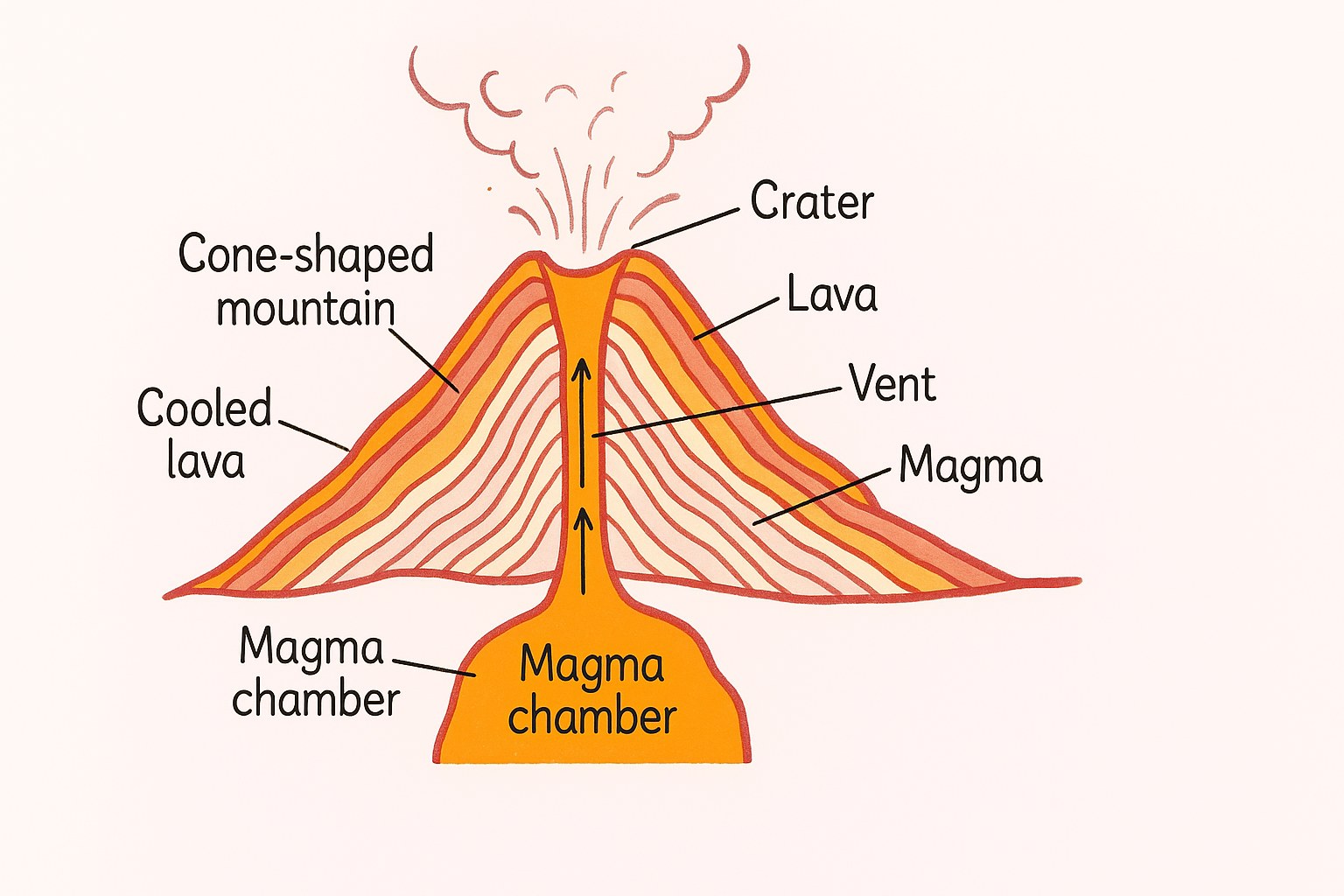
A volcano looks like a cone-shaped mountain. It grows because cooled lava builds up layer after layer. Each eruption adds a new thickness of solid rock.
The crater is a big hole at the very top. That’s where the rocks and the smoke come out. Unlike ordinary mountains, a volcano is alive and often changes shape.
The summit looks like a giant funnel turned up towards the sky. This opening stays the main passage down into the depths of the Earth.
🔥 The magma reservoir and the vent
The magma chamber is hidden beneath our feet. It’s a huge reservoir where the molten rock waits patiently. It’s like an enormous boiling pot under the Earth’s crust.
The vent links this reservoir straight to the summit. It’s a long vertical pipe carved into the rock. The magma uses it to rise quickly towards the surface.
Gases push the burning mixture upwards. Without these bubbles, the magma would stay stuck at the bottom. The pressure then becomes too strong and everything explodes suddenly.
🌡️ The difference between magma and lava
Magma is liquid rock stored under the ground. It’s extremely hot in those dark depths. As long as it stays hidden, it keeps that exact name.
It becomes lava the moment it finally comes out. On contact with the air, the gases escape from the liquid. It’s a bit like opening a well-shaken bottle of fizzy drink.
The change of name marks the meeting with the outside world. The lava then starts to flow down the slopes. In the end it hardens and turns into solid stone.
💥 Two types of eruptions for two styles of volcano
Now that we know the anatomy of the monster, let’s look at how it wakes up.
🟠 Effusive volcanoes and their lava flows
Red volcanoes have very runny lava. It flows along calmly, like warm strawberry syrup. These are the least dangerous eruptions.
The lava burns everything in its path but moves slowly. It follows the route of the flows down the slopes. You can often watch them from afar without any risk.
The lava from effusive volcanoes can reach a speed of 60 km/h on steep slopes, but it slows down quickly on flat ground.
💨 Explosive volcanoes and their ash clouds
Grey volcanoes have very thick lava. It blocks the vent and creates terrible explosions. It’s an impressive sight but a very risky one.
Ash clouds rise very high into the sky. The volcano also hurls out blocks of stone called bombs. Pyroclastic flows race down the slopes at a wild pace. Everything gets covered in grey dust.
These eruptions radically transform the landscape. The ash can even hide the sun for several days.

🔥 Why is lava so hot?
The heat comes from the heart of the Earth. The deeper you go, the higher the temperature climbs. The rock ends up melting completely.
Lava can reach 1,200 degrees Celsius. That’s ten times hotter than boiling water. These numbers often spark children’s imagination.
Cooling down takes a long time. Even when it’s black on the surface, lava stays burning hot underneath. Sometimes it takes years for it to go cold.
🔍 Telling an active volcano from an extinct one
Not all volcanoes are angry at the same time, some prefer to take a nap.
💤 Active, dormant and extinct volcanoes
Active volcanoes move often. They smoke or spit out lava regularly. We have to watch them very closely because they’re very excitable.
Dormant volcanoes are calmer. They’ve done nothing for a long time but they can wake up. It’s as if they were having a very long nap.
Extinct volcanoes will never move again. Their magma store is empty or cooled. They are now part of the calm natural landscape forever.
⚠️ The signs that announce an eruption
Here are the clues that specialists watch for to predict a wake-up:
- Small earthquakes beneath the summit
- Swelling of the slopes of the volcano
- An increase in smoke and gases
The ground shakes when the magma rises. The volcano changes size because the inner pressure increases. Scientists use special tools to measure these bulges. It’s a very important warning signal.
Animals sometimes sense the danger before we do. They often flee far from the crater before the explosion.
🗺️ Where volcanoes are found on Earth
The famous Pacific Ring of Fire is impressive. It’s a huge circle where most of the volcanoes are found. There are hundreds of active summits there.
There’s a link with the tectonic plates. The Earth is like a puzzle that moves. Volcanoes are born where the pieces touch.
You’ll find famous giants in Italy or in Iceland. In France, the volcanoes of the Auvergne are famous but extinct. Today they form magnificent green hills.
🌌 Discovering undersea volcanoes and the ones in space
If you thought you’d seen everything on land, wait until you see what’s hiding under the water and up in the sky.
🌊 How volcanoes work under the sea
The vast majority of volcanoes hide under the ocean. We never see them, but they work non-stop. The deep water hides absolutely incredible eruptions.
The burning lava cools instantly on contact with the cold water. It then forms round balls called pillow lava. It’s a truly strange thing to watch down in the depths.
These aquatic giants sometimes create brand-new islands from scratch. The lava builds up patiently until it rises out of the water. That’s how the famous Hawaiian Islands were born.
🪐 Olympus Mons and the volcanoes of other planets
Let’s travel to Mars to discover the colossal Olympus Mons. It’s the biggest volcano in our entire Solar System. It rises to two and a half times the height of Everest.
On Mars, everything seems huge because gravity is different. Compared to our volcanoes on Earth, it’s a titan. And yet this giant is completely dormant, and has been for a very long time now.
Let’s also look at Io, a particularly active moon of Jupiter. It has volcanoes that spit out sulphur all the time. Space really is full of quite surprising volcanic worlds.
👨🔬 The job of a volcanologist day to day
Adventurous scientists study these mountains of fire every day. They wear special suits to put up with the intense heat. Their work is as exciting as it is essential.
They use sensors to listen to the heart of the Earth. They analyse pieces of lava they’ve collected. Their goal is to predict the next eruptions.
In the end, these experts save thousands of lives every year. Thanks to their monitoring, threatened villages can be evacuated in time.
🦺 Staying safe and studying volcanic rocks
Admiring volcanoes is great, but knowing how to stay safe and study their remains is even better.
🦺 Safety and prevention measures
Evacuation plans save lives during an alert. Every resident must know their exact route to a safe zone. Safety always stays the absolute priority for everyone.
Wearing a certified N95 mask protects the lungs effectively. Volcanic ash stings the eyes and brings on dry coughs. You absolutely must cover your face with suitable equipment.
Crossing the safety barriers exposes you to deadly risks. Active zones stay strictly off-limits to the public without a specialist guide. Danger can strike very suddenly.
🌍 Protecting the environment when eruptions strike
Ash covers the gardens and ends up smothering the young shoots. Yet this grey dust also brings precious nutrients to the soil. The earth then becomes more fertile.
Life takes hold again as soon as the lava cools. Brave little flowers often grow back in the cracks of the black rocks. Nature shows itself to be incredibly strong and patient.
The climate can change after a massive release of gas. The dust sent into the sky sometimes blocks the sun’s rays. This can cool the Earth’s temperature for a few months.
🪨 Identifying volcanic rocks and their textures
Pumice stone is amazing because it floats on water. It holds a multitude of tiny air bubbles trapped during cooling. It’s a very light rock but also a rough one.
Basalt is a black stone, very heavy and compact. You find it everywhere on the active volcanoes of the world. This rock is known for its strength and its great hardness.
| Rock | Appearance | Special feature |
|---|---|---|
| Pumice | Pale and porous | Light and floats on water |
| Basalt | Dark grey or black | Heavy and very tough |
| Obsidian | Glassy black | Sharp like glass |
🧪 Learning with a volcano experiment and games
To finish on a high note, let’s turn your kitchen into a fun geology lab.
🧪 The vinegar and baking soda volcano experiment
Mixing baking soda and vinegar creates a magic foam. It’s the perfect base for testing mini volcano experiments at home. This activity always fascinates little curious minds.
Add some red colouring to mimic the lava. The carbon dioxide makes the mixture rise out of the container. It’s a chemical reaction with no danger at all. Children love to see this colourful overflow.
Use a little washing-up liquid for more bubbles. Your homemade volcano will then be really impressive.
🎨 Creative activities and family models
Make a volcano out of modelling dough or cardboard. You can use recycled materials for the scenery. It’s a great hands-on activity.
Offer sensory games with warm colours. Red, orange and yellow remind us of fire. You have fun touching different textures.
Invent stories about giants of fire. Children can draw their own imaginary volcano. This boosts their creativity while they learn.
💗 Managing your emotions with the volcano metaphor
Use the image of the volcano to talk about anger. Sometimes you feel it rumbling inside. It’s like the magma pushing up.
Offer breathing techniques to calm down. You blow out gently to bring the pressure down. This avoids the explosion of shouting.
Explain that expressing your feelings helps a lot. Putting words to the emotion releases the trapped gases. You feel better afterwards, like a soothed volcano.
These fascinating giants, whether they’re red and effusive or grey and explosive, remind us of the power of the Earth. To keep the adventure going, try the vinegar volcano experiment and become a real budding volcanologist. Understanding volcanoes explained for children means turning a geology lesson into an explosive, unforgettable family memory!
🎬 Watch the video
❓ FAQ
🌋 What exactly is a volcano?
A volcano is a landform that often looks like a cone-shaped mountain. It’s a living structure that shows all the bubbling activity inside our Earth.
It forms little by little, when molten rock and ash build up at the surface. Unlike ordinary mountains, it has a crater at the top, a kind of big funnel where the lava and the smoke come out.
🔥 What is the difference between magma and lava?
It’s a game of hide-and-seek! Magma is the name for liquid rock as long as it stays hidden under the ground, in a large reservoir called the magma chamber.
As soon as this burning mixture comes out into the open air during an eruption, we then call it lava. It’s a bit like a bottle of fizzy drink: while it’s closed you don’t see the bubbles, but as soon as you open it, the gases escape and everything overflows!
💥 Why do some volcanoes explode while others flow gently?
It all depends on the “recipe” of the magma. Effusive volcanoes (the red volcanoes) have very runny lava that flows like syrup. It’s an impressive sight but often less dangerous.
The other way round, explosive volcanoes (the grey volcanoes) have very thick lava that blocks the vent. The pressure rises and rises… and ends up causing terrible explosions with ash clouds and showers of rock.
🌊 Are there volcanoes under the water?
Absolutely, and they’re even the most numerous! It’s estimated that 90% of our planet’s volcanoes hide under the oceans. We don’t always see them, but they work non-stop in the depths.
When lava comes out under the water, it cools all at once and forms round balls called “pillow lava”. Sometimes, by building up rock, these volcanoes end up rising above the water and create new islands, like in Hawaii or on Réunion.
⚠️ How do you know if a volcano is going to wake up?
Volcanologists are real detectives who watch the signs of the Earth’s “anger”. Before an eruption, you often see small earthquakes or a swelling of the volcano’s slopes, because the magma is pushing to get out.
Scientists use special tools to measure these changes and the escaping gases. Even animals sometimes sense the danger and move away from the crater long before we do!
🗺️ Where is the biggest known volcano?
To find it, you have to look up at the sky! The all-round champion is called Olympus Mons and it’s on the planet Mars. It’s enormous: two and a half times higher than Everest!
On Earth, most volcanoes are concentrated along the Pacific “Ring of Fire”. In France, we have the magnificent volcanoes of the Auvergne, but don’t worry, they’re extinct and today they form lovely green hills.
