
🔌 Explaining electricity to children can feel like a real challenge, because this invisible force seems so abstract. ⚡ This article sets out to turn that flow of energy into something concrete, using simple pictures and fun experiments you can try at home. You will discover how tiny electrons travel through wires to light up our lamps, and how to teach these ideas to your little scientists in complete safety.
- Electricity explained simply for kids
- The secrets of a working circuit
- Conductors and insulators
- Fun experiments to learn without getting bored
- Home safety and protecting the planet
- Choosing the right electric kit by age
⚡ Electricity explained simply for kids
Once you start wondering how the world around us works, you naturally arrive at the building block of everything that exists: the atom.

⚛️ Atoms and their tiny electrons
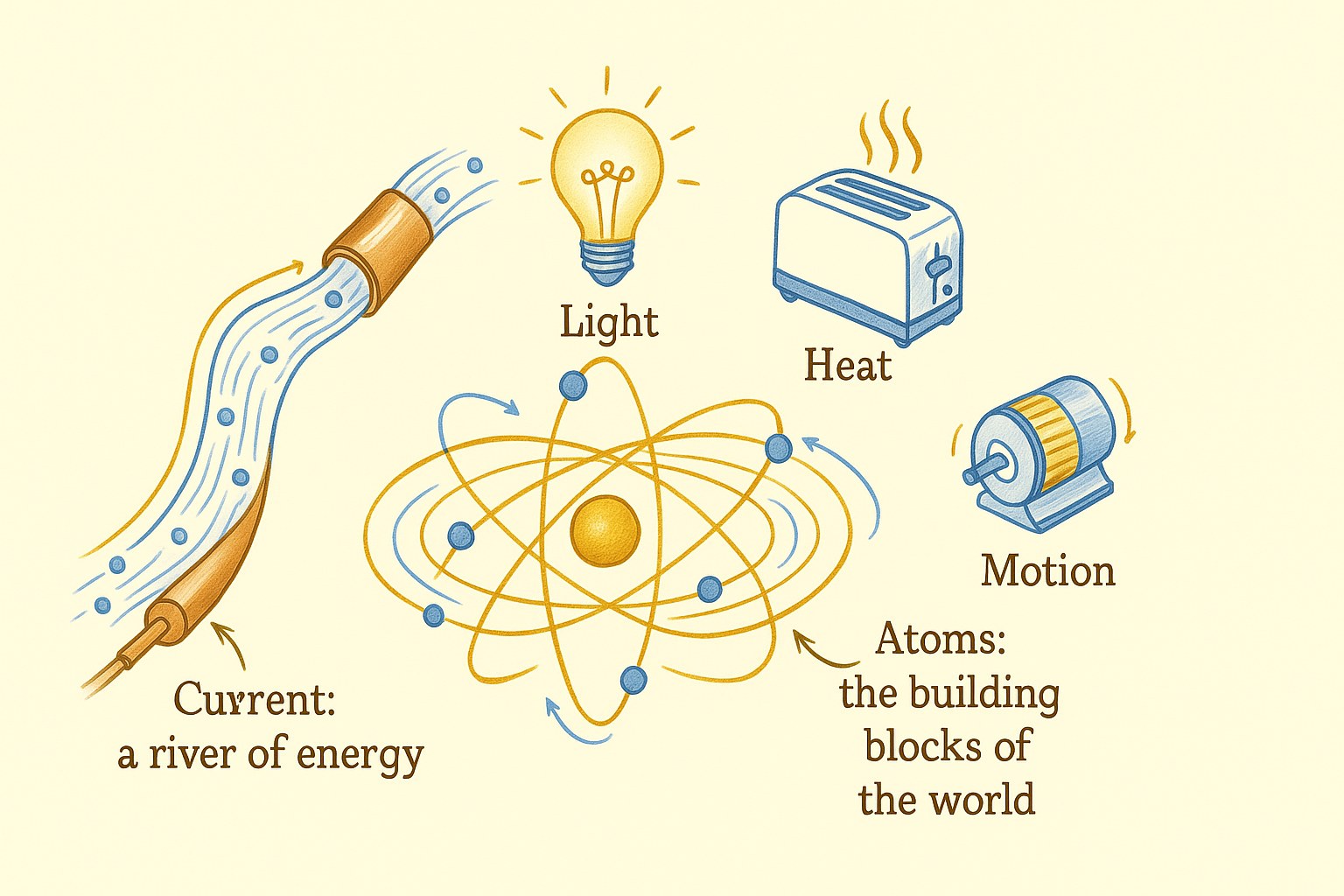
Imagine that every object is made of tiny bricks called atoms. These are far too small to see with the naked eye. Yet they form the basis of all the matter around us.
At the centre sits a nucleus packed with protons. Electrons spin around it, like a miniature solar system. It is exactly this never-ending movement that ends up creating usable energy.
Electrons carry a negative charge. They love hopping from one atom to the next. This tiny, constant journey kicks off the whole process we call electricity.
〰️ How energy moves through the wires
You can think of an electric current as a river of electrons. They flow along a pipe, often a copper wire. It is the perfect path for them to travel without any trouble.
Static electricity stays put, like the charge on a rubbed balloon. A flowing current, on the other hand, sees all the electrons move forward together. It is a real team marching as one.
Electricity is nothing more than a huge queue of electrons, eager to move along a conductor and carry energy with them.
💡 The visible effects of an electric current
As electrons pass through, they sometimes make heat, just like inside your toaster. Energy changes form when it meets resistance. It is a concrete and almost magical effect.
Here is how this energy shows up in your home:
- Light, thanks to bulbs.
- Heat, through radiators.
- Movement, with the motors in toys.
- Magnetism, from electromagnets.
A current can even make real objects move. That is the basic principle behind electric motors. At last you can see what these tiny travelling electrons are truly good for.
🔌 The secrets of a working circuit
Now that we know what an electron is, let us see how to build it the perfect road so it can do something useful.

🔁 The closed loop that makes the bulb glow
For electricity to flow, it needs an unbroken loop. If the path is cut, the electrons stop dead. It is a bit like a raised drawbridge blocking the cars.
The current sets off from the source towards the device. The battery pushes the energy, the bulb glows, then the current comes back. This cycle has to be completely whole for anything to work.
We then talk about an open circuit or a closed circuit. This is the basic vocabulary of little engineers. Without that perfect loop, no light is possible in the build.
🔋 Batteries and switches: the drivers of the current
A battery turns chemistry into electricity for us. It acts as the main energy store for the whole build. It gives the electrons the push they need to move.
A switch behaves exactly like a door. You open it to stop the flow, and close it to let it through. It is the real conductor of the simple circuit.
There are also LEDs to play with. They are tough and use very little power. They are a perfect choice for first experiments at home, with no danger.
✏️ Drawing your first circuit diagram
First you need to learn the universal symbols. A line stands for the wire, and a circle stands for the lamp. It is a visual language that scientists all over the world share.
Learning to read a plan is handy before you connect anything. It helps you avoid silly mistakes and short circuits. You prepare your little build like a true professional.
Linking the drawing to reality feels like magic. The diagram becomes the road map of energy. It is so satisfying to finally see the build work thanks to your sketch.
🧪 Conductors and insulators
For our circuit to be efficient and safe, we need to pick the right materials, the ones that let our electrons through or block them.
🔩 Why metal lets the current pass
Metals are the electrons’ best friends. Their atoms let charges flow very easily. That is why we use them everywhere.
Copper and aluminium are perfect. They are the champions of carrying energy. You will find them in every cable in the house.
Their inner structure is like a clear motorway. Nothing slows the particles down. That is the very definition of a good conductor.
🪵 Plastic and wood to keep us safe
Insulators are the guardians of safety. Plastic, wood and glass block the electrons. They stop them straying off the chosen path.
Electric wires are wrapped in coloured sheaths. That is there to protect us from shocks. Without it, handling electricity would be far too risky.
Many everyday objects insulate us too. The soles of shoes and the handles of tools are good examples. They form an invisible but effective barrier.
💇 The mystery of hair standing on end
Static electricity is a fun thing. It appears when you rub two insulating objects together. The electrons pile up without being able to flow.
Have you ever rubbed a balloon on a jumper? The hairs are pulled up as if by magic. It is the imbalance of charges that creates this force.
This is a rather lazy kind of electricity. It waits for a chance to jump and balance itself out. That is the little spark when you touch a door handle.
🔬 Fun experiments to learn without getting bored
Theory is all very well, but nothing beats hands-on practice for truly understanding how these tiny electrons spring into action before our eyes.
🍋 The lemon battery that surprises everyone
For this experiment, all you need is a lemon, a copper coin and a galvanised nail. The fruit’s natural acidity sets off a surprising chemical reaction. It makes an astonishing natural battery.
The idea relies on a reaction called oxidation-reduction. The zinc from the nail gives electrons to the copper. The lemon juice acts as the vital bridge for this invisible journey of the particles.
You can test the result with a small LED. It is solid proof that energy hides absolutely everywhere around us.
🛠️ Building a homemade conductivity tester
| Object tested | Material | Conductor? | What you see |
|---|---|---|---|
| Metal spoon | Metal | Yes | Bulb lights up |
| Eraser | Rubber | No | Bulb stays off |
| Plastic ruler | Plastic | No | Bulb stays off |
| Pencil lead | Graphite | Yes | Bulb lights up |
| Coin | Metal | Yes | Bulb lights up |
| Cork | Cork | No | Bulb stays off |
You put together a battery, a bulb and two loose wires. If the object you touch lets the current pass, the lamp lights up. It is a real science detective’s tool.
It is great fun sorting your finds from around the house. You soon discover that metal wins every time. It is a perfect way to fill a rainy Sunday afternoon.
🎭 Role-play games to understand electrons
Get a group of children to stand in a ring to act out a circuit. They pass an object around to stand for the energy. It is a visual and very active exercise for little ones.
Then show what happens when someone lets go of a hand. The chain is broken and the current stops dead. It is the perfect picture of a switch left open.
Just add a bit of speed to show intensity. The faster you run, the more energy is produced. Children absolutely love playing these tiny moving particles.
🛡️ Home safety and protecting the planet
Playing with batteries is fun, but the electricity in the home demands far more respect and care every single day.
⚠️ The golden rules for handling it safely
The electricity from wall sockets is very powerful and dangerous. It can cause serious burns. The safety devices in modern homes are there for a very good reason.
To protect the youngest children, fitting shuttered sockets and 30 mA safety switches is an absolute priority. This equipment blocks access to the current and cuts the power automatically if there is a problem in any room of the house.
Never bring water near an electrical source. That is rule number one to remember. Safety comes before any experiment.
🌱 Simple ways to save energy
Producing electricity has an impact on our planet. So we must avoid wasting it. Switching off the lights is a good start.
Energy is hard to store in large amounts. We use what is being made at that very moment. Every little action counts for the environment. It is a team effort.
Set family challenges to cut the bill. It is a fun way to become a responsible citizen. The planet will thank you. Who can switch off the most standby lights tonight?
♻️ The life cycle of a recycled battery
A battery thrown into nature pollutes a great deal. It contains heavy metals that damage the soil. You should always take them back to the shop. It is a simple but vital habit.
During recycling, the metal is recovered to make new objects. You can even make spectacle frames from old batteries! It is a virtuous circle worth encouraging.
Choose rechargeable batteries for your favourite toys. It is cheaper and far greener. A smart choice for the future. That way you avoid making useless waste.
🎁 Choosing the right electric kit by age
To go further, there are wonderful tools suited to every stage of your little scientist’s growth.
🧒 A gentle start for ages 4-6
At this age, the focus is on hands-on, sensory play. Conductive pens let children draw magic circuits. It is a very artistic approach.
Avoid connections that are too tricky or any small parts. Kits with big magnetic blocks are perfect. Children learn while having fun, with no frustration.
The goal is to marvel at a light switching on. It is the first contact with science. Curiosity is the best engine of all.
🧩 Circuit challenges for ages 7-9
Children of this age love concrete challenges. Building sets with clip-on parts are ideal. They can build sound alarms.
You can introduce the first ideas of simple robotics. Making a little brush robot move is very rewarding. They begin to grasp the logic of wiring.
This is the time to try circuits in series or in parallel. Mistakes turn into chances to learn. They become a real little technician.
🌿 Green energy and STEM projects from age 10
For the older ones, you can explore renewable energy. Solar or wind kits are thrilling. They make their own clean energy.
It is also a chance to learn how electricity is produced through a real visit to a power plant. It is a concrete and memorable experience.
Build complex projects, such as cardboard lamps. This is the spirit of STEM, mixing science and hands-on making. You are shaping the inventors of tomorrow.
Understanding electricity for children means discovering the journey of electrons and the importance of closed circuits. Adopt good safety and energy-saving habits straight away to protect our planet. Become, starting today, the little engineers of a bright and responsible future!
🎬 Watch the video
❓ FAQ
⚡ What exactly is electricity for a child?
Electricity is a natural phenomenon that comes from tiny invisible parts called atoms. Inside these atoms are even smaller particles, the electrons, which love travelling from one atom to another. It is this movement of electrons that creates the energy we use.
You can compare it to a river: when the electrons all move together in the same direction, like the water in a stream, it forms an electric current able to light a bulb or turn a motor.
🔌 How can you simply explain how a circuit works?
Picture a closed-loop racetrack. For the electrons to do their work, they need a continuous path that starts at a battery (the engine), passes through an object such as a lamp, and returns to the battery. If the path is cut, for example when a wire is unplugged, everything stops dead.
The switch is the little door on that path. When you press it to switch off, you open the door and the electrons can no longer pass. When you switch on, you close the door and the loop is complete!
🪙 Which materials let electricity through?
We call these materials “conductors”. Metals, such as the copper inside cables or aluminium, are the electrons’ best friends. They give them a real motorway to travel along without any obstacle.
By contrast, there are “insulating” materials such as plastic, glass or wood. These block the way. That is why electric wires are always wrapped in plastic: it lets us handle the cables without the electrons escaping towards our hands.
💇 Why does my hair sometimes stand on end by itself?
This is what we call static electricity! Unlike the current flowing through wires, this kind of electricity stays put. It often appears when you rub two insulating objects together, like a balloon against a woolly jumper.
The electrons gather on the surface and create an invisible force that pulls your hair up. It is also what causes the little spark or “tickle” you sometimes feel when touching a metal door handle after walking on a carpet.
⚠️ Is electricity dangerous at home?
Yes, the electricity coming out of wall sockets is far more powerful than that of the little batteries in our toys. It can cause serious burns or very dangerous shocks, because our bodies are conductors too. So you must never put anything into a socket and always stay away from water when using an electrical device.
To protect us, modern homes use special sockets and safety systems that cut the power automatically if there is a problem. The golden rule is simple: play with batteries, but leave the sockets to the grown-ups!
💡 Why is it important to switch off the light when leaving a room?
Producing electricity takes a great deal of effort and resources from our planet. Since this energy is very hard to store in large amounts, it is better not to waste it. Every action, like switching off a lamp or unplugging a device, helps protect the environment.
It is also why you should recycle used batteries in special bins. They contain metals that can pollute the soil if thrown in the bin, but that are very useful when recovered to make new objects.
