
Does your child keep asking why the dinosaurs disappeared, and you’re looking for an answer that’s simple but still complete? This guide explains how a giant asteroid and angry volcanoes turned Earth upside down 66 million years ago. You’ll uncover the secrets of this geological detective story — from the crater in the Yucatán to the clever little mammals that survived to become our ancestors.
- A giant rock falls from the sky 66 million years ago
- Why Earth turned dark and cold
- Angry volcanoes played a part too
- The clever ones that made it through
- How we know all this without being there
- Could the dinosaurs ever come back?
☄️ A giant rock falls from the sky 66 million years ago
Earth was calm when a bright dot ripped across the blue sky. The Chicxulub asteroid had just made its crashing entrance, changing our planet’s fate forever.
📏 The size of the Chicxulub asteroid in Mexico
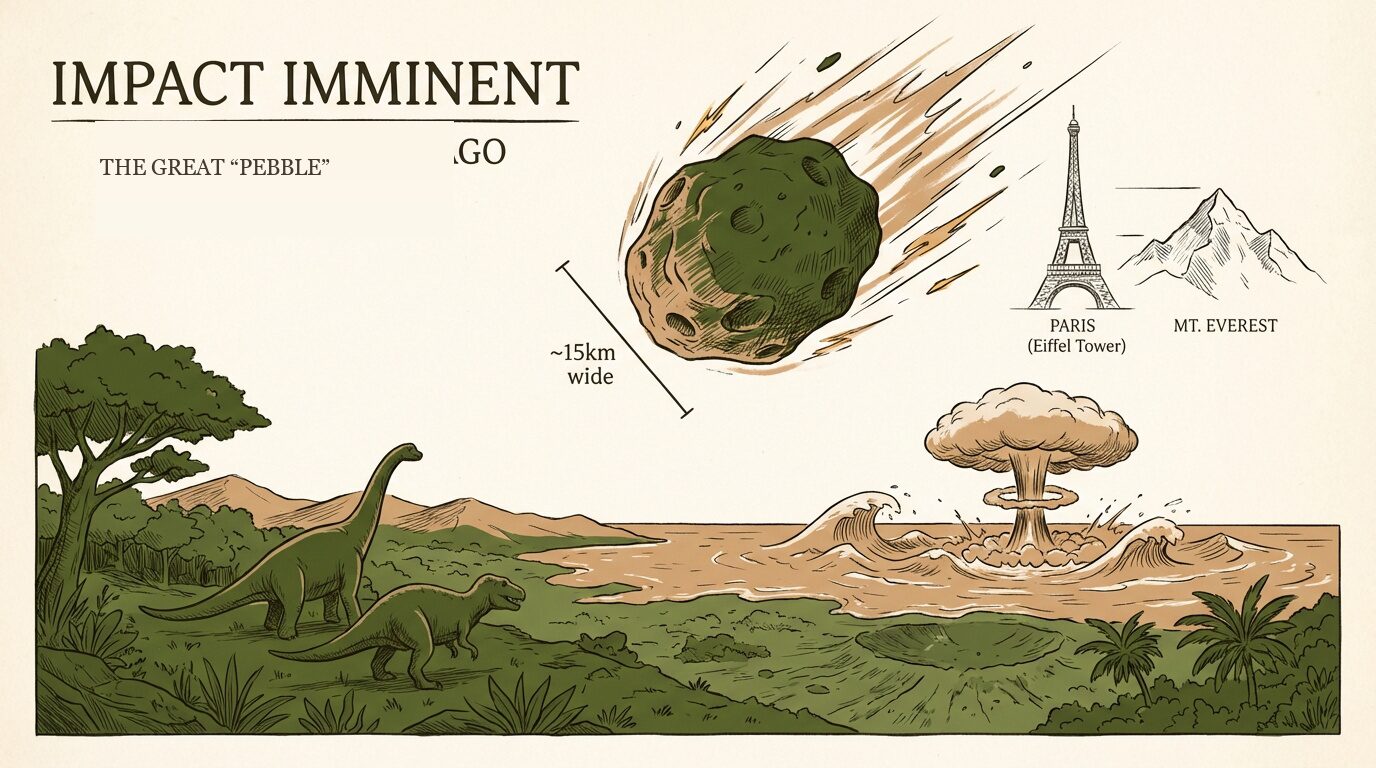
This space rock was a giant about 15 kilometers (9 miles) wide. Picture the whole city of Paris, or Mount Everest, dropping out of the sky. It was a monster of stone heading straight for us.
The object tore through the atmosphere faster than a bullet. The terrible impact happened in Mexico, on the Yucatán Peninsula. The violence of the crash marked Earth forever.
Today, the crater is hidden under the sea. We call it the Chicxulub crater.
💥 An explosion stronger than thousands of bombs
The energy released at the moment of impact was monstrous. It was far more powerful than all the atomic bombs ever made, put together. The ground shook across the entire planet.
Giant tsunamis swept across the oceans. These waves, as tall as buildings, wiped out everything along the coasts. The water destroyed whole regions in an instant.
The impact was so violent that it literally vaporized the rock and flung burning debris all the way into space before it rained back down.
⏰ The exact moment the Cretaceous ended
This drama happened 66 million years ago. On that day, Earth’s history changed course as the Cretaceous gave way to the next era. The world would never be the same again.
The event was shockingly brutal. In just a few hours, the world of the dinosaurs was devastated. It wasn’t a slow change — it was an immediate shock.
The story of why the dinosaurs disappeared rests on this mass extinction at the end of the Cretaceous. It was a major turning point for life on Earth.
🌑 Why Earth turned dark and cold
After the colossal explosion, the real nightmare began for the planet. The sky changed color and the temperature plunged, turning the dinosaurs’ garden into a hostile place.
🌫️ The curtain of dust that hid the sun
Dust and ash filled the atmosphere. The sky went pitch black. The sun could no longer light up the ground. This total darkness lasted for long months, even years.
Without light, the warmth disappeared. Earth became a giant freezer. The bright colors of flowers and forests faded away in the dark.
It was a winter with no end. The world was plunged into an icy night.
🌱 Plants and plankton stopped growing
Plants make their own food using light — that’s photosynthesis. Without the sun, they stopped growing and eventually died. Sad news for the scenery.
In the seas, plankton met the same fate. These tiny algae are the foundation of ocean life. They vanished first, triggering a disaster underwater.
The lack of light brought plant life to a dead stop.
🍽️ Famine in the food chain of the giants
The plant-eaters had nothing left to graze on. Big dinosaurs like Triceratops were starving. Their stomachs were empty because the forests were gone. A sad end for such giants.
The meat-eaters followed the same path. With no plant-eaters left to hunt, the T. rex had no prey. It was a domino effect that destroyed the food chain.
The biggest animals needed too much food. They were the first to go extinct.
🌋 Angry volcanoes played a part too
The asteroid wasn’t the only culprit in this tragedy. Earth itself was already in upheaval long before the final blow.
🌋 The massive eruptions of the Deccan Traps in India
In India, enormous volcanoes were spewing lava. It went on for thousands of years. This place is called the Deccan Traps — it was a true sea of liquid fire back then.
These eruptions pumped out toxic gases. The air became hard to breathe. Tons of ash also blanketed the landscape across incredible distances.
Earth was already gasping for air. The volcanoes were setting the stage for the final catastrophe.
🌡️ A climate change that dragged on
The volcanic gases trapped heat. Then the ash cooled everything down. The climate kept swinging back and forth.
The dinosaurs were worn out by all these changes. Their bodies couldn’t adapt that fast. They were already weakened before the asteroid even fell.
| Catastrophe | Main effect | Estimated duration |
|---|---|---|
| Asteroid | Sudden shock | Instant |
| Volcanoes | Gas and lava | Thousands of years |
| Nuclear winter | Darkness | Several months |
☄️ The deadly mix of lava and asteroid
The two catastrophes stacked up. It was an unbelievable pile-up of bad luck. Nature had no time to heal between the two.
It was this combination that turned out to be fatal. The asteroid delivered the final blow, but the species were already on the edge because of the volcanoes.
So the story of the dinosaurs’ disappearance also runs through this extraordinary volcanic activity that changed everything.
🐭 The clever ones that made it through
We often imagine everything vanished in one wave of a magic wand — but that’s not true. Some animals found incredible tricks to ride out this unprecedented storm and keep going.
🐁 Why being small was a huge advantage
Small animals ate very little. That was their superpower for surviving the famine. They could get by on roots or insects. The giants, meanwhile, couldn’t find enough calories.
They could also hide easily. Many lived in burrows underground. That way they were protected from the intense heat and the freezing cold.
Our mammal ancestors looked like mice. They survived thanks to their small size.
🐦 The birds are the dinosaurs in your backyard
Here’s the truth about birds: they’re the direct descendants of feathered dinosaurs. The T. rex is a distant cousin of the chicken. Pretty amazing to imagine.
Look at a bird’s legs. They look like reptile legs with scales. Some dinosaurs simply evolved to become smaller and able to fly.
To better understand this survival, you can explore the theropod family tree. They are the only dinosaurs still among us today.
🐟 Life underwater facing the disaster on land
Crocodiles and turtles held up better. The water acted as a shield against the fires. They could go a long time without eating, or get by on leftovers.
But the big marine reptiles disappeared. The Plesiosaur didn’t survive the crisis. Who lived and who died often came down to diet and size.
Here are a few groups that hung on:
- Crocodiles
- Turtles
- Some fish
- Small mammals
- Birds
🔬 How we know all this without being there
Science works like a real detective investigation. It lets us travel back in time using clues hidden in the ground to understand why the dinosaurs disappeared.
🪨 The layer of iridium hidden in the soil
Iridium is a metal that’s very rare on our planet. But there’s lots of it in asteroids. Scientists found a thin gray layer of iridium all over the world. It’s the proof of the impact.
This space dust settled after the explosion. It sits exactly at the ground level dating from the extinction. It’s like a signature left by the giant rock.
This layer separates the world of the dinosaurs from ours. You can see it in cliffs.
🦴 Fossils tell the end of an era
Paleontologists dig through the earth patiently. They find bones that have turned to stone. Above the iridium layer, there are no more dinosaur bones to be found.
That’s how we know they disappeared. The fossils stop dead at a certain depth. It’s visual proof of their sudden, total extinction.
Fossils are like the pages of a history book whose final chapters on the dinosaurs were suddenly torn out.
⏳ Using the geological clock to picture time
Imagine Earth’s whole history fits into 24 hours. The dinosaurs lived for several hours of it. The story of humans lasts only a few seconds at the very end.
That helps you picture geological time. It’s a span so huge it’s hard to wrap your head around. The dinosaurs stuck around far longer than we have.
It’s worth discovering this incredible story of life to better grasp these fascinating timescales.
🦖 Could the dinosaurs ever come back?
Once you understand why the dinosaurs disappeared, you often wonder whether these giants could ever poke their heads up again. It’s a dream of a question — but reality is quite different.
🐘 The rise of mammals after the giants were gone
Mammals took over all the space. Without the dinosaurs, they were able to grow and multiply. Nature created incredible new species. We wouldn’t be here today without that empty space.
It was a lucky break for human evolution. The small animals of the shadows became the kings of the Earth. The world reshaped itself to make room for us at last.
The disappearance of some made room for the life of others. That’s the natural cycle.
🎬 Science vs. the Jurassic Park myth
Let’s tell movies and reality apart. Dinosaur DNA is far too old. It breaks down over time. We can’t clone a T. rex today.
Labs can’t recreate these giants. It’s pure science fiction. You can sleep easy — no dinosaur is going to pop up on your street tomorrow morning.
- DNA breaks down after about 6 million years
- Fossils are made of stone
- No fresh blood available
🌍 Learning to protect the species still alive
The extinction of the past teaches us a lesson. Nature is fragile in the face of change. We need to protect the animals still living around us today.
Birds are our last dinosaurs. By taking care of them, we keep a link to that distant past. Let’s stay curious about and respectful of today’s wildlife.
Science helps us understand so we can act better. That’s our job as guardians.
The asteroid’s impact and the volcanoes turned Earth upside down, breaking the food chain. Understanding why the dinosaurs disappeared helps us protect today’s species. Let’s be careful guardians of our beautiful natural world. The past teaches us that every small life is a precious treasure.
❓ FAQ
📏 How big was the asteroid that wiped out the dinosaurs?
This space rock, which scientists call the Chicxulub asteroid, was a true giant. Its diameter is estimated at about 15 kilometers (9 miles) — roughly the size of the city of Paris, or the height of Mount Everest!
Picture such a monster of stone hurtling toward Earth. The impact was so powerful that it left a giant crater nearly 200 kilometers (124 miles) wide, now hidden under the sea and land in Mexico.
📍 Where exactly did this giant rock land?
The asteroid picked the Yucatán Peninsula in Mexico to end its wild ride. That’s the precise spot where the explosion happened, setting off catastrophes all around the globe.
Even though the crater is invisible to the naked eye today, covered by nature and ocean, researchers were able to find it using special instruments that see through the ground.
🦕 Why couldn’t the dinosaurs survive the impact?
It wasn’t just the crash that was fatal, but mostly what came after. The explosion threw so much dust into the sky that sunlight could no longer get through. Without sun, the plants died, and without plants, the dinosaurs had nothing left to eat.
It was a bit like a giant domino effect: the plant-eaters disappeared first, quickly followed by the meat-eaters like the famous T. rex. The temperature swings, from icy cold to stifling heat, finished off the survivors.
🤔 Did all the dinosaurs really disappear from Earth?
Well, no — believe it or not, a few survivors are still around! While the big, impressive dinosaurs all perished, a small line of feathered dinosaurs managed to pull through. They are the ancestors of today’s birds.
Next time you spot a pigeon or a chicken in the yard, remember you’re looking at a distant cousin of the Tyrannosaurus. They survived because they were small, ate little, and could fly off to find new shelter.
🌋 Did volcanoes also play a role in this story?
Absolutely — the asteroid wasn’t the only culprit. In India, enormous volcanoes called the Deccan Traps had been spewing lava and toxic gases for a very long time. That made the air hard to breathe and was already throwing off the climate.
You could say the dinosaurs really had no luck: they were already weakened by these massive eruptions when the asteroid came to deliver the final blow. It’s this combination of catastrophes that transformed the planet.
🔬 How can we be sure of all this today?
It’s a real detective investigation! Scientists found a special layer of dust in the ground, rich in iridium — a metal that’s rare on Earth but very common in asteroids. This layer is everywhere in the world, exactly where dinosaur fossils stop.
By studying rocks and fossils, paleontologists read the past like a book. They can see the precise moment dinosaur bones disappear and give way to small mammals — our distant ancestors.
