
Explaining to your children why the sun goes away every evening can quickly turn into a puzzle. 🌍 This article shows how the Earth’s rotation turns our round planet into a giant spinning top to create this natural cycle. You’ll discover the secrets of our tilted axis and some simple tricks to show this never-ending movement without any headaches.
- The Earth spins on itself without ever stopping
- The face-off between our planet and the Sun
- Why do we see the Sun move across the sky?
- A few technical details about how we measure time
- How daylight varies from region to region
- The step-by-step experiment: lamp + globe in 5 steps
- What happens during 24 hours on Earth?
- Why is the sky pink at sunset?
- And on the other side of the Earth, what’s happening?
- How to remember which way the Earth turns
- Did you know? 5 facts about the Earth’s rotation
- 3 activities to do with your child to understand rotation
- Frequently asked questions about the Earth’s rotation
🌍 The Earth spins on itself without ever stopping
Now that we’ve set the scene with the sun’s daily show, let’s look at the invisible engine behind it all: the rotation of our planet.

🔄 A full lap in 24 hours
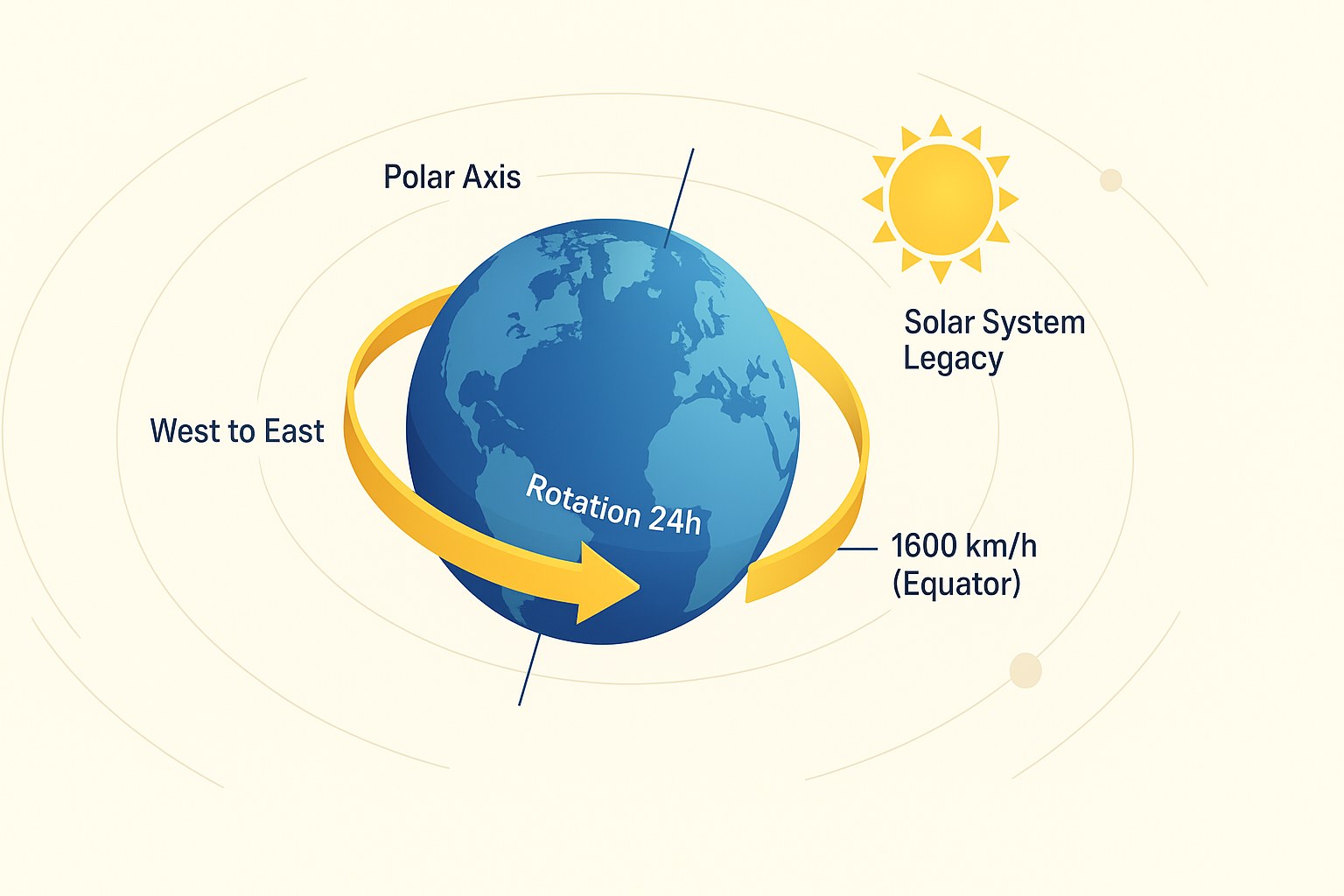
The Earth never takes a break. It makes one full turn on itself in exactly 24 hours. This constant movement is what sets the length of our day.
At the equator, we’re racing along at about 1,670 km/h without feeling a thing (40,075 km around ÷ 23.93 h ≈ 1,670 km/h). It’s a steady, smooth speed. This regularity helps keep our climate and our daily routines stable.
This endless movement isn’t new. It’s a precious legacy from the birth of the Solar System, billions of years ago.
📍 The polar axis, that imaginary pivot
Picture a rod running through the Earth from the North Pole to the South Pole. That’s the axis of rotation that everything turns around. This line stays invisible, but it’s very real.
The planet spins like a giant top on this invisible base. This pivot sets the direction the Earth turns around.
The movement goes from west to east. That’s why we always see the stars rise on the same side each morning. Why is there day and night? The Earth’s rotation is the key.
🌌 A spin inherited from the birth of the Solar System
The cloud was already turning very slowly. As it pulled in on itself, it spun faster and faster — like a skater drawing in her arms. That’s how it all began.
In the emptiness of space, nothing slows the Earth down. It simply keeps going under its own momentum, by pure inertia (in other words, on its own impulse, with no need to be pushed), without any engine.
Lots of children worry the Earth might suddenly stop. Reassure them: no force today can bring it to a sudden halt. We can sleep soundly.
☀️ The face-off between our planet and the Sun
This constant spinning would mean nothing to our eyes without a giant spotlight: the Sun.
☀️ The side that faces the light
The Sun is our one true lamp. Its rays travel through empty space to strike the surface of the Earth. It’s a steady, powerful flow of energy.
Light always travels in a straight line. It can’t bend around massive obstacles like our round planet. So it only strikes whatever is in front of it.
Because of this path, only one half of the Earth gets the light. That’s what we simply call day. The other half stays in shadow.

🌙 The Earth’s shadow and the calm of night
The part facing away from the Sun is plunged into darkness. The Earth blocks the path of the light rays. In doing so, it creates its own zone of total darkness.
It isn’t the Sun going out — it’s us turning our back on it. So shadow is simply the absence of direct light. It’s the time for rest and the quiet of night. Everyone can finally catch their breath.
The Earth acts as a screen. It shields part of its surface from the sun’s glare. This constant spinning explains the change between day and night.
🌕 The Moon, that mirror reflecting the light
The Moon isn’t a star. It produces no light of its own, contrary to what people sometimes think. It’s a lump of rock covered in grey dust.
It acts like a huge mirror in the sky. It simply bounces part of the Sun’s rays back towards us. That’s what lets us see it shine.
Moonlight is soft and indirect. It’s nothing like the power of the direct sunlight source. It’s a simple reflection, a pretty wink in the night.
🌅 Why do we see the Sun move across the sky?
If the Earth turns and the Sun stays still, why do we get exactly the opposite impression?
🧭 The apparent journey from east to west
In the morning, the Sun appears in the east. It then climbs through the sky to its highest point. Finally, it drops back down to vanish in the west when evening comes.
In reality, the Earth turns the other way, from west to east. This mismatch creates a feeling of movement for the observer on the ground. It’s simply a matter of where you’re standing.
What we see fools us about the physical reality. We’re the ones moving, not the Sun.
👁️ The optical illusion from solid ground
When your train pulls away, you sometimes think the platform is moving backwards. That’s exactly what happens with our planet and the Sun. The Earth’s movement explains this magic trick.
Long ago, people thought everything turned around us. Today, we know the system is heliocentric (a model where the Sun is at the centre). The Sun takes the central spot in our corner of space.
The illusion of the moving Sun is the first great trap our senses fall into when faced with the mechanics of the sky.
⚫ The idea of a shadow cast on a sphere
Because the Earth is a sphere, light doesn’t strike everywhere in the same way. This creates natural transition zones. The Sun can only light one half at a time.
Daylight doesn’t stop all at once. The curve of the Earth lets us see dusk and dawn, those moments of soft, dimmed light. It’s a gentle transition into darkness.
Here’s a look at the day-night cycle on a globe. It shows clearly how the shadow creeps across the round surface.
⏰ A few technical details about how we measure time
To organise our lives, we had to turn this cosmic ballet into precise mathematical rules.
⏳ The difference between a solar day and a sidereal day
A solar day lasts 24 hours. It’s the time between two passes of the Sun at its zenith (its highest point in the sky). But the sidereal day, based on the stars, is about four minutes shorter.
To measure one exact turn, astronomers aim at very distant stars. The Earth also moves along its orbit, which shifts our solar reference point. It’s a fascinating technical detail.
We use the 24-hour day. It simply matches the return of the Sun above our heads. It’s more practical for our schedules.
🕰️ Splitting the world into time zones
Since the Earth turns, noon can’t arrive everywhere at the same time. We had to slice the planet into sections. It’s a matter of pure logic.
We divided the sphere into 24 separate time zones. Each zone is one hour apart from the one next door. That’s the UTC system (Coordinated Universal Time, which acts as the world’s reference) that we know today.
Without this system, clocks would never match the Sun’s real position. It would be total chaos for travellers.
🌐 Opposite moments happening at the same time around the globe
When you’re having breakfast in London, someone in Sydney is probably getting ready for bed. That’s simultaneity. The Sun can’t be everywhere at once.
| City A | State of the sky | City B (on the other side of the world) | State of the sky |
|---|---|---|---|
| London (7 a.m.) | Sunrise: time to make the tea. | Tokyo (3 p.m.) | Mid-afternoon: a snack at the office. |
| New York (3 p.m.) | Afternoon: work is in full swing. | Sydney (5 a.m. the next day) | Dawn: the first joggers head out. |
The Earth turns all in one piece. This creates these constant contrasts between light and dark.
🌐 How daylight varies from region to region
While the basic mechanism is simple, the tilt of the Earth adds a bit of spice to the length of our days.
📐 The tilt of the axis and its effect
Our planet isn’t upright. It leans by about 23.4 degrees. This tilt changes everything about how light reaches us.
This tilt makes the amount of sunlight vary. Some places get more light than others. It mainly depends on the time of year.
Don’t mix it all up, this part matters. Rotation creates the day. But it’s the orbit around the Sun that creates the seasons.
🌌 Polar nights and the midnight sun
At the poles, the usual 24-hour cycle is turned upside down. The Sun can stay visible for several months in a row. It’s quite something to live through.
The other way round, winter plunges these regions into total darkness. This phenomenon of polar day and night is explained by the tilt of the Earth’s axis (23.4°), which points the poles towards the Sun for 6 months and away from it for 6 months.
Imagine going to sleep while the Sun is still shining at midnight. It’s a reality for many people. Sleep habits have to adapt.
🗺️ How latitude shapes the cycle
At the equator, days almost always last 12 hours. It’s the most stable zone on our planet. The rhythm there is very regular.
Where we live, in Europe, days get longer in summer and shorter in winter. It’s the direct result of our position between the equator and the pole. This is still driven by the Earth’s rotation, but our latitude tunes the whole thing.
These changes of rhythm shape the life of nature. Everything balances out this way.
🔦 The step-by-step experiment: lamp + globe in 5 steps
Here’s a ready-made experiment to help your child grasp why it’s daytime here while it’s night somewhere else. Allow 10 minutes, in a room you can darken.
What you’ll need:
- An adjustable desk lamp (or just a strong torch) to play the role of the Sun.
- A globe, or failing that a football or a big round ball.
- A small round sticker or a piece of sticky tack to mark a spot.
- Your child, curious and ready to watch.
The 5 steps:
- Set the scene. Close the curtains, switch on the lamp and place it about 50 cm from the globe. The lamp is the Sun, the globe is the Earth. The rest of the room is dark space.
- Mark your home. Stick the sticker where you live (or right on your country). Ask your child: “Which side of the globe is our house on right now — the lit side or the side in shadow?”
- Turn the Earth. Spin the globe very slowly, always the same way (from west to east, that is anticlockwise when you look down on the globe over the North Pole). Have your child watch the sticker move from the lit side to the shadowed side.
- Count the hours. Explain that one full turn of the globe = 24 hours. A quarter turn = 6 hours, a half turn = 12 hours. When the sticker is right in front of the lamp, it’s noon. When it’s directly opposite, it’s midnight.
- Find the antipode (the exact opposite point on the Earth). Ask your child: “When it’s noon here, what’s happening on the other side of the globe?” Have them point to the spot in shadow, on the opposite side: that’s where it’s midnight. You’ve just explained time zones without saying the words.
Tip: for older children (10-12), you can tilt the globe slightly (about 23 degrees) to show why the North Pole stays lit in summer and sits in darkness in winter.
🕐 What happens during 24 hours on Earth?
To make the idea real that the Earth keeps turning while we go about our day, here’s a timeline comparing three big cities at the same moment. When it’s a certain time in London, what are people doing in Tokyo and New York?
- Midnight in London. Everyone’s asleep. In Tokyo, it’s already 8 a.m. and the children are off to school. In New York, it’s 7 p.m. the previous evening and families are having dinner.
- 6 a.m. in London. The sky starts to brighten, time to get up. In Tokyo, it’s 2 p.m., the afternoon is in full swing. In New York, it’s 1 a.m., the city is drifting off to sleep.
- Noon in London. The Sun is at its highest, time for lunch. In Tokyo, it’s 8 p.m., the evening meal. In New York, it’s 7 a.m., people are making the coffee.
- 6 p.m. in London. The Sun is going down, time to head home. In Tokyo, it’s 2 a.m., the heart of the night. In New York, it’s 1 p.m., right at lunchtime.
- Midnight in London (the next day). The Earth has made one full turn. And in that time, Tokyo has lived a whole day, New York too, but at different points.
This timeline shows something magical: there’s no single “world time”. Every place lives its own day depending on where it sits on the turning Earth. That’s exactly why time zones exist: they slice the globe into 24 sections so that everywhere, noon roughly matches the moment when the Sun is highest.
A little challenge for your child: on the globe, ask them to point to a city whose exact time they’d like to know right now. Work out the time difference with home together and find the answer.
🌇 Why is the sky pink at sunset?
While the Earth turns and the Sun seems to drop down the sky, you’ve surely noticed a magical detail: the sky turns orange, pink, sometimes purple. Why this burst of colours?
The Sun’s light looks white, but it’s really a mix of all the colours (like in a rainbow). Each colour matches a different wavelength: blue is short, red is long.
When the Sun is high in the sky (at noon), its rays pass through a fairly thin layer of atmosphere. The blue light is scattered in every direction by the air molecules, which is what makes the sky blue above us.
But at sunset, things change. Because the Sun is very low on the horizon, its rays have to cross a much thicker layer of atmosphere to reach us. The blue light is scattered so much that it spreads out completely before it reaches our eyes. Only the long wavelengths (orange, red, pink) manage to push through that thickness. That’s why the sky turns pink: the cool colours have been filtered out by the atmosphere, leaving only the warm ones.
The same thing, sharpened by the low angle of the Sun, happens at daybreak. That’s why sunrises and sunsets are the most colourful moments of the day. And all of this exists only because the Earth turns and brings the Sun grazing the horizon twice a day.
🌏 And on the other side of the Earth, what’s happening?
It’s probably children’s favourite question: “When it’s noon at home, what’s happening on the other side of the world?” Here’s a quick trip around the globe, at the exact moment it’s noon in London.
- New York (USA): 7 a.m. The Sun is just rising. American children are still asleep or only just waking up. The time difference with London is 5 hours behind.
- Tokyo (Japan): 9 p.m. It’s night. Japanese families are already having dinner or watching television. The difference is 8 hours ahead.
- Sydney (Australia): 10 p.m. Late evening. Australians are starting to get ready for bed. The difference is 9 hours ahead (up to 11 in Australian summer).
- Los Angeles (US West Coast): 4 a.m. The heart of the night. The whole city is asleep, it’s the quietest time. The difference is 8 hours behind.
To understand this mechanism, just think of the turning globe. At noon in London, the city is facing straight at the Sun. New York, which lies further west, has already had its night and is only just coming out of dawn. Tokyo and Sydney, further east, hit noon a few hours earlier and are tipping over into evening.
This is what we call time zones: the Earth is sliced into 24 sections, one for each hour of difference. Without this convention, it would be impossible to plan a plane trip or a phone call with a loved one abroad.
A little game: next time you call a family member on the other side of the world, ask your child to work out what time it is there before you dial the number.
🧠 How to remember which way the Earth turns
The direction the Earth spins is one of those things people easily muddle up. Here’s a simple memory trick, to learn once and for all: the Earth turns from WEST to EAST.
To help your child remember it, start from something they’ve seen a thousand times: the Sun rises in the EAST in the morning and sets in the WEST in the evening. It’s a fact you can check for yourself by watching the Sun’s path over a day.
Now if the Sun seems to move from EAST to WEST (left to right when you face due south in the northern hemisphere), it’s because the Earth is actually turning the other way: from WEST to EAST. It’s exactly like being in a car: when you move forward, the scenery streams backwards, but it’s really you who’s moving.
A little phrase to remember with your child:
📐 Memory trick: The Sun rises in the East, so the Earth races towards the East.
Once that idea is locked in, there’s no more doubt. And if you want to check on a globe: turn it anticlockwise when you look down on it over the North Pole. That’s exactly the right way.
Bonus tip: almost every planet in the Solar System turns the same way (from west to east), with two exceptions, Venus (which turns backwards) and Uranus (which turns almost on its side, with an axis tilted at 98°, a one-of-a-kind case in the Solar System). There’s a tricky question to surprise your child with.
💡 Did you know? 5 facts about the Earth’s rotation
The rotation of our planet hides secrets that few people know. Here are 5 amazing facts to tell your child to turn an ordinary chat into a moment of wonder.
- At the poles, the Sun doesn’t set for 6 months. In the polar summer, the Sun stays visible 24 hours a day: that’s what we call the polar day, or “midnight sun”. The other way round, the polar winter plunges these regions into a night that also lasts 6 months. All because of the tilt of the axis, combined with the orbit around the Sun.
- A 24-hour day isn’t really one full turn of the Earth. The “solar day” we know (exactly 24 hours) is worked out against the Sun. But if you measure one full turn against the fixed stars, you get the “sidereal day”, which lasts only 23 hours, 56 minutes and 4 seconds. Four minutes’ difference, because of the Earth’s movement around the Sun.
- The Earth is slowing its spin, slowly but surely. Because of the tides caused by the Moon, our planet loses about 1.7 milliseconds every 100 years. Over millions of years, that adds up: in the age of the dinosaurs, a day lasted only 23 hours. In the very, very distant future, it could last 25 hours.
- The Moon always shows us the same face. Unlike the Earth, which spins quickly on itself, the Moon makes one turn on itself in exactly the same time it takes to go once around the Earth. The result: from Earth, we always see the same face. That’s what we call synchronous rotation. The far side of the Moon wasn’t photographed for the first time until 1959.
- At the equator, we race along at 1,670 km/h without feeling it. The Earth is about 40,000 km around at the equator. In 24 hours, that point covers this distance at full speed, faster than an airliner. If you live further north, like in Europe, you go “only” 1,100 km/h. And yet we feel nothing: everything around us (the air, the sea, the buildings) turns with us at the same speed.
🎲 3 activities to do with your child to understand rotation
Beyond the lamp + globe experiment, here are three extra activities to lock in the idea of rotation through direct observation and hands-on play. Each one takes between 5 and 30 minutes, depending on how keen you are.
Activity 1: the apple and the pencil
Push a pencil (point downwards) right through an apple: that’s the axis of rotation of your tiny Earth. Hold the apple by the two ends of the pencil, tilted slightly to one side. Switch on a lamp aimed at the apple, then turn your apple gently. Show your child how the same region goes from light to shadow, and back again. With the pencil tilted, they’ll also see that one side of the apple stays lit the whole time as you turn, which illustrates the seasons and the midnight sun.
Activity 2: the torch on the ceiling
This activity needs only a torch and a wall or a ceiling. Ask your child to lie down in the middle of a room. Switch on the torch and slowly turn your child round on the spot (helping them spin on their bed or on a rug). They’ll see the light appear and then disappear depending on which way they face. This hands-on, whole-body activity helps younger ones understand that it’s us moving, not the Sun. A guaranteed “wow” moment.
Activity 3: watching your shadow through the day
Pick a nice sunny day. In the morning (around 9 a.m.), ask your child to stand on the pavement in the sun. Draw the outline of their shadow in chalk. Do it again at noon sharp, then around 4 p.m., each time standing your child in exactly the same spot. You’ll get 3 different shadows. The shortest one will be the noon shadow, when the Sun is at its highest. The other two will be longer and point in opposite directions. It’s concrete, measurable proof that the Sun changes position in the sky: which really means the Earth has turned between the three measurements.
🎬 Watch the video
❓ Frequently asked questions about the Earth’s rotation
⏰ Exactly how long does a day last?
A full day lasts 24 hours. More precisely, we talk about the mean solar day, which is the time between two passes of the Sun at its highest point in the sky. It’s this length that we use in everyday life to pace our days, our weeks and our calendars.
🌍 Why does the Earth spin on itself without stopping?
It’s a legacy that goes back to the birth of the Solar System, billions of years ago. As it formed, a huge cloud of gas and dust collapsed, creating a swirling movement that passed on to our planet. In the emptiness of space, there’s no air to slow this movement down. So the Earth keeps turning by pure inertia.
🌗 What causes the alternation between day and night?
The day/night cycle comes solely from the Earth’s rotation on itself. The side of the planet facing the Sun is lit (that’s day), and the opposite side is in shadow (that’s night). Since the Earth keeps turning, every place moves alternately from one side to the other, which creates the 24-hour cycle.
💨 How fast does the Earth spin at the equator?
At the equator, the Earth turns at about 1,670 km/h. This speed drops the further you move from the equator: in Europe, it’s about 1,100 km/h, and at the pole, it’s almost zero. This fast spinning goes unnoticed because everything around us (the atmosphere, the buildings, the water) turns with us at the same speed.
🤔 Why don’t we feel the Earth turning?
Our body senses changes in speed, not speed itself. Since the Earth has been turning at a perfectly steady speed for billions of years, and everything on its surface moves exactly with it (the air, the oceans, the houses), there’s no friction or jolt to feel. It’s the same principle as on a high-speed train running at a steady pace on a perfectly straight track: you forget you’re moving.
☀️ Why doesn’t the Sun turn around the Earth?
For centuries, people believed the Sun turned around the Earth, until Copernicus and Galileo argued the opposite (the rigorous proof came later with Kepler and Newton). In reality, it’s the Earth that spins on itself (rotation) and also turns around the Sun (revolution, in 365 days). The illusion comes from our point of view: from Earth, we see the Sun travel across the sky, but it’s really us who are moving.
📊 What’s the difference between a solar day and a sidereal day?
A solar day lasts exactly 24 hours: it matches the return of the Sun above our heads. It’s our everyday reference for organising family life and school. The sidereal day is a little shorter, about 23 hours and 56 minutes. It measures one full turn of the Earth against the distant stars. This small four-minute difference comes from the fact that the Earth also moves along its orbit around the Sun while it spins on itself.
☀️ Why are days longer in summer than in winter?
It all comes from the tilt of the Earth. Its axis isn’t upright, but leans by about 23.4 degrees. Depending on the time of year, our hemisphere is either tilted towards the Sun or pointed away from it. In summer, since we’re tilted towards the Sun, we stay longer in the lit zone as the Earth turns. The other way round, in winter, we spend more time in shadow, which shortens our days.
🧊 Are there places without night? Does the Sun never set at the poles?
Yes, it’s what we call the midnight sun. Because of the tilt of the Earth, the polar regions can stay facing the Sun for several months without a break during the summer. The other way round, during the polar winter, these same regions stay plunged in total darkness for a long stretch. It’s a very unusual cycle, radically different from the 24-hour rhythm we know at the middle latitudes.
🧒 How do you explain the Earth’s rotation to a 6-year-old vs a 10-year-old?
For a 6-year-old, keep it very concrete: “The Earth is a big ball that spins on itself like a spinning top. The Sun only lights one side at a time. When our side faces the Sun, it’s day; when we move behind, it’s night.” Mime the movement with an orange and a lamp. For a 10-year-old, you can bring in the numbers and the more advanced ideas: 24 hours for one turn, 1,670 km/h at the equator, the axis tilted at 23.4 degrees, time zones, the sidereal day. At this age, the diagram and the analogies hold up well.
🎒 At what school level do children learn about the Earth’s rotation?
The Earth’s rotation comes up at several levels in the school curriculum. A first introduction in the early primary years through watching day and night. A fuller explanation in the later primary years in science, with the apparent movement of the Sun and the idea of an axis of rotation. And finally a deeper look in lower secondary school, with the seasons, the time zones and the complete Solar System.
