
Word searches are often thought of as an activity for children who already read fluently. But from around age 4, you can offer 4 to 6 year olds very simple grids with just a few words, written in CAPITAL LETTERS and with no diagonals. 😊 It’s a wonderful way to build letter recognition, visual scanning and focus without it ever feeling like schoolwork. On this page you’ll find 5 grids, each 8×8, specially designed for preschool, each one with only 6 ultra-simple words of 3 to 6 letters. The themes are familiar (animals, colours, family, fruit, school), the words are always in CAPITALS, and they only run across or down. Print one in a single click and sit your child down at the table with a pencil.
🔤 5 easy word search grids for preschool
Each grid is 8 squares by 8, hides 6 words, and uses a theme drawn from a child’s everyday world. The words only run left to right or top to bottom, never diagonally and never backwards. The list of words to find is printed in CAPITALS under each grid. 🖍️
🐶 Familiar animals
A reassuring first grid with animals every child knows. CAT, DOG, LION, BEAR, RAT and HEN — short, friendly words to get started. It’s perfect for a first session, done with a grown-up beside your child to show the move: you read letter by letter, then circle the word once you’ve spotted it.
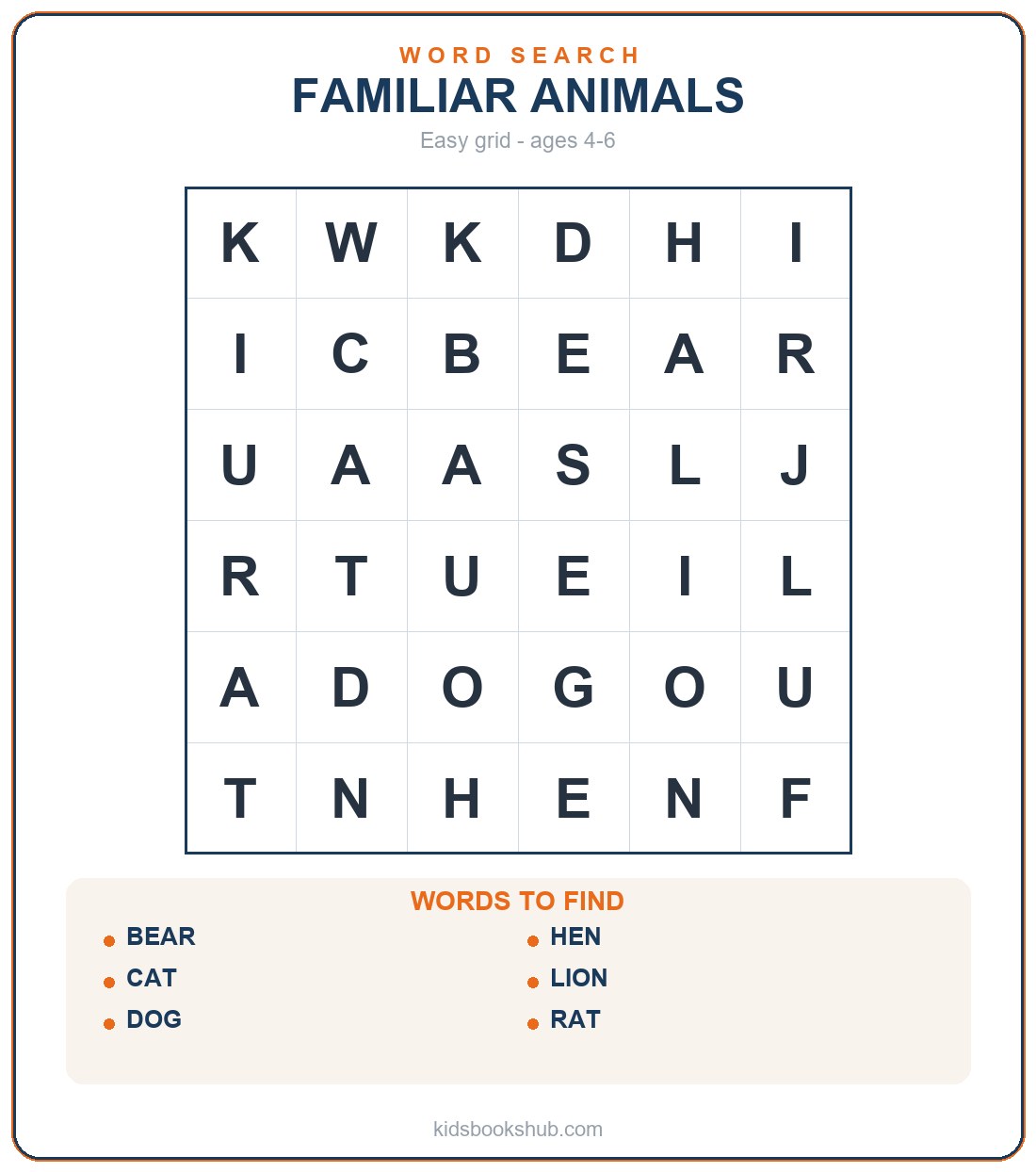
Words to find: CAT, DOG, LION, BEAR, RAT, HEN.
🎨 Colours
The colours of everyday life: RED, BLUE, GREEN, BLACK, PINK and WHITE. This grid does double duty: your child finds the word, then you point to something in the room that matches the colour. It’s a perfect bridge between reading and visual vocabulary.
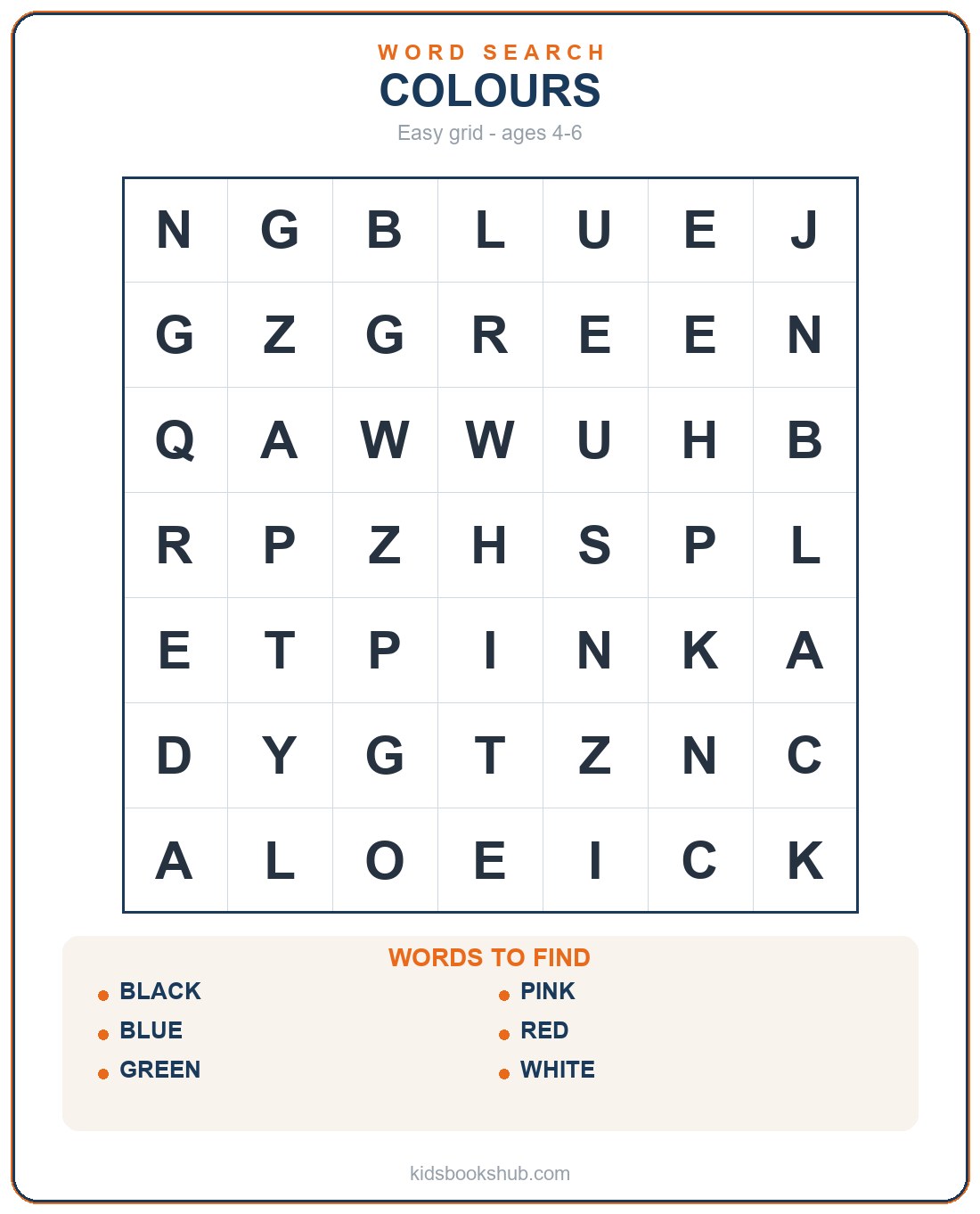
Words to find: RED, BLUE, GREEN, BLACK, PINK, WHITE.
👨👩👧 Family
The words with the most emotional weight at this age: MUM, DAD, SISTER, BROTHER, BABY and NANNY. Many children already recognise these words in writing before they can even read. So this grid often brings the proudest moment of all: “look, I can read MUM all by myself.” 💛
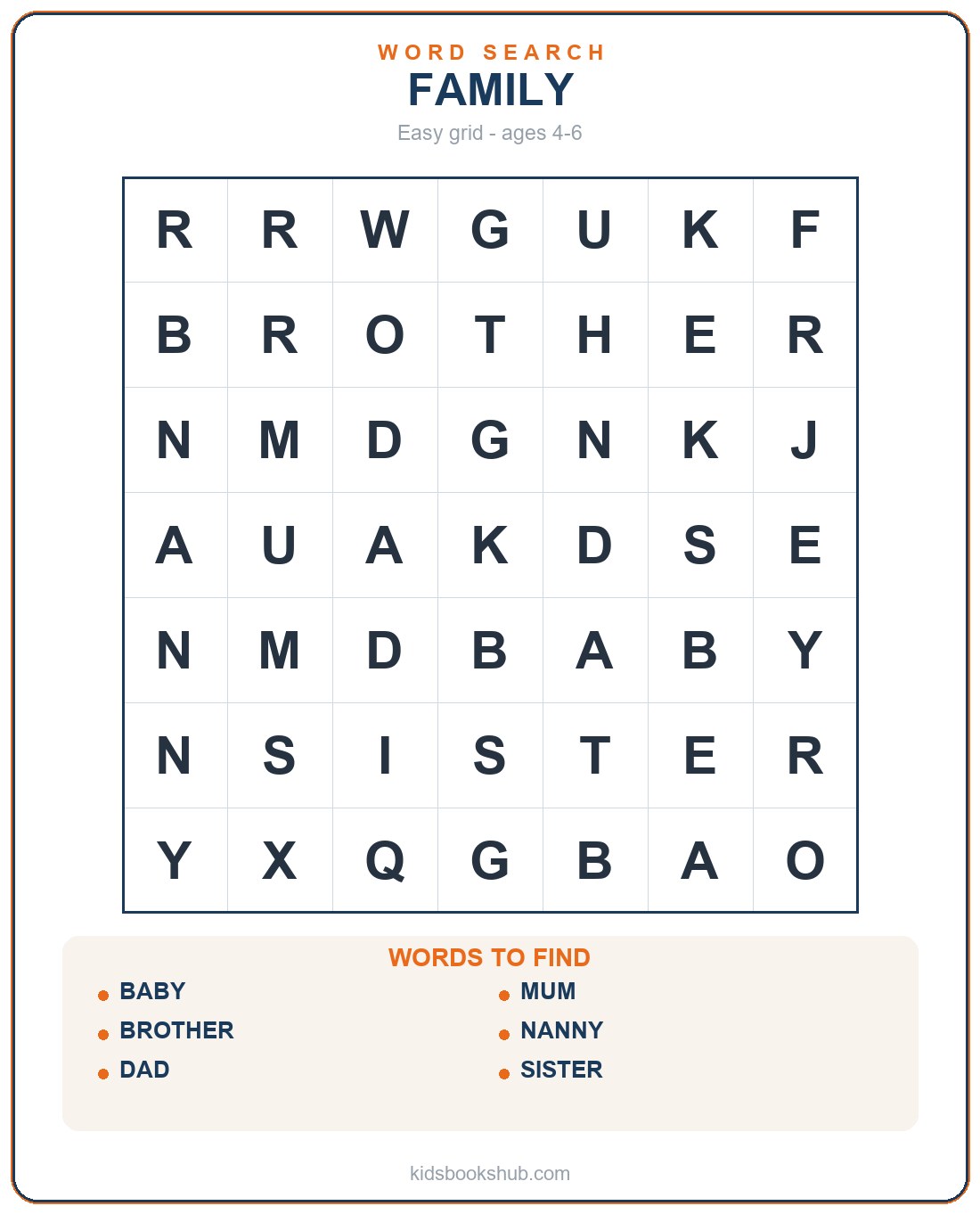
Words to find: MUM, DAD, SISTER, BROTHER, BABY, NANNY.
🍎 Fruit
APPLE, PEAR, KIWI, MELON, PLUM and GRAPE. A perfect grid to print for snack time or alongside a little cooking activity. You can bring out a real piece of fruit while your child searches: pairing the written word with the real object is a small leap forward for early reading.
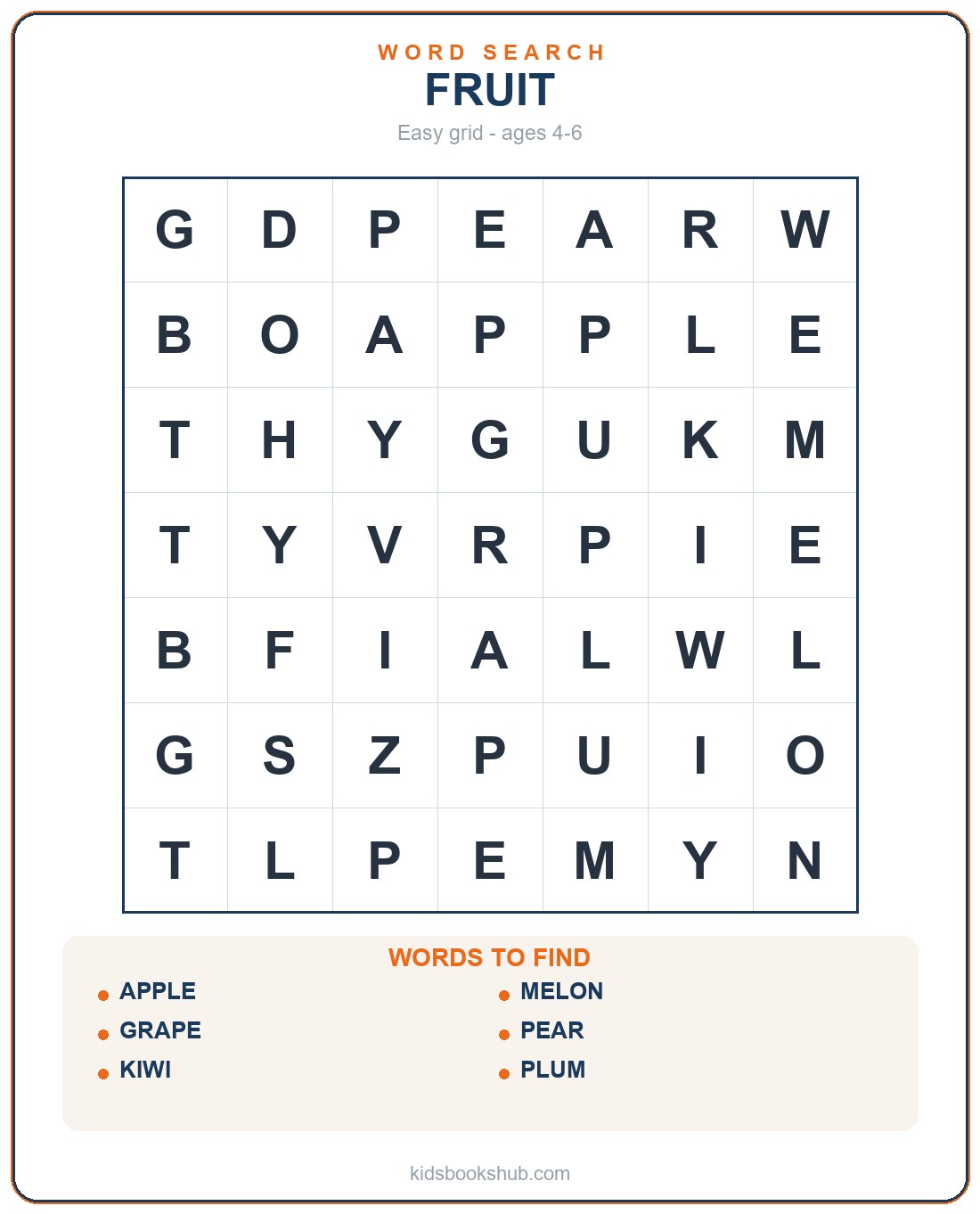
Words to find: APPLE, PEAR, KIWI, MELON, PLUM, GRAPE.
🏫 School
The objects of the classroom: BOOK, PEN, RUBBER, RULER, GLUE and CHALK. This grid is great for the start of term, or to help a child starting their last preschool year get used to everyday school words. Many teachers use it as a quiet end-of-term workstation activity.
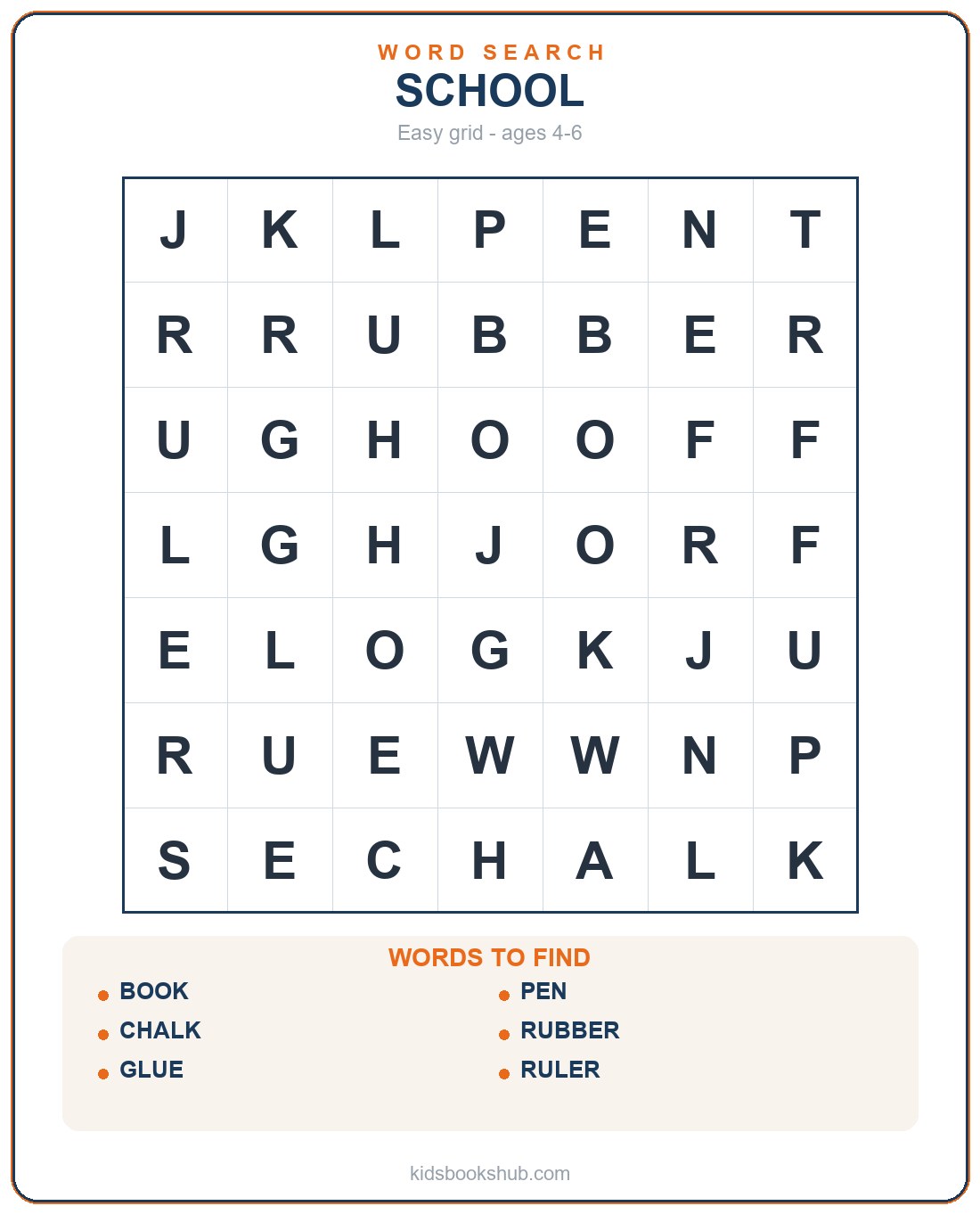
Words to find: BOOK, PEN, RUBBER, RULER, GLUE, CHALK.
👶 At what age can children start word searches?
The common belief is that you have to read fluently to do word searches. That’s not true: from age 4 to 5, many children already recognise CAPITAL letters, and the grid becomes a hunt for signs. Here’s what you can expect at each age.
Ages 4 to 5. Your child knows most CAPITAL letters but can’t read yet. You can show them a short word (CAT, RAT, HEN, BABY) and ask them to find the same string of letters in the grid. It’s visual pattern-matching, not reading — and that’s exactly what their brain needs at this age.
Ages 5 to 6. This is the ideal age for these 8×8 grids. Your child starts linking letters and sounds, decodes short words, and the hunt becomes more active. Completing the animals or family grid on their own is a realistic goal by the end of this year.
Signs your child is ready. They recognise at least 15 to 20 CAPITAL letters. They enjoy pointing out letters in their name or on packaging. They can stay focused on a calm activity for 5 to 10 minutes. If those three boxes are ticked, you can bring out a grid.
💬 How to explain the task to a child who can’t read yet
The tricky part isn’t the grid itself, it’s the instruction. A preschooler who can’t read won’t naturally understand that they’re looking for one precise string of letters. Here’s how to introduce the activity simply.
1. Show the model word in big letters. Before the grid, write the word to find large on a sheet of paper (CAT, for example). Your child has the exact sequence of letters right in front of them, like a treasure map.
2. Do the first search together. Place your finger on the first letter of the word in the top-left corner of the grid. Ask: “is this a C?” Move along together, square by square, line by line. When you find it, you both circle it.
3. Give the simple rule: we read like a book. Tell your child the words are written either in rows (left to right, the way we read) or in columns (top to bottom). There’s no need to look in every direction, which is hugely reassuring for this age.
4. Be happy with just one find, and celebrate it. In a first session, finding ONE word alone is a victory. There’s no need to race through all six at once: keep the grid for the next day and play again.
🧠 Why is it good for preschoolers?
Beyond the calm moment, these grids work on several key early-years skills.
Getting ready to read. Spotting a string of letters in a busy background (the other letters in the grid) is exactly what we ask of a brain learning to read. It’s pre-reading practice in the disguise of a game.
Organised visual scanning. To find the words, your child learns to scan a page systematically (left to right, line after line). That’s the very eye movement of reading, picked up without them noticing.
Sustained attention. Staying with the same sheet for 8 to 10 minutes is an important goal at this age. Short grids manage it where a reading worksheet would be too frustrating.
Self-esteem. Finding a word alone, circling it, showing the sheet to a parent: it’s a little cycle of success that builds your child’s positive relationship with the written word, at an age when that relationship is set for life.
❓ Frequently asked questions
What age are these grids really suited to?
From age 4 with a parent helping, and 5 to 6 for partial independence. Before 4, it’s better to stick to recognising single letters in your child’s name.
Why are the words written without accents in the grid?
Because keeping the words simple and clean makes reading easier for a child who is just learning their letters. Short, plain spellings let them focus on the pattern of letters rather than extra marks.
My child doesn’t recognise all the letters yet — is it too soon?
No. You can turn the activity into a matching game: “look at the C in CAT on the sheet, find the same C in the grid.” Your child doesn’t need to know a letter by name to spot it visually.
My child wants to write in the grid — is that a problem?
No, quite the opposite. Circling the word they’ve found, highlighting it in colour, or drawing a line through it are all moves that strengthen the memory trace. Let them use a coloured pencil if they prefer.
How long does it take?
Between 5 and 15 minutes per grid depending on age and experience. For a first time, allow 10 to 15 minutes with help. Working independently by the end of preschool, some children finish a grid in 5 minutes.
Do I need a colour printer?
No. The grids stay perfectly clear in black and white: only the title banner is in colour, but the letters and the grid are in black, with no loss of contrast on a budget print.
Looking for more printable activities for preschoolers? You’ll find plenty of word searches, free worksheets and printable games to keep little hands busy. Happy letter hunting! 🔍
