
Is your little one sometimes overwhelmed by noise, or flatly refusing to taste that new green vegetable? Explaining the 5 senses of the human body to children helps them understand how their brain decodes every smell, sound and texture to build their intelligence. You’ll discover simple tricks to spark their curiosity without wearing them out, turning every walk into a real science adventure at a child’s height.
- How the 5 senses guide a child’s development
- Looking and listening to understand the world
- Touch and smell in the service of emotions
- Taste and the discovery of new flavours
- Ideas to stimulate the senses every day
- Respecting a child’s pace and sensitivity
🖐️ How the 5 senses guide a child’s development
After those first sparks of awakening, it helps to understand that everything begins with a complete sensory immersion that literally sculpts the brain.
🧠 How sensations build the brain
Every stimulus, like a flash of light or a sound, triggers a tiny electrical burst between neurons. Repeating it carves solid pathways into the malleable brain. In fact, these connections multiply at a rate of 5,000 per second during pregnancy.
The child takes in a piece of information, then the brain processes it. Next, they act to explore their surroundings even more. This cycle strengthens their thinking skills at an incredible pace. It’s a real engine for everyday learning.
Brain plasticity is a gift. The richer the environment, the denser the connections become. Positive interactions fuel this amazing growth.
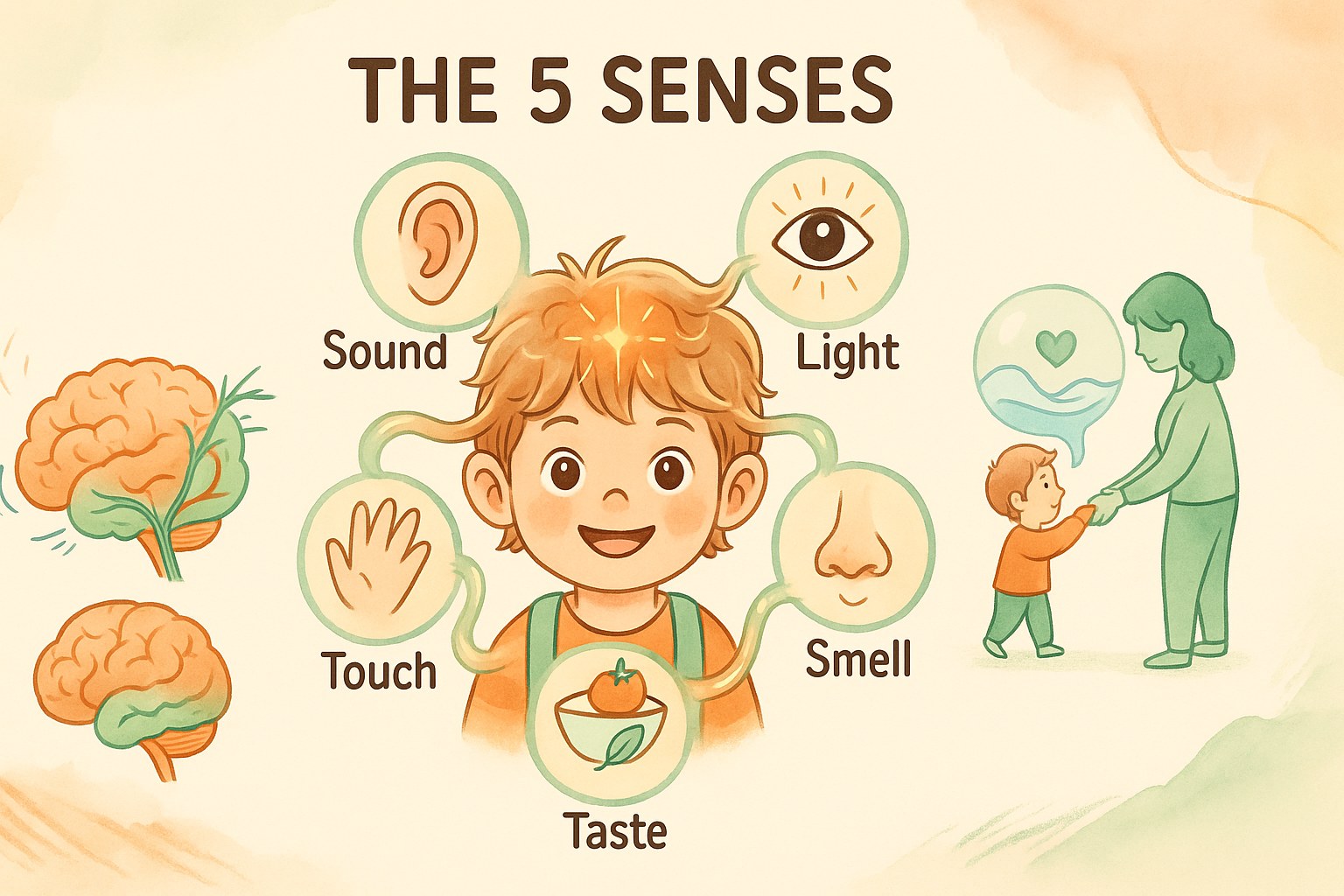
🗣️ The link between the senses and language
Sensory exploration is the bedrock of vocabulary. Before saying “cold”, a child has to feel the ice cube melt. Experience always comes before the abstract idea. That’s exactly how the 5 senses of the human body, explained to children, truly come to life.
It helps to name sensations precisely. Use adjectives like “rough” or “sour”. This helps the child organise their thinking. Their spoken language then grows richer with real, concrete shades of meaning.
Naming a sensation gives a child the power to share their inner world and to understand their surroundings better.
💛 The role of the senses in emotional security
Shared attention is key here. When you look at the same object as your child, their perception is confirmed. This simple sharing builds an unbreakable bond of trust. They feel heard and valued.
The senses have an instantly soothing power. A parent’s smell or a familiar voice calms the nervous system. Oxytocin, the bonding hormone, then encourages new connections. This emotional security later allows a bold exploration of the world.
A child who feels understood in what they sense develops better self-esteem. They build an inner security that lasts a lifetime.
👁️ Looking and listening to understand the world
If the brain is the engine, sight and hearing are the first radars that let a child map out the space around them.
👶 How vision develops from birth
At birth, sight is blurry and limited to about twenty centimetres. That’s the perfect distance to focus on the face of whoever is feeding them. Black-and-white contrast leads the way.
Around three months, bright colours appear. The child starts to follow objects with their eyes. Their sense of depth sharpens as both eyes learn to work together.
There are fascinating resources on this subject. They can help you explain how vision matures step by step.
🎵 Musical awakening and recognising sounds
Hearing works well before birth. In the womb, the baby already picks up heartbeats and deep voices. It’s their very first link with the outside world.
After birth, mixing up the soundscape is helpful. Don’t fear everyday noise, but offer melodic moments too. Music stimulates brain areas linked to maths and empathy.
Learning to tell a birdsong from an engine builds a fine ear for listening from a very young age.
👂 Activities to sharpen looking and listening
Offer simple observation games. Hide an object and let your child find it with their eyes. Use sensory bottles filled with glitter or colourful beads.
Silence is a teaching tool too. Switch off the screens and listen together to the sounds of the house. It’s a powerful exercise for a child.
Here are a few ideas to put the 5 senses of the human body into practice with children every day:
- “Search and find” games.
- Listening to a variety of nursery rhymes.
- Moments of complete calm to pick out single sounds.
👃 Touch and smell in the service of emotions
Beyond sight, it’s through direct contact and invisible scents that a child weaves their closest bonds.
✋ The skin as the first channel of contact
Skin is the largest organ in the body. Physical contact releases oxytocin, the happiness hormone. It’s vital for a baby’s growth.
Touch also guides fine motor skills. By handling different textures, a child learns to adjust their strength and grip. Every stroke or press tells the brain something about their own bodily limits.
Baby massage is a wonderful practice. It strengthens the parent-child bond while boosting circulation.
🌸 The power of smells over memory
Smell is wired straight to the limbic system, the seat of emotions. A scent can trigger an instant memory. It’s a powerful sense, and often an underrated one.
The human nose is astonishingly precise. It can tell apart thousands of distinct smells, according to recent scientific research.
The smell of milk or of a favourite blanket soothes a child at once. These familiar scents are essential anchors of security during separations, such as starting nursery.
🌿 Handling natural and varied materials
Move beyond smooth plastic toys. Offer wood, wool, or cool stones. A variety of tactile sensations enriches the sensory repertoire.
Compare the sensations together. Is it prickly or silky? These contrasts help sharpen perception and the descriptive vocabulary that goes with touch.
The 5 senses of the human body also come alive through discoveries like these:
- Rough tree bark
- Light feathers
- Fine sand
- Cool, smooth pebbles
👅 Taste and the discovery of new flavours
This exploration of the world often peaks at the dinner table, where every sense comes together to form one whole experience.
🥕 The stages of introducing solid food
Taste buds change with age. A newborn has a natural preference for sweetness, a reminder of breast milk. Bitterness usually takes longer to learn.
Introduce flavours one at a time. Sour and bitter are surprising discoveries for a little one. There are helpful teaching resources on the basic flavours worth exploring.
Patience pays off. Sometimes you have to offer a food ten times before it’s accepted.
📝 Learning the vocabulary of sensations
Eating isn’t only about taste. It’s also a question of texture. A food can be crunchy, melting or grainy on the tongue.
Encourage your child to describe what they feel. Does it fizz? Is it warm? Putting sensations into words eases the worry of the unknown.
Language turns a simple mouthful into an intellectual adventure, letting a child sort their likes and their discoveries.
🍽️ The joy of mealtimes
A meal should stay a playful moment. Never force it, but encourage curiosity. A child who plays with their food is also getting to know it.
Smell and taste work as a duo. We call the result flavour. Without smell, an apple and an onion taste almost the same. Explain this in simple terms to your child.
Serve up colourful plates. Sight gets the mouth watering and prepares the body to digest with pleasure. That’s how the 5 senses of the human body, explained to children, become real every day.
💡 Ideas to stimulate the senses every day
You don’t need fancy gadgets to awaken a child; the home and nature are bursting with free treasures.
♻️ Making sensory bins from recycled objects
Take a plastic tub and fill it with rice, pasta or cork stoppers. Add spoons and small containers for pouring. It’s simple and effective.
These activities cost almost nothing but keep children captivated for hours. They explore the sound of grains tumbling and the feel of them on their hands. It’s a brilliant lesson in everyday physics for little ones.
Change the theme with the seasons. Use conkers in autumn or warm water in summer. The 5 senses of the human body, explained to children, also come alive through these hands-on activities.
🍃 Using natural elements on a walk
A simple walk in the forest is a sensory festival. Touch the damp moss, listen to dry branches crackle. Nature offers rich, soothing stimulation.
Open-air events and garden visits are a perfect chance to enjoy hands-on outdoor activities. It’s a great way to learn while having fun outside.
| Natural element | Sense stimulated | Suggested activity |
|---|---|---|
| Fallen leaves | Hearing and touch | Crunch them to make them crackle |
| Damp earth | Smell and touch | Breathe in the smell of rain |
| Birdsong | Hearing | Listen and identify |
| Wild flowers | Smell and sight | Smell their varied scents |
🏡 Setting up a space that invites exploration
Create dedicated corners around the house. A small mat with different textures is enough. The child should be able to reach it on their own, safely, for their discoveries.
Don’t tidy everything away. Leaving a few curious objects within reach sparks natural curiosity. The key is to allow free experimenting without the adult stepping in constantly, so you don’t break their concentration.
A clean but texture-rich space encourages calm, deep learning. That’s how little ones take in their sensory skills more easily.
🤗 Respecting a child’s pace and sensitivity
Stimulation is a good thing, but knowing when to stop matters just as much for a child’s balance.
😴 Spotting the signs of sensory overload
Too much stimulation kills curiosity. If a child looks away, rubs their eyes or grows irritable, they’re probably overloaded. Their brain is saturated and stops taking anything in.
Learn to read these small signals. When there’s too much stimulation, the best response is an immediate return to calm. Dim the lights and speak softly to help their nervous system settle back down.
Every child has their own tolerance threshold. Respect it and never push, even in play.
🧘 The good side of boredom and calm
Boredom isn’t the enemy. It’s in these empty moments that the brain locks in what it has learnt. Quiet lets it sort through the information gathered during the day.
Offer stretches of time with no planned activity. Your child will learn to listen to their own needs and grow their imagination. It’s an essential skill for their future independence and mental health.
Calm is the fertile soil where earlier sensory discoveries take root.
🎯 Adapting activities to each child’s needs
Some children are highly sensitive. A faint noise can feel overwhelming. Adjust your ideas gently, never rushing their senses. Take it one step at a time.
Tailor your approach to their temperament. An active child will love busy sensory bins, while a calm child will rather watch games of light.
The 5 senses of the human body, explained to children, also call for patience.
Sensory awakening isn’t a race for performance, but a caring journey towards discovering oneself and others.
By exploring sight, hearing, smell, taste and touch, your little one builds both their brain and their language. Offer them sensory bins or nature walks to stimulate these abilities right now. A rich, calm environment sets the stage for their future flourishing. Hand them the world, right at their fingertips!
🎬 Watch the video
❓ FAQ
🖐️ What exactly are the 5 senses of the human body?
The five senses are our natural little radars for discovering the world: sight, hearing, smell, touch and taste. Each one uses a special organ, like the eyes or the ears, to gather information and send it to the brain, which then makes sense of it.
Working hand in hand, they let us learn, communicate with others and, above all, fully enjoy all the little pleasures of everyday life.
🌱 How do the senses help my child grow up well?
Sensory development is the foundation for building the brain. From life in the womb, sensations create essential neural connections. It’s through their senses that a child organises information, grasps cause and effect, and develops their motor skills.
Later, between two and three years old, these discoveries feed directly into language and thinking. By exploring textures or sounds, your little one builds their body map and gains independence while waking up to the world.
🗣️ What’s the link between sensory awakening and learning to speak?
Sensory exploration is the first step before a child can put words to ideas. Handling a variety of objects, for example, helps develop the fine motor skills needed to produce complex sounds. Nursery rhymes and sound games also help them remember the sounds of language.
By pairing a sensation (like the cold of an ice cube) with a word, a child builds their vocabulary in a concrete way. Every touch or taste is a chance to give meaning to the sentences they’re starting to form.
😴 How can I tell if my child is worn out by too much stimulation?
Some signs are unmistakable: if your little one covers their ears, rubs their eyes or suddenly turns very irritable, their nervous system may be overloaded. Sensory fatigue can also show up as a need to be alone, or trouble falling asleep after a busy day.
Faced with this overload, the best answer is an immediate return to calm. Dim the lights, turn down the sound and make room for rest, so their brain can quietly sort through everything it has taken in.
🏡 What simple activities can I do at home to stimulate their senses?
You don’t need complicated toys! You can make sensory bins with rice, pasta or cork stoppers to explore textures and sounds. A simple walk in the forest is also a festival for the nose and ears, between the smell of damp earth and the song of the birds.
At mealtimes, have fun describing the flavours (sweet, salty, sour, bitter) or the textures (crunchy, melting). The idea is to turn everyday life into a small, playful adventure, never forcing it, simply following your child’s natural curiosity.
