
It’s hard to keep your thoughts straight when you face the vastness of the night sky, isn’t it? This article lifts the veil on what a galaxy is by exploring the secrets of our Milky Way, the giant disc that is home to our Solar System. 🌌 You will discover how this spiral of gas and stars, held together by gravity, hides a supermassive black hole and mysterious dark matter at its heart.
- What exactly is the Milky Way galaxy?
- The surprising shape of our space home
- Where are we in all this mess?
- What you cannot see with the naked eye
- The different tribes of galaxies
- Our neighbours and our cosmic future
🌌 What exactly is the Milky Way galaxy?
Have you ever looked up on a beautiful summer night to admire that whitish streak that crosses the sky? It looks like a veil of mist, but it is actually our enormous cosmic home, a fascinating structure that scientists study to unlock its mysteries.
✨ A big family of stars and dust
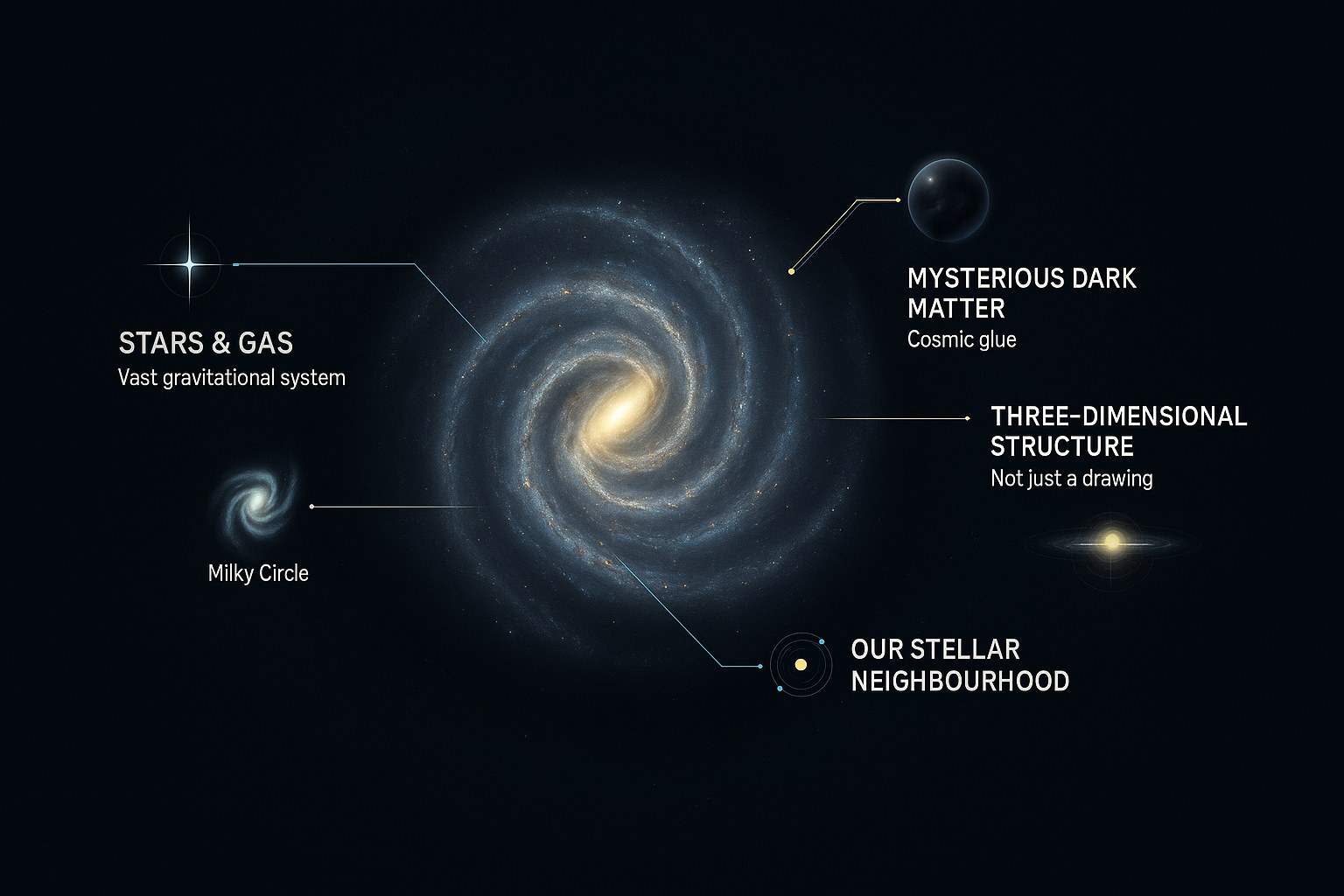
A galaxy is a gigantic group held together by the force of gravity. It gathers billions of stars, planets, gas, dust and a large share of invisible dark matter.
Without gravity, all these elements would scatter into the void. This force acts like an invisible glue. It keeps a coherent structure and stops the celestial bodies from drifting just anywhere.
These groups are often part of vast cosmic clusters. They constantly interact with the surrounding intergalactic medium.
🥛 Why such a tasty-sounding name?
The word comes from the Greek “galaxias”, which literally means milky. This name comes from the look of our galaxy in the sky. It really does resemble milk spilled across a black tablecloth.
Mythology tells that the goddess Hera spilled her divine milk while pushing baby Hercules away. In reality, this whiteness comes from the combined light of billions of stars too far away to be seen one by one.
The name of our galaxy comes from the Greek Galaxias Kyklos, which literally means milky circle, referring to its appearance.
⭐ The difference from a simple constellation
You mustn’t mix the two up. A constellation is an optical illusion, while a galaxy is a massive physical structure.
Imagine that a constellation is just a poster stuck on a wall. A galaxy, on the other hand, is the whole building where we live. The scales of size are absolutely not comparable.
Each galaxy is independent. It travels alone through the vastness of the void, far from its neighbours.
🌀 The surprising shape of our space home
Now that we know what a galaxy is, let’s take a step back to look at the outline of our own, because it is not just a shapeless heap of stars.
🌀 A disc that looks like a spiral
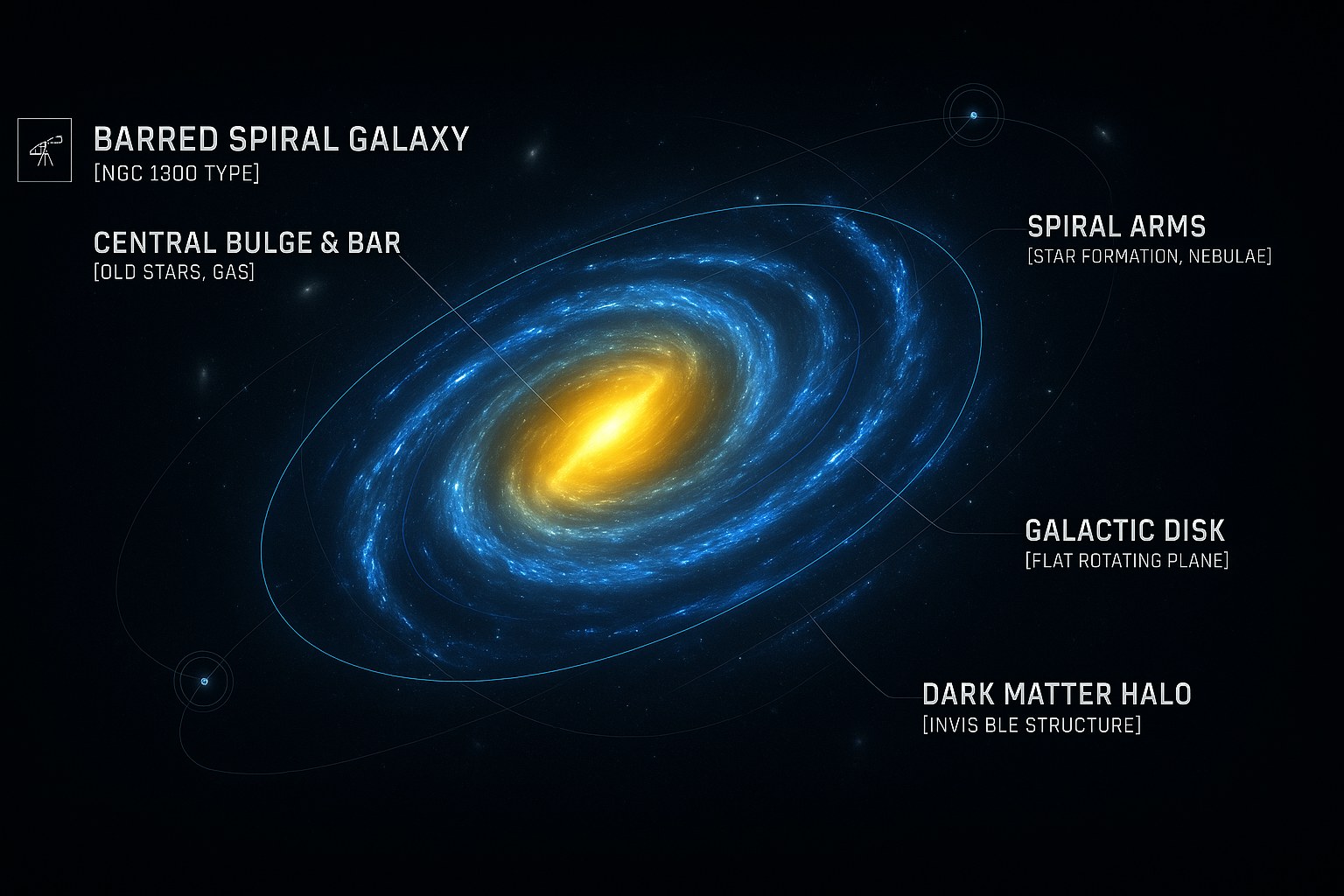
Imagine a saucer or a very flat disc. The Milky Way belongs precisely to the category of barred spirals. It is an important shape distinction that helps us place ourselves.
A bar of stars crosses the galactic centre. This straight structure is spectacular. The famous arms only begin to curl outward from the ends of this glowing bar.
This huge group is moving. It spins around like a giant carousel of light.
💡 The central bulge and its glowing bar
Let’s zoom in on the bulge, that very dense central area. There you find an incredible concentration of very old stars. It is the beating, hot heart of the galactic structure.
The brightness there is intense. It clearly contrasts with the darker edges of the disc. It is here, in this core, that the story of our galaxy really began.
Dust hides this spectacle. Infrared telescopes pierce this veil.
🌌 The arms that curl around the centre
The major structures are called Perseus, Sagittarius or Centaurus. They are density waves where gas piles up massively. Stars are born there by the billions.
These arms are the real galactic nurseries. Young, blue stars shine brightly there. That is where the raw material to build new worlds is found.
Here are the main arms that make up our horizon:
- Perseus Arm
- Sagittarius Arm
- Norma Arm
- Scutum-Centaurus Arm
📍 Where are we in all this mess?
We’ve seen the overall structure, but where is our little Solar System hiding in all this vastness? Spoiler: we are far from being at the centre of the action.
📍 Our exact address in the Orion Arm
The Earth nestles in the Orion Arm. It is a secondary arm of the galaxy. Imagine a quiet little lane, slightly away from the bustle. We sit 27,000 light-years from the centre.
From this spot, we observe a whitish band. It is the build-up of distant stars. They form that very particular milky arc in our night sky.
This position is ideal. We avoid the dangerous galactic centre. We don’t end up in a deserted outskirts either.
🔢 The numbers that make your head spin a bit
The dimensions are dizzying. The Milky Way measures between 100,000 and 200,000 light-years across. It is estimated to hold 300 billion stars. Each point of light is a potential sun.
| Feature | Estimated value |
|---|---|
| Diameter | 100,000 ly |
| Number of stars | 300 billion |
| Disc thickness | 1,000 ly |
| Distance from the centre | 27,000 ly |
These figures come from Gaia. It is the latest mission from the European Space Agency.
🔭 How to observe it from your garden
It is all a matter of perspective. Since we live inside it, we see the galaxy edge-on. That creates this milky streak that crosses the sky.
You have to escape the city lights. Light pollution spoils the whole spectacle. Summer is still the perfect season to look towards the south.
Grab a simple pair of binoculars. The swarm of stars then becomes striking. It is a free and magnificent show.
🔭 What you cannot see with the naked eye
Beyond the bright stars, the Milky Way hides invisible and far darker secrets that nonetheless lay down its law.
🌑 The quiet role of dark matter
Dark matter acts like a ghostly mass. We never see it directly. And yet, we feel its immense weight, which stops our galaxy from completely falling apart.
The stars on the edge spin far too fast. This observation defies the classic laws of gravity. Only an invisible mass can explain this strange spinning.
Recent research even refines the recent estimates of this overall mass.
🌪️ Sagittarius A*, the very powerful central engine
At the centre sits a supermassive black hole. Sagittarius A* weighs about 4 million times the mass of the Sun. It is a monstrous gravitational anchor, but it is essential to the galaxy’s balance.
The Event Horizon Telescope pulled off a real technical feat. We finally have an image of the shadow of this giant. It is a historic visual proof for modern astronomy.
Sagittarius A* is the invisible heart around which our whole galaxy dances, a gravitational abyss of unimaginable power.
🫧 The strange Fermi bubbles
Two giant lobes of gamma rays tower over the galactic centre. These structures stretch out on either side of the disc. It is a recent discovery that greatly intrigues researchers.
A past explosion of the central black hole could be the cause. These bubbles may be the remnants of very ancient space “volcanic” activity. The show must have been impressive long ago.
These bubbles stay completely invisible to the naked eye. Only high-energy space telescopes manage to detect them. Understanding what a galaxy is, with the Milky Way explained through its hidden structures, is fascinating.
🌠 The different tribes of galaxies
The Milky Way is our home, but it is only one specimen in an incredibly varied cosmic menagerie.
🌀 Varied shapes, from spirals to ellipses
Galaxies are classified by their outline. The ellipticals look like rugby balls. The irregular ones have no defined shape at all.
Spirals are the most beautiful. They contain a lot of gas to form stars. The ellipticals are often more “dead”.
- Spiral galaxies (65%)
- Elliptical galaxies
- Irregular galaxies (10%)
🛰️ How we figured out we weren’t alone
Edwin Hubble changed history in 1925. Before him, people thought the Milky Way was the whole Universe. He proved that Andromeda was another galaxy.
It was a cultural and scientific shock. The Universe suddenly became billions of times bigger. We found our real place.
Astronomers confirm that there are around 2,000 billion galaxies.
⭐ The eventful life cycle of stars
Matter goes through constant recycling. Stars die and throw out gas. This gas will be used to create the next generation.
Nebulae are magnificent colourful clouds. They are the factories that build the stars. The galaxy is a living organism that keeps evolving.
But this process is running out of steam. One day, there won’t be enough gas left.
🚀 Our neighbours and our cosmic future
To finish this tour of the place, let’s look out of the window. Our neighbours are getting closer and the future looks eventful.
🌌 The Local Group and its little satellites
The Milky Way belongs to the Local Group. It is a family of around forty galaxies. Andromeda and our Galaxy are its two main pillars.
You also find the Magellanic Clouds there. These dwarf galaxies orbit calmly around us. They are visible from the southern hemisphere of the Earth.
This small-group arrangement is very real. You can explore the details of this neighbourhood on space agency websites.
🤝 The scheduled meeting with the Andromeda galaxy
An unavoidable collision is slowly building up. Andromeda is rushing towards us at 110 km/s. In 4 billion years, our two galaxies will merge. They will form just one single entity.
Don’t worry about the fate of the stars. Space is so empty that collisions between stars are almost impossible. It is a graceful ballet, not a brutal crash. Everything will happen gently.
Researchers confirm this precision. The speed of approach is now well known.
📈 The expansion that pushes the other families away
And yet there is a paradox of expansion. While Andromeda is approaching, the distant galaxies are fleeing. The space between the great clusters stretches relentlessly every day. It is quite fascinating to imagine.
Gravity wins the battle locally. But on a large scale, the Universe is becoming emptier and emptier. Our current neighbours will be our only lasting companions. The rest of the sky will eventually disappear.
Loneliness awaits our distant descendants. Make the most of the view. It is unique in history.
This giant spiral, held together by gravity, is home to our Solar System among billions of stars and mysterious dark matter. To admire that milky streak, escape the city lights this very evening. Understanding our Milky Way galaxy offers a dizzying journey towards the infinite. Look up, the Universe is waiting for you.
❓ FAQ
🥛 Where does the name of our galaxy come from and why do we talk about a “milky path”?
The word “galaxy” comes straight from the Greek Galaxias, which literally means “milky”. It is a pretty reference to the look of the Milky Way in our night sky. According to Greek mythology, it would be a streak of milk that escaped from the breast of the goddess Hera while she was nursing baby Hercules.
Today, we know that this white streak is not milk, but the build-up of billions of very distant stars. The Latin term Via Lactea gave us our “Milky Way”, a poetic name that travels through the ages to describe our great cosmic neighbourhood.
⭐ What is the difference between a galaxy and a constellation?
It is a very common mix-up! To put it simply, a galaxy is a real, massive physical structure. It is an immense group of stars, gas and dust held together by gravity. It is a bit like the whole building we live in, on the scale of the Universe.
A constellation, on the other hand, is a kind of imaginary drawing. It is a human invention to find our way in the sky. We link bright points to form figures, but those stars can actually be very far from each other. It is a simple optical illusion from our garden.
🌑 What exactly is a galaxy made of, and what is the role of dark matter?
A galaxy is a joyful mix of stars, planets, gas and dust. But it also hides invisible ingredients! You often find a supermassive black hole at its centre, like Sagittarius A* for ours, which acts as a powerful gravitational anchor.
There is also the mysterious dark matter. We can’t see it, but it is essential. It acts like an invisible glue that stops the stars from scattering into the void. Without its weight, galaxies couldn’t keep their shape and would quickly fall apart.
🔢 How many galaxies are there in the Universe, and how big is ours?
Hold on tight: it is estimated that there are up to 2,000 billion galaxies in the observable Universe! Some are dwarfs, others are giants. Ours, the Milky Way, is already a fine structure measuring about 100,000 to 200,000 light-years across.
Our galaxy is home to between 200 and 400 billion stars. It is a dizzying figure, especially when you think that each point of light could light up a planetary system like ours. We really are a tiny part of a colossal whole.
📍 Where exactly is the Earth in the Milky Way?
We are not at all at the centre of the action! The Solar System sits about 27,000 light-years from the heart of the galaxy. We live in a fairly calm zone called the Orion Arm, which is a secondary arm of our spiral galaxy.
It is an ideal position, a bit like a peaceful little street on the outskirts of a big city. We are quite far from the very dense, busy centre, but close enough to enjoy the galactic structure. That is what lets us observe the galaxy edge-on on beautiful summer nights.
