
Explaining to our little ones why the sea is salty can feel like a real puzzle for parents. 🌊 This guide reveals how rock erosion and ancient volcanoes seasoned the oceans over billions of years. You’ll discover the secret of solar evaporation, plus fun tricks to watch those invisible salt crystals appear right in your own kitchen.
- Why the sea is salty and where that taste comes from
- The legacy of volcanoes and the early Earth
- The sun that lifts the water but leaves the salt
- What hides right down in the deep sea
- Fresh water and salt water: a question of weight
- 3 sea curiosities and little games to try
🧂 Why the sea is salty and where that taste comes from
After admiring that endless blue, we often wonder why a single mouthful leaves such a peculiar taste on the tongue. In fact, it all starts far from the coast, where rain meets dry land.
🌧️ The rain that nibbles away at the rocks
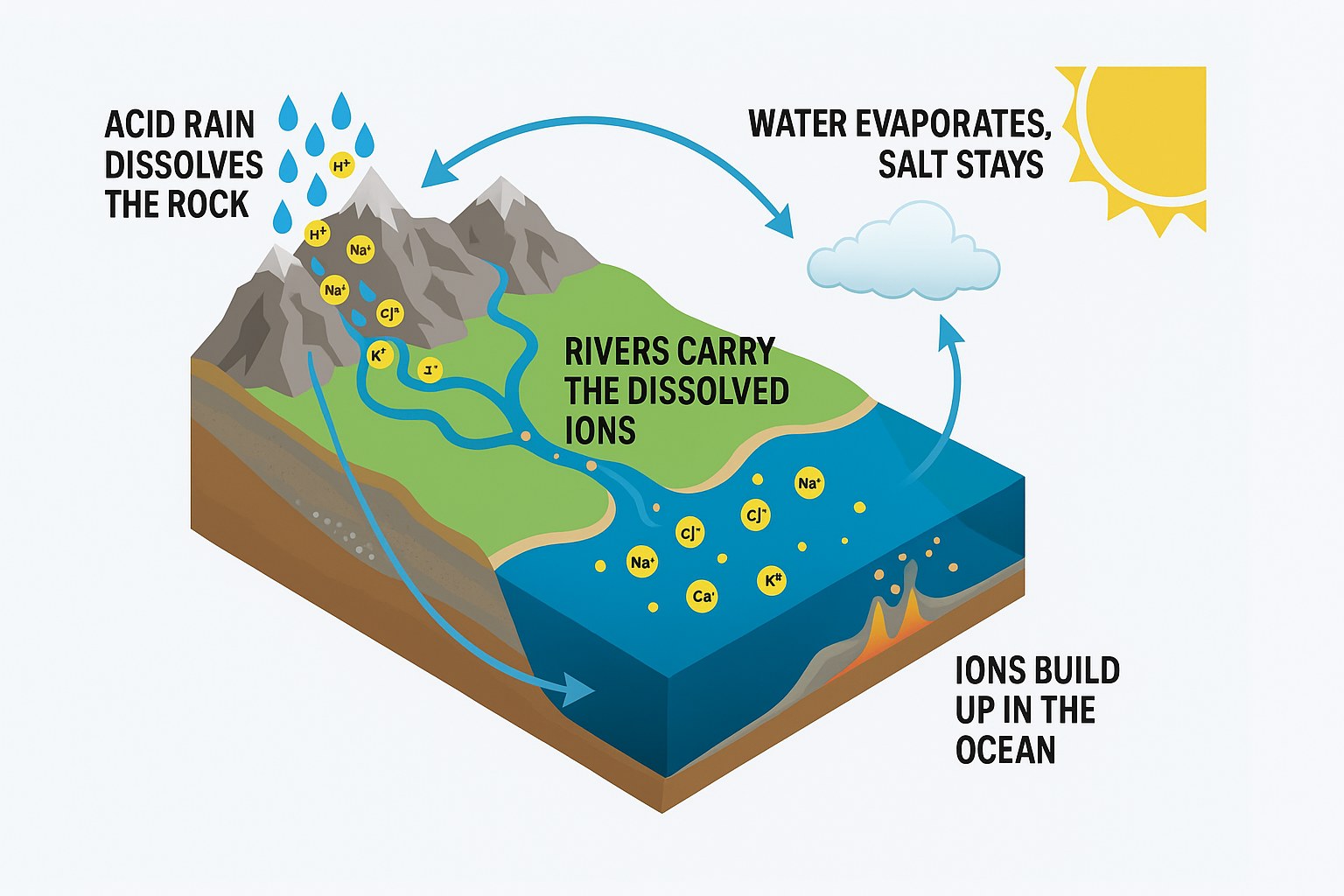
Rain isn’t pure water. It turns slightly acidic by soaking up carbon dioxide from the air. This water then gently attacks the stone of the mountains.
This erosion process frees the minerals trapped inside the rock. They turn into tiny ions that travel through the water. The salt comes from the rocks of the continents, thanks to this natural chemical reaction.
This nibbling has been going on for billions of years. It’s invisible work, but a colossal one. The stones wear down and release their precious salty treasures over time.
🏞️ The journey of minerals down the rivers
Rainwater trickles down and joins the little streams. These streams carry the dissolved minerals along. Eventually, they all finish their long run inside the world’s great rivers.
Every year, rivers pour roughly 2 billion tonnes of cations into the ocean. It’s a relentless natural conveyor belt. That quantity of particles is simply astronomical.
Once they reach the sea, these minerals never leave. They build up while the pure water evaporates. The reason the sea is salty is a bit like a giant piggy bank.
🧂 The kitchen salt hidden in nature
Sodium chloride is the main ingredient. It’s exactly the same as your table salt. It’s born from the perfect chemical marriage between sodium and chlorine.
The water stays clear because the salt dissolves completely. The molecules split apart and become invisible. You can’t see a thing with the naked eye, but your taste buds catch everything.
It’s like stirring sugar into warm milk. Even though the grain vanishes, its flavour soaks into every drop. That’s the magic of molecular dissolving in water.
🌋 The legacy of volcanoes and the early Earth
If dry land supplied part of the ingredients, the rest of the recipe comes from the burning depths of our planet, back when the landscape was anything but welcoming.
💨 The gases released during the great eruptions
Let’s travel back to the Earth’s youth. Volcanoes were spewing out massive amounts of gas. Among these fumes, there was notably a great deal of chlorine.
These gases eventually joined the water. The chlorine mixed with the water vapour in the atmosphere. It then fell back as acid rain. There you have the missing ingredient for making salt.
This process matters enormously. Without that intense volcanic activity, our oceans would be terribly bland today. The volcanoes literally seasoned the primitive soup.
🌊 The birth of the oceans through cooling
The Earth’s crust finally cooled down. The water vapour condensed into giant clouds. Torrential rains then began to fall.
The boiling water filled the hollows of the surface. It immediately started dissolving the surrounding minerals. The ocean already held salt water around 4.5 billion years ago.
This deluge lasted millions of years. It washed over the entire planet. That’s what helped create those huge reservoirs of salt water we know today.
🧪 The chemical make-up of the first waters
The original chemical cocktail is simple. It’s a blend of earthly sodium and volcanic chlorine. This union forms sodium chloride, a very stable molecule.
Chloride is barely involved in the planet’s geological cycles, which explains its constant presence in the sea ever since it first formed.
This recipe stays remarkably stable. For billions of years, the proportions have hardly shifted at all. The chemical balance of seawater is a frozen legacy. Why the sea is salty for kids and curious minds comes down to this very old mixture.
☀️ The sun that lifts the water but leaves the salt
You might think that with all this constant supply, the sea would end up as a solid paste of salt. Yet a natural mechanism keeps a perfect balance, thanks to the warmth of the sun.
✨ The magic trick of evaporation
The sun heats the surface of the oceans fiercely. Under this heat, the water slowly transforms. It turns into a light gas that floats up towards the blue sky.
Salt is far too heavy for this airy journey. Only the pure water molecules manage to rise into the atmosphere. The crystals stay trapped, raising the salt concentration locally.
It’s like a pan of salted water forgotten on the hob. If you boil the water, it eventually disappears completely. All that’s left is a white crust at the bottom.
☁️ Why the salt doesn’t fly off with the clouds
Let’s compare the weight of the elements for a moment. Salt ions are real giants next to water molecules. The vapour acts like a selective lift.
This cycle naturally purifies our planet. When the rain falls, it’s soft and has no salty taste at all. The salt stays behind in the great sea reservoir, thanks to the evaporation that filters the water.
The beauty of this journey lies in its simplicity. Water circulates, cleans itself endlessly and comes back to us. The salt, loyal, simply keeps its place in the dark deep sea.
⚖️ The balance that stops the sea from saturating
You might wonder why the sea doesn’t become completely saturated. The extra salt eventually sinks naturally to the bottom. It then slowly works its way into the deep sea sediments.
Living creatures also play an essential role. Some animals pump up the minerals to build their solid shells. In doing so, they actively remove part of the salt from the water.
Everything balances out between the rivers and these natural removals. This dynamic balance has stayed steady for ages. And that’s why the sea is salty for kids and curious minds.
🌊 What hides right down in the deep sea
But salt doesn’t only come from the sky or the rivers. If you dive down into the darkest ocean depths, you discover a real underground chemical factory.
🌋 The chimneys that spew out minerals
Hydrothermal vents pierce the ocean floor. Seawater seeps into these dark cracks. It then heats up intensely as it touches the burning magma.
This fluid comes back out loaded with metals and various salts. These famous black smokers feed the deep ocean directly. It’s an internal source of salinity that stays constant. Why is the sea salty for kids? Here’s one solid start to an answer.
These structures look like big underwater geysers. They constantly inject fresh minerals into the body of water. The sight is as strange as it is fascinating, far from our eyes.
🌍 The role of the moving plates
Plate tectonics also shape this salty cycle. The seabed sometimes sinks beneath the massive continents. It carries with it part of the salt stored there.
The minerals then return to the deep mantle of the Earth. They’ll come back out much later through volcanic eruptions. It’s a huge loop that lasts millions of years. You never get bored with geology.
The Earth renews itself endlessly, with infinite patience. Nothing is lost, everything is transformed over the ages. Salt plays an active part in this great planetary movement.
⏳ How long the elements spend in the water
Residence time is a truly curious idea. It’s the average length of time an ion spends in the great blue. Some elements leave quickly, while others prefer to stay.
Salty elements like sodium stay in seawater for a very long time, possibly remaining there for around 100 million years before being removed.
The salt you taste today is incredibly old. It watched the dinosaurs come and go, along with many other species. It’s a little piece of history tingling on your tongue.
⚖️ Fresh water and salt water: a question of weight
If salt is everywhere, why don’t our glasses of tap water have that briny taste? It’s all a matter of dose.
🏞️ Why you can’t taste the salt in rivers
Rivers do contain a tiny bit of salt. That amount stays minute compared to the ocean. So it’s far too little for our taste buds.
River water keeps flowing towards the sea. It doesn’t have time to build up. Evaporation doesn’t concentrate the salt in the waterways. The renewal is constant.
Fresh water is just water passing through. It carries the salt along without ever keeping it for itself. Picture a conveyor belt heading out to the open sea.
💧 The story of the heavier water drop
Salt water is heavier than fresh water. The minerals add weight to every drop. It’s purely a matter of density.
In the sea, you float better because the water pushes you up more strongly. The water feels more “solid” beneath your body. It’s a very real physical effect for swimmers.
Here are a few figures to understand it better:
- Salt water weighs about 1,025 kg per cubic metre
- Fresh water weighs 1,000 kg per cubic metre
- This difference lets the ocean currents flow
🚱 Why you can’t drink seawater
Too much salt is poison for our cells. Our body has to flush it out quickly. So drinking this water is a very bad idea.
To get rid of this salt, the body uses up lots of water. You end up losing more water than you drank. It’s a deadly trap for thirsty castaways.
The kidneys work too hard against such a concentration. They tire out fast. Better to keep seawater for swimming and games.
🎲 3 sea curiosities and little games to try
To wrap up this journey, let’s explore the salinity records and become a little chemist.
🌊 The mystery of the Dead Sea and the Baltic
Comparing the extremes is striking. The Dead Sea is so loaded with salt that you float in it like a cork. The water of the Baltic, by contrast, is almost fresh.
The climate explains these variations. In hot regions, the water evaporates and leaves the salt behind. Near the poles, melting ice brings in fresh water.
Here’s a quick look at the salinity differences between the Mediterranean and the Baltic to picture these gaps across different parts of the globe.
| Sea | Level (g/L) | Special feature |
|---|---|---|
| Dead Sea | 275 | Total floating |
| Mediterranean | 38 | Warm basin |
| Atlantic | 35 | Average |
| Baltic | 7 | Brackish water |
🦐 The incredible life in very salty places
Some survival champions absolutely love salt. We call these micro-organisms halophiles. They thrive where others simply couldn’t live.
The little shrimp in the salt marshes make the most of it. They give flamingos their famous pink colour. It’s a food chain that depends on salt.
The work of salt harvesters lets us gather this treasure. They collect the “flower of salt” with age-old know-how. These landscapes are both beautiful and useful.
🏠 Making your own salt at home
Let’s try an easy experiment. Stir a spoonful of salt into a glass of warm water. Keep stirring until the grains vanish completely.
Pour this water into a flat plate. Leave it in the sun or on a radiator for a few days. Watch the little white, square crystals come back.
You’ve just recreated the cycle of evaporation. It’s magical to see the salt reappear. Science hides inside a simple glass of water.
This journey of minerals, from rocks nibbled by the rain to ancient volcanoes, finally explains why the ocean is salty. The sun evaporates the pure water but lets that precious salt build up over billions of years. A fascinating balance that turns every swim into a real dive into the history of our Earth.
❓ FAQ
🧂 Where does all that salt in the ocean come from?
It’s a story that’s been going on for billions of years! The salt mostly comes from the erosion of rocks on the continents. The rain, which is slightly acidic, slowly nibbles away at the stones and releases minerals. These invisible little pieces of rock are carried by rivers all the way to the sea.
Another part of the salt comes from deep inside the Earth. As our planet formed, volcanoes spat out gases loaded with chlorine. Mixing with the sodium brought in by rivers, this created the famous sodium chloride, the scientific name for table salt.
🏞️ Why doesn’t river water taste salty to us?
River water does contain mineral salts, but in tiny amounts. Because river water flows constantly towards the ocean, the salt doesn’t have time to build up. It’s a bit like a conveyor belt that carries the ingredients along without ever keeping the finished dish for itself.
The ocean, on the other hand, is the end of the line. Once the minerals get there, they can’t leave again. The sun evaporates the water to form clouds, but it leaves the salt behind. That’s why the concentration is far stronger in the sea than in your garden.
🏊 Is it true you float better in seawater?
Yes, and it’s a really fun bit of physics! Salt water is denser, which means it’s “heavier” than fresh water because of all the minerals it carries. One cubic metre of seawater weighs about 1,025 kg, against 1,000 kg for fresh water.
Because the water is denser, it pushes up on our body more strongly. That’s why you’ll make much less effort to stay at the surface at the beach than in the pool. In the Dead Sea, it’s even more obvious: you float there like a little cork!
🚱 Why can’t you drink seawater to quench your thirst?
Tempting though it is when you’re thirsty at the beach, it’s a very bad idea. Seawater is far too salty for our body. To get rid of all that extra salt, our kidneys would need to use up even more water than we just drank.
This is what’s called paradoxical dehydration: the more salt water you drink, the more water you lose. Our body wears itself out trying to clean up the surplus. So it’s better to keep seawater for building sandcastles, and to bring along a good bottle of fresh water for snack time.
⏳ Does the sea get saltier and saltier over time?
You might think so, since rivers keep bringing in salt, but nature is well designed. A balance has settled in. The extra salt eventually sinks to the bottom of the water to form sediments or salt rocks.
Some sea animals also use these minerals to build their shells. Between what arrives via the rivers and what is “used up” or stored at the bottom of the deep sea, the salinity of our oceans stays broadly stable, and has done for millions of years.
