
Explaining why there are tides to a curious child can quickly turn into a puzzle if you don’t have the right words. 🌊 This article unpacks the ocean’s “breathing” movement by picturing the Moon and the Sun as real space magnets. You’ll discover how these invisible forces and the Earth’s spin orchestrate that daily back-and-forth, turning our beaches into ever-changing playgrounds.
- The ocean’s back-and-forth, explained simply
- The Moon and the Sun lead the dance
- Why are there two high tides a day?
- 3 tide variations depending on the coefficients
- Understanding the daily shift in timings
- Watching nature and animals on the beach
🌊 The ocean’s back-and-forth, explained simply
After admiring the horizon, you quickly notice that the water never stays still, as if the sea were following a rhythm all of its own.
🌊 The sea that breathes on the sand
The sea is like a giant lung. The water rises and falls gently over the sand, creating a very steady movement. It’s a peaceful sight that you can watch every day.
The water doesn’t vanish into a hidden hole. It simply slides from one place to another on our blue planet.
This natural phenomenon is truly soothing. You can admire it all along beautiful coastlines, from rocky bays to long sandy shores.
This cycle is endless. The sea always ends up coming back to us.
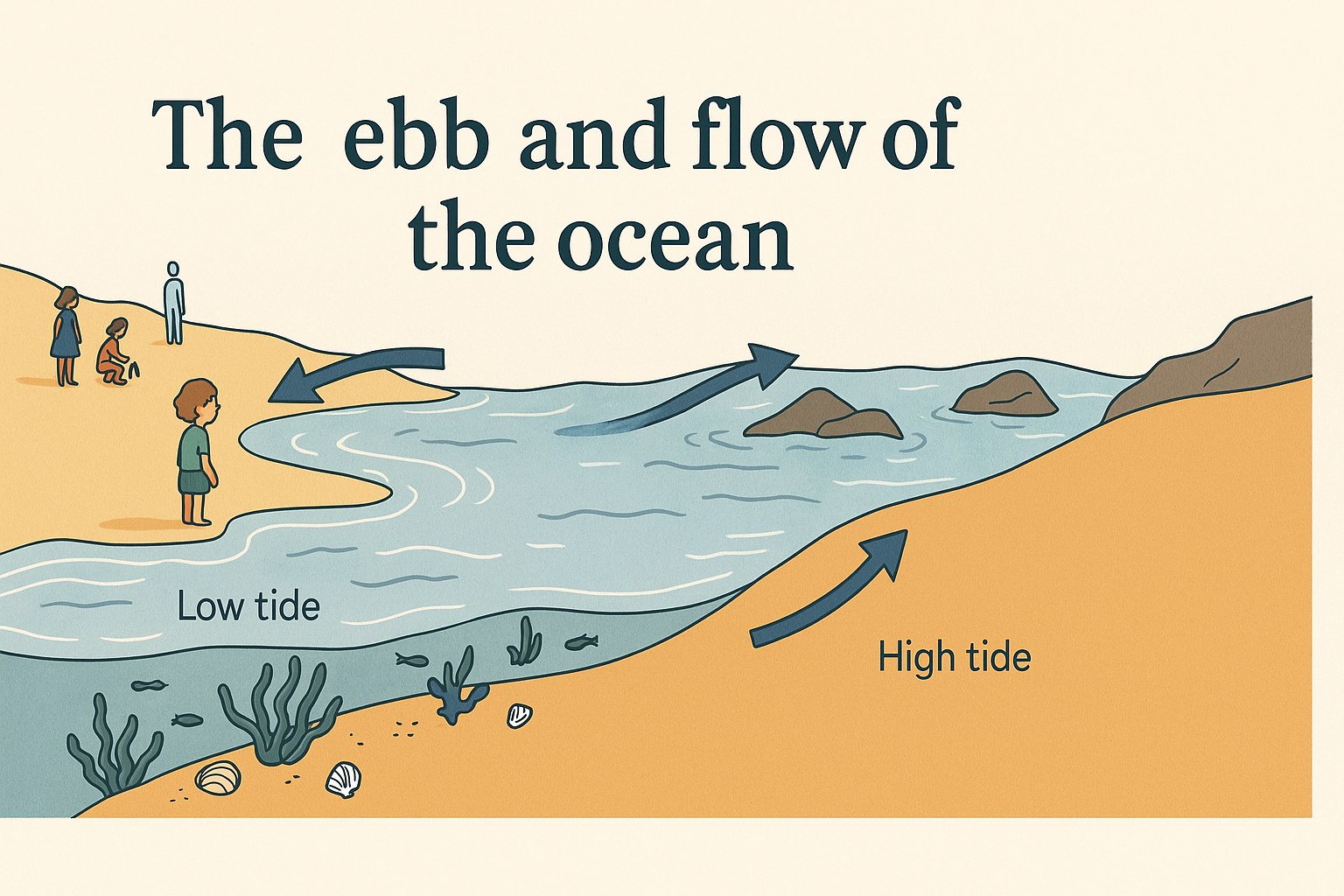
⚖️ The difference between high tide and low tide
At high tide, the ocean completely covers the rocks and the sand. The sound of the waves grows louder against the sea walls. The landscape suddenly looks fuller.
At low tide, it’s the exact opposite. The sand is uncovered for miles. You then see puddles appear, along with green seaweed and little crabs that quickly hide away.
This change radically transforms the face of the beach. Every day, the scenery is new.
💧 The journey of the moving water
The Earth always keeps the same amount of water. When the level drops here, it has to rise somewhere else. It’s a question of balance for the oceans of the globe.
You can picture this transfer like a giant wave. It’s a very slow wave that travels calmly from one ocean to another, without ever stopping.
This movement is incredibly precise. Sailors have used this regularity since forever to navigate safely.
🌙 The Moon and the Sun lead the dance
This movement doesn’t happen by magic, it’s steered by conductors sitting very high up in the sky.
🧲 An invisible force, like a magnet
The Moon is our closest neighbour. It acts like a giant magnet that pulls the ocean water towards it without ever needing to touch it. It’s fascinating.
This invisible force is called gravity. It’s precisely what creates a big bulge of water facing the Moon on our planet.
The Moon wins the match against the Sun for a simple reason. It’s much closer to us than the huge yellow star.
Without the Moon, our beaches would be calm. There would be no movement at all.
☀️ The Sun’s influence despite the distance
The Sun is enormous but sits really far away. Its pulling force is therefore about twice as weak as that of our little Moon. It stays a supporting actor.
Its role becomes crucial, though, when it lines up with the Moon. At that exact moment, they pull the water together with far more power. United, they’re stronger.
The Sun is like a powerful assistant that comes to boost or slow down the Moon’s action, depending on its position in the sky.
🎈 The analogy of the squashed water balloon
Imagine a balloon filled with water. If you pull hard on one side, the balloon stretches at once and ends up out of shape. It’s quite funny.
The Earth is that balloon and the ocean is the thin layer of water around it. The pull of the heavenly bodies then creates bumps on the surface of the globe.
These water bumps point straight towards those bodies. That’s where the high-tide zones are. That’s why there are tides, explained for kids.
🔁 Why are there two high tides a day?
If the Moon pulls the water on one side, you’d think there would be only one bulge, but reality is a bit more balanced.
🌍 The Earth’s spin and centrifugal force
The Earth spins on itself very fast. This constant rotation creates an invisible force. It naturally pushes objects outwards.
It’s like a bucket of water you swing round at arm’s length. The water stays right at the bottom of the bucket. Centrifugal force works exactly the same way here.
This particular push creates a second bulge of water. It sits at the exact opposite of the first.
⚖️ The see-saw effect between the bodies
The Earth-Moon duo is like two dancers. They hold each other firmly by the hands and turn together. The balance is then shared on both sides.
So the water gathers in two opposite places at the same time. That’s why we see two high tides a day on our coasts. It’s a finely tuned ballet.
The Earth is like a wet spinning top that throws its water outwards on each side to keep its perfect balance.
🏞️ Why lakes don’t have tides
The Moon tries to pull all the available water. That even includes the water in your glass. But you need a huge mass for the effect to become visible.
The vastness of the Atlantic Ocean is nothing like the volume of a lake. The lake stays too small. The water can’t pile up there into a giant bulge.
On a lake, the difference in level is tiny. It rarely goes beyond a few millimetres. So it’s completely invisible to the naked eye.
📊 3 tide variations depending on the coefficients
Not all tides are the same, because the strength of the tides depends on the exact position of our celestial neighbours.
🪐 Spring tides and the alignment of the bodies
The Moon, the Earth and the Sun line up perfectly in space. Their pulling forces then add together powerfully. They all pull on the ocean water together.
This creates the famous spring tides. The sea rises very high on the sand. It then drops back very far, revealing rocks usually hidden under the waves.
These exceptional days let you watch a record tidal range in the bay. It’s a truly impressive natural sight to see.
🌗 Neap tides during the quarter moons
Sometimes, the Moon and the Sun form a right angle relative to us. The bodies work against each other. They no longer pull the water in the same direction.
Their gravitational forces then partly cancel out. The level of the ocean moves far less. These are the neap tides, marked by small coefficients.
The sea currents become very calm. Sailing near the coast is then easier. It’s a rest period for the sea.
The tidal range is minimal. The beach barely changes.
🌓 The role of equinox tides
In spring and autumn, special moments occur. The Earth sits perfectly upright facing the Sun. The equator then gets maximum solar pull.
This set-up boosts the power of the water movements. You record the biggest coefficients of the year. The sea seems to multiply its usual strength.
Beachcombers wait for these dates impatiently. They dig out rare shellfish. These treasures stay out of reach the rest of the time.
⏰ Understanding the daily shift in timings
If you come back to the beach tomorrow at the same time, you’ll be surprised: the water won’t be in the same place.
🌝 The lunar day and its 50-minute delay
While the Earth spins on itself, the Moon is moving too. It drifts calmly along its orbit. It doesn’t stay neatly in place waiting for us.
To end up exactly facing the Moon, the Earth has to turn a little more. That small extra effort takes around 50 minutes. It’s a very simple astronomical sum.
This is what we call the lunar day. That’s why the time of the tide shifts a notch each day. It’s an appointment that keeps changing.
📐 Using the rule of twelfths simply
Do you know the rule of twelfths? The sea doesn’t rise at the same speed during the six hours of the cycle. The flow of the water varies on a precise rhythm.
At the start and the end, it rises gently. In the middle, between the third and fourth hour, it gallops. That’s where the current becomes really powerful and fast.
- Slow speed at the start
- Maximum acceleration in the middle of the cycle
- Final slowdown before high water
📅 Reading a tide table without mistakes
Learning to read the little tide booklet is child’s play. You need to spot two main columns. There you’ll find the exact time and the predicted water height.
Then look at the coefficient, often noted from 20 to 120. The bigger the number, the more forcefully the sea will move. It’s the sign of a big tide.
A little safety tip. Always check these timings before heading off to picnic on a sandbank. That way you avoid nasty surprises.
🦀 Watching nature and animals on the beach
This great movement of water isn’t just a feast for the eyes, it’s a daily challenge for every creature of the shore.
🌊 Why an enclosed sea barely moves
Some seas are almost closed off. They connect to the ocean only through a narrow strait. This set-up hugely limits the movement of water.
Imagine a huge basin with a tiny tap. The water doesn’t have time to flow in or out in large amounts. So the level stays very stable.
The shape of the coast changes everything for the tidal range. Here are a few figures to picture these differences in height from place to place.
| Sea / Ocean | Type of tide | Average height (range) | Main cause |
|---|---|---|---|
| Enclosed sea | Weak tide | 0.4 m | Closed geography |
| Open ocean | Strong tide | 4 m | Open geography |
| Funnel-shaped bay | Record tide | 12 m | Funnel effect |
🐚 How shellfish survive at low tide
Mussels and oysters are very clever. They close their shells tightly shut. This lets them keep a little reserve of water and stay cool.
Worms and little crabs prefer to hide. They bury themselves deep in the wet sand. It’s their trick to escape the sun and predators.
Seabirds love this moment. For them, low tide is buffet time on the uncovered sand. They find food easily.
⚠️ Activities and safety for children
You can hunt for treasures in the leftover rock pools. You’ll often find shrimp or sea anemones there. It’s perfect for understanding why there are tides, explained for kids.
There is, however, a golden rule. Never stay alone when the tide is coming back in. The water can surround a rock very fast and trap you.
It’s a great idea to read up on the energy of the tides too. It’s a brilliant way to learn while having fun.
The Moon and the Sun pull our oceans like magnets, creating this natural breathing rhythm. Between centrifugal force and celestial alignments, the water travels endlessly to reshape our landscapes. Quickly check the tide table so you can explore the foreshore safely. The sea won’t wait, so set off fast to conquer the treasures of the shore!
❓ FAQ
🌊 Why does the sea rise and fall all the time?
It’s a bit as if the ocean were breathing. This steady movement is caused by the Moon and the Sun, which act like giant magnets. They pull the water towards them, which makes the level rise on our beaches, and then the water moves elsewhere when the pull changes.
It’s good to know that the water never disappears. It simply travels from one point of the globe to another. When the sea is low here, it’s high on the other side of the Earth!
🌙 What is the Moon’s role in the tides?
The Moon is the great conductor of the oceans. Even though it’s far away, its force of gravity pulls on the masses of water. Because it’s much closer to us than the Sun, it has the biggest influence on the movement of the waves.
This invisible force creates a little “bulge” of water that follows the Moon while the Earth turns. That’s what explains why swimming time changes a little each day.
🔁 Why are there usually two high tides a day?
It’s a question of balance and rotation! The Earth spins on itself like a spinning top, which creates a centrifugal force. This force pushes the water outwards, a bit like the water that stays at the bottom of a bucket when you swing it fast at arm’s length.
So there’s a bulge of water on the Moon’s side, and a second bulge on the exact opposite side of the Earth. By spinning on itself in 24 hours, a beach passes through both of these high-water zones in turn.
⚖️ What’s the difference between spring tides and neap tides?
It all depends on where the bodies are. When the Moon and the Sun are well aligned with the Earth, they pull the water together with great force: these are the spring tides or “big tides”. The sea then rises very high and drops back very far.
The other way round, when they form a right angle, they squabble a little and their forces work against each other. We then see neap tides. The water level barely changes and the sea looks much calmer on the sand.
🏖️ Why is there almost no tide in an enclosed sea?
An enclosed sea is almost shut off, a bit like a big basin with a tiny jet of water to fill it. It connects to the open ocean only through a very narrow strait.
The water simply doesn’t have time to flow in or out in large amounts to create a visible movement. The change in level is often just a few centimetres, which is almost invisible to the naked eye compared with open coasts.
🦀 How do beach animals survive when the sea goes out?
The little creatures of the shore are very crafty. Mussels and oysters close their shells tightly to keep a little fresh water inside. Small crabs and worms prefer to bury themselves in the wet sand to stay sheltered from the sun.
For others, it’s party time! Seabirds wait impatiently for the sea to pull back. Low tide turns the beach into a huge free buffet where they can easily peck up little treasures hidden under the sand.
