
Struggling to tell apart the long-necked giants and the sharp-toothed hunters when your child fires question after question at you? 🦕 This article breaks down every type of dinosaur, from peaceful plant-eaters to nimble meat-eaters, so you can finally sort these creatures by their hips or by what they ate. You’ll pick up surprising facts about the T-Rex and the Triceratops — and you’ll even learn how to spot the true descendants of these giants right in your own garden.
- The two types of dinosaur and their families
- The meat-eaters with razor-sharp teeth
- The giant plant-eaters and their long necks
- Armour and horns for defence
- The false friends of prehistory
- The end of an era and a new take-off
🦖 The two types of dinosaur and their families
Once you’ve set the scene of the Mesozoic era, it’s time to dig into the heart of the matter: how palaeontologists find their way around this jumble of fossils. It all comes down to a question of hips.
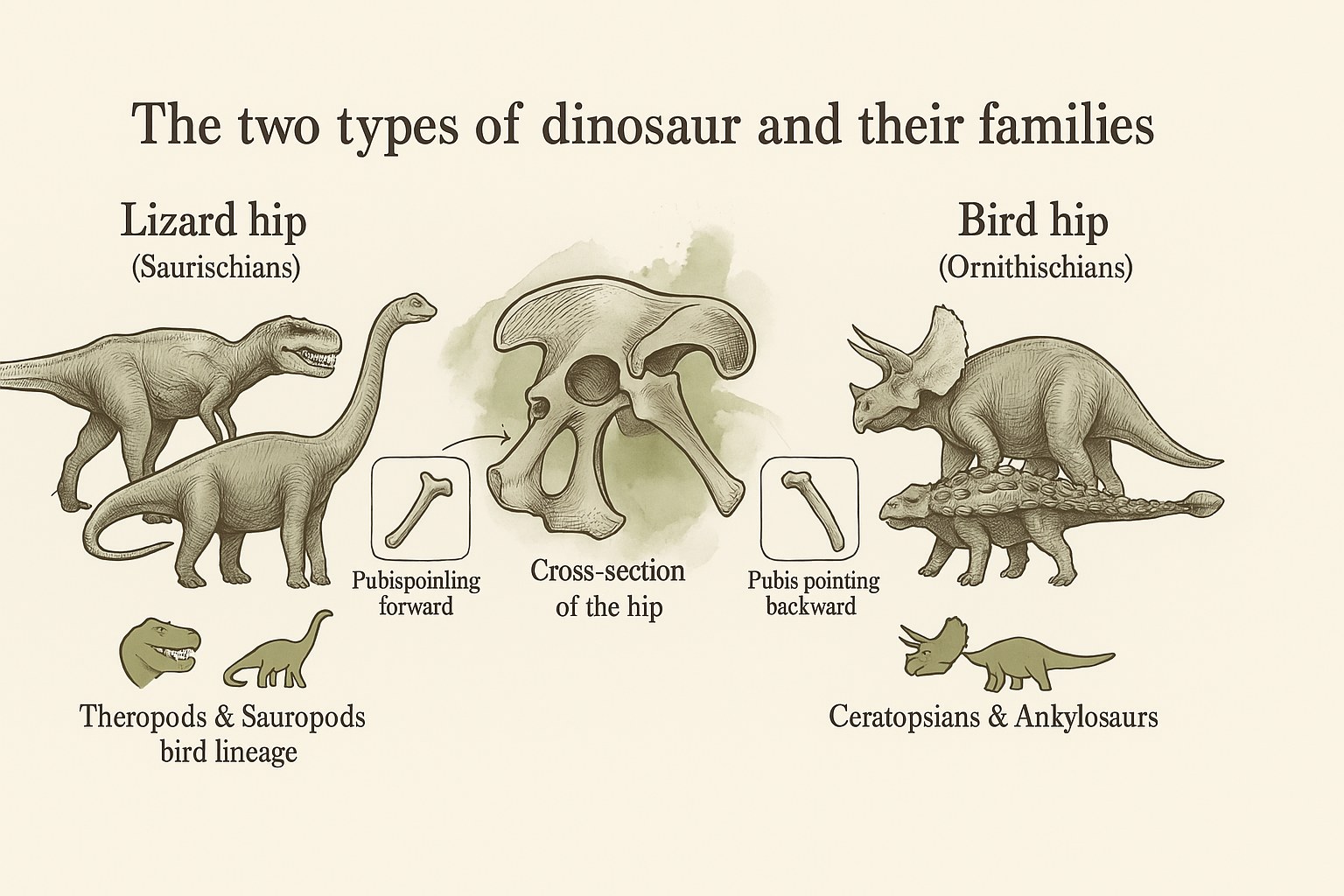
🦎 The saurischians and their lizard-like look
The name literally means “lizard hip”. Their bone structure is easy to recognise. The pubis points forward, an ancient feature in these reptiles.
You’ll find two main branches here. Theropods were often fearsome meat-eaters. At the other end, sauropods were giant plant-eaters with endless necks.
Yet there’s a little twist that often amuses researchers. Despite that lizard name, this line gave rise to birds. Biology sometimes has funny surprises in store.
🐦 The ornithischians with their bird hip
Here, the pubis points backward. It lines up alongside the ischium, just like in our birds today. This striking likeness belongs only to a wide range of plant-eating species.
This group brings together celebrities like the ceratopsians. You’ll also meet the armoured ankylosaurs. Many used a horny beak to graze peacefully on the plants around them.
This body shape was no accident. It left room for a large belly. That was vital for digesting tonnes of tough plant fibre.
🦴 Why this bone shape matters
The shape of the hips decides where the muscles sit. That directly affects how an animal moves. It’s the key clue for telling whether they walked on two legs or four.
Without this clue, sorting new finds would be impossible. The family tree would turn into total chaos. It’s the essential compass for every palaeontologist.
But watch out — nature loves to muddle the trail. Birds have a bird hip, yet they come from the saurischians. It’s an evolutionary twist you always need to keep in mind.
🦷 The meat-eaters with razor-sharp teeth
Now that the bone structure is clear, let’s turn to the ones that used their muscles to hunt down prey. The world of theropods was far from all the same.
🦖 The T-Rex, undisputed star of the predators
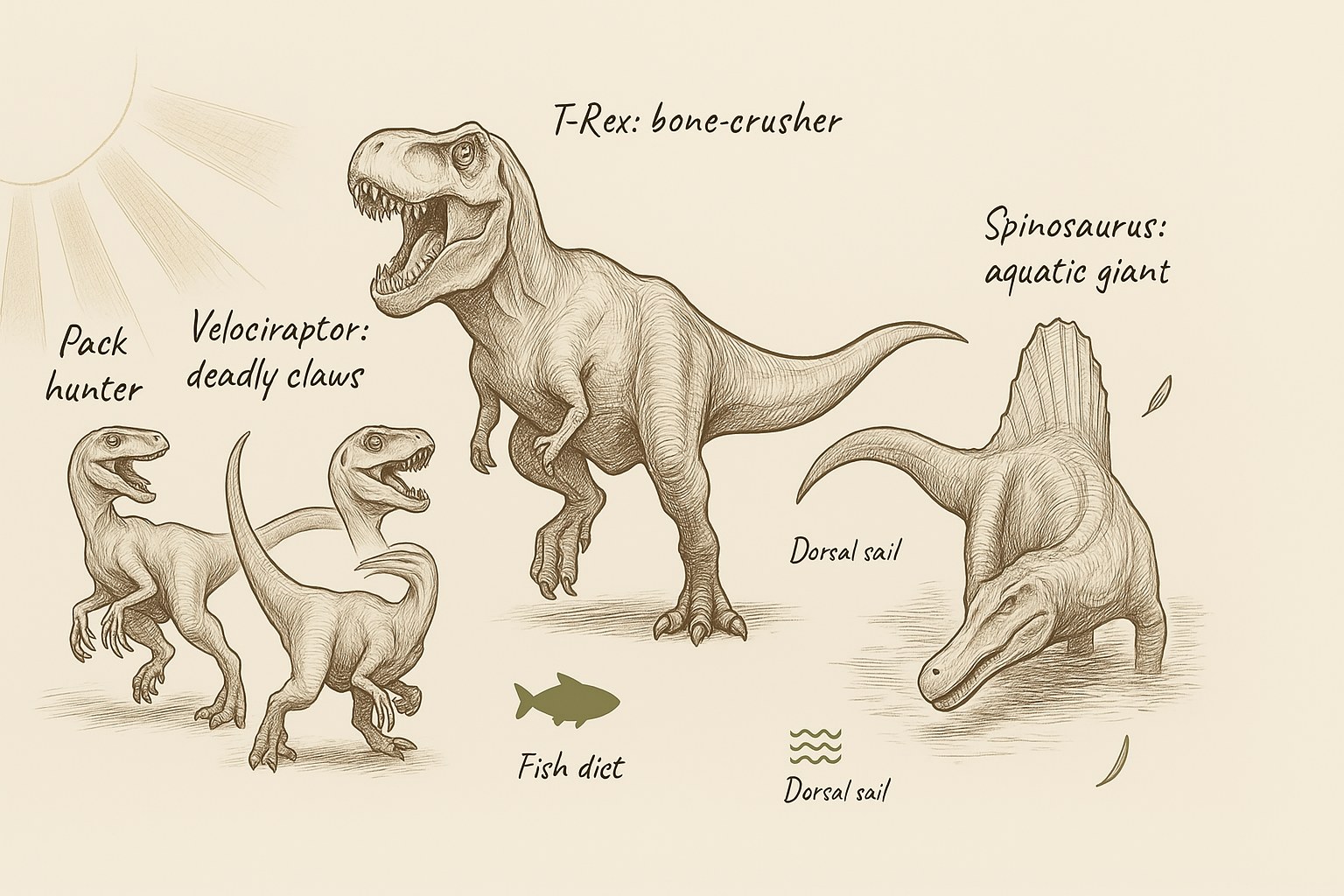
The jaw of the Tyrannosaurus rex packed phenomenal power. Its jagged teeth crushed bones with ease. It was a true biological war machine.
This giant could also act as an opportunistic scavenger, according to some experts. Its bite force matched the pressure of several cars at once. Its skull stayed rigid to make the most of every impact.
Its massive two-legged stance still impresses today. Its arms were tiny compared to its body. Yet what they were really for is still up for debate.
🐾 Velociraptors and hunting in packs
These medium-sized predators stood out for their agility. They bet everything on speed and clever tactics. Their sickle-shaped claws, held up off the ground, were fearsome weapons.
The evidence points to complex social behaviour. Attacking as a pack let them bring down prey far bigger than themselves. It was a brutally effective survival strategy.
The velociraptor wasn’t the scaly monster from the films, but a nimble hunter probably covered in feathers to control its body temperature.
🌊 The Spinosaurus and its watery habits
This giant sported a striking sail on its back. It spent most of its time in the water. Its long snout actually looks rather like that of our crocodiles.
Its diet was made up mainly of fish. Its flattened tail and short limbs worked like propellers. It’s the only large semi-aquatic theropod we know of. It even grew bigger than the famous T-Rex.
This very particular niche spared it any direct competition. It ruled supreme over the rivers of Cretaceous Africa. A one-of-a-kind predator.
🦕 The giant plant-eaters and their long necks
Let’s leave the fangs behind for the leaves. If the meat-eaters impress, the sauropods flat-out defy the laws of physics with their sheer size.
🦕 The Diplodocus, a skyscraper on legs
The Diplodocus had an endless silhouette. Its huge neck and tail worked as a perfect counterbalance. It was a real suspension bridge of flesh and bone, stretched out lengthwise.
Its skeleton was lightened by air pockets. Without these hollow vertebrae, it would have collapsed under its own weight. Natural engineering reaches its peak here.
It swept through low and high plants with ease. Even so, it didn’t necessarily raise its neck straight up to feed.
🌿 Eating tonnes of leaves a day
These giants faced a never-ending challenge to fuel their bodies. They had to swallow hundreds of kilos of plants every single day. It was a full-time job just to stay alive.
- No real chewing to grind down the plants.
- Swallowing gastroliths (stomach stones) to help break up the fibre.
- A huge gut needed to ferment all that greenery.
Their tiny head naturally limited the size of each mouthful. So they made up for it with almost non-stop eating.
👥 The social life of the big sauropods
These giants moved in herds to protect the youngest among them. Fossil trackways confirm this group behaviour. There was clearly strength in numbers.
They had effective passive defence strategies. A single whip of the tail could break a reckless predator’s bones. Their sheer mass alone was often enough to put off an enemy.
| Species | Estimated length | Average weight | Diet |
|---|---|---|---|
| Diplodocus | 25 to 30 m | 10 to 24 t | Plant-eater |
| Brachiosaurus | 23 m | 30 to 50 t | Plant-eater |
| Argentinosaurus | 35 m | 70 to 90 t | Plant-eater |
| Patagotitan | 37 m | 70 t | Plant-eater |
Looking at these figures, it’s easier to see why the different types of dinosaur — plant-eaters, meat-eaters and more — fascinate so many people. These heavyweights had no rivals their own size.
🛡️ Armour and horns for defence
While some bet on size, others built up a real arsenal of armour. Welcome to the battle tanks of the Cretaceous.
🦏 The Triceratops and its skull shield
The Triceratops was an impressive four-legged plant-eater with three horns. This giant grazed peacefully thanks to its very sturdy front legs. Its outline is still one of the most iconic of all the dinosaurs.
Its broad bony frill protected its neck well from bites. It also worked as a signboard during courtship displays. It was an essential tool for social communication within the group.
Living alongside the T-Rex was often explosive and tense. Their legendary duels don’t belong only to the cinema. These two giants really did clash for survival.
🛡️ The Ankylosaurus, a true battle tank
The Ankylosaurus wore armour made of bony plates called osteoderms. These solid shields covered its whole back. Even its eyelids had bony protection against predators.
Its tail ended in a fearsome bony club. A well-aimed blow could snap a theropod’s ankles clean off. It was its ultimate argument for a passive but effective defence.
This dinosaur led a quiet, solitary life. It spent its days grazing on low-growing plants. Its natural shield gave it complete peace of mind.
🦆 The duck bills of the hadrosaurs
Hadrosaurs had a flat snout that looked like a duck’s bill. Their dental batteries held hundreds of sturdy teeth. They were replaced constantly to grind down tough plants.
The Parasaurolophus used its head crest like a sound box. It produced deep notes to communicate over long distances. This clever alarm system warned the group of any coming danger. It was a real natural trumpet.
These animals could switch between walking on two legs and four. This flexibility made it much easier for them to flee. That way, they quickly adapted to their surroundings.
🤔 The false friends of prehistory
Beware of easy labels. Not everything big, old and scaly is a dinosaur — and the difference is a big one.
🐊 Marine reptiles swim in their own lane
You really need to tell the plesiosaurs apart from the dinosaurs. Their lines split very early on. They are marine reptiles, not dinosaurs.
Their bodies show extreme adaptations to the ocean. Their limbs turned into swimming paddles. They ruled the waters while the dinosaurs ruled the land.
The Mosasaurus was the ultimate sea predator. Even so, it has no direct family link with the T-Rex.
🦇 Pterosaurs are not birds
The pterosaurs were the masters of the prehistoric sky. Their wings were a membrane of skin stretched over one long finger. They are not flying dinosaurs.
They are a sister group to the dinosaurs. They share a common ancestor but evolved towards flight on their own. The build of their skeleton confirms this difference.
Mixing up a pterosaur with a dinosaur is a classic mistake — a bit like muddling a cat and a dog.
🔍 How to recognise a real dinosaur
The main clue is the upright position of the limbs. Dinosaurs carry their legs directly under the body. This anatomy allows a very efficient way of walking.
Crocodiles and lizards have a sprawling gait. Their elbows and knees point outward. This greatly limits their stamina and mobility.
To identify the dinosaur family, experts look for precise signs:
- A hole in the hip joint.
- At least three sacral vertebrae.
- Straight limbs sitting under the body.
☄️ The end of an era and a new take-off
The curtain falls suddenly 66 million years ago. But this catastrophic ending was really just a new beginning for an unexpected line.
☄️ The asteroid that turned everything upside down
A giant asteroid struck the Yucatán with incredible force. The impact set off a devastating nuclear winter. The food chain collapsed.
A mass extinction followed this climate chaos. The great dinosaurs… did not survive. Only small, opportunistic creatures managed to make it through.
This tragic event opened up precious ecological niches. That’s when mammals began their slow rise around the world.
🪶 Feathers long before sparrows
Theropod fossils reveal surprising plumage. At first, feathers were used for keeping warm or for display. Flight only came much later.
Some specimens still had a very specific scaly skin structure. These anatomical details fascinate researchers today. Science moves forward with every new find out in the field.
The link between these meat-eaters and birds is clear. The evolutionary transition is now solidly documented by experts.
🐦 Watching dinosaurs in your garden
Birds are technically theropod dinosaurs. They belong to the line of dinosaurs that survived. It’s a major shift in how we see the world.
Compare a hen with a T-Rex. You’ll find the same leg structure and the same fused collarbones. The genetic and physical likenesses are undeniable. Watching a bird means watching a survivor of the Cretaceous.
The variety of these modern dinosaurs is incredible. From pigeons to eagles, the Mesozoic legacy is everywhere around us.
From lizard hips to the Ankylosaurus’s armour, the variety of dinosaurs reveals fascinating survival strategies. Spot these giants with your children to turn every walk into a palaeontology adventure. This journey back to the age of prehistoric reptiles promises exciting discoveries for the whole family. The past is just waiting for you!
❓ FAQ
🦴 How can you tell dinosaurs apart by the shape of their hips?
It’s a question of bone structure. Palaeontologists divide dinosaurs into two big groups: the saurischians, with a “lizard hip”, and the ornithischians, with a “bird hip”. In saurischians, the pubis points forward, while in ornithischians, it points backward, alongside the ischium.
This anatomical difference, set out by Harry Seeley, affects everything from posture to movement. Curiously, even though the ornithischians have a bird hip, it was certain saurischians that eventually evolved into our modern birds. Nature sometimes has a funny sense of humour!
🍖 What were the different diets among dinosaurs?
The dinosaur world was very varied at the table. There were plant-eaters, like the Diplodocus or the Triceratops, who spent their days grazing on plants. At the other end, meat-eaters like the T-Rex or the Velociraptor were nimble predators with sharp teeth for hunting their prey.
There were also the opportunists: the omnivores. Species like the Ornithomimus or the Oviraptor ate a mix of plants, eggs, insects and small animals. This varied diet was a huge advantage for survival in changing environments or during harder times.
🤔 Why aren’t marine reptiles and pterosaurs counted as dinosaurs?
It’s a very common mix-up, but the difference is real. Dinosaurs are strictly land animals, with limbs placed directly under their body for upright walking. Marine reptiles, like the plesiosaurs, had limbs turned into swimming paddles, while the pterosaurs had hollow bones and membrane wings for flight.
Their skeletons tell different stories: one is built for dry land, another for the ocean depths, and the last for conquering the skies. Although they shared the same era, they belong to separate lines. Mixing up a pterosaur with a dinosaur is a bit like muddling a cat and a dog!
🐔 Is it true that the birds we see today are dinosaurs?
Yes, it’s absolutely true, and it’s fascinating! Birds are technically theropod dinosaurs that survived the mass extinction. They descend directly from small, feathered meat-eaters. If you look closely at a hen, you’ll find the same leg and collarbone structure as in its Cretaceous ancestors.
Recent discoveries show that many dinosaurs had feathers long before they could fly, first to stay warm or to attract a mate. So next time you spot a sparrow in your garden, remember that you’re admiring a true little survivor of the prehistoric age.
🛡️ What were the best defence tactics of the plant-eating dinosaurs?
Faced with predators, each one had its own little recipe. Giants like the Diplodocus relied on their huge mass and their whip-like tail. Others preferred heavy armour, like the Ankylosaurus, a living battle tank covered in bony plates and fitted with a tail club able to break bones.
There were also the specialists in horns and shields, like the Triceratops, whose frill protected its neck. And finally, some preferred communication: the hadrosaurs used their head crests as sound boxes to alert the herd the moment danger showed its face.
