
Explaining the solar system to children can quickly become a headache when you get tangled up between the gas giants and the little rocky pebbles. 🌞 This simple guide puts the stars back in order to help your curious little ones picture our cosmic neighbourhood with ease. At last you’ll be able to compare the size of the planets with everyday objects and shine on your next family stargazing night.
- The solar system explained simply to children
- The 4 rocky planets closest to us
- How to tell the gas giants apart
- Distances and movements in space
- The special case of Pluto and the Moon
- 3 activity ideas for watching the stars
🌞 The solar system explained simply to children
After looking up at the night sky, you often wonder what’s really hiding up there. Here’s a little guided tour to see things more clearly.
⭐ What is a star, a planet and a satellite?
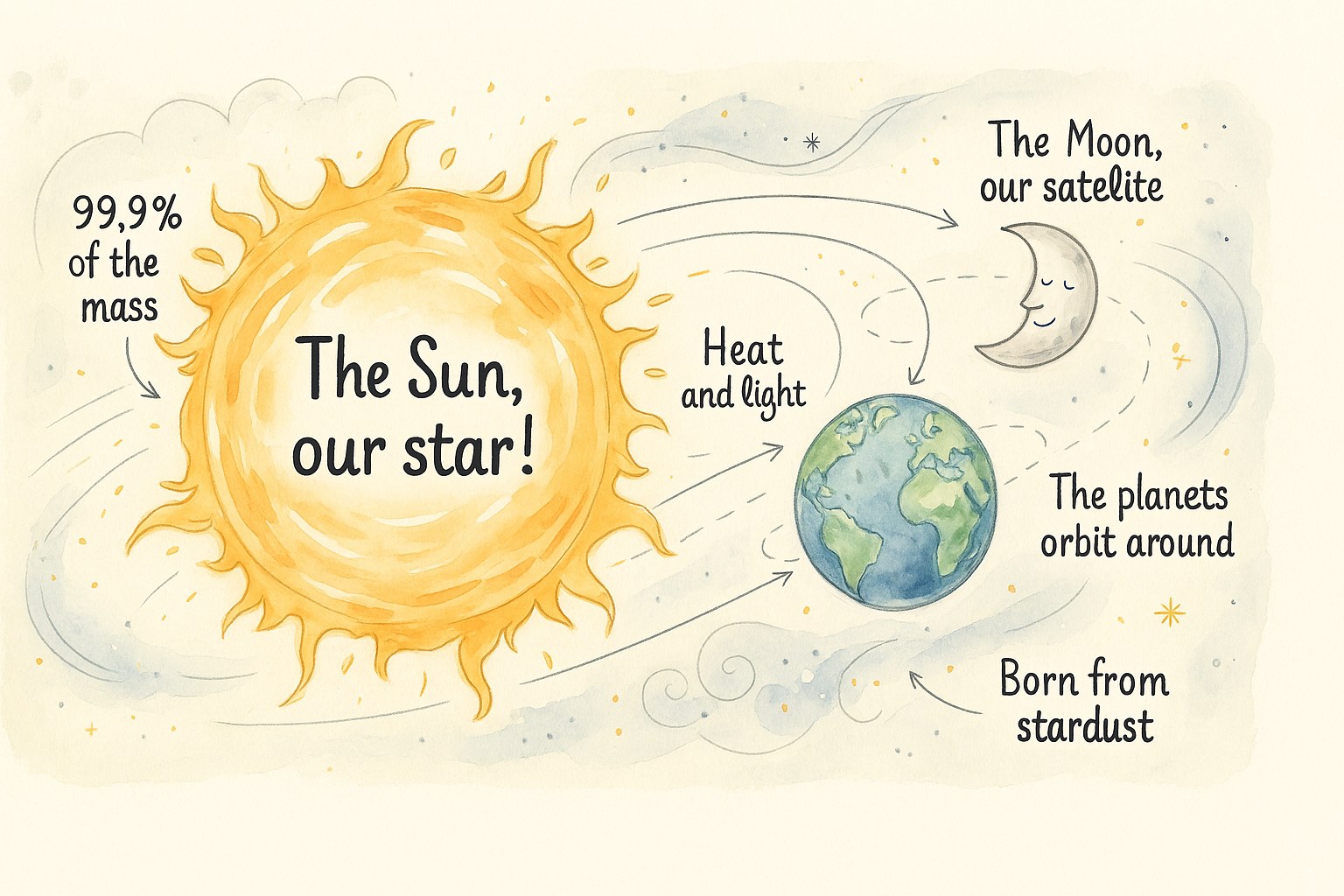
The Sun is a massive star. It makes its own light and its own heat. It’s an enormous ball of fire. It shines all on its own in the dark.
The planets go around the Sun. They don’t shine by themselves. They reflect the light of our star. They act like a giant mirror.
The Moon is a natural satellite. It follows the Earth everywhere. It’s our faithful travel companion. The system has 8 planets and a multitude of asteroids.
☀️ The Sun, our everyday engine of life
The Sun is the conductor of the space orchestra. Everyone spins around it. It sits right in the centre. It lights us up every single day.
Without its heat, the Earth would freeze. It helps plants grow. It lets animals breathe. It’s our natural battery.
The Sun makes up 99.9% of the total mass of the Solar System, which is why it pulls every other body towards it without exception.
✨ How it all began with stardust
At the start, there was a cloud. This gas was spinning very fast. Then, everything slowly collapsed. That was the starting point of our neighbourhood.
Gravity worked like a busy little ant. It stuck the grains together. Balls began to form. These balls became the planets we know today.
This happened 4.5 billion years ago. That’s a truly huge age. It’s hard to imagine. We are made of stardust.
🪨 The 4 rocky planets closest to us
Now that we know the setting, let’s look at the first four beads on the necklace, the ones with their feet on the ground.
🔥 Mercury and Venus, the scorching neighbours
Mercury is the tiny flea of the system. It’s right next to the Sun and has no air to protect it. During the day, it literally bakes under the solar rays.
Venus is even hotter because of its thick air. It’s a real greenhouse that traps the heat. You couldn’t set foot there without frying.
These two worlds are deserts of stone with no moons at all. They travel alone on their race around the central fire. They are hostile but truly amazing planets.

🌍 Earth and Mars, the worlds of stone
Our Earth is the only one with liquid water. That’s what lets fish and humans live here. It’s blue, beautiful and very precious.
Mars is its little red and dusty sister. It has the biggest volcano in the whole system. We call it the red planet because of its rust.
Scientists are looking for traces of ancient rivers on the Martian soil. Robots roll around up there to find clues. It might be our future home for explorers, since Earth is still the only place with liquid water on its surface.
🪨 Why are these planets made of rock?
Near the Sun, it was far too hot for the gases. Only metals and rocks could stay solid. That’s why they are hard and compact.
Understanding the solar system also means understanding how the planets were built:
- Mercury is made of iron and rock.
- Venus has volcanic ground.
- Earth has a metallic core.
- Mars is covered in iron-rich dust.
Their small size is down to the lack of materials available at the centre. They couldn’t grow as big as the faraway giants. They remain our little space pebbles.
🪐 How to tell the gas giants apart
If we keep heading outwards, the scenery changes completely and we meet monsters of gas.
👑 Jupiter and Saturn, the queens of the system
Jupiter is the biggest of all the planets. It has a red spot that is a giant storm. It’s so huge it could swallow all the others. In fact, it’s more massive than all the other planets combined.
Saturn is famous for its magnificent shining rings. They are made of billions of pieces of ice. It’s probably the most beautiful object in the night sky. You can’t miss it with its jewellery.
These two giants have dozens of moons spinning around them. Some moons even hide oceans under the ice. They are real little solar systems in miniature. It’s a permanent show up there.
🧊 Uranus and Neptune, the bluish, icy worlds
Uranus and Neptune are the most distant planets. They are a magnificent blue because of methane gas. They are very cold, mysterious worlds. They are often called the ice giants.
Uranus has a very funny quirk: it spins lying on its side. It looks as if it’s rolling along its orbit like a marble. It’s the only one that does this. Picture a spinning top travelling sideways.
Neptune has winds faster than fighter jets. It’s permanently freezing cold there. It’s the last sentinel before the black emptiness of deep space. The tour of the planets almost stops here.
💨 Understanding the difference between gas and rock
On these planets, there is no solid ground. If you tried to walk on them, you’d fall forever. They are made only of air and thick clouds. It’s a bit like trying to sit on a cloud.
Hydrogen and helium are the main ingredients of these giants. They’re the same gases found in the Sun. They’re like failed stars. They didn’t grow big enough to shine on their own.
Unlike the rocky planets, the gas giants have no fixed surface, which makes any attempt at landing absolutely impossible for our current probes.
🚀 Distances and movements in space
This whole little world doesn’t stay still. It spins, it dances and it holds together thanks to an invisible force.
🔄 Rotation and revolution to understand time
The Earth spins on itself like a spinning top. This movement is what creates day and night. When we face the Sun, it’s morning.
Revolution is the great journey around the Sun. It takes a whole year to go all the way round. The further out you are, the longer and slower the journey.
On Neptune, one year lasts more than 160 Earth years. You’d never get to celebrate your birthday. Time really depends on our place in space.
🧲 Gravity, the invisible glue of the universe
Why don’t the planets fly off into the dark? It’s thanks to gravity, a force that pulls on everything. Picture a giant magnet hidden at the heart of the Sun.
The heavier an object is, the more it pulls on the others. The Sun is so massive that it commands everyone. It keeps its planets firmly on a lead.
The Earth does the same with the Moon. It holds onto it so it doesn’t escape. It’s a perfect balancing dance between speed and pull.
📏 Picturing the immensity with simple comparisons
| Celestial object | Everyday object for scale | What makes it special |
|---|---|---|
| Sun | Yoga ball | Massive star at the centre |
| Jupiter | Watermelon | The biggest planet |
| Earth | Marble | Our little blue planet |
| Moon | Pea | Earth’s natural satellite |
| Space | The gap between objects | Huge invisible distances |
Space is mostly filled with vast emptiness. Between each planet there are incredible distances. Even light takes time to travel from one point to another.
If we drove to the Moon by car, it would take six months. To reach the Sun, it would take more than 150 years. The universe is truly gigantic.
🌙 The special case of Pluto and the Moon
It’s not all about big planets. There are also little rebels and influential satellites.
❄️ Why is Pluto no longer a classic planet?
Pluto lost its title as the ninth planet in 2006. Astronomers decided it was too small. It now belongs to the family of dwarf planets.
To be a real planet, you have to clear your own path. Pluto shares its orbit with lots of other icy pebbles. It’s not strong enough to do the tidying up.
It lives far away in the Kuiper Belt. That’s a zone full of comets and ice. Pluto is still a little star in our hearts, though.
🌊 The Moon and its influence on our oceans
The Moon pulls on the water of our oceans. That’s what creates the tides that rise and fall. Without it, the sea would stay at almost the same level all the time.
It always shows us the same face. That’s because it spins on itself at the same speed as the Earth. We never see its back.
It also helps the Earth not to tilt too much. It stabilises our climate to avoid wild seasons. It’s a real anchor for our blue planet.
☄️ Asteroids and comets, the travellers of the sky
Asteroids are big pebbles that float around. Most of them hide between Mars and Jupiter. They are the leftovers from the birth of the solar system.
Comets are balls of dirty snow. When they come close to the Sun, the ice melts a little. This creates a magnificent shining tail trailing behind them.
- Asteroids are rocky
- Comets are icy
- the main belt sits between Mars and Jupiter
🔭 3 activity ideas for watching the stars
The lesson is over, so let’s move on to the practical part and have fun with the planets from the garden.
🧠 Tricks to remember the order of the planets effortlessly
Learning the names by heart can be a bit boring. Use a magic sentence to help you instead. Each first word matches the name of a planet. It’s a very handy little secret.
“My Very Easy Method: Just Set Up Nine.” M for Mercury, V for Venus, E for Earth. It’s a foolproof method for never getting it wrong. Your children will love this fun little trick.
You can also make up your own silly sentence. The more original it is, the easier it is to remember. Then draw the planets in order to fix the images in your mind. The solar system then becomes child’s play.
🛠️ Crafts to make your own mini-system
Build a model with fruit of different sizes. Use a grapefruit for the Sun and a blueberry for the Earth. It’s visual and very tasty. You understand the scales better.
You can also play planets in the living room. One child is the Sun and the others spin around. It’s perfect for understanding the rhythm of the orbits. You move while learning astronomy.
For a longer-lasting version, set up a craft table. Here’s what you’ll need to make your project a success:
- Polystyrene balls of various sizes
- Acrylic paint (yellow, red, blue)
- Wire and black cardboard
- Shiny stickers for the stars
🔭 Getting started in astronomy with a first telescope
To begin, a simple pair of binoculars is often enough. You can already see the craters of the Moon very clearly. It’s a sight that always leaves you speechless. You don’t need very complex equipment.
Download a sky-map app on your phone. Point it at the stars to discover their names. It’s like having a guide in your pocket. Technology really helps curious little ones.
Choose a really dark night far from the city lights. Switch everything off and let your eyes get used to the darkness. The universe will then reveal itself to you. It’s a magical moment to share as a family.
Remember that our solar system is made up of eight unique planets, from the nearby rocky ones to the faraway gas giants, all bound together by gravity. To help your children picture these distances, quickly build a model with fruit! Explore the immensity of the universe together tonight under the stars.
❓ FAQ
💫 How did the solar system form in the first place?
It all began about 4.5 billion years ago with a huge cloud of gas and dust that started spinning very fast on itself. As it collapsed, most of the matter gathered at the centre to form the Sun, while the rest flattened into a disc all around.
In this disc, the little grains of dust stuck to one another thanks to gravity, forming bigger and bigger balls. This is called accretion, and it’s how our eight planets were born, along with the asteroids and comets we observe today.
⏳ How old is our solar system, roughly?
Our cosmic neighbourhood isn’t so young any more! Scientists estimate its age at about 4.6 billion years. It’s a colossal figure that’s sometimes hard to imagine, but it has been confirmed by studying very old meteorites that fell to Earth.
These rocks from space are real fossils dating from the birth of the solar system. By analysing them, we discovered they were the same age as the oldest rocks on our own planet, proving that this whole little world appeared at roughly the same time.
🪐 What are the eight planets that orbit the Sun?
The solar system has eight main planets, split into two groups. The first four are the rocky planets, the closest to the Sun: Mercury, Venus, Earth and Mars. They are small and solid, perfect for setting foot on (well, mainly on ours!).
Then, after crossing an asteroid belt, we find the four giants. There are the gas giants, Jupiter and Saturn, then the ice giants, Uranus and Neptune. These huge worlds have no solid surface and are made mostly of gas and thick clouds.
🤔 Why is Pluto no longer considered a planet?
Pluto was long the ninth planet in our school books, but the rules changed in 2006. Astronomers decided that a “real” planet had to be strong enough to clear its orbit and be alone on its path. Sadly, little Pluto shares its space with many other icy objects.
It hasn’t vanished, though, it has simply changed category! It’s now part of the family of dwarf planets. It lives very far away, in the Kuiper Belt, and remains a fascinating celestial object that scientists keep studying with great interest.
⭐ What is the difference between a star and a planet?
That’s a great question for seeing the sky more clearly! A star, like our Sun, is an enormous ball of burning gas that makes its own light and its own heat. It’s a bit like a giant battery shining all on its own in the darkness of space.
A planet, on the other hand, doesn’t produce light. It just reflects that of its star, a bit like a mirror. Planets orbit calmly around their star and are far less massive than the star itself.
