
Struggling to explain to your little explorers why the thermometer keeps going up and down all year long? ☀️ Understanding the seasons explained for kids becomes child’s play once you picture our planet as a slightly tilted spinning top travelling around the Sun. Discover how this simple tilt transforms our landscapes, from the return of flowers in spring to snowball fights in winter.
- Earth, this big ball travelling through space
- The secret of the tilt, or the story of the leaning spinning top
- Why the Sun’s rays warm us more or less
- The cycle of the four seasons and their little changes
- Solstices and equinoxes to spot the key moments
- The life of plants and animals month by month
- An upside-down world in the southern hemisphere
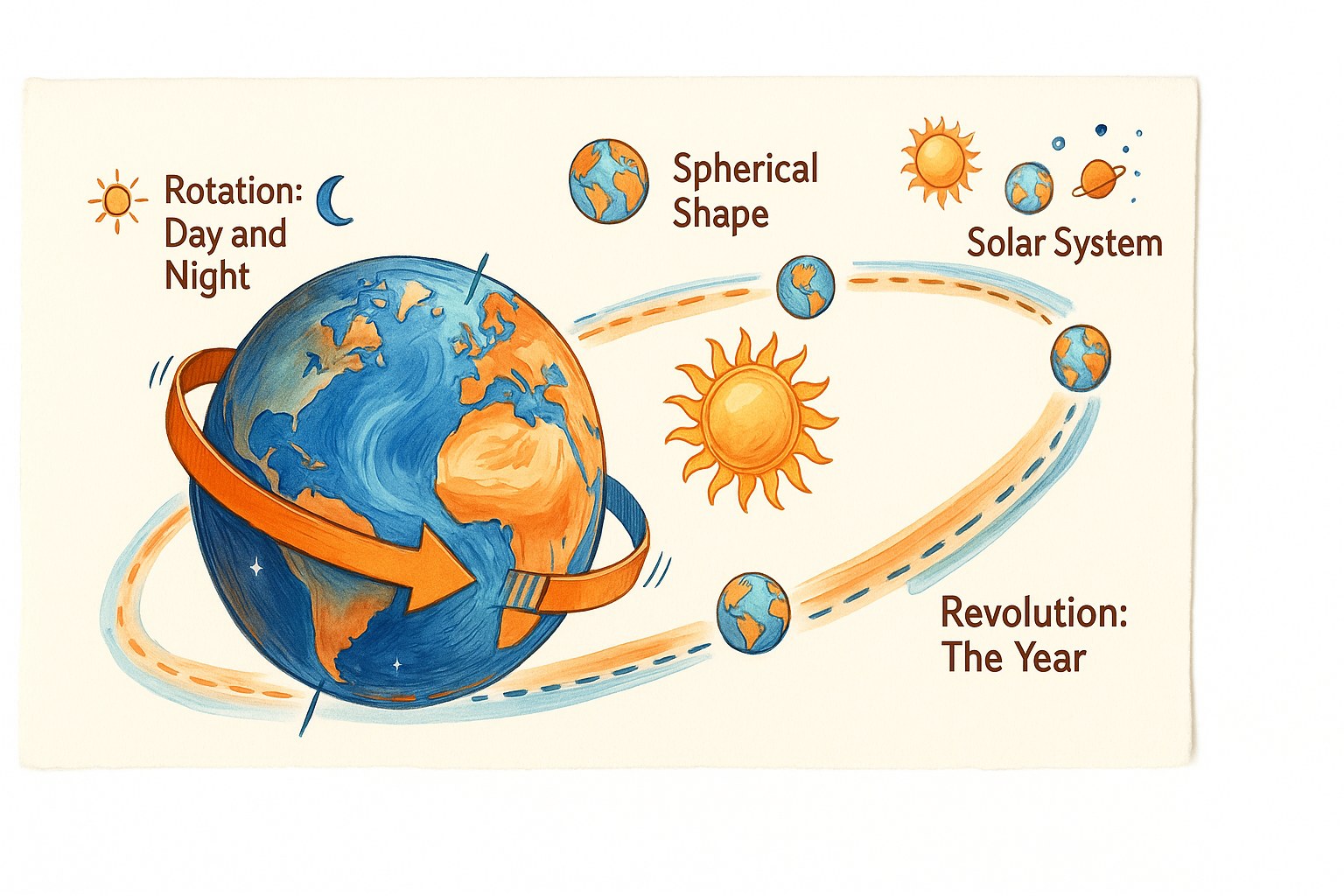
🌍 Earth, this big ball travelling through space
Picture our planet as a tireless traveller zooming along at full speed among the stars. To understand why it gets hot or cold, we first need to look at its basic movements.
🌗 The rotation movement for day and night
Earth spins on itself like a football balancing on a fingertip. This is what we call rotation. The movement is constant and has been going on since the dawn of time.
This pirouette creates the alternation between light and darkness. When we face the Sun, it is daytime. Otherwise, we slip into the shadow and it is night. It is a 24-hour cycle.
Earth never stops turning on its axis. In fact, it has been doing so for about 4.6 billion years. It is a leftover from its formation in space.
🌞 The great yearly journey around the Sun
Earth also draws a huge invisible circle in space around our star. We call this revolution. It is a path shaped like a stretched-out oval.
One complete loop takes exactly 365 days and a few hours. That is the length of a whole year for us. We travel at the astonishing speed of 110,000 kilometres per hour.
This journey is linked to the gradual change in the weather. Travelling changes our position relative to the heat. That is how the seasons explained for kids, and why it gets hot or cold, becomes clearer.
🪐 The shape of Earth and its place in the solar system
Earth is a sphere floating in the emptiness of space. It rests on nothing at all. It is the third planet in our solar system, nestled between Venus and Mars.
The Sun remains our central, constant source of light. It is the heart of our system. Its warmth gives us an average surface temperature of 15°C.
We can think of these movements as a precise dance. Earth waltzes around its star. It protects us thanks to its atmosphere and magnetic field.
🎯 The secret of the tilt, or the story of the leaning spinning top
If Earth’s journey around the Sun explains the length of a year, it is our planet’s posture that hides the real secret of the seasons.
📐 Earth’s axis is not perfectly straight
Earth does not stand up straight. Its rotation axis is a little crooked compared to the Sun. This leaning position changes everything for us.
Picture a spinning top that leans while it twirls on itself. Earth does exactly the same thing, with a fixed tilt of 23.5 degrees. The tilt is the key to everything.
This position never changes during its great yearly journey. Earth always keeps the same angle. It stays leaning to the same side all along its orbit.
🤔 What would happen if Earth stood up straight
Without this tilted axis, the seasons simply would not exist. The landscape would stay the same every month. We would have neither spring nor autumn to transform nature.
The temperature would be the same all year long. There would be no snow in winter. Summer heatwaves would vanish completely from our calendar too.
This little slope is essential for variety. It lets life adapt. That is how nature can change its colours.
🍎 A little experiment with an apple and a stick
You can picture Earth’s axis with a piece of fruit skewered by a stick. It is a simple model to make at home. An apple works perfectly.
Just tilt the object to copy the planet’s real position. Lean the stick a little to the side. You then get Earth’s exact posture.
The two ends of the stick stand for the North Pole and the South Pole. This shows how each half of the world is exposed to the Sun differently.
☀️ Why the Sun’s rays warm us more or less
Now that we know Earth’s position, let’s see how it changes the strength of the light we receive.
⚡ Direct rays that bring lots of energy
Rays that fall straight down warm us intensely. All the solar energy concentrates on one small, precise spot. The heat then becomes very strong.
This is exactly what explains the high temperatures of summer. The Sun beats down hard because it sits high in the sky. The air heats up very quickly under this direct light.
Picture a flashlight held right above your hand. You feel the heat much faster that way. That is the secret of scorching July days.
📉 Slanted rays that lose their strength
Slanted rays spread out over a larger area of ground. The heat is lost because it has to cover more space. The warming then becomes much less effective.
This spreading of energy makes the surrounding air much colder. The ground simply cannot warm up. Temperatures drop despite the presence of the Sun.
This phenomenon matches exactly the winter period. The Sun looks low and shy in the sky.
📏 The distance between Earth and the Sun
The distance between us and the star changes a little during the year. Yet this is not the cause of the seasons. It is a very common misconception.
We have to forget the idea that the heat comes from being closer. In fact, Earth’s orbit is almost round. We are actually closer to the Sun in January.
Everything depends only on the angle of the solar rays on our ground. The angle makes all the difference. It is the tilt of Earth’s axis that controls the whole calendar.
🍂 The cycle of the four seasons and their little changes
These variations in solar energy radically transform the landscape we see through the window as the months go by.
🌷 Nature waking up in spring and summer
The warmth slowly rises and light floods our days. Buds finally burst open after the cold. Everything seems to spring back to life all at once before our eyes.
The scent of fresh flowers perfumes the garden air. The grass becomes warm and soft underfoot. You just want to go out and run everywhere.
The Sun stays high for a very long time in the blue sky. The days stretch out because Earth receives more energy. This is the moment when light wins the game.
❄️ Earth resting in autumn and winter
Temperatures drop and the Sun hides away faster. Grey skies often settle in by snack time. Scarves come back out of the cupboards to protect us.
Dead leaves crackle loudly under our heavy steps. The ground turns hard and cold to the touch. Nature seems to fall asleep.
The cold sets in because the Sun stays very low. Its faraway rays no longer warm us enough.
🌦️ The link between weather and daily activities
We adjust our clothes to the weather of the day. We go from swimsuits to thick coats. Each season demands its own kind of wardrobe.
Food also changes with the outdoor temperature. We prefer hot soups in January to warm ourselves up. Juicy fruits wait patiently for the Sun to return.
Our pace of life adapts to natural light. We come home earlier when darkness arrives. Here are the signposts to find your way:
- Spring: begins around 20 March, ideal for planting.
- Summer: begins around 21 June, perfect for swimming.
- Autumn: begins around 23 September, time to gather the leaves.
- Winter: begins around 21 December, favourite season for skiing.
📅 Solstices and equinoxes to spot the key moments
To mark the move from one season to the next, astronomers use very precise landmarks in the year.
📅 The longest and the shortest day of the year
The summer solstice is the peak of light. It is the true festival of the Sun. The rays then warm our northern hemisphere intensely.
At the winter solstice, night takes up the most space. It is officially the shortest day. The Sun then looks very low.
The solstice is the moment when the Sun seems to stop rising or sinking in the sky before setting off again.
In winter, the days shorten noticeably. This comes from Earth’s maximum tilt. Our side sulks a little away from the Sun.
⚖️ The perfect balance during the equinoxes
There are two moments when day lasts as long as night. It is a perfect equality everywhere. The Sun sits right over the equator.
These dates mark the move towards spring and autumn. Nature then changes its rhythm. Temperatures gently begin to tip over.
At this moment, Earth is leaning neither forward nor backward. It stays neutral. Solar energy is then shared out fairly.
🔁 The calendar of seasons that always comes back
These dates are fixed landmarks every year. We can count on them. The Gregorian calendar neatly organises these celestial appointments.
The regularity of the cycle helps to reassure us. Good weather always returns after the cold. It is a promise from nature.
Picture an endless loop for the months. It is an eternal circle. Earth turns without ever stopping.
🌱 The life of plants and animals month by month
Animals and plants have no calendar, but they feel these changes deep within their cells.
💤 Hibernation and deep sleep to get through winter
Some animals sleep for a long time to save their precious energy. The hedgehog or the bear then hide in safe shelters. They slow down their bodies to survive the cold.
Finding food becomes a real challenge when the frost arrives. There are no more berries or insects to nibble. Fat reserves then replace meals.
To protect themselves, fur or feathers thicken during autumn. They put on their big natural jumper to stay warm. It is an effective barrier against the snow.
🌸 The flowering and life cycle of plants
The tree drops its leaves to survive the winter frost. It protects itself this way by stripping bare during the cold months. This pause stops the water from freezing inside it.
The spring warmth finally gives the awaited signal to the buds. It is the moment all the vegetation wakes up. The sap rises and the first flowers finally appear.
Fruit production depends directly on the abundance of sunlight. The Sun makes the sugar. Without this light, harvests would be impossible.
🦅 The migrations and journeys of birds
Many birds set off to look for warmth and food elsewhere. They fly south to escape the freezing temperatures. This journey is a matter of survival.
Nature is always on the move to adapt to the weather. Nothing stays frozen, because each species follows its own rhythm. It is a permanent balance between regions.
The return of migrating birds officially announces the change of season. It is a promise of spring that we watch for with joy. The nests fill up once again.
| Season | State of the trees | Animal behaviour | Temperature felt |
|---|---|---|---|
| Spring | Buds in flower | Waking up and nests | Mild |
| Summer | Green leaves | Lots of activity | Hot |
| Autumn | Colourful leaves | Stocking up and leaving | Cool |
| Winter | Bare branches | Deep sleep | Cold |
🔄 An upside-down world in the southern hemisphere
But watch out, not everyone experiences the same thing at the same moment on our big blue planet.
🇦🇺 Christmas in the sunshine in Australia
Some countries celebrate winter while enjoying the beach. It is a strange but very real sight for us. We imagine snow while they pull out their swimsuits.
When the North leans towards the Sun, the South naturally moves away from it. It is a constant seesaw of our globe. Solar energy shifts this way from one side to the other.
In Sydney, families have lunch outdoors in strong heat in December. Meanwhile, in big northern cities, people pull out their thick coats. The two places live the complete climate opposite.
🔄 The total reversal of seasons between the two poles
The seesaw mechanism between top and bottom is fascinating. It is like a giant swing in space. Earth’s tilt aims the rays in a selective way.
The seasons are opposite but follow exactly the same yearly rhythm. The cycle stays identical. Only the calendar of temperatures changes depending on the place.
Earth receives its heat unevenly depending on its position. The sharing is lopsided. Everything depends on the way Earth’s axis is pointed towards our star.
✈️ The imaginary journey to compare climates
Picture a quick journey from one hemisphere to the other today. In a few hours by plane, you change worlds completely. You leave the snow for the dazzling sunshine. The temperature contrast is striking the moment you step off the plane.
Landscapes seen at the same time of year do not look alike. The colours are totally different between summer green and winter grey. It is a real visual shock.
The diversity of our blue planet is truly incredible. It is full of surprises for those who watch the sky. The seasons explained for kids, and why it gets hot or cold, then becomes obvious.
Earth’s tilt and its journey around the Sun explain why it gets hot or cold. By understanding this natural cycle, you help your children marvel at every change of season. Start today by watching the path of the Sun to anticipate together the next mild days of spring.
❓ FAQ
🌡️ Why do temperatures change over the course of the year?
The secret does not come from the distance to the Sun, but from Earth’s position. Our planet travels while leaning a little on its axis, like a spinning top that will not stand straight. Because of this tilt, some regions receive the Sun’s rays very directly, which warms strongly, while others receive them at an angle, which brings far less heat.
☀️ Does Earth get closer to the Sun in summer?
This is a very common misconception, but it is a little myth! The distance between Earth and the Sun changes ever so slightly during its journey, but that does not explain our seasons. It is really the angle of the solar rays that makes all the difference: the more they hit us “standing up”, the hotter it gets.
🌙 Why are the days shorter when it is cold?
In winter, our part of Earth is tilted away from the Sun. Since we are “hidden” behind the curve of the planet, the Sun stays visible above the horizon for less time. That is why scarves come out at the same time as night falls earlier, because we receive less solar energy.
📅 What exactly is a solstice?
It is a key moment when the Sun reaches its highest or lowest position in the sky. The summer solstice gives us the longest day of the year, a true festival of light. By contrast, the winter solstice marks the longest night, the moment when the Sun seems to be at its lowest before slowly climbing back up.
🇦🇺 Why is it hot in Australia when it is winter up north?
Earth works like a seesaw. When the northern hemisphere leans towards the Sun, the southern hemisphere moves away from it, and the other way round. So while we are making hot soups in December, Australians enjoy the beach because their side of the planet receives the rays directly at that moment.
⚖️ What is the difference with an equinox?
The equinox is a moment of perfect equality that happens in spring and autumn. Earth is then leaning neither forward nor backward in relation to the Sun. The result: the day lasts exactly as long as the night everywhere on the planet. It is the official signal that nature is changing its rhythm.
🐾 How do animals know that the season is changing?
Even without a calendar, animals feel the drop in light and warmth. Some, like the hedgehog, choose to sleep to save their energy: this is hibernation. Others, like birds, prefer to fly south to find the warmth again. They simply adapt in order to survive.
