
Do your children often ask you why the sky keeps changing, or how clouds are made, and you struggle to explain it simply? ☁️ This article follows the journey of water, from the warmth of the sun to the moment those big white sheep appear in the sky, using words that little explorers can understand. You’ll discover how a pinch of dust and a touch of cold turn invisible vapour into a cloud that can weigh as much as hundreds of elephants.
- What is cloud formation, explained for kids?
- The sun heats up Earth’s giant pot
- Warm air rises towards the sky
- Dust helps the droplets be born
- Spotting the different types of clouds
- Why do clouds change colour?
- Where do clouds go when they disappear?
- Make a cloud in a bottle at home
☁️ What is cloud formation, explained for kids?
Have you ever taken the time to watch those white shapes drifting above our heads? You might think they’re candyfloss, but the truth is a lot wetter.
💧 A big pile of water droplets
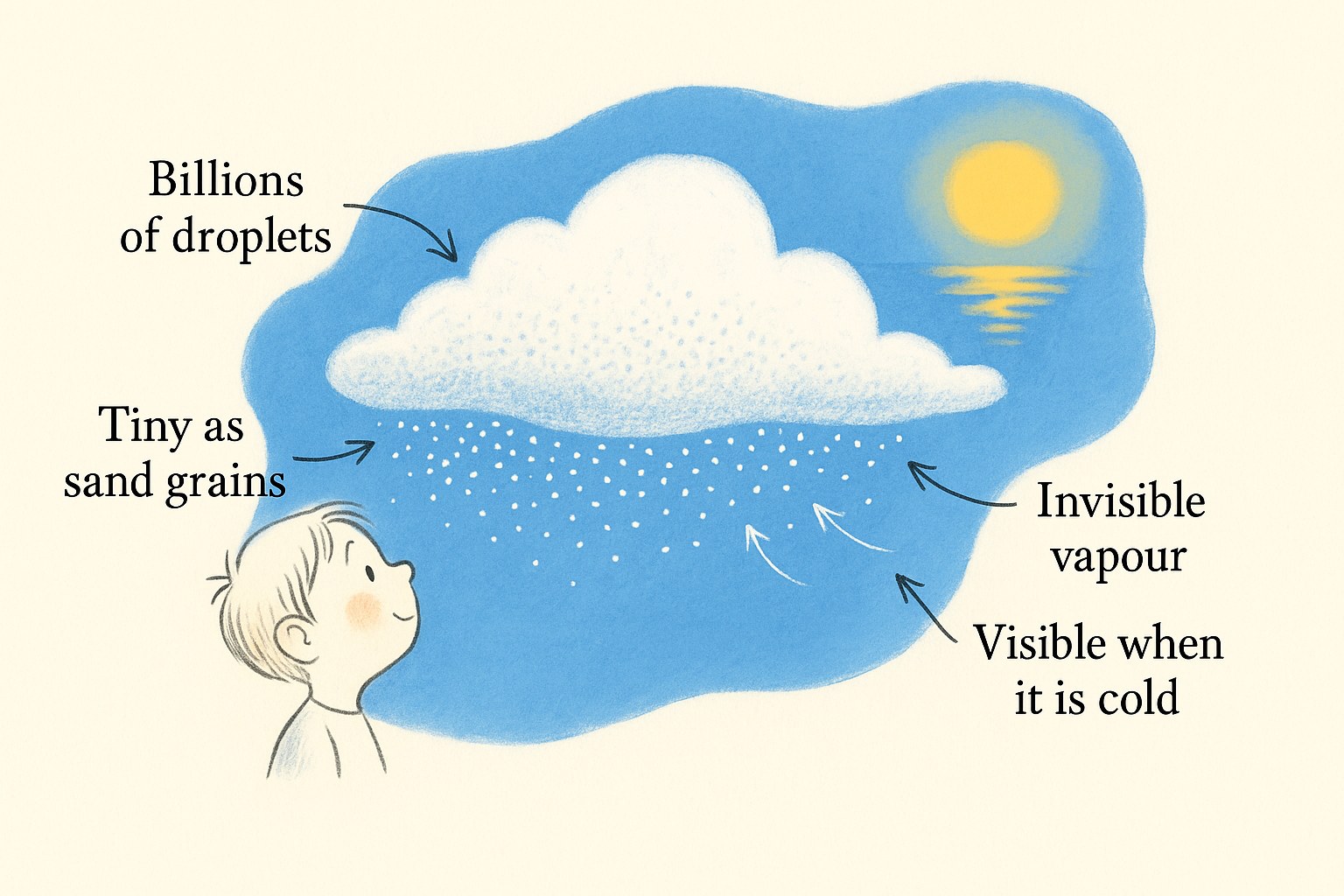
Clouds aren’t smoke. They aren’t gases either. They are billions of tiny droplets of liquid water all bunched together.
It’s like the mist on a cold window. Or the steam rising from boiling pasta. These droplets are so light that they float in the air. It’s a really simple bit of physics.
Each droplet is tiny. It’s smaller than a grain of sand. A cloud is one enormous, very damp gathering.
👻 Water vapour stays invisible
You need to tell the difference between water you can see and water that’s hidden. Vapour is an invisible gas. We breathe it in all the time without even noticing.
A cloud only appears when this vapour changes state. It’s a precise physical change. As long as the water stays a gas, the sky stays perfectly blue and see-through.
Water vapour is a ghost that only becomes visible when it gets a little too cold up in the sky.
💺 Why you can’t sit on a cloud
Forget the idea of solid cotton wool. If you tried to sit on a cloud, you would fall straight through. It’s exactly like trying to lean on a very thick fog.
Aeroplanes fly through these masses without any bump at all. The pilots simply find themselves surrounded by white or grey. You feel a damp haze, like a forest on an early morning.
A cloud mostly just decorates the sky. It has no real solidity, it’s only moisture floating in the air.
☀️ The sun heats up Earth’s giant pot
To make this water in the sky, you first need a powerful engine: our star. Without this source of energy, nothing up there would move.
🌊 The ocean water that evaporates
The sun heats the surface of the oceans and lakes. The heat turns liquid water into invisible vapour. It’s the start of the great journey up to the heights.
Look at a puddle on the pavement. After the rain, the sun makes it vanish quickly. The water hasn’t really left, it has flown off as a gas.
This process is called evaporation. It’s a key step for understanding how the sky fills up with future droplets.
🌞 The sun’s role in the weather
The sun is the conductor of the whole world’s weather. Without its heat, water would stay still on the ground. It creates the movement needed to form the cloud masses everywhere, just like you learn at science workshops for children.
This water cycle never stops. It works day after day across the whole surface of our blue planet.
Without this heat energy, the sky would stay empty. The sun is the battery that powers the weather machine.
🛫 Water vapour begins its journey
Water vapour is lighter than the dry air around us. So it starts to rise all on its own. It’s a very simple law of physics.
Think of a helium balloon slipping out of your hands. The vapour climbs higher and higher into the atmosphere. It follows the rising currents of warm air.
The higher it goes, the further it gets from the warmth of the ground. This vertical journey is essential for what comes next. Nothing can stop it on its way.
🎈 Warm air rises towards the sky
Now that the vapour is climbing, let’s see why it doesn’t stay down here with us.
🎈 The hot-air balloon effect in the sky
Warm air spreads out and takes up more space. So it becomes less dense and lighter. It’s the very same idea as a hot-air balloon.
Cold air, which is heavier, sinks down and pushes the warm air upwards. It’s an invisible lift carrying the moisture. This movement creates currents that birds often use.
The vapour hitches a free ride. It rises up towards the cold zones.
🧊 Cooling down as you climb higher
As it rises, the temperature drops quickly. That’s why there’s snow on the mountains. The sky is a giant freezer up high.
This cold is the trigger for the transformation. The water vapour starts to shiver and tries to bunch together. Without this cooling, it would stay an invisible gas forever.
It’s a crucial step in the cycle. Cold turns the invisible into the visible.
💦 Vapour turns into droplets
This is called condensation. The water molecules squeeze up against one another. They then form tiny, round, liquid droplets.
This is the moment the dew point is reached. The air can no longer hold the water as a gas. It absolutely has to turn back into a liquid to exist.
At last we can start to see something appear. The cloud is being born before our very eyes.
💧 Dust helps the droplets be born
But watch out, the water needs a little helping hand, or rather a tiny grain of sand to cling to.
⚪ Tiny grains of sand and salt
The air is never completely clean. It carries minuscule specks of dust that are invisible to the naked eye. They’re called condensation nuclei.
These grains come from desert sand or sea salt. Even smoke from forest fires plays a part. They travel thousands of kilometres on the wind.
These specks are vital for the weather. Without them, there could be no rain.
🧲 Droplets hooking onto the dust
The dust acts like a magnet for the vapour. The water needs something solid to settle on. It wraps itself around the grain of sand.
Imagine a door handle you can hold on to. Without this resting point, the droplet would struggle to stay formed. It’s the hidden skeleton of every little droplet.
Every raindrop hides a tiny treasure of dust or salt right at its heart.
🌥️ The birth of a visible cloud
When billions of droplets form, they gather together. It’s this giant cluster that creates the white shape. The cloud finally becomes visible from the ground.
The cloud keeps growing as long as the vapour keeps arriving. It can become huge in just a few minutes. It’s a real city of water hanging in the air.
Its shape depends on the wind currents. That’s why they’re always changing how they look.
🔍 Spotting the different types of clouds
Not all clouds look alike; each one has its own name and personality. Here’s a little guide to understanding how clouds form, kept nice and simple.
🐑 Cumulus, the big white sheep
These are the illustrators’ favourite clouds. They look like big cauliflowers or fluffy sheep. They drift peacefully across a lovely blue sky.
Cumulus clouds usually mean good weather. You can have fun spotting animal shapes in them. It’s a perfect game for summer afternoons.
They’re plump and nice and white. They’re the sign of a calm day.
🪶 Cirrus and the angel hair
These clouds live very high up in the sky. They aren’t made of liquid water but of ice. They look like fine white feathers.
They’re often called angel hair. Their wispy look shows there’s a lot of wind up there. They sometimes warn that rain is on the way.
They’re very elegant and discreet. They look like brushstrokes of paint.
☁️ Stratus and the grey blanket
Stratus clouds form a great grey sheet across the sky. You can’t see the sun at all. They’re very low and a bit gloomy.
It’s like fog that has decided to climb up a little. They often bring a fine, persistent drizzle. It’s the typical weather of autumn days.
Everything turns grey and even. It makes you want to stay cosy and warm.
⛈️ Cumulonimbus and the fury of the storm
This is the king of clouds, the most impressive of all. It looks like a giant mountain or an anvil. Its base is often very dark, almost black.
Watch out, it hides big storms inside. It holds heavy rain, thunder and lightning. It’s a powerful and slightly scary cloud.
It’s best to head indoors when it arrives. It’s the giant of the sky.
🎨 Why do clouds change colour?
Have you noticed that clouds go from bright white to threatening grey? Here’s the secret.
🌈 Sunlight passing through the water
The white of clouds comes from sunlight. The rays bounce off the little water droplets. This creates that bright, pure look.
It’s like a glass of milk. The light is scattered everywhere. All the colours mix together to make white.
- White for thin clouds
- Grey for thick clouds
- Pink at sunset
🌫️ The shadow of big grey clouds
A cloud turns grey when it’s very thick. It holds so many droplets that the light can barely get through. The bottom stays in shadow.
Imagine a big parasol above you. It blocks the rays and casts a shadow. That’s what happens with big clouds.
The more water a cloud holds, the darker it gets. It’s often the sign that rain is coming soon.
⚖️ The incredible weight of floating clouds
We think they’re as light as feathers. Yet a big cloud weighs hundreds of tonnes. That’s the weight of several dozen elephants.
They don’t fall because the droplets are tiny. The rising warm air keeps them levitating, like dust in the sunshine.
| Type | Weight | Altitude | Rain |
|---|---|---|---|
| Cumulus | 1M tonnes | 2,000 m | Light |
| Cirrus | Variable | 8,000 m | None |
| Stratus | High | 500 m | Medium |
| Cumulonimbus | 1Bn tonnes | 10,000 m | Heavy |
Estimates for a medium-sized cloud (about 1 km³): the weight depends on the volume and the density of liquid water. Source: NOAA (National Oceanic and Atmospheric Administration).
To understand how clouds form, just remember that water evaporates thanks to the warmth of the sun.
💨 Where do clouds go when they disappear?
A cloud isn’t forever; it always ends up going away in one way or another.
🌧️ Rain, snow and hail
The droplets eventually bump into each other and merge. They then become too heavy to float. Gravity pulls them down to the ground: that’s rain.
If the air is very cold, the water falls as snow. If the currents are violent, it forms hail. It all depends on the temperature during the fall.
The water goes back into the rivers and oceans. The cycle can then start all over again.
💨 Evaporating straight into dry air
Sometimes a cloud disappears without any rain at all. It simply evaporates on the spot. The dry air around it “drinks up” the little droplets.
It’s like a sugar cube in a hot coffee. The cloud dissolves and turns back into invisible vapour. It fades away gently until it leaves a blue sky behind.
It’s a very peaceful ending for a cloud. It becomes a ghost of water again, hidden in the air.
✈️ The white trails of aeroplanes
Aeroplanes sometimes make their own clouds. The engines release very hot water vapour. When it meets the icy air, it freezes instantly.
This forms those long, straight white lines. They’re artificial clouds called contrails. They can stay visible for a very long time if the wind is calm. They’re a good sign of moisture high up.
They end up spreading out and looking like Cirrus clouds. It’s the only visible human trace in the clear sky.
🧪 Make a cloud in a bottle at home
To really understand it, nothing beats a little magic experiment to do in your kitchen.
🧰 The kit you need for the experiment
You need a clear plastic bottle. Also grab a little warm water and some matches. The kit is very simple to find at home.
Here’s what to get ready:
- An empty 1.5L bottle
- Warm water
- A match (handled by an adult)
- A cap that closes tightly
Careful, an adult must be there. You never play with fire on your own.
📋 The steps to create condensation
Pour the warm water into the bottom of the bottle. The adult lights a match, blows it out and lets a little smoke drift in. Quickly close the cap to trap it all inside.
Squeeze the bottle hard with both hands. Then suddenly release the pressure to create a quick cooling. A white veil appears inside as if by magic. That’s your very own little cloud, just born.
Do the squeeze again to watch the cloud disappear. It’s really amazing.
✅ The weather-watcher’s checklist
Become a true little weather expert. Look at the sky every morning and write down what you see. It’s a fascinating habit for understanding nature.
Watch which direction the clouds are travelling. Draw their funny shapes in a special notebook. Note whether they’re white, grey or look like feathers. That’s how real sky scientists work.
Have fun with the shapes. The sky is a free picture book.
The sun heats the water, which evaporates and condenses into droplets around specks of dust to create these giants of the sky. Whether they’re Cumulus or Cirrus, watch them quickly before they rain or evaporate. Understanding how clouds form turns every walk into a fascinating nature lesson.
❓ FAQ
🤔 Why don’t clouds fall to the ground?
That’s a really clever question! Even though a cloud can weigh as much as several elephants, it stays up in the air thanks to the warm air rising from the ground. The little water droplets are so light and spread out that they float like dust in a sunbeam.
As long as the rising air current is there to carry them, they keep levitating. They only fall when they become too big and too heavy: that’s when it starts raining on our heads!
🤲 Can you really touch or sit on a cloud?
We’d all love it to be a big cotton-wool cushion, but it’s impossible to sit on one. A cloud is a bit like a very thick fog. If you tried to climb onto it, you’d go straight through, exactly as if you were walking through water vapour.
Aeroplane pilots will tell you: when they fly through a cloud, they just see grey or white all around them. It feels like a damp haze, but there’s nothing solid to grab hold of.
🌪️ How does dust help make clouds?
Dust is an essential secret ingredient! Water vapour needs a little solid support to turn into a droplet. These tiny grains of sand, sea salt or smoke act as a “hooking point” for the moisture.
Without these condensation nuclei, the vapour would stay an invisible gas. You could say every little raindrop hides a tiny treasure of dust at its centre. It’s the invisible skeleton of every cloud.
🎭 Why are some clouds all grey and others all white?
It’s all about light and thickness. White clouds are thin and let the sun’s rays bounce around everywhere. It’s this mix of light that gives that beautiful, bright cotton-wool colour.
Grey clouds, on the other hand, are full of much more water and are very thick. They act like a big parasol that blocks the sunlight. The bottom of the cloud is then in shadow, which gives it that dark, threatening look.
🌊 Where does the water vapour that rises into the sky come from?
The engine behind it all is the sun! It heats the surface of the oceans, lakes and even little puddles after the rain. This heat turns liquid water into an invisible gas called water vapour.
Because this vapour is lighter than dry air, it flies up into the sky. It’s the start of a great vertical journey that only stops when the air gets cold enough to turn that gas into little visible droplets.
