
Fruit and Vegetable Word Searches to Print for Kids
🍎 These printable fruit and vegetable word searches bring together two worlds your child already knows well: everyday foods and the fun of hunting for hidden words. As they work through these letter grids, your child builds up food vocabulary, learns to spell words they often say out loud, and develops concentration in a playful way.
This selection offers six grids that grow with your child, from a beginner level for the last year of nursery to an expert level for ages 8 to 9. Each grid prints in a single click and can be used at home, in class or on a trip. Hand over a coloured pen to circle the words found and the activity becomes even more satisfying.
🥕 Why choose the fruit and vegetable theme
The fruit and vegetable theme has a rare teaching advantage: your child meets these foods in everyday life. They touch them at the market, taste them at the table, recognise them on their plate. That familiarity builds a bridge between the real world and learning to read and write, which makes word searches especially effective on this theme.
When your child meets “TOMATO” or “STRAWBERRY” written out in a grid, they link the printed word to a strong mental image. This sensory link helps spelling stick far more than simply copying a list of words.
On the nutrition side, the activity can also spark family chats about seasonal foods, fruit we eat raw or cooked, and vegetables we grow in a garden. The word search then becomes a starting point for natural, enjoyable food education.
📋 Our printable word search grids
Here are six grids carefully built to take your child from the very first level all the way to the most advanced.
🍎 Easy grid: common fruit
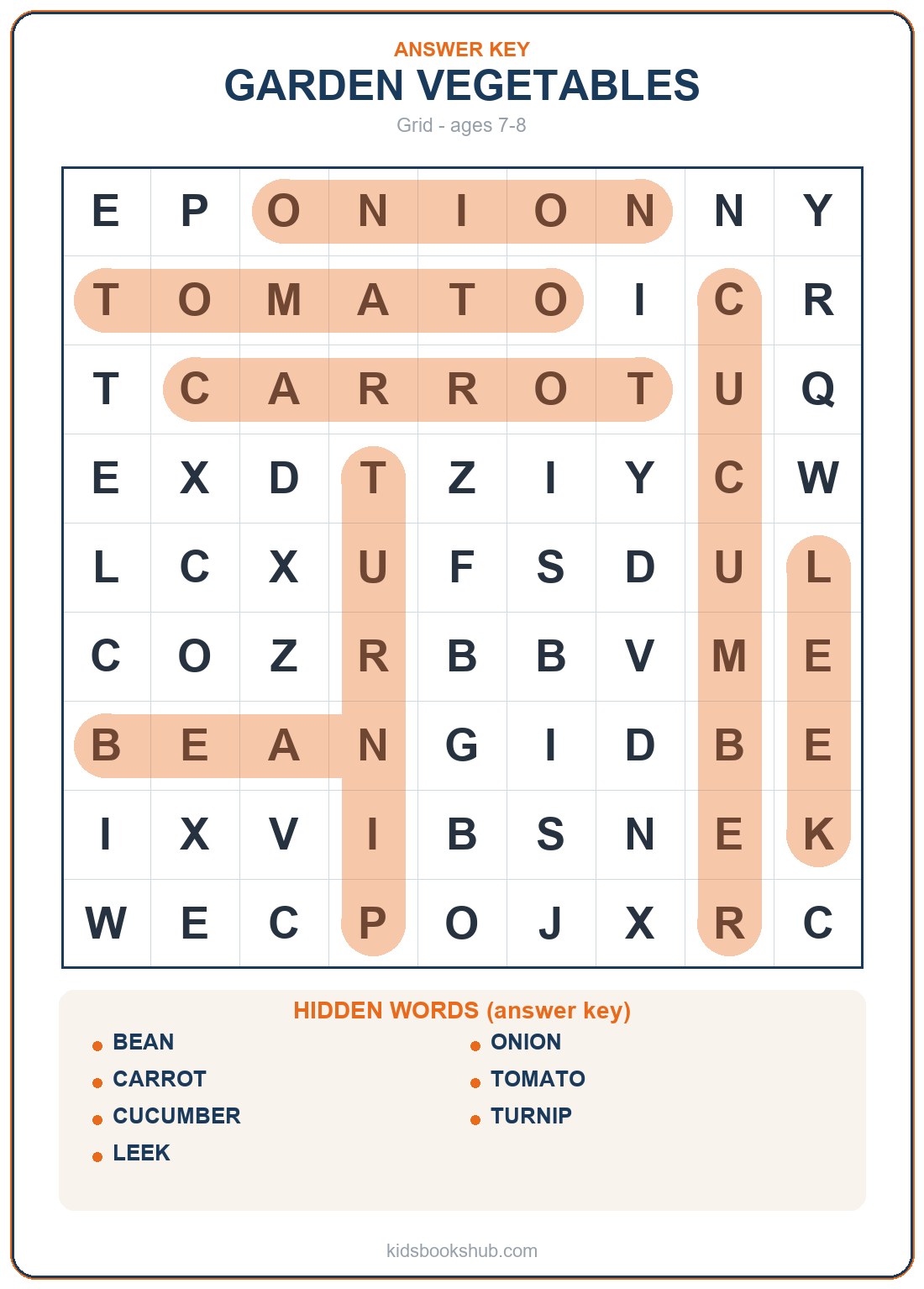
APPLE, PEAR, BANANA, CHERRY, GRAPE. Five simple words, a small grid, and across-and-down directions only. This grid is recommended for children in the last year of nursery or at the very start of primary school. The words are short, well known from speech, and easy to spot at a glance.
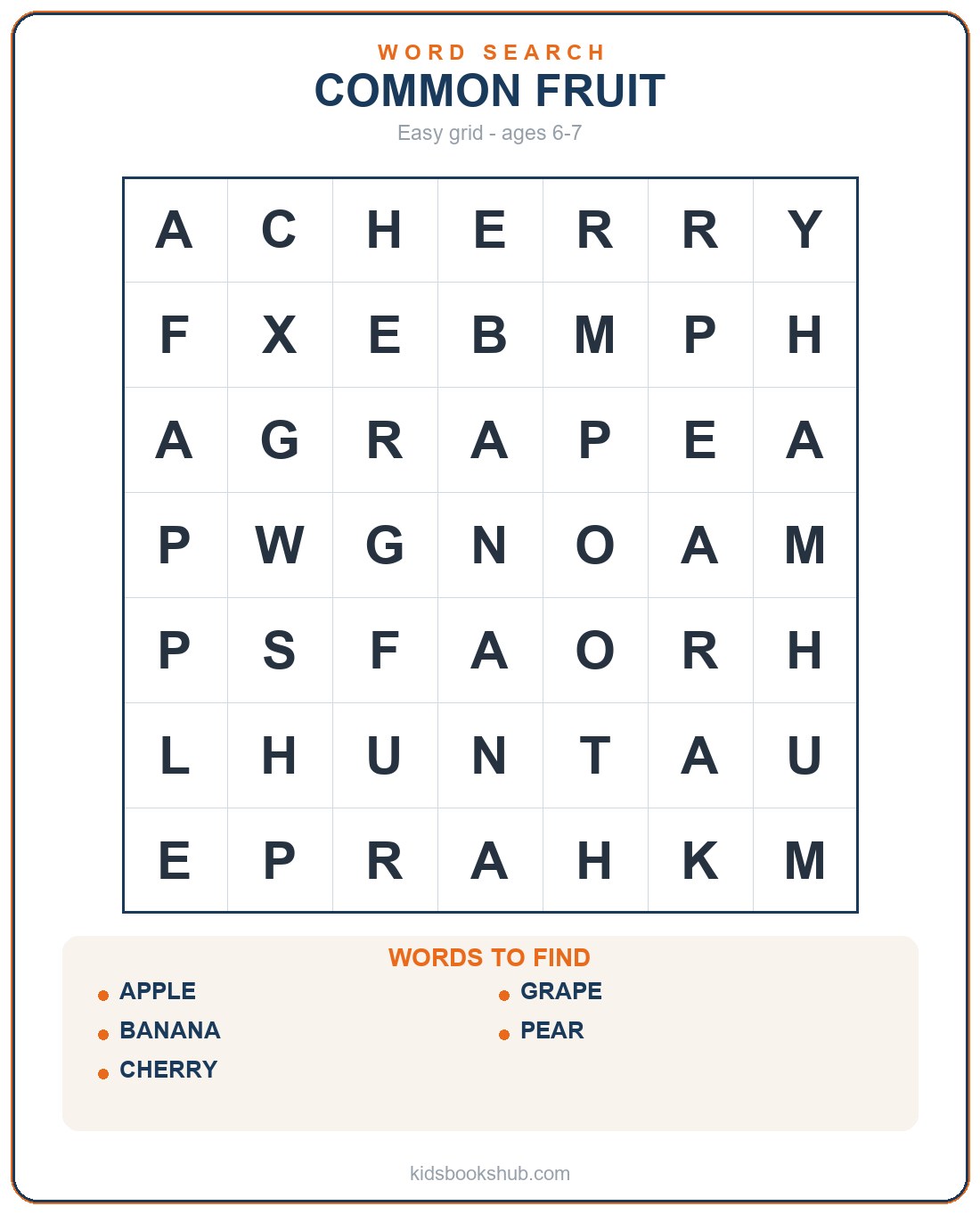
Words to find: APPLE, PEAR, BANANA, CHERRY, GRAPE.
🥬 Garden vegetable grid
CARROT, TURNIP, LEEK, BEAN, TOMATO, ONION, CUCUMBER. Here is a grid devoted to the vegetables you find in a vegetable patch or at the local market. It is a lovely chance to pair the activity with a trip to the greengrocer or a visit to the family garden.
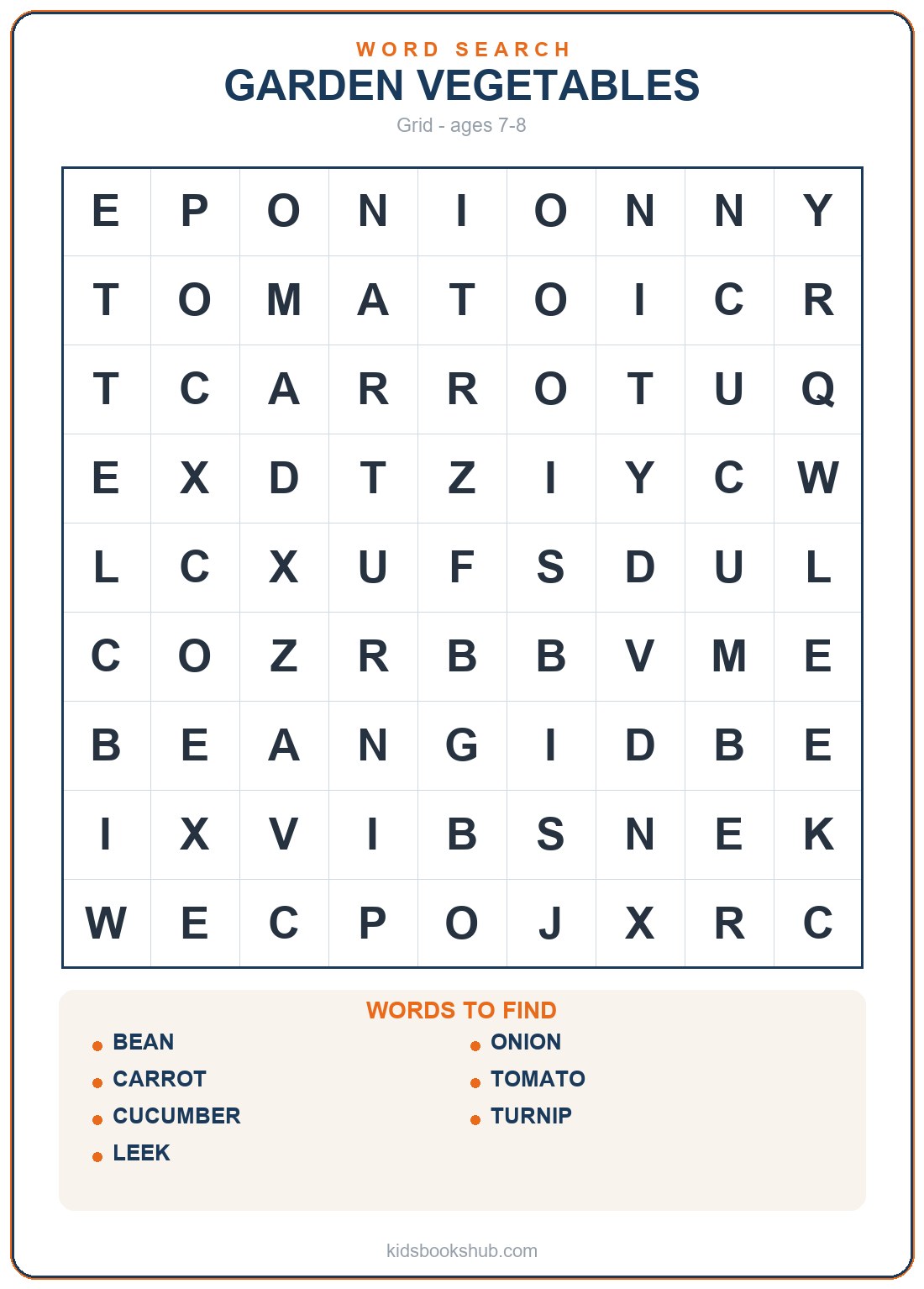
Words to find: CARROT, TURNIP, LEEK, BEAN, TOMATO, ONION, CUCUMBER.
🌸 Seasonal grid: spring
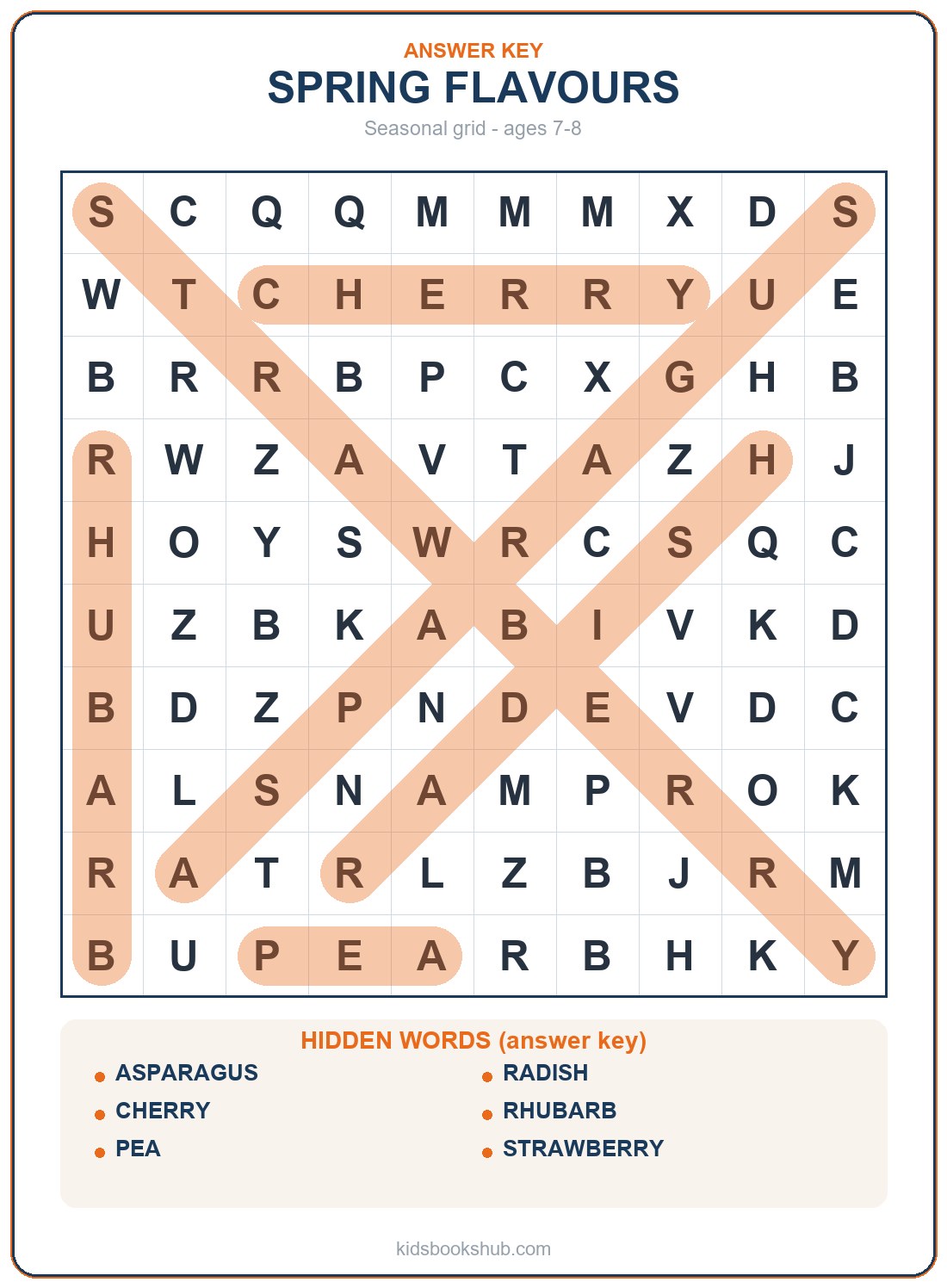
STRAWBERRY, CHERRY, ASPARAGUS, RADISH, PEA, RHUBARB. Spring fruit and vegetables fill this seasonal grid. Your child may discover words they did not know yet, such as RHUBARB or ASPARAGUS, and will be able to recognise them next time they turn up on their plate.
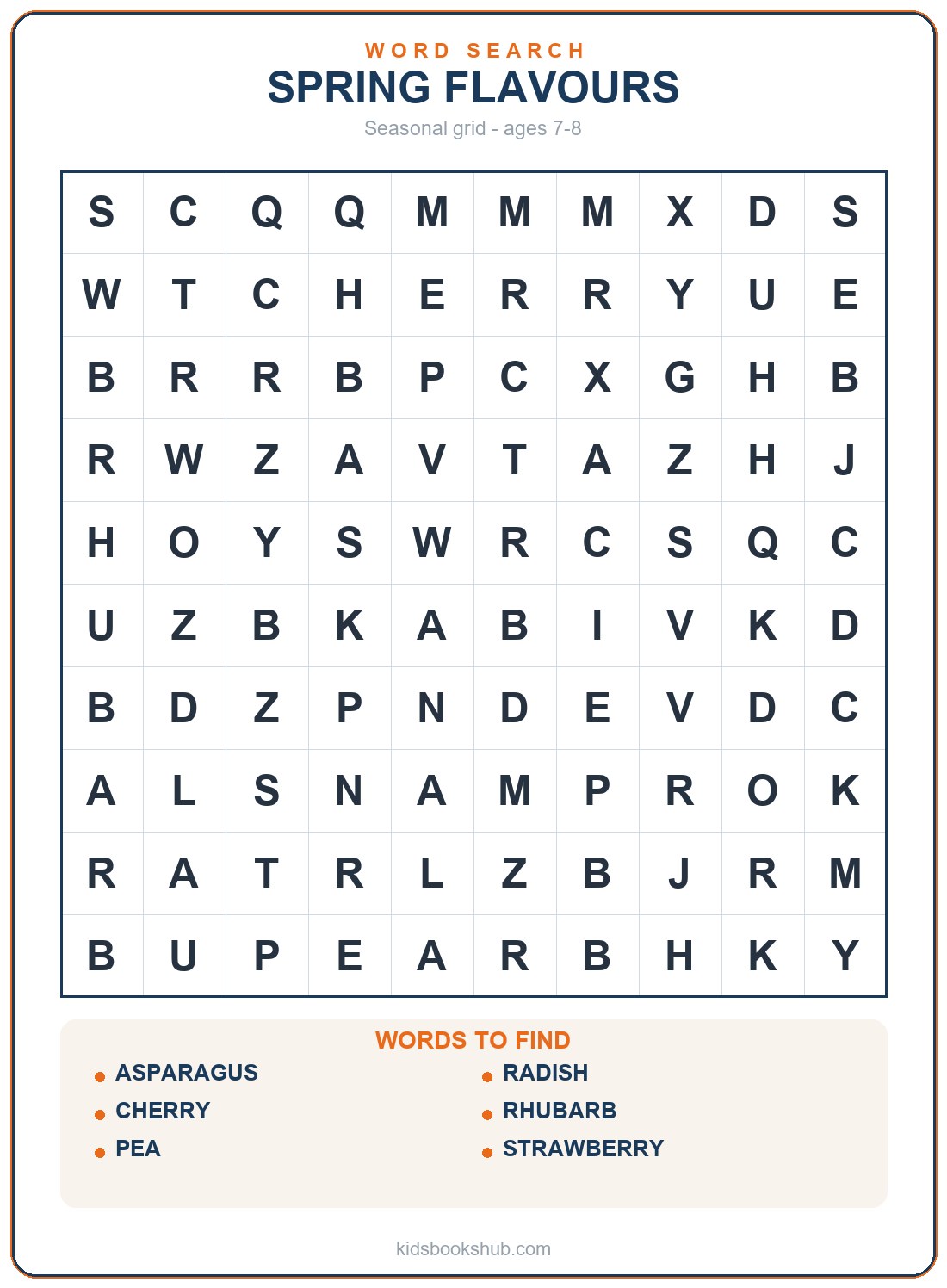
Words to find: STRAWBERRY, CHERRY, ASPARAGUS, RADISH, PEA, RHUBARB.
🍂 Autumn grid
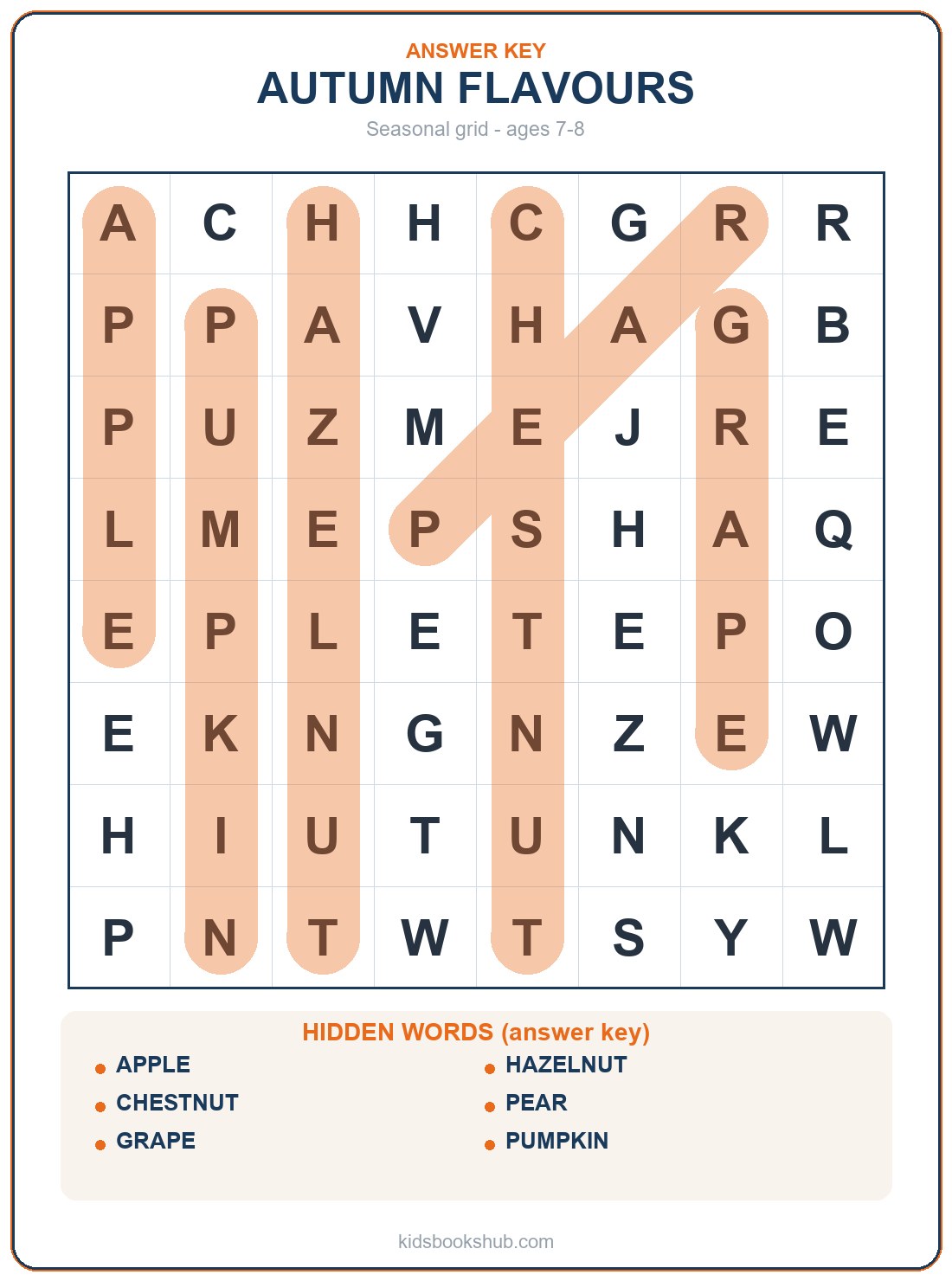
PUMPKIN, CHESTNUT, HAZELNUT, APPLE, PEAR, GRAPE. Autumn offers a colourful, evocative vocabulary. This grid can be used alongside seasonal activities in class: making pumpkin lanterns, going out to gather chestnuts, cooking apple compote.
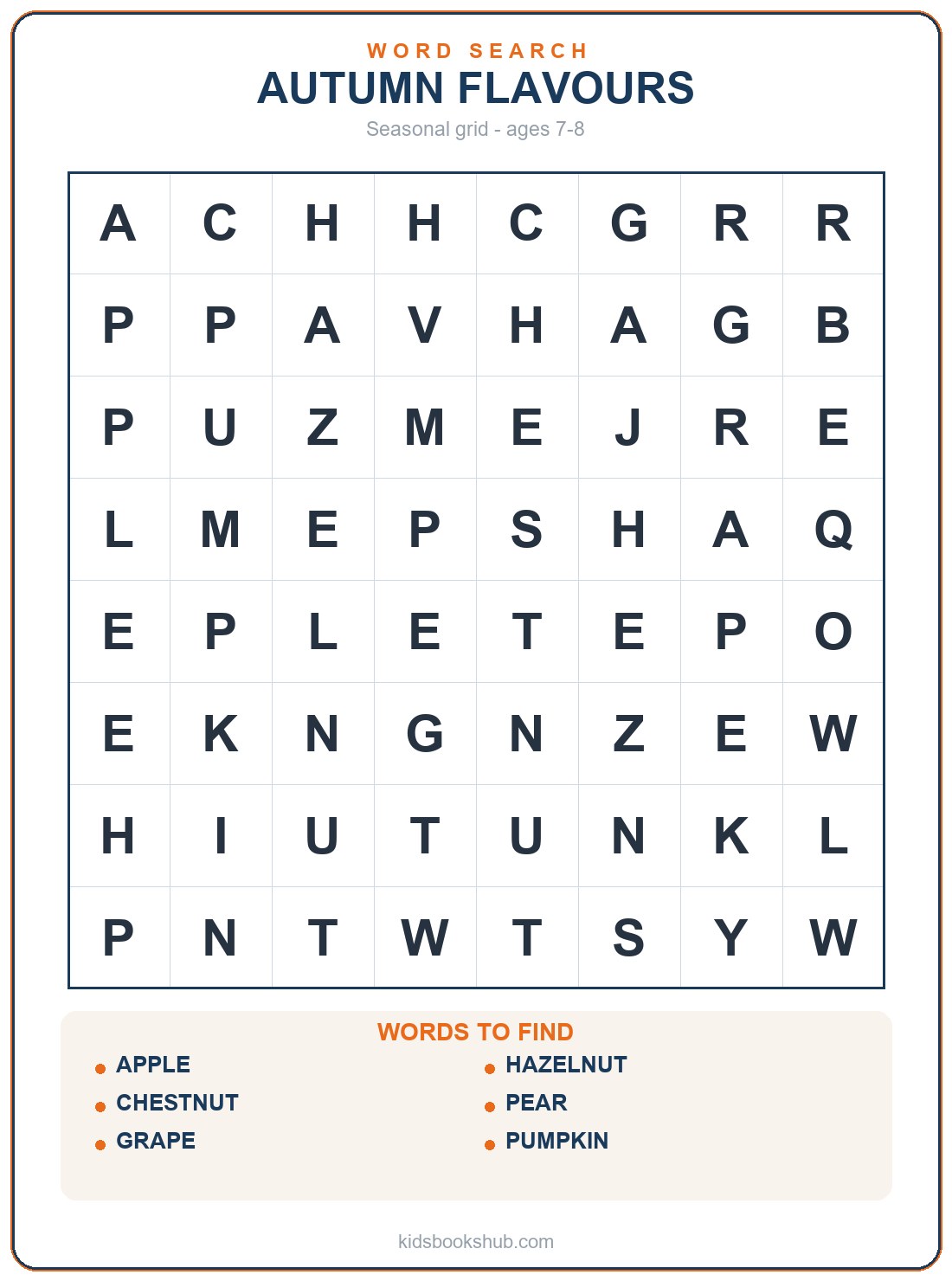
Words to find: PUMPKIN, CHESTNUT, HAZELNUT, APPLE, PEAR, GRAPE.
🥭 Exotic grid
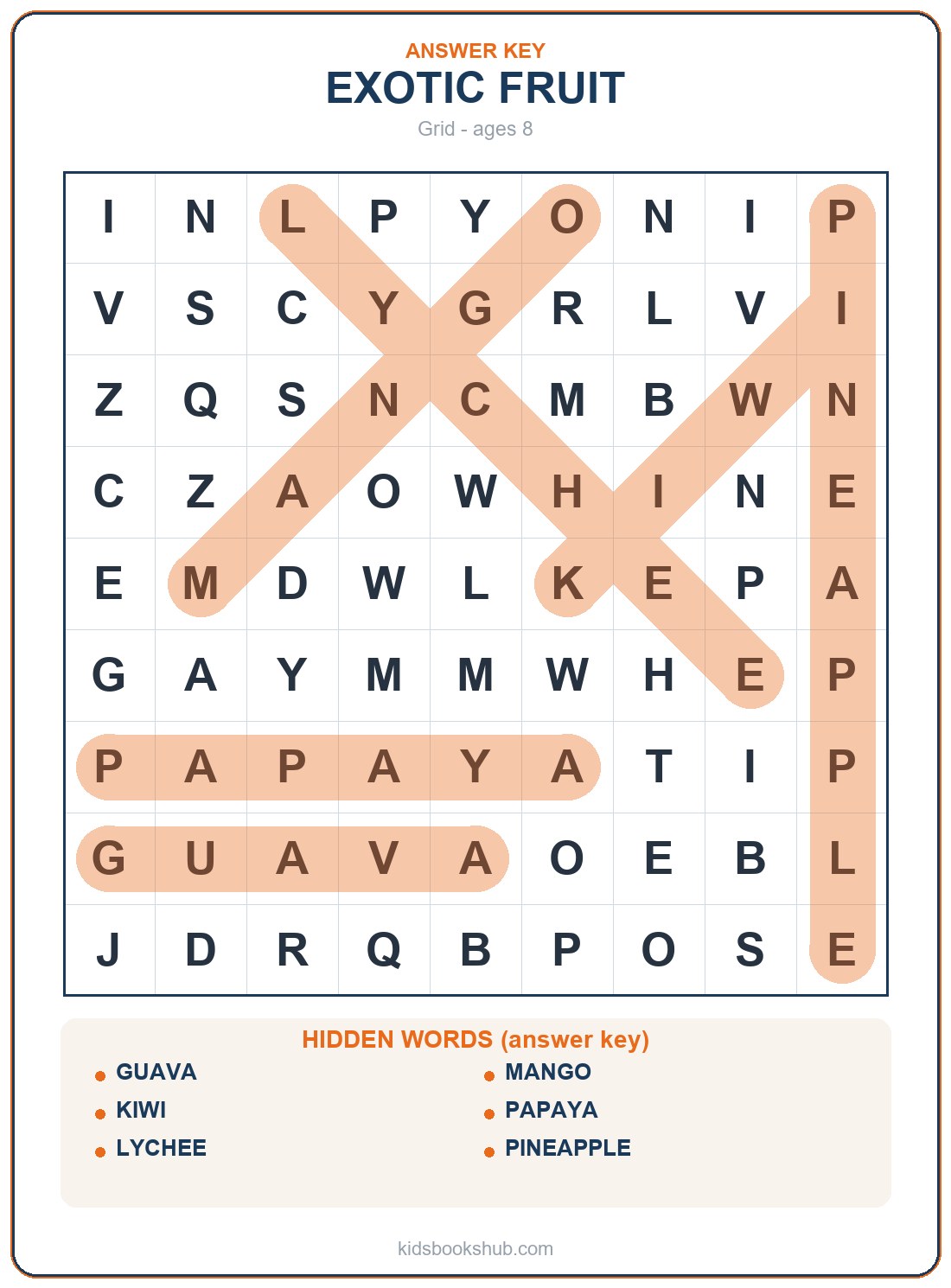
MANGO, PINEAPPLE, PAPAYA, LYCHEE, KIWI, GUAVA. This grid brings in fruit that is less common in children’s daily lives, which makes it a great tool for opening up to other cultures. Your child can look for these fruits at the supermarket or in a world cookery book.
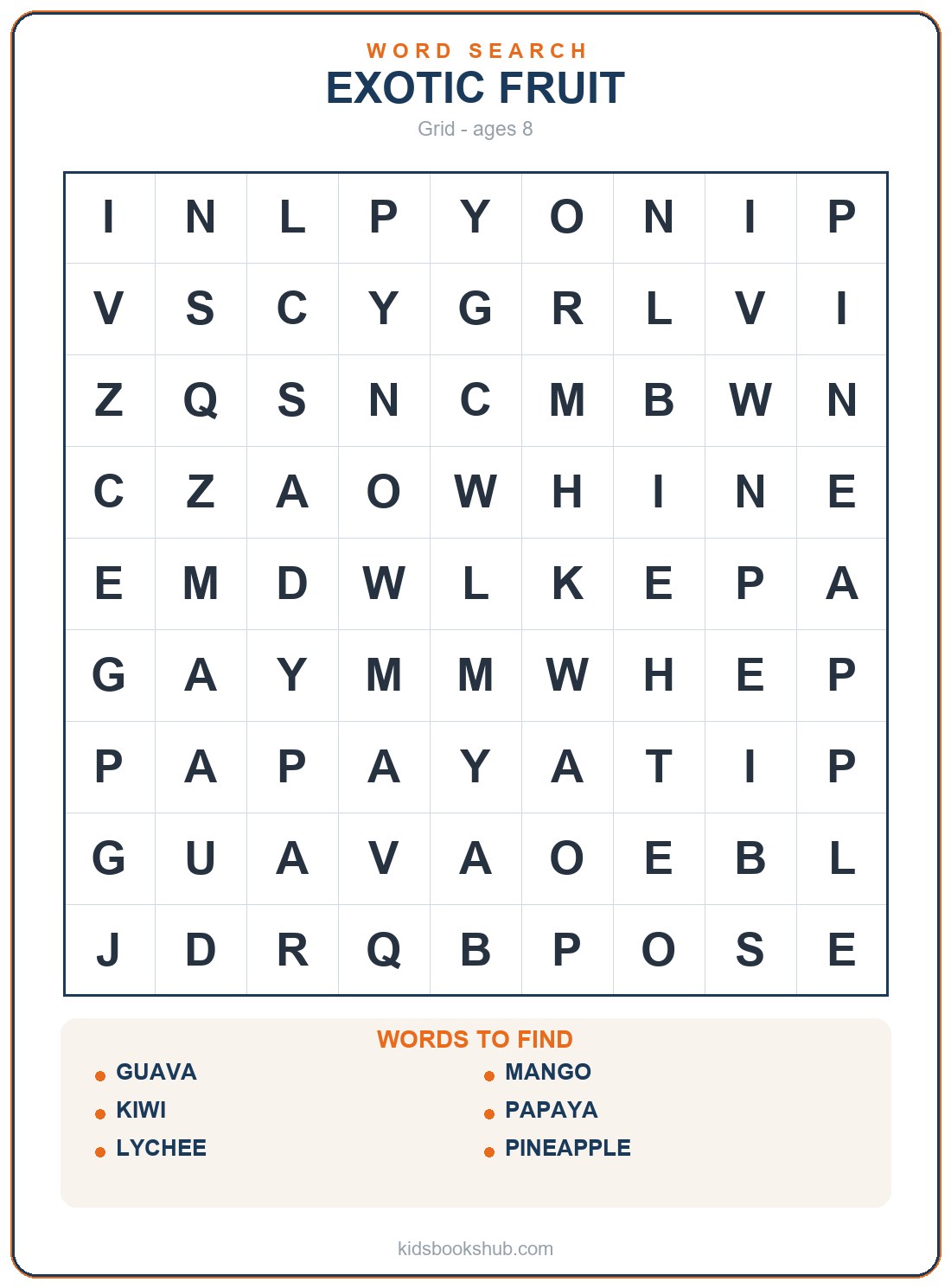
Words to find: MANGO, PINEAPPLE, PAPAYA, LYCHEE, KIWI, GUAVA.
🥗 Hard mixed grid: fruit and vegetables
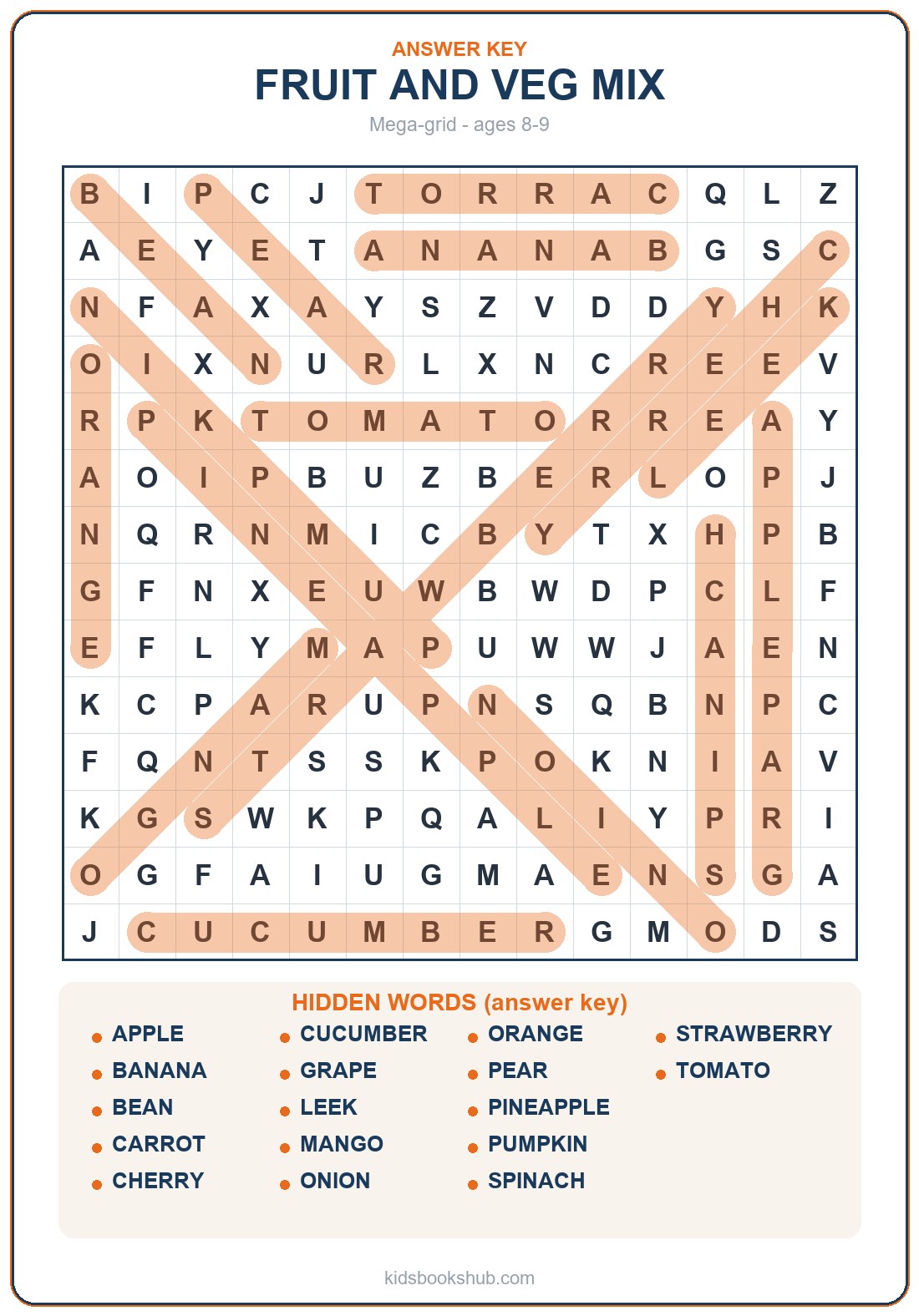
The most complete grid blends fruit and vegetables in one large, multi-directional puzzle. The words can hide across, down, diagonally, and sometimes backwards for the most advanced. This grid is the ultimate challenge for children aged 8 to 9 who want to test what they can do.
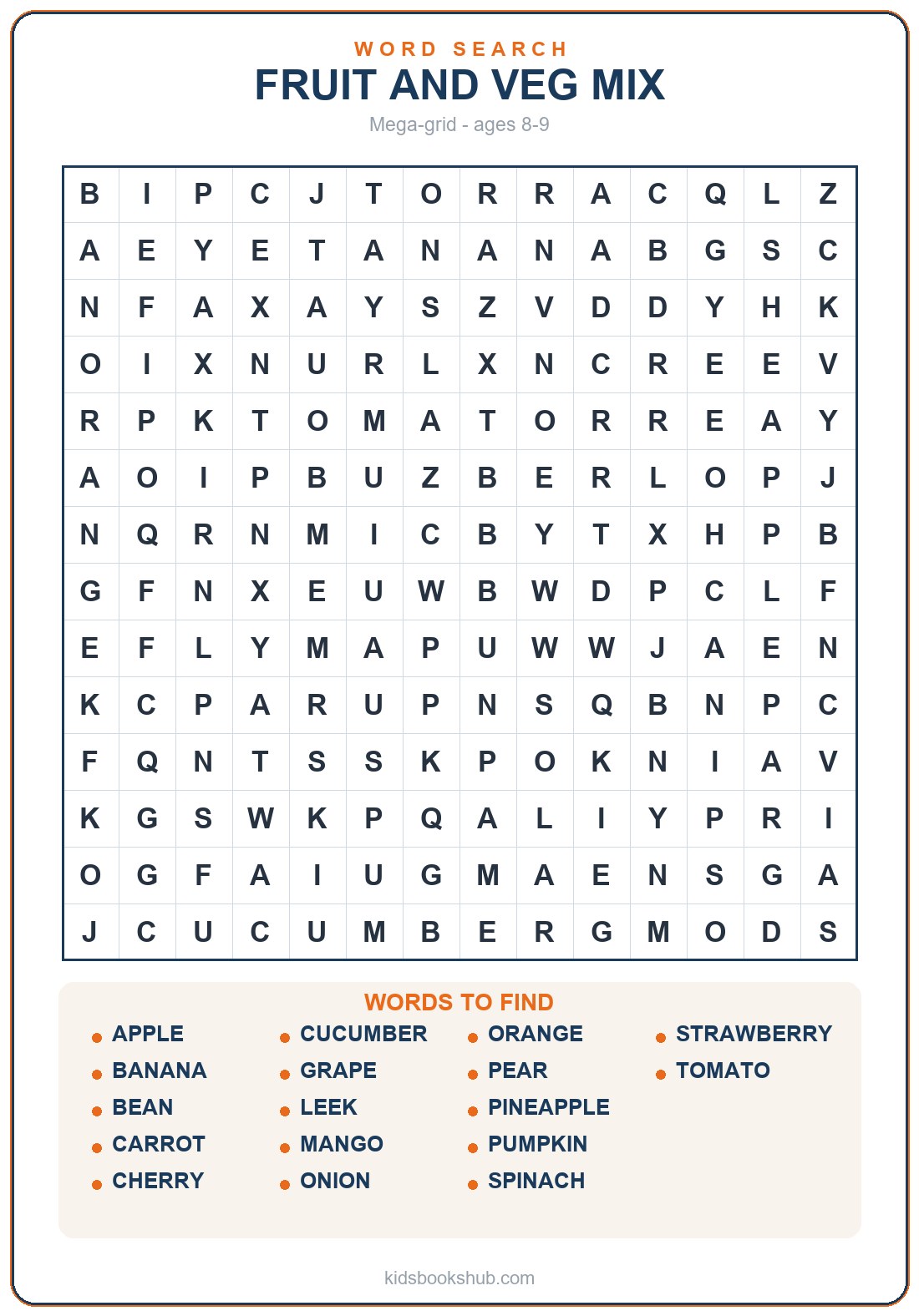
Words to find: APPLE, PEAR, BANANA, CHERRY, GRAPE, STRAWBERRY, MANGO, PINEAPPLE, ORANGE, CARROT, TOMATO, ONION, LEEK, BEAN, PUMPKIN, SPINACH, CUCUMBER.
🧠 The learning benefits of the activity
Fruit and vegetable word searches build several key skills at the same time, in a way that feels fun.
Reading comes first, of course. Your child has to read the word list before searching the grid, then pick out the right letters one by one in the table. This repeated decoding work strengthens reading fluency.
Spelling is called on indirectly but very effectively. To spot AUBERGINE in the grid, your child has to know the exact order of the letters. They cannot approximate. This constraint gets them used to spelling precisely, without it feeling like a dictation exercise.
An analytical eye develops too. Your child learns to scan the grid methodically, not to skip squares, to check letter by letter. This kind of steady attention is precious for many school activities.
Finally, patience is a quality word searches naturally build. Finding the last word in a big grid can take time. Your child learns not to give up and to feel the pride of seeing it through to the end.
📖 The rules of the game explained for your child
Here is how to present the rules to your child so they can play on their own.
The list of words to find is shown next to the grid. Your child picks a word, reads it carefully letter by letter, then starts searching the grid, scanning the lines from left to right.
When they spot the first letter of the word, they check the possible directions: to the right, downwards, and diagonally if the grid allows it. If the next letters match, well done: they circle or highlight the word found and tick it off the list.
A handy tip for beginners: start with the shortest words, as they are easier to spot. Only then tackle the long ones. This strategy helps your child fill in part of the list quickly and stay motivated.
If they get stuck on a word, they can ask for a clue rather than a straight answer. For example: “This vegetable starts with a C and is eaten cooked in a soup.” This kind of help keeps the joy of discovery alive while guiding the search.
👶 Which level for your child’s age
For the activity to stay enjoyable and stimulating, it is important to offer a grid that suits your child’s level.
Ages 5-6: short grids with 4 to 5 letter words and simple directions (across and down only) are ideal. Your child is starting to read and quick success keeps them keen to carry on.
Age 7: medium-sized grids with words of 5 to 8 letters work well. You can bring in diagonals gradually. The seasonal or garden theme often goes down well at this age, as it matches science-of-nature lessons.
Ages 8-9: advanced grids with long words, diagonals and less common words (exotic fruit, old-fashioned vegetables) are a real mental challenge. Your child can also try to beat their own time record.
Age 10 and over: offer the hard mixed grid, or invite your child to design a grid themselves for the family to solve. Building a grid is much more demanding than solving one, and it is a great thinking exercise.
🎨 Activities to keep the game going
Fruit and vegetable word searches fit easily into a day full of varied learning.
After the activity, take your child shopping at the market with the list of words they found in the grid. They have to spot these fruits and vegetables on the stalls, name them, touch them. This link between the written word and the real thing strengthens learning enormously.
You can also suggest a gardening activity: planting radishes or strawberries in a pot needs little space and gives a full sensory experience. Your child can keep a log where they note the names of the plants they hunted for in the grid before sowing them.
Cooking is another natural follow-up. A simple recipe using fruit or vegetables from the grid (compote, smoothie, fruit salad) puts the new vocabulary into practice. Your child reads the ingredient list and recognises the words they searched for in the grid a few days earlier.
🔑 Grid answer keys
🧩 Here are the solutions to the six fruit and vegetable grids. Use them to check the words found: each hidden word is highlighted in orange.
🍎 Answer key — Common fruit grid
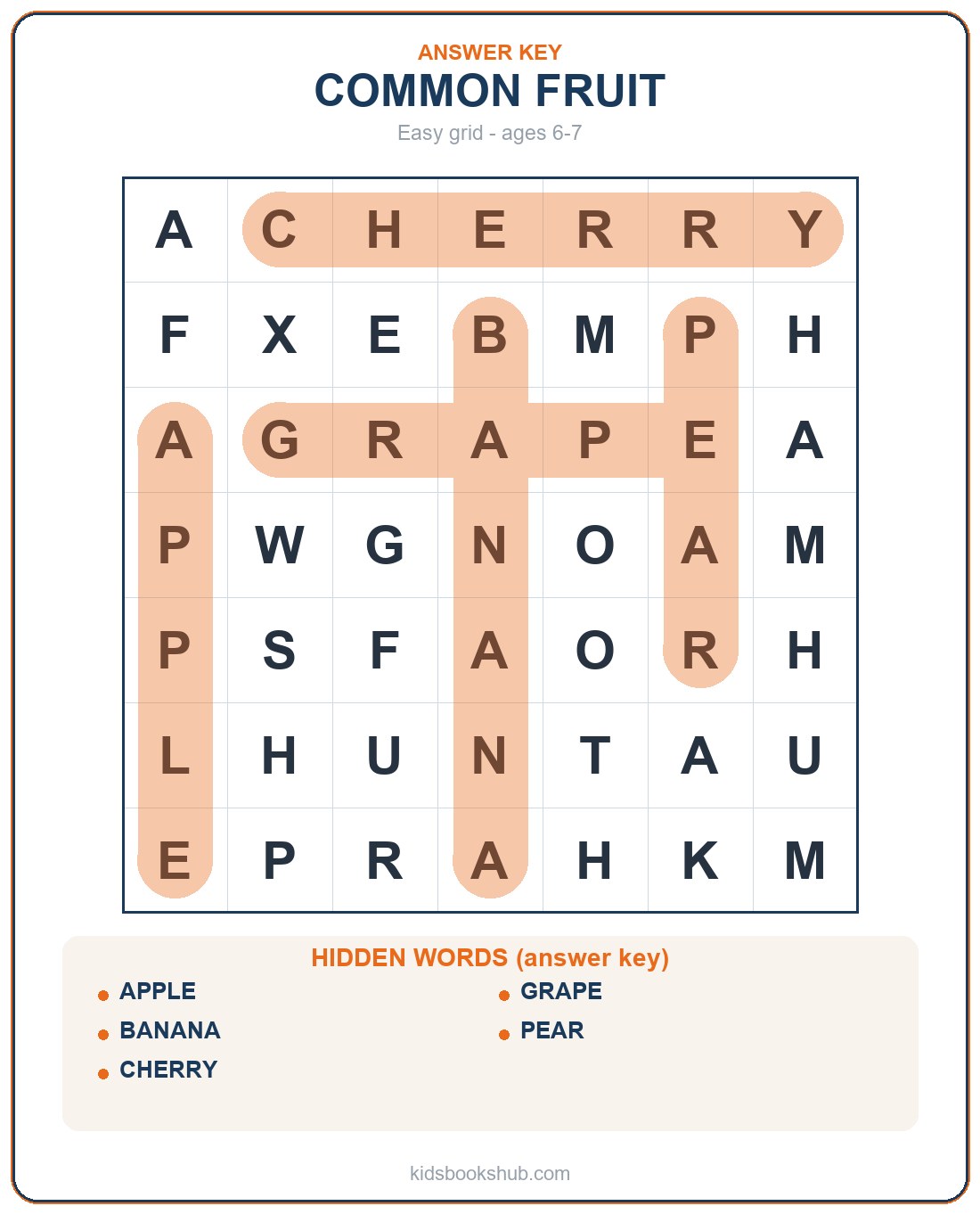
🥬 Answer key — Garden vegetable grid
🌸 Answer key — Spring grid
🍂 Answer key — Autumn grid
🥭 Answer key — Exotic fruit grid
🥗 Answer key — Mixed fruit and vegetable grid
❓ FAQ
👶 What age can you start fruit and vegetable word searches?
From the last year of nursery (ages 5-6), your child can begin with small grids containing common words such as APPLE or PEAR. For younger children who cannot read yet, you can use picture grids where the child copies a sequence of letters visually, using the drawing of the matching fruit as a guide.
✍️ Do word searches really help with spelling?
Yes, significantly. Searching for a word in a grid forces your child to check each letter in the right order, which calls on spelling memory. Many teachers use word searches as a revision tool after a vocabulary lesson, because the visual trace left by the search helps memorisation.
🤝 How do I help my child if they get stuck on a word?
Rather than showing exactly where the word is, give a step-by-step clue: “It starts with the letter P”, then “It is in the top part of the grid”, then “It runs downwards”. This gradual approach keeps the joy of discovery alive while helping your child move forward without frustration.
🏫 Can these grids be used to prepare a lesson on the seasons in class?
Absolutely. The seasonal grids (spring, autumn) fit perfectly into a unit on seasonal fruit and vegetables. After solving the grid, children can sort the foods they found by season, by colour, or by type (fruit or vegetable), which makes for an effective sorting activity.
🌍 Can you combine word searches with learning another language?
Yes, it is a great idea. Simply build a grid with the names of fruit and vegetables in the target language and pair the word list with their translations. Your child searches for the foreign word in the grid while learning its meaning.
💰 How can I make printing cheaper for regular use?
Print several grids on one A4 sheet by choosing the “multiple pages per sheet” option in your print settings (2 or 4, depending on the grid size). For grids your child wants to do again, you can also laminate the sheet and use a wipe-clean pen, which allows unlimited use.
