
Bears have always fascinated children, whether it’s the teddy bear sitting on the bed or the great grizzly spotted in a documentary. 🐻 Offering your child free bear colouring pages to print is a way to let them dive into the world of these impressive animals while practising fine motor skills and coordination. Every drawing becomes a little adventure, a forest to explore at the tip of a crayon.
This collection brings together eight drawings carefully chosen to cover a whole range of worlds: a sweet cub in the forest, a majestic grown-up brown bear, story-like scenes by the lake or under the moon, and a kawaii cub that comes with its own colour model. You’ll find designs to suit every level here, from simple outlines for the youngest to detailed illustrations for more experienced children. A bear colouring page to print fits in anywhere: a rainy afternoon, a creative break between two lessons, or a family nature workshop.
🐻 Why do bears captivate children so much?
🧸 An iconic animal in the world of childhood
The bear holds a special place in the world of childhood. From a very young age, your child has surely had a teddy bear, listened to the story of Goldilocks and the Three Bears, or sung along to woodland songs. This animal combines two seemingly contradictory images: impressive power and an almost soft roundness that makes it instantly likeable. This dual nature fascinates children and feeds their imagination, as they project onto it epic adventures as much as tender stories.
🌲 A bridge to discovering nature
Colouring a bear is also a chance to start a conversation about natural ecosystems. Your child can learn that the brown bear lives in the forests of Europe and North America, that it fishes for salmon in the rivers, that it sleeps in a den in winter. Colouring becomes a natural teaching aid for introducing ideas about ecology and biodiversity in an accessible, playful way.
👶 An activity for every age
One of the great strengths of this collection is the variety of difficulty levels. A cub with rounded, simple lines is perfect for a preschool child, while a big grown-up bear with detailed fur will happily keep an older primary pupil busy. Every level finds its drawing, and the activity can be done alone, with siblings or in class, without anyone being left out.
🐻 Our 8 bear colouring pages to print
🌲 The smiling cub in the forest
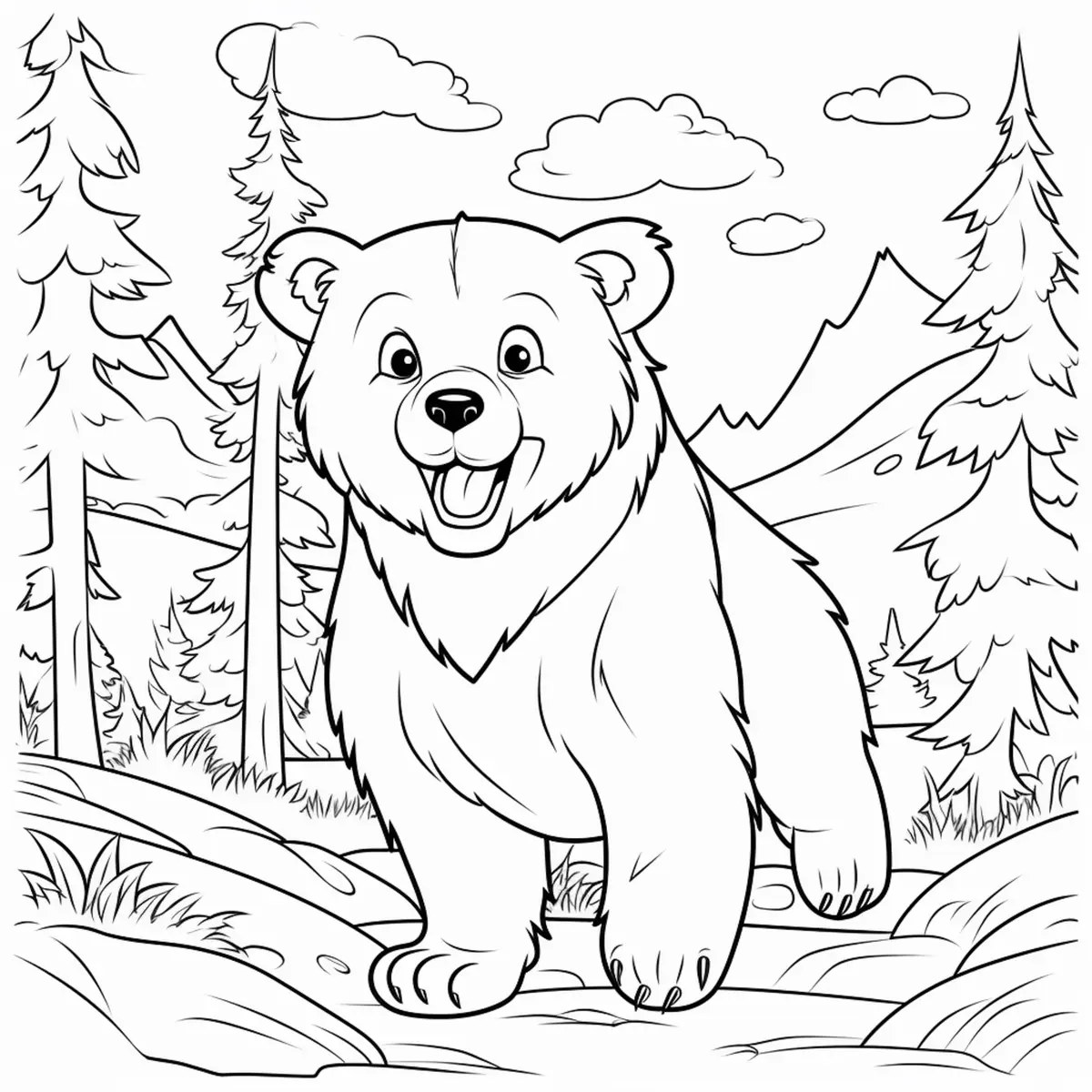
This first drawing features a little bear, all smiles, walking between the fir trees against a backdrop of mountains and soft clouds. The outlines are thick and well defined, which makes colouring easy for the youngest. Your child can have fun varying the greens for the fir trees, giving the cub’s coat a warm tone, and imagining a spring or autumn sky depending on their mood.
🍯 The greedy cub and its honey pot
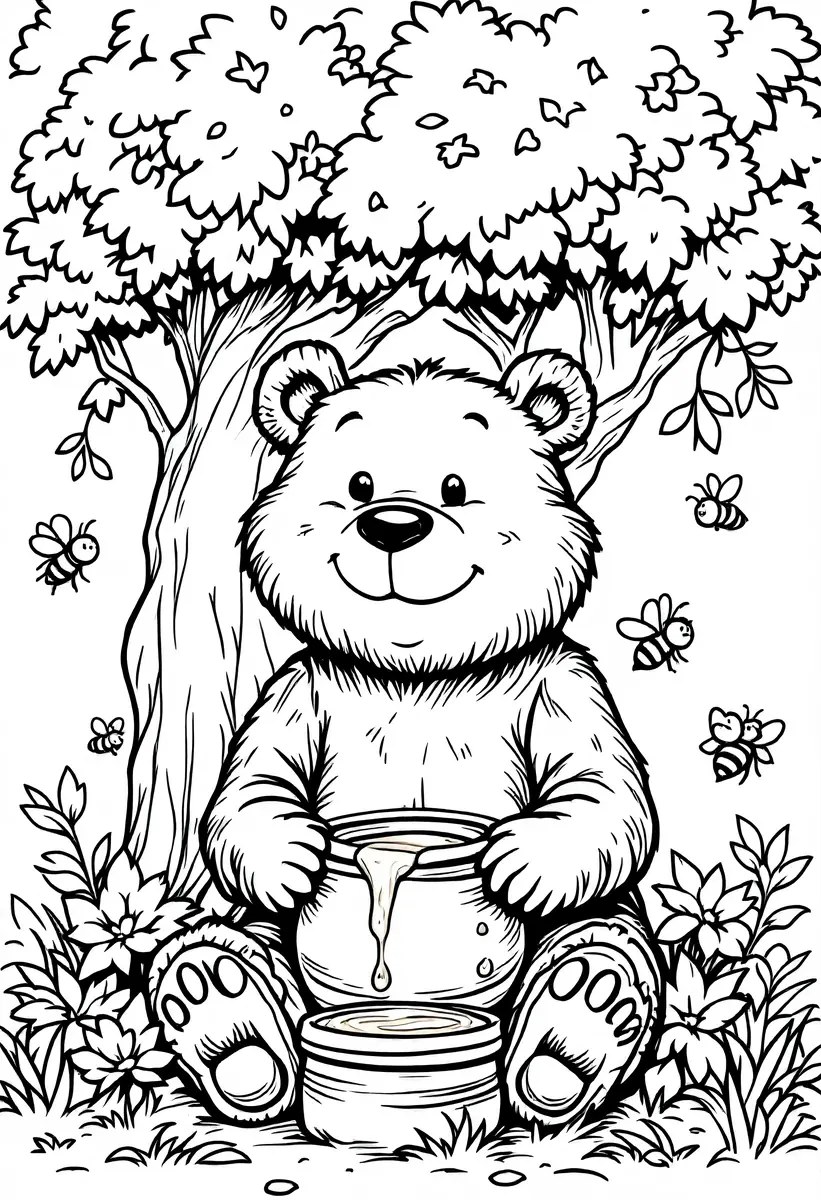
This drawing, with its soft, rounded lines, shows a little cub sitting under a tree, hugging a big tipped-over pot of honey between its paws. The bees buzz around it, the flowers grow at its feet. Ideal for preschool and reception children, this design is great for practising filling in different shapes: bees in yellow and black, amber honey, leaves in soft green.
🌳 The big brown bear in the clearing
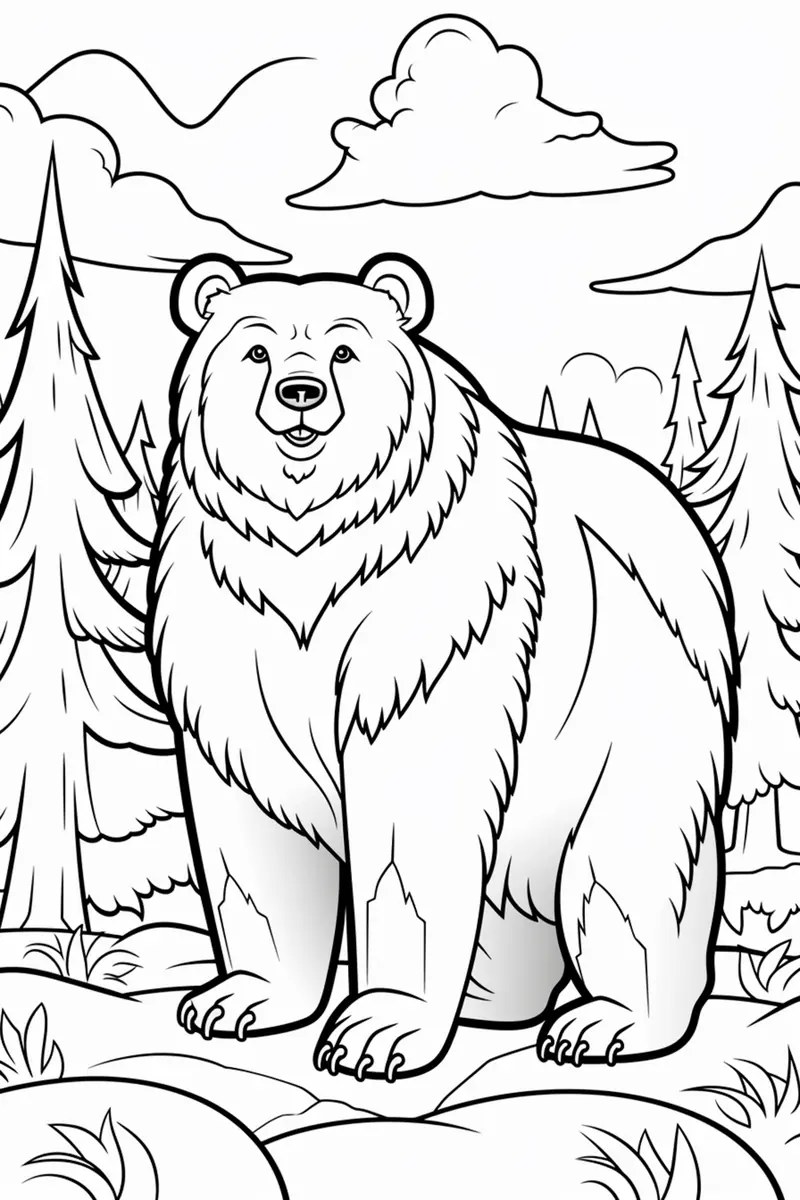
A massive grown-up bear stands in the middle of a clearing, with shaggy fur and a calm gaze. The fir trees in the background, the decorative clouds and the bushes in the foreground make up a very detailed scene. This design suits children from age 7: it invites them to work on shades of brown, to respect the shadow areas of the coat, and to dress the forest in several shades of green to add depth.
🪵 The bear on the log by the lake
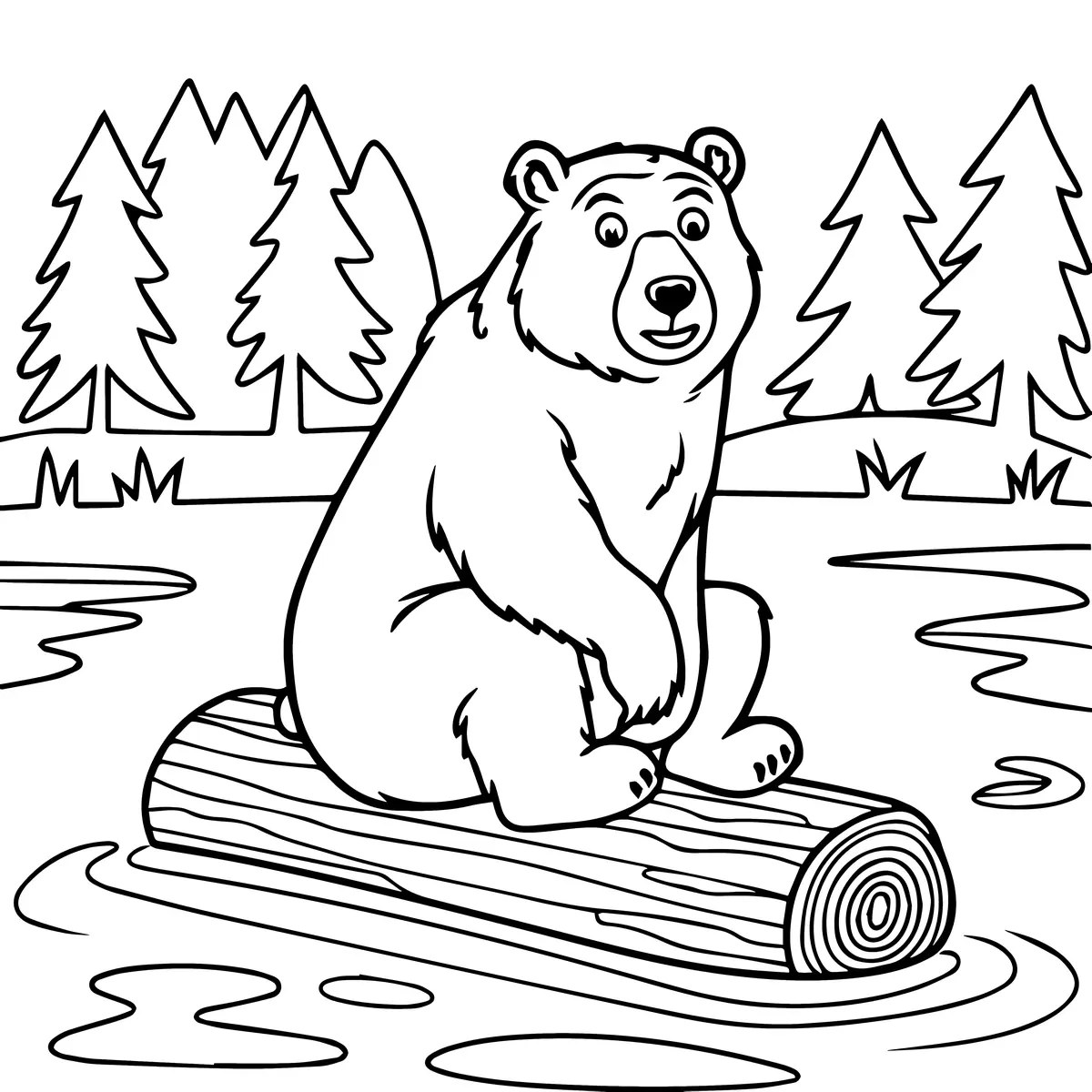
This drawing tells a little story: a bear has settled on a floating log by the edge of a lake, surrounded by fir trees reflected in the calm water. An ideal scene for children who love to imagine a story as they colour. The reflections in the water can be coloured in light blue, the fir trees in different greens, and the log in brown with shades to bring the bark to life.
☀️ The brown bear on the mountain in the sun
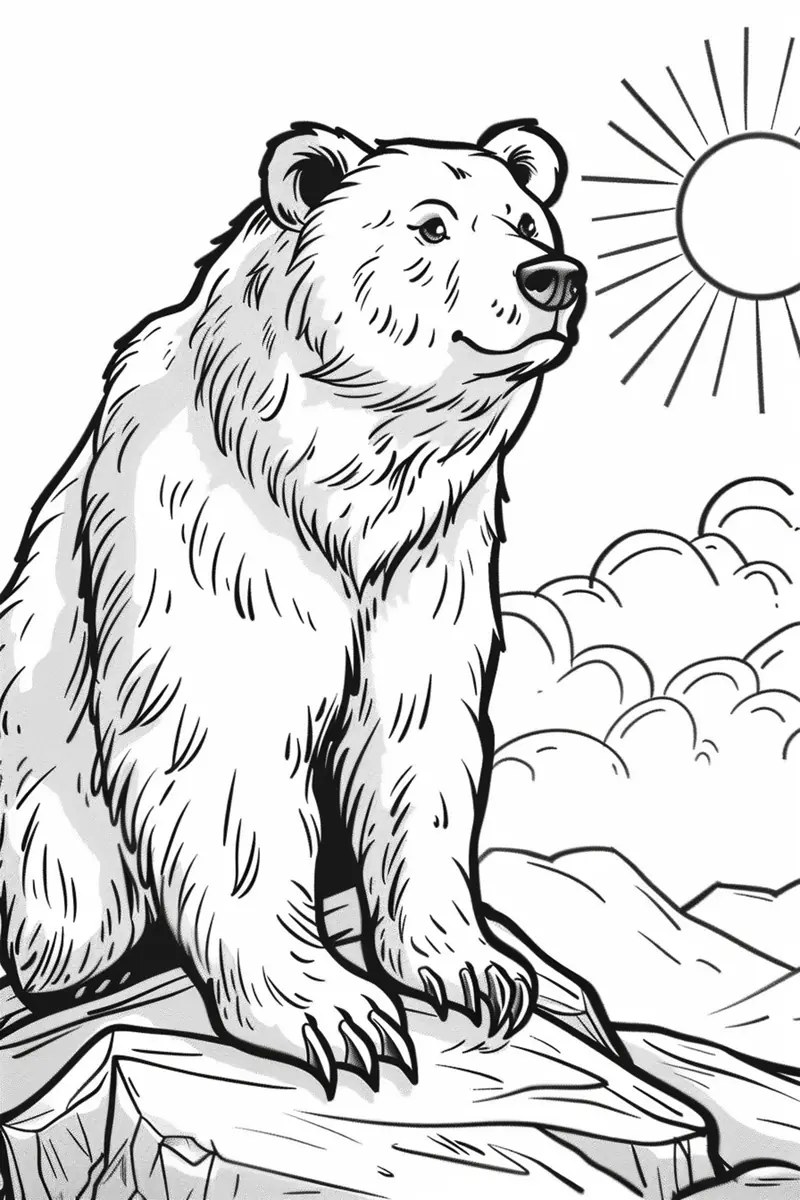
A striking close-up: a brown bear sitting on a rock at the top of a mountain, its muzzle raised towards a great beaming sun. The drawing is expressive and more detailed, perfect for a child of 8 or over who wants to take on an ambitious colouring page. The sun’s rays can be coloured in golden yellow, the coat in reddish brown, and the rocks in blue-grey for a strong contrast.
🌙 The bear on a rock in the moonlight
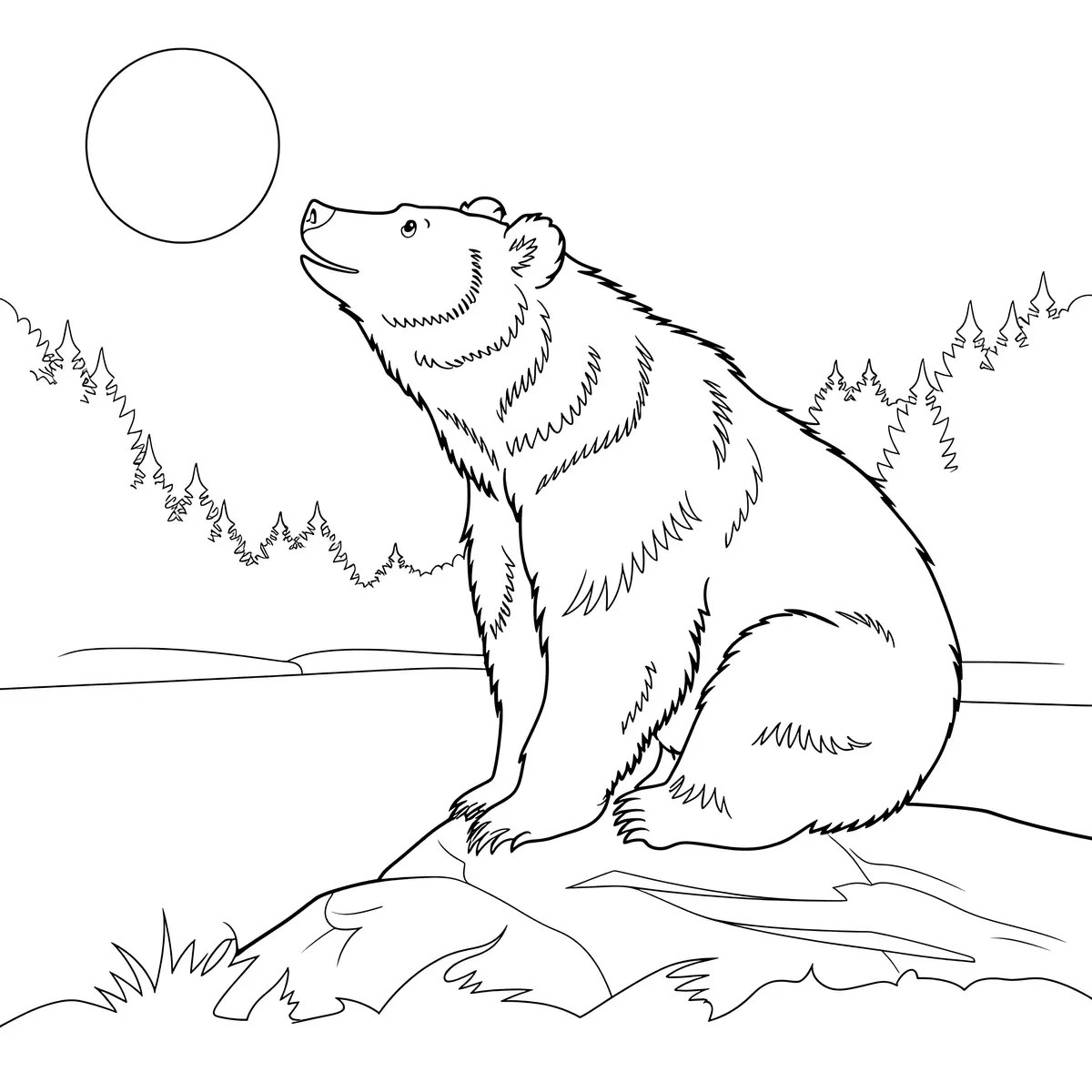
A poetic scene: a bear sits on a rock, its head raised towards the round, bright moon, with a few fir-tree silhouettes on the horizon. This drawing lends itself to a more unusual palette, where the night sky can be deep blue or purple, the moon pale yellow, and the bear’s coat painted grey-brown. A lovely chance to experiment with a mysterious night-time atmosphere.
🍳 The cook cub at the barbecue
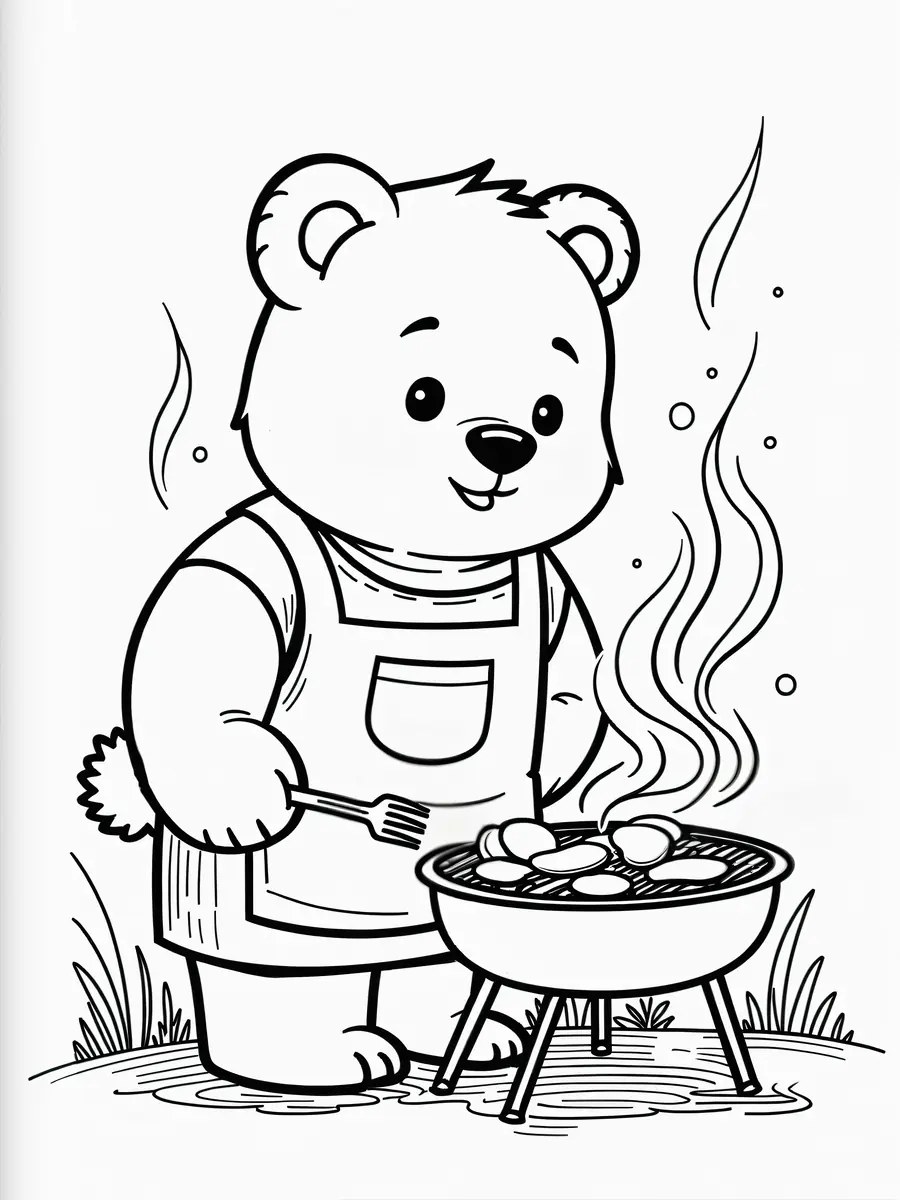
A touch of humour in the collection: a kawaii cub in an apron keeps an eye on its barbecue, with flames rising in funny little swirls. This drawing makes children laugh and is a nice change from the classic nature scenes. A colourful apron, orange and red flames, mouth-watering skewers: everything is an excuse to play with bright colours.
🎨 The kawaii cub with its colour model
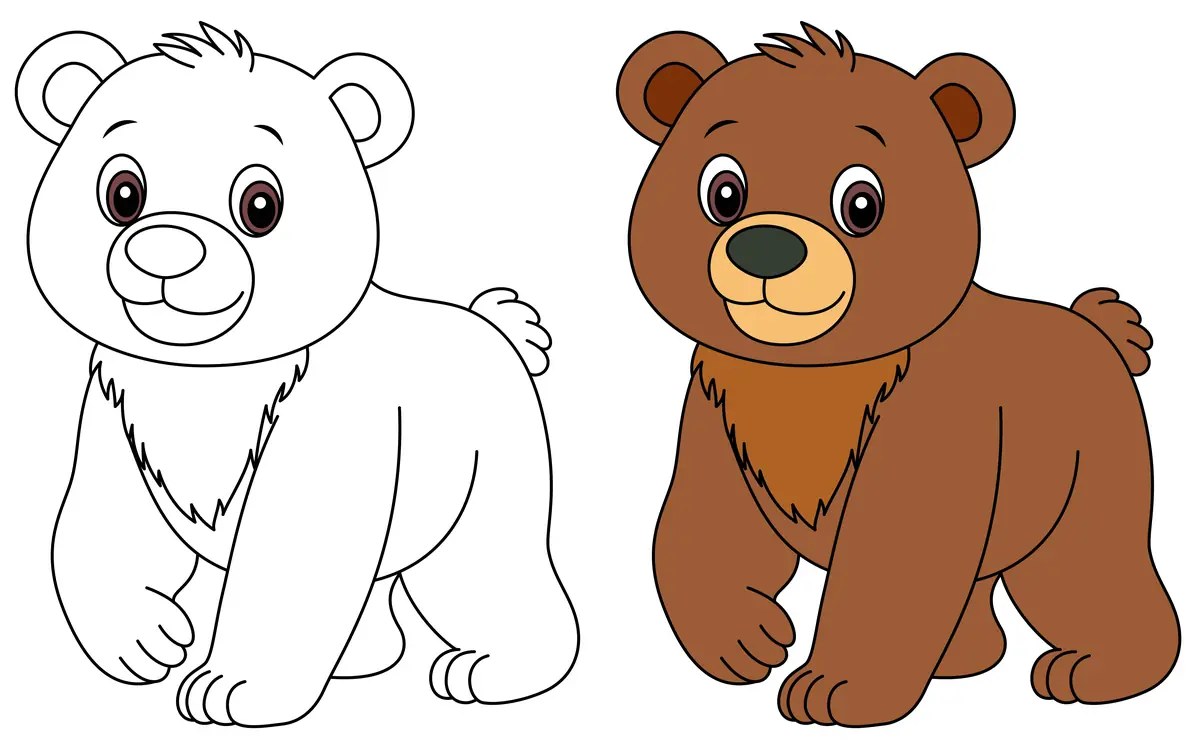
This last drawing is a gift for children who can’t decide on colours: on the left, the kawaii cub in black outlines to colour in; on the right, the same cub already coloured in as a model. Your child can either copy the warm brown of the model exactly, or use it as inspiration to invent their own shades. An excellent way to practise observation and staying true to a model.
🌟 The benefits of colouring for your child
✋ Building fine motor skills
Colouring is one of the most effective exercises for getting the hand ready to write. Holding a crayon, keeping a steady pressure, staying within the outlines of a drawing: all these actions work the little muscles of the hand and wrist. In preschool children especially, this daily practice gradually builds the dexterity they’ll need for the learning to come.
🧘 Building concentration and patience
In an often hectic daily life, colouring gives your child a space of calm and focus. Finishing a bear drawing means staying attentive for a stretch of time, going back to forgotten areas, and persevering to the end. This ability to sustain effort on a task is precious in every area of learning.
🎨 Sparking creativity and personal expression
There’s no rule that says your child has to colour a bear brown. They can absolutely imagine a rainbow bear, a candy-pink bear, or a bear with multicoloured patches. Letting this imagination run free is a healthy way to encourage creativity and to express a personal view of the world. The most unexpected drawings are often the ones that reveal the liveliest imagination.
🟫 Which colours to use to colour a bear?
🟫 Natural tones: brown, beige and black
For a realistic look, brown bears call for a palette of warm browns, golden beiges and dark greys for the shadow areas. Coloured pencils are particularly suitable here, as they let you layer several coats to create fur-like shades. A little russet-brown on the flanks and a darker brown on the back give a very satisfying sense of depth.
🌲 Green and blue to dress the forest
Most of the drawings in this collection place the bear in a natural setting. Vary the greens for the fir trees (dark fir green, soft green, sea green) and use different blues for the sky and the lake water. Mixing several close shades instantly gives a landscape more depth and avoids the flat look of plain blocks of colour.
🌙 Daring to try unusual moods
The bear under the moon lends itself to a night-time palette (deep blue, purple, pale yellow), while the bear on the sunny mountain calls for golden yellows and warm ochres. Don’t hesitate to ask your child to imagine a particular mood before they start: dawn, dusk, broad daylight, starry night. It’s an excellent exercise for linking colours to a storytelling intention.
🖨️ Practical printing tips
📄 Choosing the right format and paper
All the drawings in this collection are in A4 format, ready to print straight away. For use with coloured pencils, standard 80 gsm paper is perfectly fine. If your child prefers markers, go for slightly thicker paper (90 or 100 gsm) to stop the ink bleeding through the sheet. Always print in “black and white” or “greyscale” mode to save your colour cartridges.
🖨️ Setting the print quality
To get crisp, well-defined outlines, set your printer to “normal” or “high” quality rather than “draft”. A clean line is essential so that your child can follow the lines without difficulty. If the outlines look too faint, increase the contrast slightly in the print settings before you start the job.
📑 Printing several copies
Printing the same drawing two or three times lets your child try different colour combinations without frustration. They can do a realistic bear on one copy and a fanciful bear on another, comparing the results. It’s also a way to put mistakes into perspective: if a colour doesn’t work, there’s always a fresh copy left.
📚 Taking the bear activity further
📚 Exploring bears in books and documentaries
After a colouring session, your child might be curious to learn more about these fascinating animals. Children’s libraries are full of illustrated picture books and documentaries to suit every age. Wildlife programmes offer captivating episodes about bears, with footage from the wild that beautifully extends the drawings coloured at home.
🌍 Making a mini-presentation about the bears of the world
Suggest that your child stick their finished colouring pages onto a large sheet and write a little sentence under each drawing: the name of the scene, the imagined place, the name given to the bear. This kind of mixed project develops both written expression and the pride of showing off careful work. The result makes a lovely poster to hang in their bedroom.
👫 Setting up a colouring workshop with friends
Bear colouring pages lend themselves very well to group workshops. Each child chooses their favourite design, then the finished drawings are displayed side by side to compare the colour choices. This informal exchange develops a critical eye, a sense of observation and an openness to creations different from one’s own. A lovely way to share a calm, creative activity with friends.
❓ FAQ
🤔 What’s the difference between a brown bear and a grizzly?
The grizzly is actually a subspecies of brown bear (Ursus arctos horribilis) that lives mainly in North America. It stands out for its imposing size and the clearly visible muscular hump on its shoulders. The European brown bear, found for example in the Pyrenees, is generally a little smaller. Both belong to the same great family of the Ursidae.
👶 From what age can these colouring pages be used?
The designs with broad lines and simple shapes, such as the cub with the honey pot or the kawaii cub, are fine from the age of 3. The more detailed drawings, like the big bear in the clearing or the bear on the mountain, are better suited to children of 6 and over. Just look at your child’s usual level of precision to choose the most suitable design.
🖌️ Can you use paint instead of crayons?
Yes, absolutely. Watercolour or gouache give very lovely results, as long as you print on watercolour paper or thick paper of at least 180 gsm to stop the sheet from warping. Fine-tipped markers are also popular for being easy to use and giving a bright finish. Each technique brings a different mood to the same drawing.
💤 Do bears really hibernate?
The bear doesn’t go into full hibernation like some small mammals. Instead it enters a “winter lethargy”: its body temperature drops slightly, its heart rate slows down and it sleeps deeply for several weeks, but it can wake up if disturbed. Females often give birth to their young during this period.
🖼️ How do you print a bear colouring page in large format?
In the print settings, tick the “poster” or “tile” option if your printer offers it. This feature splits the image across several A4 sheets that your child can assemble and stick together to make a large poster. You can also increase the enlargement percentage and choose A3 format if you have a compatible printer.
🔁 Is it worth colouring the same drawings several times?
Absolutely. Coming back to the same drawing with different tools or colours lets your child make progress by experimenting with variations. They can also compare their colouring pages over time and see their own progress for themselves. This deliberate repetition builds perseverance and self-esteem, two precious qualities that go far beyond the artistic activity.
