
Are your kids bombarding you with questions about ibex and marmots, and you have absolutely no idea what to say? 🏔️ Don’t panic! This article gives you printable discovery sheets to explore mountain wildlife and identify each species stress-free. You’ll become a true expert of the peaks, learning to spot tracks in the snow and the survival secrets animals use against the cold.
- Mountain animal sheets by life zone
- Portraits of the mammal kings of the peaks
- Masters of the sky and majestic raptors
- Survival secrets against the bitter cold
- Learning to read tracks in the snow
- Hands-on activities and printable ID sheets
⛰️ Mountain animal sheets by life zone
Once you’ve climbed the first trails, you quickly realise the mountain isn’t one solid block but a stack of worlds layered on top of each other.
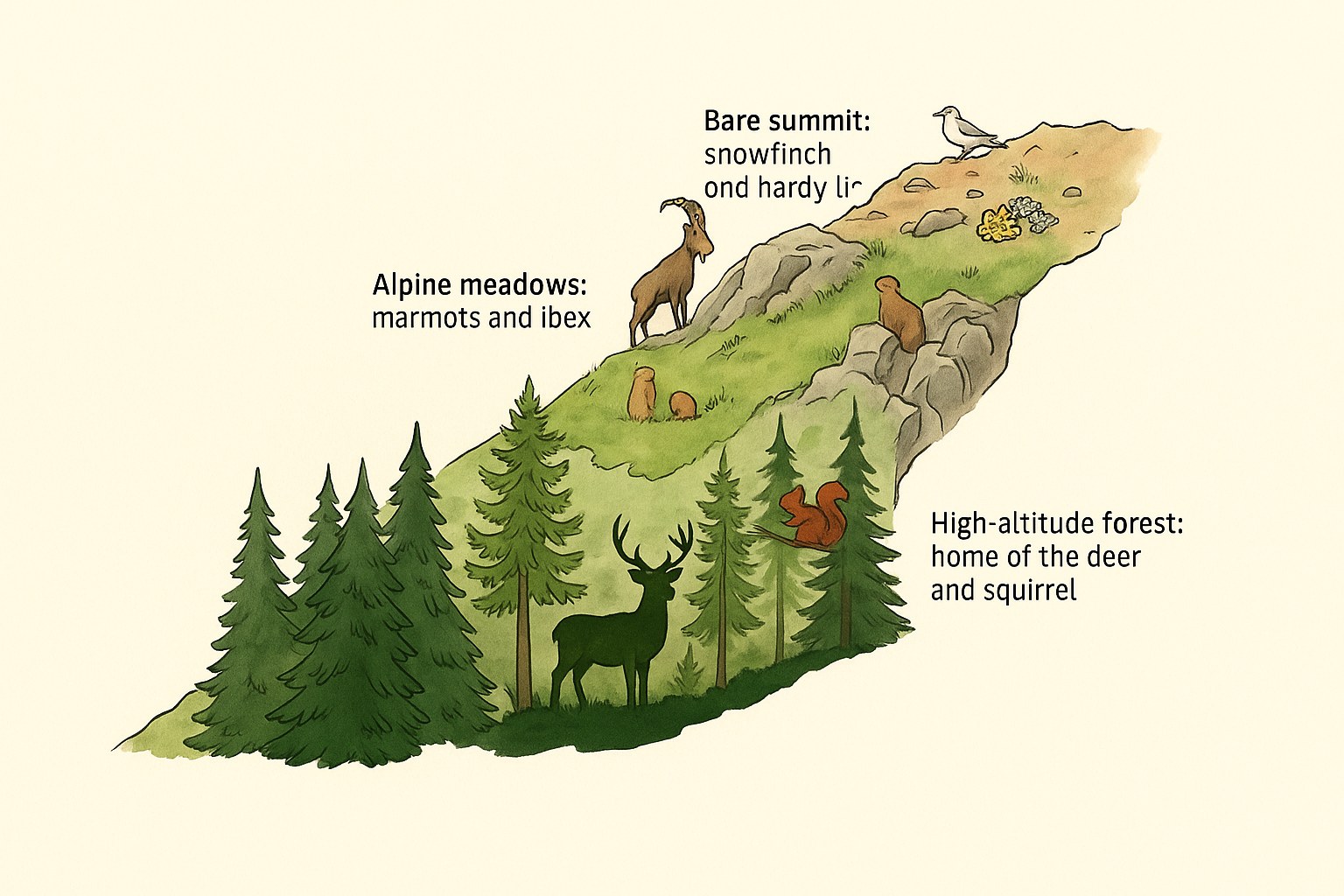
🌲 Life in the high-altitude forests
The conifer woods, made of spruce and larch trees, form a dense habitat. This is the favourite refuge of the red deer and the lively red squirrel.
The forest works as a natural thermal shield against wind and snow. Animals find seeds or tasty buds there. This larder becomes vital when the seasons turn harsh.
Staying hidden is the golden rule under the canopy. Look carefully at the low branches.
🪨 The alpine meadows and rocky slopes
Above the tree line stretch vast green grasslands. This is the favourite home of the alpine marmots. They soak up the sun and feast on the lush grass.
The steep rocks are home to ibex, those born climbers. Their hooves are perfectly suited to sheer drops and bare stone.
Here’s the rhythm of life in these high pastures:
- An active summer presence
- Meadows in full bloom
- A gradual retreat to the forest in autumn
🏔️ The extreme world of the rocky peaks
Near the summits, oxygen grows thin and the cold rules all year round. Only a few birds and the white-winged snowfinch stay up here. It’s a vertical desert of stone.
Food is almost completely absent on these bare ridges. Lichens and a few rare insects barely feed the residents. Survival is a daily feat.
Permanent life stops where the ice never melts. This is the final kingdom of bare rock.
🦌 Portraits of the mammal kings of the peaks
Moving on from the landscapes to look at the faces of the mountain helps you understand these remarkable survivors better.
🐹 The marmot and its famous whistle
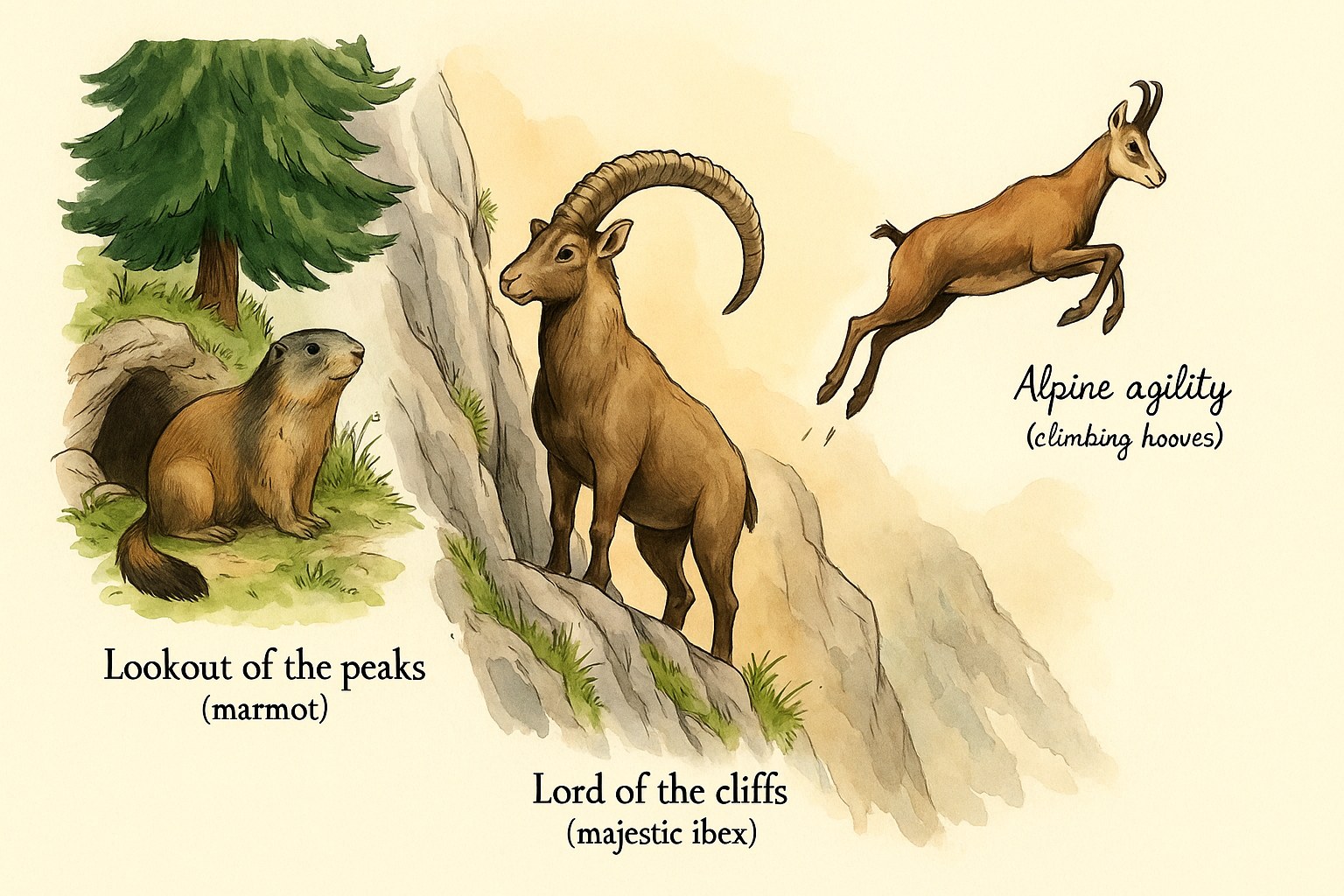
The marmot lives in families inside huge burrows. It keeps a close watch on its surroundings. It’s a very effective lookout for the group.
Its sharp whistle warns of approaching danger. If an eagle comes near, everyone dives underground. The cry echoes across the whole valley. It’s their natural alarm system.
It loves tender grasses and flowers. It eats a lot before winter.
🐐 The ibex and its impressive horns
The ibex carries massive, curved horns. It’s heavy yet still very agile. It’s the lord of the steepest cliffs.
Unlike the chamois, it’s less shy. Its horns have bumps called growth rings. This makes it easy to guess its age.
The ibex nearly vanished, but it is now protected in our national parks, much to everyone’s delight.
🦌 The chamois and its incredible agility
The chamois has hooves with a soft outer edge. This lets it grip smooth rock perfectly. It leaps with astonishing ease.
This animal is very wild and flees from people. It senses us from far away. Its eyesight and sense of smell are excellent.
In winter, it feeds on lichens and mosses. It scrapes the snow away with its hooves.
To keep the children busy during the holidays, nothing beats the printable mountain animal discovery sheets available on our site.
🦅 Masters of the sky and majestic raptors
While the mammals rule the ground, all you have to do is look up to discover the true owners of the air currents.
🦅 The golden eagle and its piercing eyesight
The golden eagle has a wingspan of more than two metres. Its flight is powerful and very graceful. It glides effortlessly on the warm air currents.
It spots prey from several kilometres away. Its hunting dive is lightning-fast. It nests on unreachable rocky ledges. This keeps its chicks safe from ground predators.
It’s the top predator of the peaks. A symbol of total freedom.
🦴 The bearded vulture and its unusual diet
This giant raptor mostly eats bones. It drops them onto the rocks to smash them open. Its stomach digests everything with ease.
You can recognise it by the rusty feathers on its belly. It also has a small beard of black feathers. It’s a rare and magnificent bird.
It acts as a cleaner in nature. It tidily removes the remains of dead animals.
🤍 The rock ptarmigan and its white camouflage
The ptarmigan changes colour with the weather. It turns completely white in winter to hide. In summer, it goes back to brown tones.
Its feet are covered in dense feathers. They act like snowshoes on the snow. This stops it from sinking too deep.
It lives near glaciers and permanent snow. It’s a bird that’s very tough against the cold.
To explore these species with your children, feel free to use educational resources like the printable mountain animal discovery sheets available on our site.
❄️ Survival secrets against the bitter cold
To stay up there when the temperature plunges, these animals have had to invent incredible biological tricks.
💤 Hibernation to save energy
During winter, the marmot’s heart beats very slowly. Its body temperature drops dramatically. This is how it saves its precious strength.
It builds up fat all summer long by eating. This reserve acts as fuel during its long sleep. It can sleep for six months without coming out. It’s a radical and effective survival strategy.
It wakes up in spring. It comes out very weak.
🐻 The seasonal coat change
The mountain hare changes its fur in autumn. Its coat turns white like fresh snow. It then becomes invisible to predators.
The fur also thickens to insulate better against the frost. The air trapped in the coat keeps the heat in. It’s a true natural duvet that works brilliantly.
This camouflage is vital so it doesn’t end up as a meal. Nature is clever.
🌡️ How local species regulate their body heat
Animals limit their movements so they don’t burn calories. They shelter behind rocks or under fir trees. Every move counts to stay warm.
Some huddle together to share their body heat. They patiently wait for the storm to pass. Their metabolism slows down naturally during these periods.
| Species | Winter strategy | Special feature |
|---|---|---|
| Marmot | Hibernation | Very low heart rate |
| Ibex | Descent into the forest | Easier-to-reach food |
| Ptarmigan | Feathered feet | Better insulation and walking on snow |
| Mountain hare | Turning white | Total camouflage in the white landscape |
To explore mountain wildlife further, the printable discovery sheets are perfect tools for learning while having fun.
🐾 Learning to read tracks in the snow
Even without seeing the animal, the snow tells us thrilling stories if you know where to look.
🐾 Identifying paw prints
You can learn to identify the tracks and clues left by wildlife. Careful observation often reveals the passing of a chamois or a mountain hare. It’s a simple and easy method.
Hooves leave two parallel, pointed marks. A fox’s pads look like a dog’s. You need to measure the gap between each step. This shows whether the animal was walking or running fast. It’s a thrilling investigation.
Fresh snow is the best surface. The details show up crisp and clear.
🔍 Spotting subtle signs of passage
Leftover meals are great clues. A nibbled pine cone points to a squirrel. Hairs on the bark signal a frequent route.
Droppings reveal an animal’s diet. Trails are paths worn into the slope. Animals use them to move around easily.
Some signs never lie:
- Snagged hairs
- Gnawed bark
- Visible nests
- Leftover feathers
👀 Adopting good observation habits
Always use binoculars so you don’t get too close. Silence is your best ally in the mountains. Respect the animals’ peace, especially in winter.
Never feed wild animals. It upsets their natural diet and their health. Stay on marked trails so you don’t disturb anything.
Watching without being seen is the finest gift for the naturalist who respects wildlife.
To go with your outings, don’t forget to prepare your tools. The mountain animal discovery sheets let you put a name to every encounter. These fun resources turn a simple walk into a real educational expedition.
📄 Hands-on activities and printable ID sheets
To lock in all these discoveries, nothing beats a little hands-on action with some fun tools.
🔗 Matching names and pictures
Ask the children to link the picture to the name. It’s a very effective visual game for memorising. Each animal has a silhouette all its own.
Use an alpine animal ID sheet to guide the exercise. Identifying the ibex or the bearded vulture becomes child’s play. It’s hands-on and really clear.
Match the habitat to each species too. Drawings help a lot.
📝 Fill-in-the-blanks on the life cycle
Complete the sentences about the birth of the young. Use words like “kid” or “marmot pup” to learn new vocabulary. It’s perfect for building up specific vocabulary.
Explain what they eat depending on the season chosen. Fill-in-the-blanks makes the child think. They check their knowledge while having fun.
Here are a few ideas to slot into your texts to make them richer:
- Hibernation
- Herbivore
- Raptor
- High pasture
🎵 A fun quiz on animal calls
Do you know who whistles or who bleats? The sound quiz is perfect for early learning. Animals communicate to breed or to warn each other.
Test your memory with sounds recorded in the forest. It’s a fun challenge for the whole family. Learn to recognise the yelp of the fox.
The mountain is a living, wild orchestra. Listen carefully next time.
Between clever hibernation and white camouflage, the animals of the peaks compete in ingenuity to survive the cold. Print your mountain animal discovery sheets right away to explore these secrets as a family. Your little naturalists will be ready to track prints in the snow first thing tomorrow!
❓ FAQ
🏔️ Which iconic animals can you discover in your mountain sheets?
In our printable sheets, you’ll find portraits of the mammal kings of the peaks such as the alpine ibex, the chamois and the famous marmot. We don’t forget the fascinating predators like the grey wolf and the red fox, which roam both the forests and the high pastures.
The sky isn’t left out either, with sheets dedicated to majestic raptors. You can introduce your children to the golden eagle, the bearded vulture or the surprising rock ptarmigan, that little bird which changes colour with the seasons.
❄️ How do mountain animals manage to survive the bitter cold?
Each species has its own little trick for getting through winter. The marmot chooses radical hibernation: its heart slows to two or three beats per minute to save energy. It sleeps like this for six months, safe in its burrow, drawing on the fat reserves built up over the summer.
Others prefer camouflage and insulation, like the mountain hare. Its coat turns white to blend into the snow and thickens to create a real natural duvet. Its feet even grow dense fur that acts like snowshoes so it doesn’t sink into the powder.
🐐 Can you really guess an ibex’s age by looking at its horns?
Yes, it’s perfectly possible and it’s a brilliant observation exercise for little naturalists! In male ibex, horn growth stops each winter and starts again in spring. This cycle leaves a visible mark called an age ring or groove.
By counting these segments between two rings, you can estimate the animal’s age fairly accurately. Be careful, though, not to confuse them with the bumps on the front, called nodes, which are purely decorative and don’t tell you the age.
🐾 What clues can you look for to spot animals passing through the snow?
The snow is a wonderful storybook. To work out who has been here, you can look at the shape of the prints: pointed hooves for hoofed animals or pads for the fox. Measuring the gap between steps also tells you whether the animal was calm or running.
Other, more subtle clues tell us about their daily lives. A nibbled pine cone often gives away a squirrel, while hairs caught on bark or leftover feathers point to a route or a resting spot. It’s a real investigation to carry out as a family on your walks.
🎨 How can you use the discovery sheets to set up a fun activity with the children?
Our sheets are designed to be interactive. You can set up matching exercises by linking the animal’s name to its silhouette or its natural habitat. Fill-in-the-blanks are also perfect for learning specific vocabulary, like the names of the young (the kid or the marmot pup) or ways of life such as hibernation.
To finish the activity in style, why not organise a little quiz on animal calls? Between the marmot’s whistle and the fox’s yelp, children have great fun imitating the wildlife. It’s a gentle, joyful way to memorise everything they’ve learnt about life at altitude.
