
🦴 Have you ever wondered how your body stays upright instead of collapsing like a pile of laundry? What the human skeleton and our bones are really for is the central question of this article, which reveals the secrets of our incredible natural framework. You’ll discover how this store of minerals and proteins protects your vital organs while quietly making your blood cells every single day.
- What the human skeleton does to keep you fit
- The axial and appendicular skeleton made simple
- What are our bones made of to be so tough?
- The mystery of bones that fuse in children
- Moving smoothly thanks to the joints
- A few tips to pamper your bones
🦴 What the human skeleton does to keep you fit
After briefly introducing how important anatomy is, we’ll see that our bones aren’t just lifeless structures but true multi-purpose pillars.
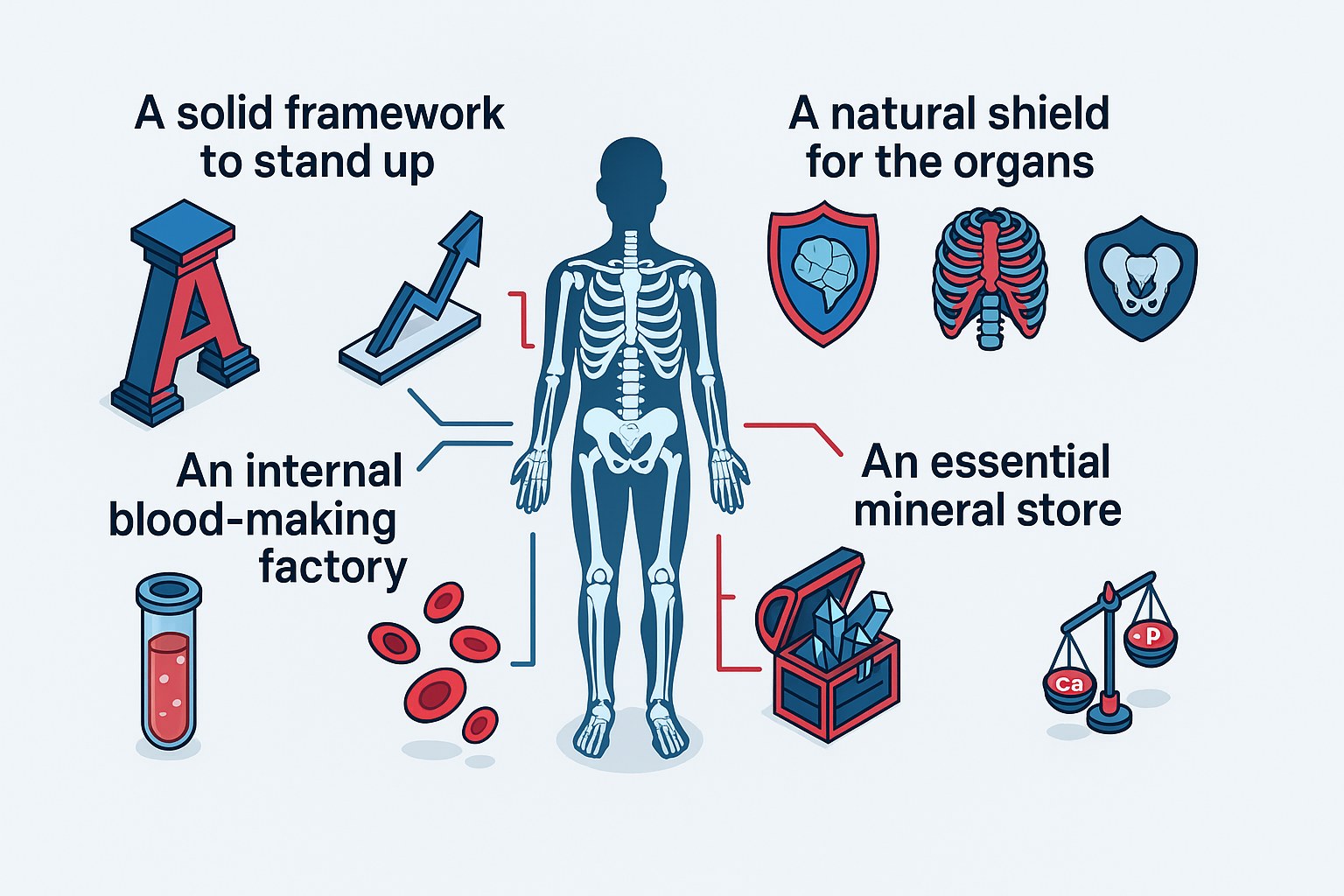
🏛️ A solid framework to stand upright
The skeleton is the essential frame of our body. Without this structure, we would just be a shapeless mass. It lets us stand up. It also defines the overall human silhouette.
The vertebrae play a major role. They keep our posture straight. They support the weight of the upper body.
The bones anchor the muscles. They act like levers.
🛡️ A natural shield for the organs
The skull protects our brain effectively. This bony safe is super tough. It keeps our command centre safe from accidental knocks from outside.
The rib cage shelters the lungs. It also protects the heart. These vital organs have a flexible barrier against physical injury.
The pelvis is essential. It supports the digestive organs.
🩸 An internal factory making blood
Red bone marrow sits at the heart of the bones. This is where blood cells are born. Experts call this vital process haematopoiesis.
It produces red blood cells and platelets. These elements ensure oxygen supply and clotting. Bone really is a living organ.
The bone matrix also depends on the role of proteins. It’s fascinating.
💎 An essential mineral store
Bone stores calcium and phosphorus. It works like a true mineral bank. The body draws on it according to its real physiological needs.
Constant exchanges regulate the blood flow. This balance is kept with precision. It guarantees that our nerves work properly.
The body manages the storage of calcium in the bones this way. Everything is connected. What are our bones for? Here’s a concrete answer.
💀 The axial and appendicular skeleton made simple
Understanding these functions is one thing, but it’s just as useful to know how this structure is organised geographically in our body.
🎯 The axial skeleton to protect the centre
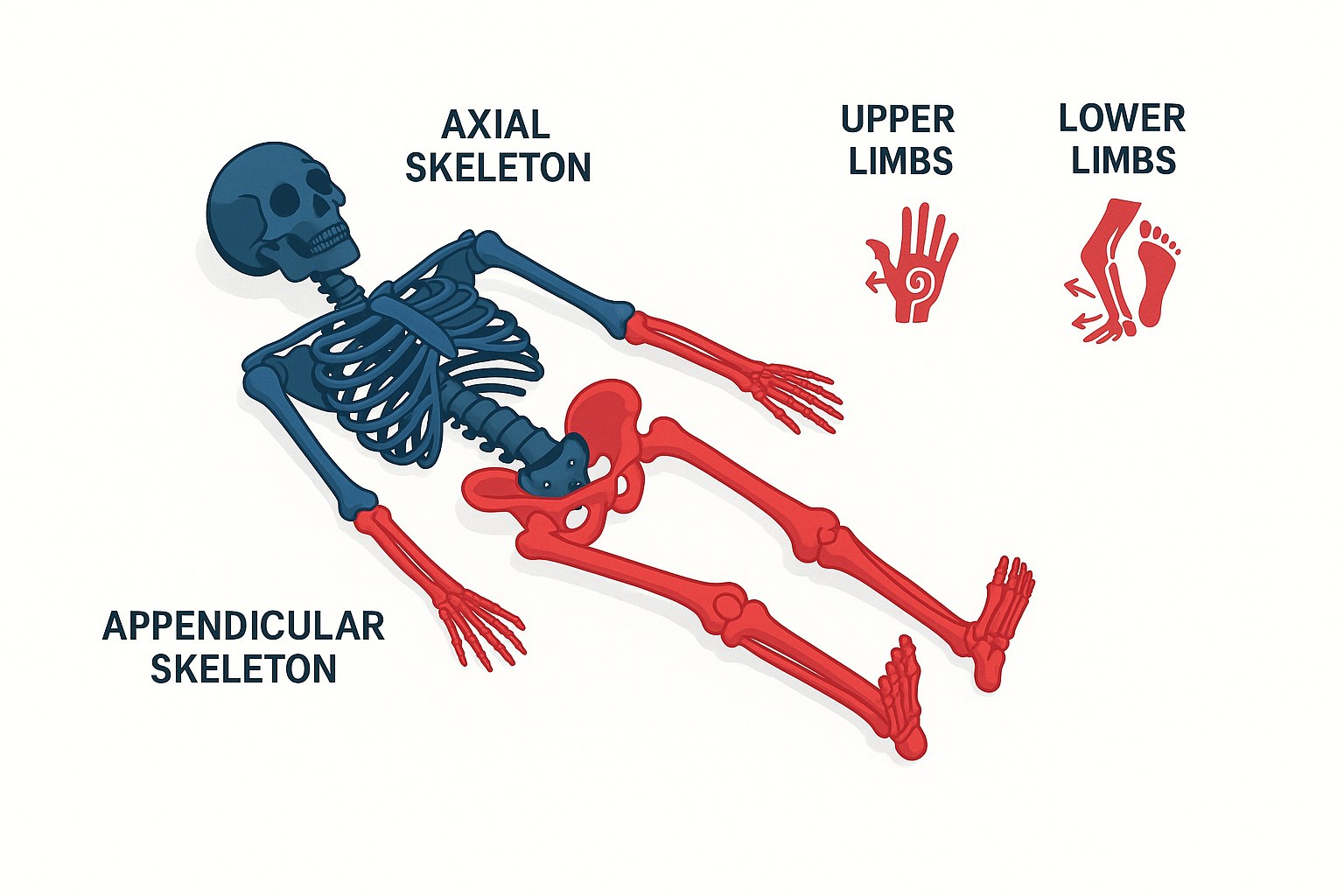
The central axis brings together the skull, the spine and the rib cage. These bones form the hard core of our anatomy. They stabilise our whole silhouette.
The vertebrae surround the spinal cord to protect it. This solid bony channel prevents serious nerve damage. It really is a top safety mission for the body.
This set stays relatively fixed. It serves as a solid anchor point for all the rest of the human body.
🏃 The appendicular skeleton for action
This system includes the upper and lower limbs and the shoulder and pelvic girdles. It’s built for movement and interaction. Without it, you couldn’t walk or grab an object. What are our bones for? For moving, of course!
The arms attach to the trunk via the shoulder blades. These joints allow an exceptional range of movement to handle objects.
The legs are linked to the pelvis. This structure supports all the weight during walking and other movements.
🦵 The differences between upper and lower limbs
Precision and flexibility are the speciality of the arms. The legs, on the other hand, are built for power. They provide the stability we need to stand up.
The femur is a great example of this strength. It’s the longest and strongest bone in the body. It contrasts with the finer bones in the wrist.
- Arms: mobility, gripping, fine bones
- Legs: stability, propulsion, massive bones
🦴 What are our bones made of to be so tough?
This spatial layout relies on materials with incredible strength, whose shape varies depending on how we use them.
🔢 The four families of bone shapes
What are our bones for? First, to give shape to our silhouette. We sort bones by their precise shape. There are long, short, flat and irregular bones.
Each shape meets a mechanical need. The femur is a classic long bone. The carpus, in the wrist, stays short. The shoulder blade is flat, while the vertebrae are irregular.
Here’s a little visual recap:
| Type of bone | Feature | Example |
|---|---|---|
| Long | Lever | Femur |
| Short | Stability | Carpus |
| Flat | Protection | Sternum |
| Irregular | Complex shape | Vertebra |
🧬 The mix of minerals and living tissue
Bone combines the hardness of calcium with the flexibility of collagen. This mix stops the bone from being too brittle. It’s perfect natural engineering to absorb everyday shocks. Cells called osteoblasts make this organic matrix.
There are two different textures. Compact bone is very dense. Spongy bone is more airy.
The skeleton also stores minerals. You find zinc stored in the skeleton in a lasting way.
🦴 The special case of sesamoid bones
The kneecap is a fascinating element. It’s the largest sesamoid bone. It improves the leverage of the quadriceps muscle to help us move.
Some bones are tiny. The stapes, hidden in the ear, is really small. On the other hand, the fine bones of the face break quite easily in a knock.
These sesamoid bones live hidden away. They’re often buried inside the tendons. They protect them against excessive wear caused by rubbing.
👶 The mystery of bones that fuse in children
While an adult’s structure seems fixed, it’s actually the result of a fascinating transformation that begins well before birth.
👶 Why babies are born with 300 bones
Newborns have about 300 bones at birth. This multitude of separate segments offers great flexibility. It greatly helps the delicate passage during birth.
In an adult, there are only 206 left. As we grow, many bones end up fusing together. The sacrum is a perfect example of this natural welding.
The human skeleton is a living matrix in constant renewal, with growth that continues until the age of 22.
📈 The mechanism of growth and ossification
Cartilage gradually turns into solid bone. This biological phenomenon is called endochondral ossification. A child’s skeleton stays very flexible. Minerals then harden the whole structure.
The growth plates make the body grow longer. They’re found precisely at the ends of the long bones.
The human body keeps up bone growth until adulthood thanks to these active zones.
🩹 The natural repair after a fracture
The body makes a bone callus after a knock. This temporary bridge links the broken parts. It’s a really fast biological reaction.
Specialised cells then turn this cartilage into hard tissue. The bone solidifies to regain its strength. The original strength almost always comes back.
Rest is still essential, though. Strict immobilisation helps the cells work efficiently.
🤸 Moving smoothly thanks to the joints
But a rigid skeleton would be no use without clever hinges to bring the whole thing to life.
🦿 How joints and cartilage work
The joints are the contact zones. They mark the meeting point between two bones. These junctions allow varied and smooth movements every day.
Cartilage plays a cushioning role. This smooth tissue avoids painful rubbing between the surfaces. It also protects the bone surfaces against premature wear.
Synovial fluid helps too. This liquid lubricates the joint like oil in an engine to make every movement easier.
🔗 The role of ligaments in stability
Ligaments are very strong bands of fibrous tissue. They hold the bones together while limiting excessive movement. They’re the guarantee of a stable, secure joint for the body.
Ligaments must be told apart from tendons. Tendons connect muscle to bone, not bone to bone. Their structure differs depending on their precise function.
A sprain happens sometimes. It’s an injury to those very ligaments after a twist or a sudden knock.
📖 A little technical glossary to impress your friends
Foramen and condyle are precise terms. The foramen is a hole that lets the nerves pass through. The condyle is a rounded joint bump at the ends.
The malleolus is also very useful. It’s the bony bump you can feel at the ankle. These features often serve as attachment points for our tissues.
Here’s a quick summary:
- Foramen: passage;
- Condyle: junction;
- Malleolus: ankle stabiliser.
💪 A few tips to pamper your bones
Now that we know the mechanics, let’s see how to look after this precious capital throughout life.
🥛 The winning duo of calcium and vitamin D
Calcium needs a little help to be effective. Without vitamin D, the body can’t fix this mineral. It’s an absolutely essential biological partnership for us.
Sunlight helps produce vitamin D naturally. Dairy products and almonds provide the calcium we need. These simple sources help us keep a nice solid structure every day.
You also need to watch the role of vitamin K and calcium. These elements work together to protect our cardiovascular and bone health.
🏋️ Physical activity to boost density
Moving directly strengthens the power of our bones. Moderate impacts stimulate the creation of new tissue. Walking or running are excellent for this. Bone reacts to stress by becoming denser and stronger.
Mixing things up helps a lot. Light strength training also helps reinforce the overall structure. It’s a small effort for a big long-term benefit.
We often forget this point. And yet, a sedentary lifestyle is the enemy of bone density. Moving a little every day changes everything.
🩺 Preventing osteoporosis and osteoarthritis
It’s useful to spot the signs of fragility. Osteoporosis makes bones porous and brittle with age. It’s a silent disease but often preventable with good habits.
Adopting healthy habits is the key. A balanced diet and medical follow-up are essential. Osteoarthritis, for its part, involves the wear of the joint cartilage and needs special attention.
Fluoride helps strengthen the bones and may play a role in preventing osteoporosis.
Taking care of your skeleton means guaranteeing your mobility and protecting your vital organs for the future. By favouring the calcium-vitamin D duo and regular physical activity, you build up your bones for the long term. Don’t wait to pamper this living framework and stay in great shape!
❓ FAQ
🦴 What does our skeleton actually do every day?
The skeleton is much more than just a frame. It acts as a solid pillar that gives our body its shape and lets us stand up instead of being a shapeless mass. It’s also a protective shield for our vital organs, like the skull that protects the brain or the rib cage that shelters the heart and lungs.
On top of this protective and supporting role, our bones serve as levers for movement thanks to the muscles anchored to them. They also work like a true internal factory making our blood cells, and as a precious store for keeping calcium and phosphorus.
💎 Why do we say bones are mineral reserves?
Our bones work like a mineral bank, mainly for calcium and phosphorus. The body draws on them according to its physiological needs to keep the nerves and muscles working well. It’s a constant balance: the bone releases these elements into the blood to maintain good health throughout the body.
To keep this “bank” well stocked, a diet rich in calcium and enough vitamin D are essential. Without vitamin D, our body really struggles to fix calcium onto the bone structure, which can weaken our health capital.
👶 Is it true that babies have more bones than adults?
It’s completely true and quite fascinating! Babies are born with about 300 bones, often separated by soft cartilage. This feature in particular helps the passage during birth and allows rapid growth. Over time, these segments fuse to form the 206 bones.
This transformation process is called ossification. Cartilage gradually turns into hard bone tissue thanks to the supply of minerals. It’s a permanent work in progress that usually continues until around the age of 22.
🩹 How does the body manage to repair a broken bone?
The human body is an amazing machine capable of self-repair. After a fracture, the body reacts immediately by creating a temporary “bridge” called a bone callus. Specialised cells then work flat out to replace this soft bridge with solid, permanent bone tissue.
For this repair to be effective, rest and good immobilisation are essential. This lets the cells rebuild the structure without being disturbed by movement. With a little patience, the bone often regains its original strength and solidity.
🦿 What is the role of the joints and ligaments?
The joints are the meeting points between two bones, allowing the smoothness of our movements. To stop the bones from wearing out by rubbing against each other, they’re covered in cartilage and lubricated by a liquid called synovial fluid, which acts like oil in an engine.
The ligaments, for their part, are very strong fibrous bands that connect the bones to each other. Their mission is to keep the joint stable and prevent the excessive movements that could cause injuries. It’s thanks to this duo that we can move with so much precision and safety.
