
🍎 Explaining digestion to children can feel like a real challenge when the questions about where food goes start flying around the dinner table. This article walks through that bumpy journey, from the very first bite of apple all the way to its unavoidable arrival in the toilet bowl. You’ll discover how teeth, the stomach and even tiny bacteria work together as a team to turn a snack into super-energy.
- The mouth gets things started
- The slide down to the stomach
- Sorting nutrients in the small intestine
- The secret helpers of digestion
- The final change into poop
- Why does digestion take so long?
👄 The mouth gets things started
A meal begins with a vital step, even before the tummy gets to work. This is where the plate meets the start of the journey to turn food into energy.
🦷 The teeth do the heavy lifting
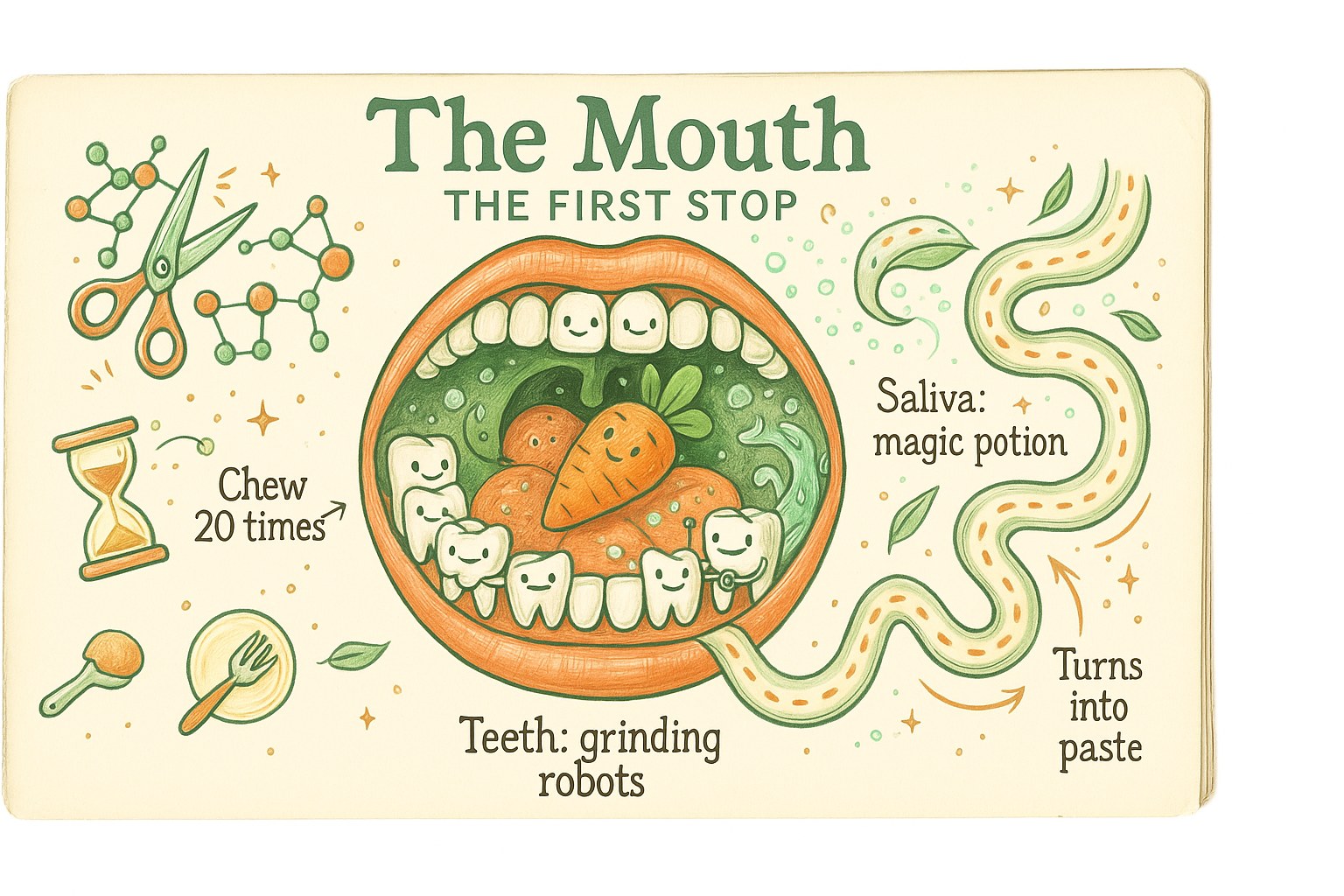
Teeth act like little personal robots. They cut, grind and crush every bite that comes in. This mechanical work is the basis of the whole digestive process.
Swallowing a big lump is simply impossible for the body. So the teeth turn the food into a soft, mouldable mush. That way they prepare the ground for the rest of the digestive tube.
Chewing well stops you from choking. It’s the very first step of digestion, from the meal to the poop.
💧 Saliva, the magic potion
Saliva is the body’s very first chemical. It contains enzymes that work like invisible scissors. These tiny tools already start cutting up the sugars.
It softens the food to create a slippery paste. This texture makes swallowing easier. Did you know your daily saliva production can reach 1.5 litres?
Saliva also protects your throat. Without this liquid, dry chunks would painfully scratch the inside of your neck as they pass through.
😬 Why chewing well changes everything
Taking your time is essential to avoid tummy aches. The stomach quickly tires if it gets pieces that are too big. It wears itself out trying to grind everything on its own.
Here’s a little game: count to twenty before you swallow. This fun habit helps the body stay in great shape. It’s a simple secret for better health.
The more you chew, the easier the rest of the journey becomes. To help little ones, you can follow these few habits:
- Take small bites.
- Put your fork down between each bite.
- Really taste the flavours with your tongue.
🛝 The slide down to the stomach
Once the mush is ready, it leaves the mouth to travel down a very special pipe.
💪 The oesophagus and its muscles
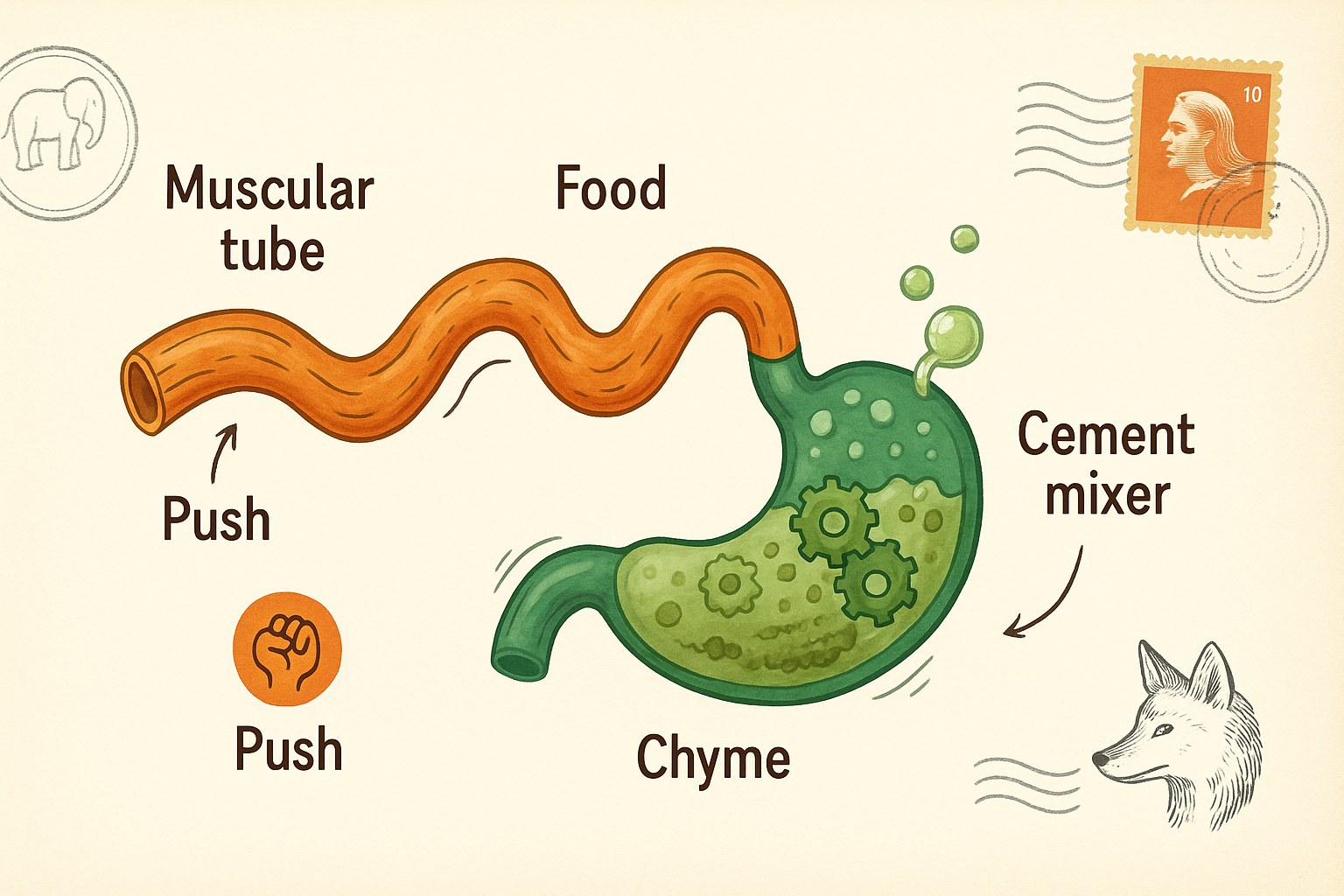
The oesophagus is like a long, muscly tube. It simply connects the mouth to the stomach. It’s not an empty hole where everything falls by chance.
The muscles work hard to push the meal along. This movement is called peristalsis. You can even eat upside down with no trouble at all.
The journey is really express. The food bolus slides down in just a few seconds. It quickly reaches its next destination.
🥣 The stomach, like a cement mixer
The stomach is a very tough, muscly bag. It churns every bite like a cement mixer hard at work. The mixture ends up becoming a thick liquid. It’s a really intense mixing stage for the body.
Food stays there for several hours. This time allows the full transformation into chyme. It’s a job that takes patience.
This organ is stretchy. It grows bigger after a good feast.
🧪 The powerful action of gastric juices
The stomach makes very powerful juices. They serve to dissolve food efficiently. You can compare it to a strong chemical shower.
The stomach uses hydrochloric acid to turn food into a liquid mush called chyme over several hours.
A special wall protects the organ from burns. The acid takes the chance to kill germs. It’s an excellent natural cleaning system.
Digestion, from the meal to the poop, goes through this step. Everything becomes a liquid soup for the intestine.
🔍 Sorting nutrients in the small intestine
After the big mix in the stomach, the liquid arrives in the longest and cleverest part.
🚇 A selective sorting tunnel
This tube is about six metres long. And yet it fits, all coiled up, inside your little tummy. It’s a truly incredible feat of nature.
The sorting factory gets going. The body examines each element that arrives. It then decides what’s good to keep and what becomes waste.
Everything happens gently in this tunnel. The organisation is perfect so nothing important for your health gets missed.
🩸 Passing into the blood
The wall is like a soft, fluffy carpet. It has thousands of tiny hairs called villi. They absorb the good things from the meal.
The nutrients cross this wall to reach the blood vessels. The blood then becomes an efficient delivery truck. It brings the energy that all the muscles need.
This is where the system shows its strength. The body recovers almost all of its precious fuel.
⚡ Energy to grow up well
Nutrients are the vitamins, sugars and fats. You can think of them as bricks. They serve to build the body strong and solid.
Without these elements, it would be impossible to run or to think. Eating gives power to the cells. It’s the secret of everyday vitality.
This sorting lets children thrive. Bones lengthen and we grow taller. Digestion, from the meal to the poop, is quite an adventure.
🤝 The secret helpers of digestion
To pull off this complex sorting, the intestine isn’t alone; it gets help from some very hard-working neighbours.
🫀 The liver and the pancreas
The liver plays a major role. It makes bile, a green liquid. Bile helps break down fats, just like soap.
The pancreas’s help is precious. It sends enzymes to finish cutting up the food. It’s a very precise chemical factory.
It’s real teamwork. These two organs pour their products straight into the beginning of the small intestine.
🦠 The microbiome and its good bacteria
Our tummy is home to billions of residents. These friendly bacteria are everywhere. They form what we call the gut microbiome.
These bacteria take care of digesting fibre. They eat what we can’t digest on our own. They also make essential vitamins for the gut microbiome.
The balance is delicate. You have to eat well to keep these little allies healthy.
🔬 A simple visual experiment
Here’s the lemon test. Just pour a few drops of lemon into a glass of milk. You’ll then see the milk change shape.
The milk curdles because of the acid. It’s an excellent chemical analogy. It’s exactly what the juices do in your tummy.
It’s a concrete observation. It shows that digestion really does turn food into something new. Digestion, from the meal to the poop, then becomes very clear.
💩 The final change into poop
Once the body has taken everything it needed, there are still some bulky leftovers.
♻️ The large intestine recycles water
The large intestine recovers the water from the food mush. The body doesn’t want to waste anything. It’s real recycling work.
By removing the water, the leftovers become compact. The stools form little by little. They become solid before coming out.
You need to drink to avoid blockages. Without water, the waste is too hard. That can give you a tummy ache.
🚽 The rectum and the feeling of needing to go
The rectum is the last little bag before the exit. It serves as a temporary storage area. It waits until everything is ready.
When it’s full, the nerves warn the brain. You then feel the urge to go to the toilet. The message is sent quickly.
It’s a very healthy natural need. You shouldn’t hold it in for too long. It’s a normal body function.
🚪 The role of the anus
The anus is a ring-shaped muscle. It only opens when you decide to push. It controls the exit perfectly.
Letting the poop out helps clean the body. It’s like emptying the bin every day. You get rid of what’s useless.
Pooping regularly shows good health. The whole system is then working perfectly. It’s a positive sign.
| Step | Organ | What happens |
|---|---|---|
| 1 | Mouth | Grinding the food and the start of its transformation. |
| 2 | Oesophagus | Transporting the food towards the stomach. |
| 3 | Stomach | Mixing the food with acidic juices. |
| 4 | Small intestine | Nutrients passing into the blood. |
| 5 | Large intestine | Absorbing water and forming the poop. |
| 6 | Anus | The final release of waste out of the body. |
⏳ Why does digestion take so long?
The journey is over now, but you might wonder why it’s so long.
⏱️ The total length of the great journey
Digestion is a slow process. It can last between one and two whole days. It really isn’t a quick sprint.
There are differences depending on the food. Meat takes longer to process than fruit. Each food moves along at its own pace.
The body shows great patience. It takes the time to extract each nutrient precisely.
🔊 The mystery of the rumbles
The moving muscles create these noises. It’s simply air and liquid moving around. We call them borborygmi.
It’s a sign of intense activity. These sounds often come when you’re hungry or after eating. It’s proof that your tummy is at work.
There’s nothing to worry about. Everybody has tummy rumbles. It’s a normal sign of life.
💦 Wee isn’t liquid poop
These are two very different systems. Wee doesn’t come from leftover food. It is made by the kidneys.
The kidneys clean the blood like sieves. They remove liquid waste and extra water. It’s a circuit completely separate from poop. Digestion, from the meal to the poop, shows these two paths clearly.
The body has several exits. That’s essential to stay clean and efficient every day.
Understanding the journey of food helps us grow up better. From careful chewing to sorting the nutrients, each step turns the meal into vital energy. Adopt the habit of chewing well from today to pamper your body. A happy tummy is the guarantee of rock-solid health!
❓ FAQ
👄 Why does digestion start in the mouth?
Digestion begins with the very first bite because the teeth cut the food into small pieces. It’s the chewing that turns the meal into a mush that’s easy to swallow without choking.
Saliva also plays the role of a magic potion. It contains enzymes that start breaking down the sugars and turns the food into a slippery paste.
⏰ How long does it take to digest a full meal?
The journey of food is a fairly slow process that can take between 24 and 72 hours in total. It isn’t a race; the body takes its time to sort everything it receives.
Some foods, like fats or meat, need more work and stay longer in the stomach. On the other hand, fruit and sugars are processed much more quickly.
🧪 What are the gastric juices in the stomach for?
The stomach makes very acidic juices, like a kind of powerful chemical shower. These liquids serve to dissolve the food and kill the dangerous germs that might be on the plate.
This mixture turns the food into a thick soup called chyme. Luckily, the stomach wall is very strong so it doesn’t get burned by its own acid!
🔍 Why is the small intestine so important?
It’s the cleverest step of the journey because this is where the body recovers the energy. The small intestine sorts the nutrients, like vitamins, and passes them into the blood to feed the muscles.
Even though it’s all coiled up in the tummy, this tube is about six metres long. It’s thanks to this that children get all the “bricks” they need to grow well and run around.
🔊 Where do the rumbling noises in the tummy come from?
The rumbles are simply the sign that the tummy muscles are working. They’re bubbles of air and liquid moving around in the pipes of digestion, a bit like in plumbing.
You often hear them when you’re hungry or just after eating. It’s completely normal and it proves that your digestive system is fully active!
🚽 What’s the difference between wee and poop?
They’re two completely different circuits! Poop is made of the leftover food that the body couldn’t use after it passed through the intestines.
Wee, on the other hand, is made by the kidneys, which filter the blood to remove the liquid waste. So the body has several exits to get rid of what it no longer needs and stay nice and clean.
