
Do you sometimes feel a little lost in the face of your little one’s sudden changes? 🌱 Understanding each stage of a child’s development from 3 to 6 helps you support their motor progress and their language explosion with a newfound calm. Here you’ll discover how their first “whys” and their conquest of getting dressed on their own gently prepare them for the great adventure of starting school.
- A child’s development at 3
- At 4, curiosity knows no limits
- The milestone of 5 and independence
- Starting school at 6
- Play as a daily engine of learning
- Supporting your child at their own pace
🧒 A child’s development at 3
After the first two years of sensory discoveries, stepping into the third year marks a major turning point towards self-assertion and structured communication.
💬 A daily vocabulary explosion
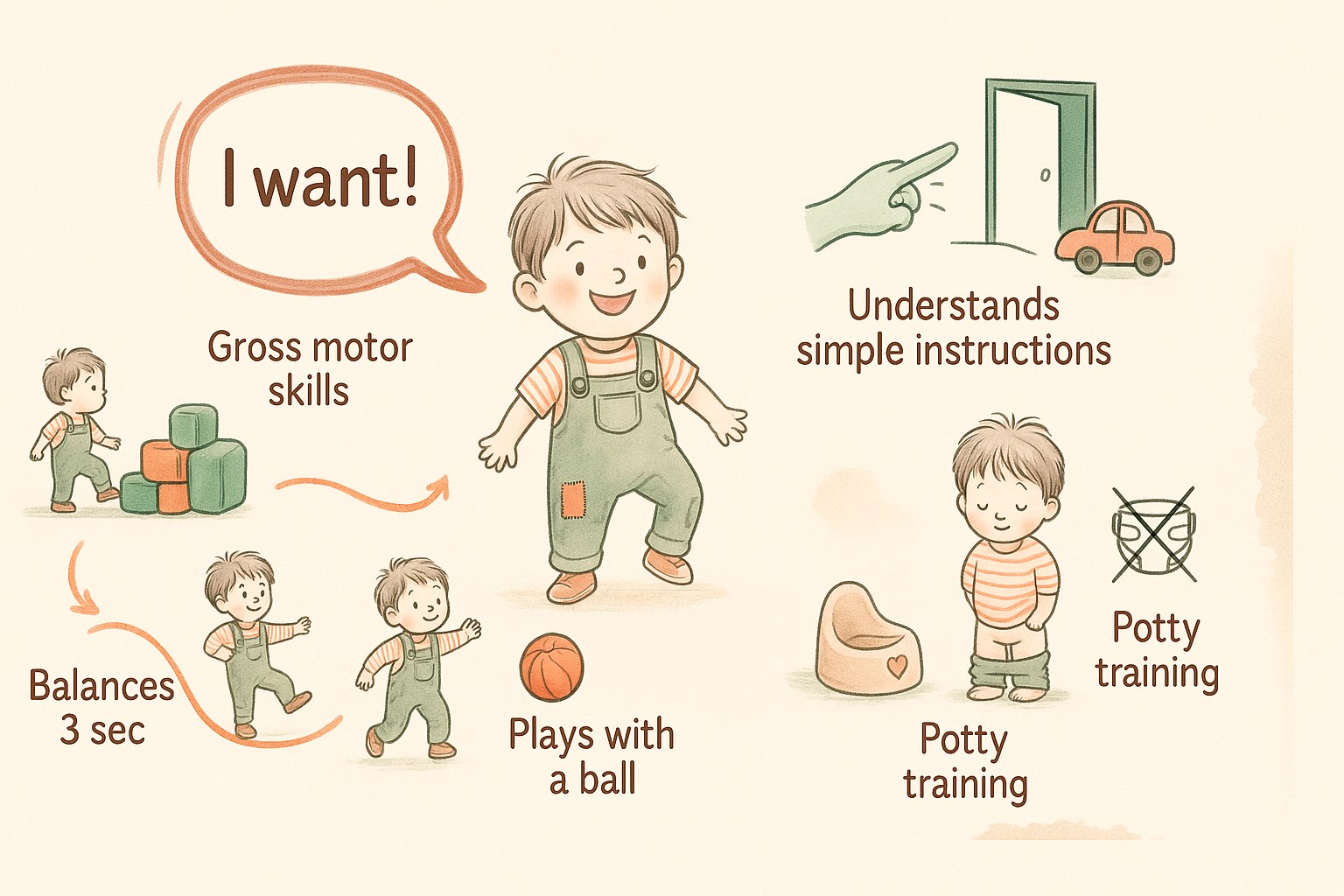
The child now builds simple sentences. They naturally pair a subject and a verb. This lets them express their basic needs more clearly.
Using the pronouns “me” and “I” becomes frequent. It’s a key stage of recognising themselves as a person.
Understanding instructions also moves forward. The child grasps simple commands. They carry them out without needing constant visual help.
🏃 Gross motor skills grow more confident
Climbing the stairs becomes child’s play. There’s no longer any need to hold their hand. They even start to alternate their feet on the steps.
Balancing on one foot improves noticeably. It’s an excellent coordination test. They often hold for a few seconds before wobbling a little.
Ball games become more interactive. They learn to throw in a precise direction. Catching the ball is a challenge they love to take on.
- Climbing steps with alternating feet
- Balancing for 3 seconds
- Kicking a ball
🚽 The first steps towards potty training
Bladder and bowel control gets sharper during the day. The child senses the need to go more clearly. They often manage to warn you before a little accident happens.
Independence in the toilet boosts their confidence. They can pull their trousers down on their own. Using the potty becomes a rewarding routine for their independence.
Nappies gradually disappear during naps. Rest stays dry more regularly. It’s a lovely victory for their independence.
🔍 At 4, curiosity knows no limits
If age 3 lays the foundations of independence, the following year propels the child into a world of endless questions and overflowing creativity.
🤔 The “why” phase to make sense of the world
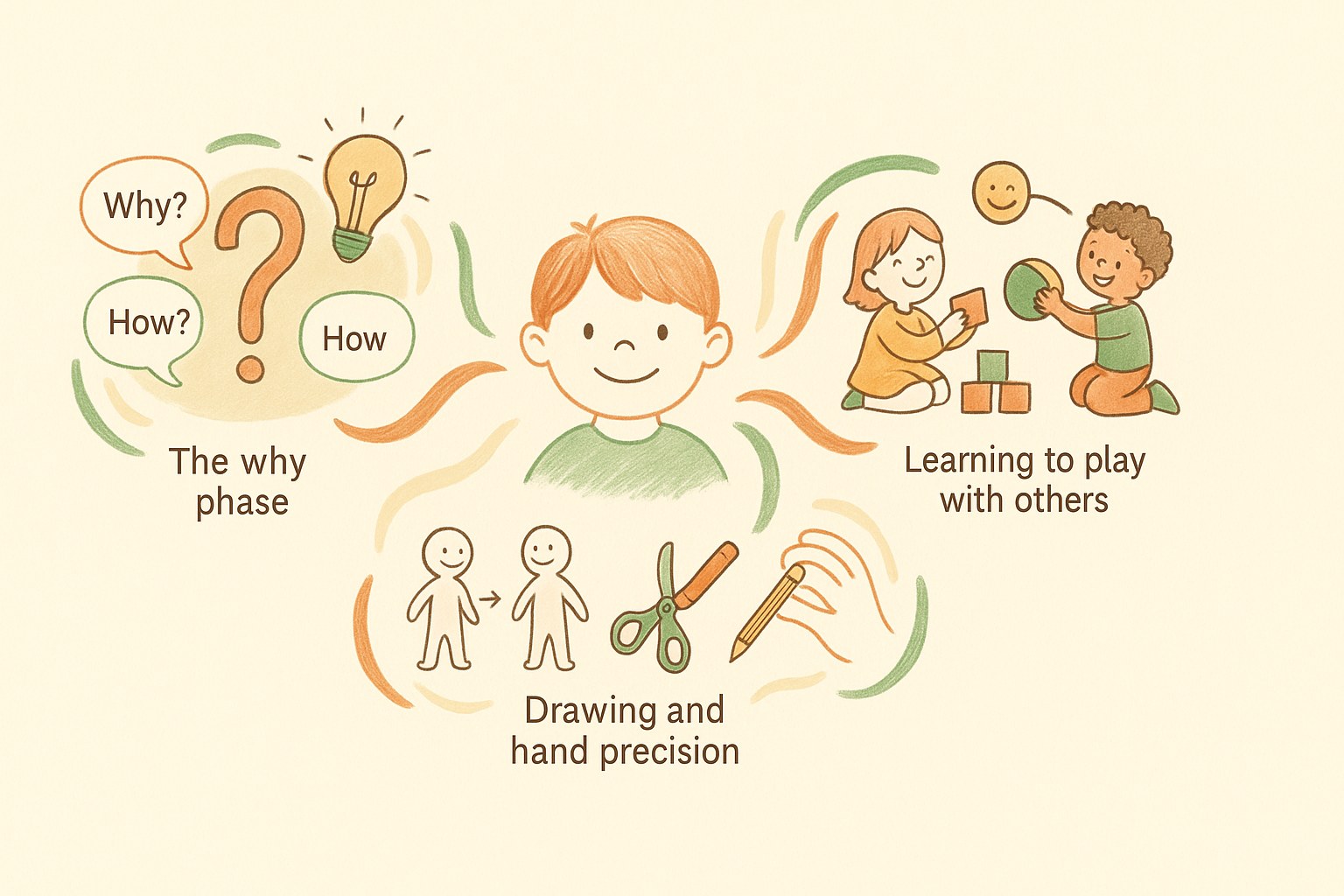
At this age, the child analyses every event to grasp its cause. They need to understand why things happen. It’s the start of causal reasoning in the little one.
Parents have to answer with great patience. It’s best to keep your explanations simple. Too many technical details risk losing this young, curious mind.
Their mind now organises itself around concrete rules. They make logical links between two lived situations. Thinking takes shape so they can better grasp their everyday surroundings.
The endless questioning isn’t a provocation, but a vital thirst to make sense of the reality around them.
✏️ Drawing and the precision of the hands
The famous tadpole figure changes in a striking way. The drawing now gains arms and legs. At last you start to make out a more complete human shape.
Using scissors becomes a central activity. Cutting out simple shapes takes real concentration. You notice that hand-eye coordination sharpens clearly.
The way they hold the pencil also changes radically. The child no longer grips their tool in a full fist. The pinch grip between the fingers slowly settles in for more precision.
🤝 Learning to play with others
You can see an important shift towards cooperative play. Children no longer just play side by side. They start to build a real shared project.
Sharing and taking turns set in. It’s a complex social phase to handle. The child gradually takes on board that their friends have their own wishes too.
The first solid friendships often start at school. Certain names come up every evening at home. This social bond becomes a real source of daily joy.
🌟 The milestone of 5 and independence
As “big school” approaches, the 5-year-old tries to prove they can manage their own world with surprising precision.
🗓️ Finding their bearings in time and space
Now, telling yesterday from tomorrow becomes natural. Time turns into a clearer line. The child can then anticipate events in their near future with confidence.
They name the days of the week and the seasons without hesitating. Daily school rituals help a lot at this stage. They finally understand that nature’s cycle repeats every year.
Following a known route becomes child’s play. They easily recognise the way to the usual bakery. Their sense of direction now takes firm root.
👕 Getting dressed alone like a big kid
The child works through the steps of getting dressed with no outside help. They put their jumper on the right way round almost every time. Choosing their clothes then becomes a real pleasure.
Managing buttons and zips moves forward clearly. Their fingers are far more nimble than before. Doing up their coat becomes a technical challenge finally within reach.
Then comes learning shoelaces, often dreaded. It’s the ultimate stage of fine motor skills. It still takes a lot of patience and many tries to succeed.
| Skill | Average age acquired | Difficulty |
|---|---|---|
| Putting on a jumper | 3-4 years | ★☆☆ |
| Doing up a zip | 4-5 years | ★★☆ |
| Buttoning a shirt | 5 years | ★★☆ |
| Tying shoelaces | 5-6 years | ★★★ |
🔤 Numbers and letters come into play
Counting to ten without a mistake is now possible. The number sequence is well memorised. They also start to count real objects in their bedroom or outside.
Recognising their own first name brings great pride. Letters become familiar, reassuring symbols. They happily point to their name label at school every morning.
Sorting by colour or shape gets sharper. This classifying forms a solid maths foundation. They organise their toys by precise, personal criteria.
🏫 Starting school at 6
Age 6 marks the big leap into core learning, where the child’s mind becomes capable of abstraction and rigour.
📖 Awakening to reading and writing
The child finally grasps the match between sounds and letters. They understand that each sign makes a specific noise. It’s the great start of sounding out syllables, so eagerly awaited.
Moving on to cursive writing takes a lot of concentration. The loops call for a smooth, controlled movement. They then proudly work hard to stay within the lines of their school exercise book.
You notice a keen interest in the stories read at night. They follow the tale with sustained attention. This love of storytelling boosts their motivation to learn every day.
😊 Better handling of strong emotions
You see a clear drop in tantrums. Frustration is now better tolerated day to day. They understand that shouting doesn’t solve everything to get what they want.
Putting feelings into words becomes a natural reflex. They can say if they’re sad or cross. Language gradually replaces sudden gestures or tears of tiredness.
Empathy towards their friends settles lastingly in their heart. They quickly notice if a friend is upset. Their social sense really sharpens through contact with the class group.
⚽ Physical coordination and sport
It’s often time for the bike without stabilisers in the garden. Dynamic balance is finally there. It’s a giant step for confidence in their own budding physical abilities.
Hopscotch and skipping ropes take over the playground. These games call for precise timing. They sync their movements with a new ease and a truly infectious joy.
The choice of dominant hand is now settled. Handedness is fixed for good. They use their preferred side for all the precision tasks they’re given.
🎲 Play as a daily engine of learning
Beyond the biological stages, it’s through play that the child takes in and cements their new skills every day.
👨👩👧 Imitating adults to grow up better
Playing pretend kitchen lets them replay social scenes. It’s a rehearsal of the real world. These symbolic games help build independence and self-confidence every day.
Changing identity with dress-up costumes helps explore different sides of themselves. The child tries out roles to better build their personality. They turn familiar actions into something extraordinary.
Imitation teaches manners and customs. You learn by pretending it’s real. This gently prepares them to understand more abstract symbols, like the letters and numbers to come.
🧘 Helping concentration through calm
Puzzles calm the mind. They force the child to focus on one precise task. Handling building blocks like Kapla also calls on very valuable fine motor skills.
Quiet encourages deep attention. Too many visual stimuli get in the way of calm thinking. A structured, screen-free setting helps channel physical energy and avoid pointless distractions.
After school, the brain needs a break. It’s essential to avoid nervous tiredness. These moments of refocusing are perfect for learning to manage emotions and impulsiveness.
😴 Sleep working for the brain
A child needs long nights. Sleep repairs the body and the mind. Between 3 and 6, you should count on 10 to 12 hours of rest a day.
It’s at night that new skills lock in. A rested brain learns much faster. Sleep processes the day’s information, which is vital for good, lasting memory.
The bedtime story soothes tensions. A fixed routine makes falling asleep quicker. This reassuring ritual helps the child anticipate the night and feel completely safe before sleeping.
🤗 Supporting your child at their own pace
To finish, let’s not forget that every little being is unique and that kindness remains the best guide for parents.
🌱 Respecting how each journey varies
Comparing children is pointless. Each one has their own inner timetable. Pressure only creates needless stress.
Areas of progress differ. One will talk early, another will be sportier. These gaps are completely normal and temporary.
Emotional maturity and physical growth go at their own rates. The body sometimes grows faster than the heart. You have to respect that emotional timing.
😤 Handling phases of defiance without wearing yourself out
There are tools to defuse tensions. Offering limited choices often helps. It gives the child a sense of control.
Firmness and kind listening go together. You need clear but gentle limits. The child needs boundaries to feel secure.
Adapted, non-violent communication helps. Expressing your own needs helps the child. They learn by example to respect others.
Defiance isn’t a war, it’s a necessary stage where the child tests how solid their reference points are.
🚨 Spotting the signs that call for advice
Language delays after 4. If sentences are still missing, it’s worth getting advice. A professional opinion makes it possible to act early.
Motor difficulties. Excessive clumsiness can be a sign. A psychomotor therapist can help the child adjust.
The paediatrician’s supporting role. They are your first health ally. Never hesitate to ask your questions during visits.
Every child grows at their own pace, between a language explosion, fine motor skills and managing emotions. By kindly supporting the stages of a child’s development from 3 to 6, you give them a secure framework for their future. Make the most of these precious moments, because they grow up so fast!
❓ FAQ
🗣️ At what age will my child start using “I” to talk about themselves?
It’s an exciting stage that usually arrives between 3 and 4. Before that point, it’s completely normal for your little one to use their own name or say “me” to express what they want. To help them gently, don’t hesitate to rephrase their sentences, stressing the “I” and the “you” without forcing them to repeat.
Pronoun use then quickly broadens. Around age 5, their language will look more and more like an adult’s, even if a few little grammar mistakes can still slip into their stories. That’s all part of the charm, isn’t it?
🚽 Is it worrying if my 3-year-old isn’t potty trained yet?
No need to panic — around 30% of 3-year-olds still wear nappies, and that’s perfectly normal. Potty training isn’t a race, but a question of physical and emotional maturity. Every child moves at their own pace, with boys sometimes taking a little longer than girls to master all the steps.
What matters is watching for signs of readiness, like staying dry for two hours or showing interest in the potty. If starting school is near, rest assured that teachers are used to supporting little ones through this transition. Stay relaxed — accidents are part of learning!
🪜 How can I help my little one go up and down the stairs like a big kid?
Alternating feet on the stairs is a skill often acquired between 3 and 4. Going down is actually trickier than going up, because it calls for better handling of gravity and depth perception. You can help by starting with small, well-secured steps at the park, with handrails at their height.
A little parent tip: stick different-coloured stickers on their shoes and the same colours on the steps to encourage them to alternate. And above all, always stay behind them going up and in front of them going down. Safety first, even for future climbing champions!
🤸 What are the major motor milestones between 3 and 6?
Over these three years, your child will become a real little athlete. At 3, they start jumping and climbing more easily. Around 4, coordination sharpens and they can climb the stairs with alternating feet. It’s also the age when they start dressing themselves, even if buttons still take a bit of patience.
The big turn comes around 5 and 6: they often master the bike or the scooter and gain in precision. At this age, handedness (the choice of the dominant hand) is well set. It’s the ideal moment to encourage all the physical activities they enjoy.
⚠️ When should you worry about a possible developmental delay?
Even though every journey is unique, some signs may invite you to seek medical advice. For example, if language is still absent after 4, or if you notice a really excessive clumsiness that bothers them day to day. A little check-up with the paediatrician or a specialist like a speech therapist can often put everyone’s mind at ease.
Don’t forget that you’re the person who knows your child best. If you have a lingering doubt, ask your questions during routine visits. The paediatrician is there to support and guide you, without judgement, so your little one can grow up calmly.
