
Explaining how the muscles of the human body work to a curious child can sometimes feel like a real puzzle. This guide breaks down the job of our 640 muscles and how they team up with our tendons to make anatomy something even the youngest kids can finally grasp. You’ll discover how the biceps-and-triceps duo works together, and why the heart is one special muscle that never stops working.
- Kids’ muscles are made for moving
- How does the muscle machine work?
- The winning duo of biceps and triceps
- 3 types of muscle to do everything
- Why do muscles get bigger?
- Experiments to understand movement at home
💪 Kids’ muscles are made for moving
After watching how easily a child runs about, you often wonder where all that energy comes from. In fact, it all starts with a fascinating engine hidden inside.
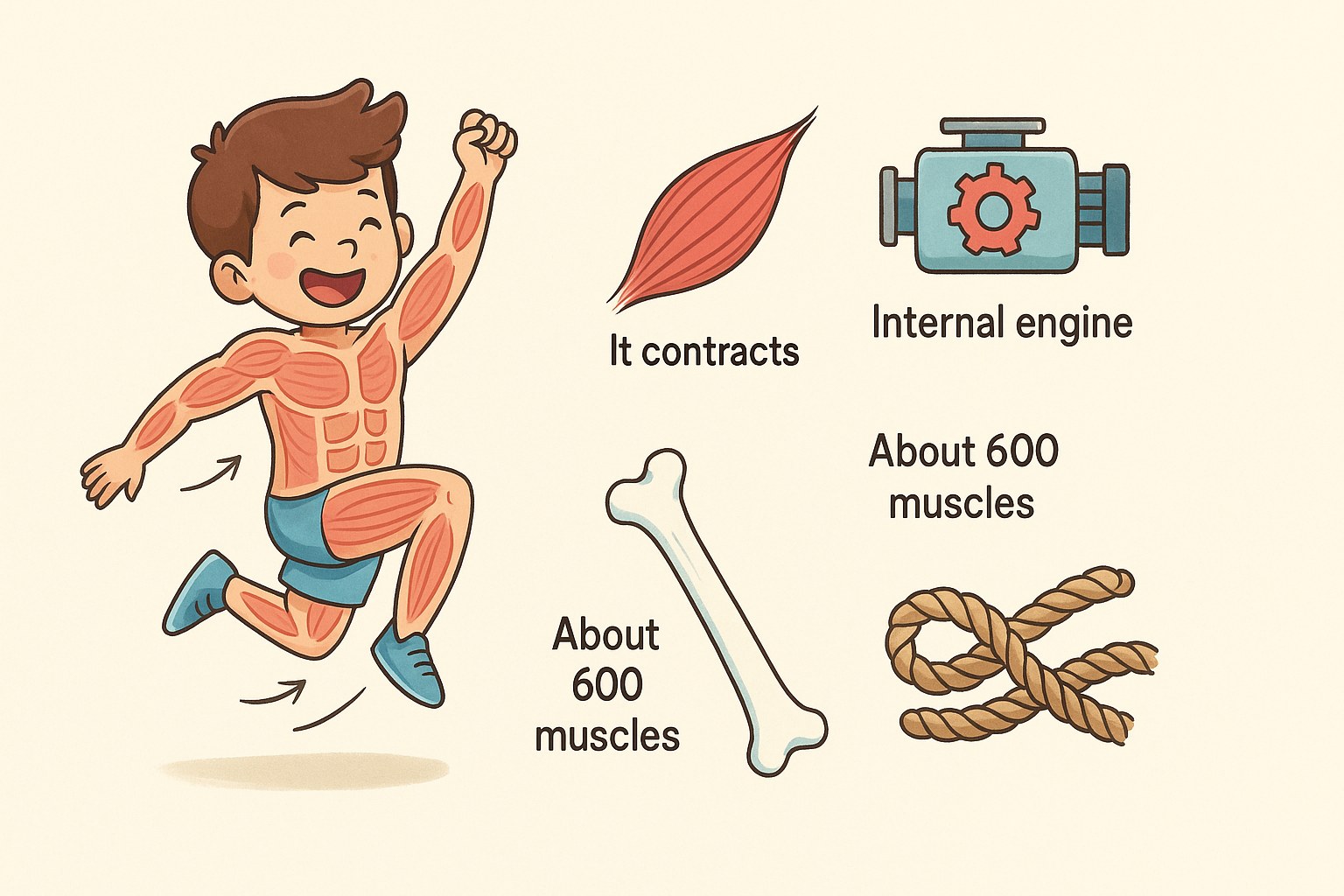
🚗 An engine hidden under the skin
A muscle is an incredible living organ that can squeeze and tighten. It’s the part that creates the force you need for every little everyday move. Without it, nothing budges.
The human body has around 600 muscles. You can compare this complex system to a car engine. It simply turns energy into movement to get us going.
Without them, we’d be stuck completely still. They’re everywhere, from head to toe.
🦴 Pulling on bones to move
When a muscle works, it gets shorter and thicker. This squeezing, which we call contraction, produces a pulling force. Movement is born from this change in shape.
Every muscle is firmly attached to the bones. As it tightens, it shifts the parts of our skeleton like levers. That’s how our limbs spring into action with real precision.
Jumping, throwing a ball or smiling all need this steady pulling action. It’s all a matter of well-oiled machinery.
🔗 Tendons make the strong link
Tendons look like tough white ropes. Unlike muscles, they aren’t stretchy. Their job is to pass on the force without ever snapping. They’re a vital link.
They join the end of the muscle to the surface of the bone. This fixing is so strong that it never gives way during an effort.
These “cables” are essential for keeping the body steady. Without them, our muscles would float about with no way to move our limbs.
⚙️ How does the muscle machine work?
Now that we know the parts of this engine, let’s see how they really fire up when we decide to wiggle a little finger.
🪨 Tightening up to go rock hard
To lift an object, a skeletal muscle tightens on purpose. You then feel a hard ball form under the skin. It’s the result of the fibres shortening straight away.
The muscle bulges because its fibres pull in close against each other. It’s the sign that it’s making a big effort to move the bone. It can only pull, never push, to create the bending movement.
Contraction is the only way for a muscle to work actively and produce force.
🧘 Relaxing to stretch out gently
For the limb to return to its place, the muscle has to stop straining. It eases off and slowly stretches out again. This is what lets the limb unfold without any resistance.
It’s a moment of calm the cells really need. The muscle goes back to its starting shape, soft and slim. It simply waits for the brain’s next order to spring back into action.
This cycle between tension and rest never stops. You can’t stay tensed forever without wearing yourself out completely.
🔍 Fibres and proteins up close
A muscle is like a big cable made of thousands of tiny stretchy threads. We call these threads muscle fibres. They’re gathered into sturdy bundles wrapped in a protective skin.
Proteins are the building blocks that repair these threads. Without them, a muscle couldn’t grow stronger. They keep the whole inner structure solid.
Myofibrils hide away inside. They’re the ones that slide over each other to create force.
🤜 The winning duo of biceps and triceps
For movement to be smooth, one muscle on its own isn’t enough. You need a well-organised team, a bit like dance partners.
👯 Working in matching pairs
The body uses opposing muscles to move. These are partners that do the exact opposite of each other. When one pulls, the other absolutely must let go for the movement to work.
A single muscle can’t push. It can only get shorter. So it needs an opposite partner to bring the bone back the other way and steady the elbow joint.
The brain commands this duo with amazing precision. It’s a real inner dance playing out at every moment. The muscles of the human body, explained for kids, then turn into a thrilling adventure.
🛌 One pulls while the other rests
Let’s look at bending the arm. The biceps tightens to bend the elbow. Meanwhile, the triceps behind it stretches right out. If it stayed hard, the arm would be stuck. Pretty clever, isn’t it?
To straighten the arm, it’s the other way round. The triceps works hard while the biceps finally takes a rest. It’s a constant seesaw game. One becomes the mover, the other the resister, depending on the direction you choose.
One muscle’s rest is exactly what lets the other do its job well.
👀 Watching your own body at work
You can try a little hands-on experiment. Place your hand on your arm and bend it hard. You’ll feel your biceps puff up like a small sports ball under your skin.
A muscle at work gets warm and firm. It’s proof that your fibres are burning energy to make that effort. The faster the fibre is fired up, the greater the force.
Look at your legs as you pedal. You’ll spot this ballet of muscles in action. It’s the best way to understand how your 640 muscles team up every single day.
🔢 3 types of muscle to do everything
The biceps may be famous, but it isn’t the only worker behind the scenes. Our body hides three very different families of muscle.
🏃 The voluntary muscles for sport
Skeletal muscles obey our orders. They’re the ones we control with our thoughts. We call them skeletal because they’re hooked onto our bones. They power all our everyday voluntary movements.
There’s no shortage of examples. The muscles in our legs help us run. The ones in our hands let us write with precision. They really do obey our every command.
Even so, these muscles tire quickly. After a long match, they need sleep to recover properly.
🤖 The automatic muscles that work on their own
Smooth muscles are more discreet. They hide inside our organs. Unlike the others, you can’t give them direct orders. They’re completely on their own.
It’s obvious with digestion. Your stomach uses these smooth muscles to grind up food without you even noticing. They move food along nice and efficiently.
In short, they keep working even while we sleep. They’re a very efficient night shift.
❤️ The heart, a truly tireless muscle
The heart muscle is one of a kind. It’s a muscle like no other. It’s automatic, yet it has incredible strength, much like our sport muscles. It’s a surprising mix.
Its mission is to act as a pump. Its job is to push blood all around the body. It beats faster when we make a big effort, to give us a hand.
Its endurance is its finest quality. It never stops, from birth right to the end of life. It’s the champion.
📈 Why do muscles get bigger?
You’ve probably noticed that some athletes have very bulky muscles. It isn’t magic, but the body adapting.
📅 Adapting to the day’s efforts
The body reacts to physical stress. Carrying heavy loads triggers small changes inside. The muscle then realises it needs to build up its strength to cope with the effort.
The muscle fibres thicken to better handle future demands. It’s a very clever survival strategy from our body. Health experts also remind us how important healthy muscle growth is, through being active.
By playing, children strengthen their tissues too. The way they build up is exactly the same.
🥩 The role of protein on your plate
Eating well is essential. To build muscle, you need solid materials. Proteins act like the bricks of a house.
They repair tired fibres after a workout. You’ll find them easily in meat, eggs or even lentils to mix things up.
A balanced diet is the key to growing. Eating only sweets won’t help muscles become strong and healthy.
😴 Why sleep matters for repair
The night is a busy time. It’s while we sleep that the body works hardest to repair tissues. Rest is a real, invisible kind of training.
Without sleep, muscles stay fragile. Aches and stiffness often mean a need for calm and water. Sleeping well stops you from staying sore.
A good balance between sport and rest is ideal. Sleep lets you bounce back full of energy for new adventures.
🧪 Experiments to understand movement at home
Nothing beats hands-on practice for really getting it. Here’s how to turn your living room into a fun little biology lab.
🎈 Build a jointed arm with balloons
To make this model, use two pieces of sturdy cardboard. Join them with a paper fastener to act as the elbow. Then fix a balloon between the two parts to stand in for the muscle.
Blow the balloon up very slightly. You’ll notice it shortens right away. This makes the cardboard bend. It’s exactly what happens when a real human arm springs to life.
It’s a visual way to understand pulling force. It’s simple and really clear.
🤸 Warming up to avoid little injuries
A cold muscle is like a hard lump of modelling clay. You need to wake it up gently. This lets the fibres become soft and stretchy before any effort.
Offer kids some fun exercises. Make big circles with your arms or bounce on the spot. These movements raise the inner temperature of the body’s machine.
Here are a few simple ideas to get the muscles of the human body, explained for kids, ready to go:
- Wrist circles
- Little kangaroo hops
- Cat stretches
- Arm swings
🏋️ Keep moving to stay in great shape
Whether it’s cycling or swimming, every movement counts. Your muscles love being used regularly. It’s the secret to staying toned and healthy.
An active body protects the heart and your mood too. You feel more nimble each day. Physical exercise even sharpens your focus at school.
Movement is a gift. Make the most of your muscles to explore the world around you.
The human body has more than 600 muscles — voluntary, smooth or cardiac — all working tirelessly to keep us moving and keep us warm. By looking after these engines with protein and sleep, we’re already getting ready for tomorrow’s big adventures. Warm up those muscle fibres well and go explore the world!
❓ FAQ
🔢 How many muscles do we have in our body?
It’s pretty impressive, but the human body has more than 640 muscles! They’re everywhere, from head to toe, and they make up a big part of our weight. Without this amazing team, we couldn’t move, or even stand up nice and straight.
💪 What exactly are kids’ muscles for?
Muscles are the body’s engines. They let us run, jump and play, but they also have other hidden jobs. They steady our joints, help us keep good posture, and even produce heat to keep us nice and warm when they work hard.
🔗 What exactly is a tendon?
Picture some very strong, slightly stretchy ropes that attach the muscle to the bone: those are the tendons. Their job is to pass the muscle’s force on to the skeleton to create movement. They’re made of collagen, which makes them tough — a bit like biological steel cables.
🏃 How do muscles make us move?
It all comes down to contraction. When a muscle gets a signal, it shortens and pulls on the bone through the tendon. Then, thanks to its stretchiness, it can return to its starting shape. It’s this “pull and release” game that lets you bend your arm or walk.
👯 Why do we say muscles work in twos?
We call them opposing muscles. Since a muscle can only pull and never push, it needs a partner to make the opposite movement. For example, the biceps tightens to bend the arm while the triceps rests. To straighten the arm, it’s the other way round: the triceps works and the biceps relaxes.
🧠 Do all our muscles obey our will?
Not all of them, and just as well! There are voluntary muscles and involuntary muscles, like the ones in the stomach or the heart. They work all on their own, day and night, without us ever having to think about it.
🏋️ How can we help muscles get stronger?
The secret lies in regular physical activity, like swimming or cycling, which builds up stamina. To grow, muscles also need “bricks”: the proteins we find in our food. And don’t forget sleep, because it’s during the night that muscle fibres repair and grow stronger.
