
Explaining the human skeleton to kids can sometimes feel as tricky as building a piece of flat-pack furniture with no instructions, especially when they ask why their body doesn’t flop like a jellyfish. This article lifts the lid on that inner framework by spelling out what bones and joints actually do, helping curious little ones get to grips with their own anatomy. You’ll find out how this amazing factory makes blood, why babies have more bones than grown-ups, and pick up a few simple tips for keeping that precious support in great shape.
- The children’s skeleton: what it’s for
- 206 bones in adults: why the number changes
- Bone anatomy: a quick tour of the body
- Axial and appendicular: the two skeleton families
- How do joints and cartilage work?
- 3 tips for keeping bones strong
🦴 The children’s skeleton: what it’s for
Hidden under our skin is an incredible structure that lets us stand up and move every single day.
🏗️ A solid support, like the frame of a house
The skeleton is a bit like the frame of a house. Without these bones, our body would simply collapse. We’d be like a jellyfish stranded on the sand.
This structure is essential for walking or running. Bones are very hard and tough. They carry our whole weight. They form a sturdy frame.
It’s the framework we couldn’t do without. Without it, no shape would be possible at all.
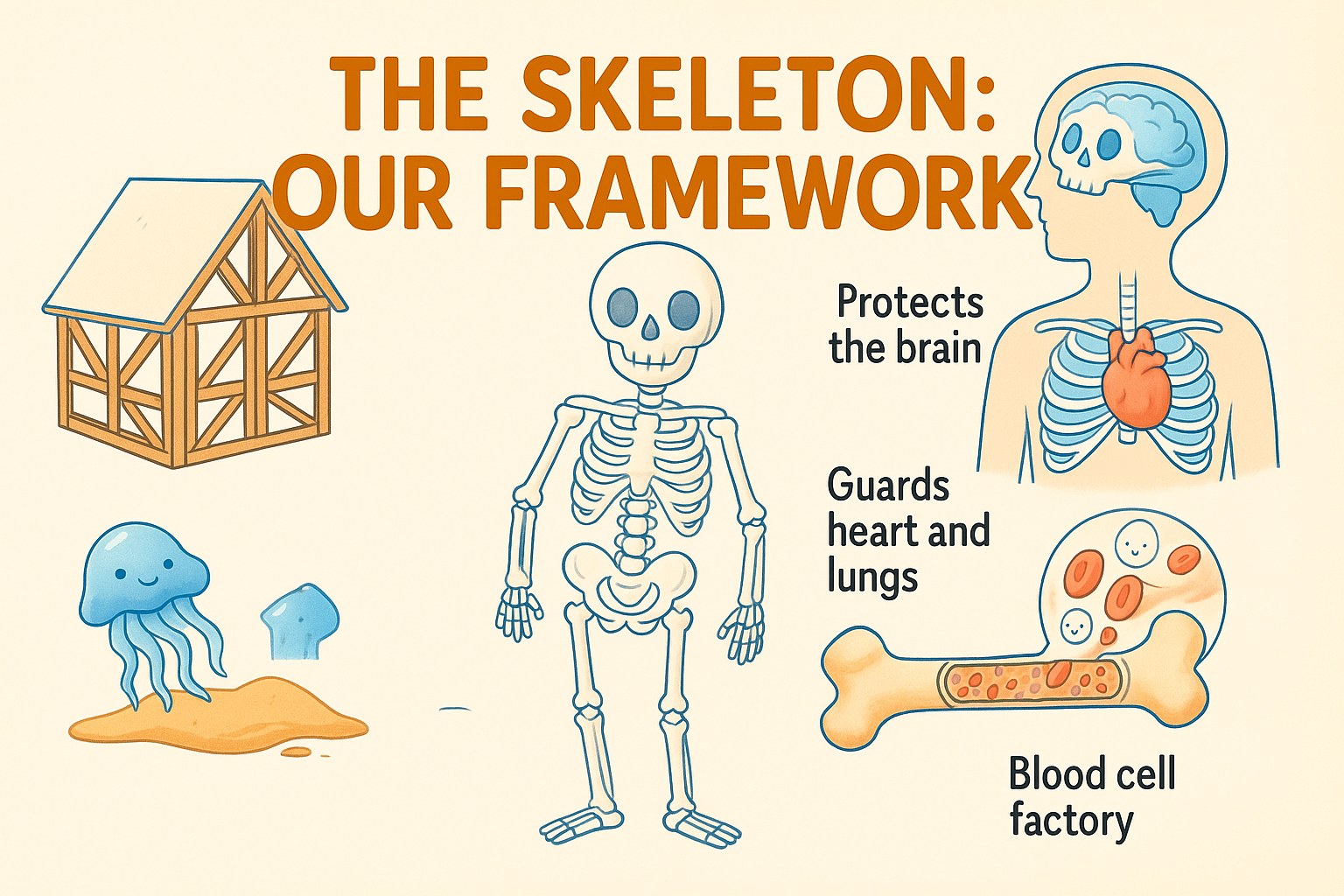
🛡️ A shield for our fragile organs
The skull protects our brain. Because the brain is soft and fragile, the bone works just like a helmet. It’s a very hard, natural shield.
The ribcage wraps around the chest. The ribs protect the heart and the lungs. They form a vital wall against knocks and bumps.
The skeleton isn’t just a support — it’s a real safe that keeps our organs out of harm’s way.
🩸 Making blood cells
Bone marrow hides away inside the bones. It’s a magical, very busy factory. It makes the essential parts of our blood.
The skeleton helps to create red and white blood cells. These cells travel around to keep us healthy. They’re renewed constantly and quickly.
So bones are truly alive. They work away in silence to protect us.
🔢 206 bones in adults: why the number changes
The job bones do is clear enough, but their number is a surprise that shifts all through our lives.
👶 Why babies have more than 300 bones
Newborns come into the world with around 300 bones. These pieces are often tiny. They stay separated by very soft cartilage.
This flexibility helps a great deal during birth. It lets the baby pass more easily through the birth canal. It’s a brilliant trick of nature.
As we grow, all those little pieces start to change. The body transforms.
🔗 How bones fuse as we grow
Several small bones join together. In the end they form a single, bigger bone. This is what we call bone fusion.
This joining-up process is gradual. It usually finishes by the age of 20 or 25. At that point, the skeleton finally becomes complete.
Growth happens at the ends of the long bones. Scientists have studied these biological mechanisms in detail.
🦴 The adult’s 206 bones and their variety
Once growth is over, the count is settled. Just 206 official bones remain. That’s the number everyone refers to.
Among them you’ll find a huge range of shapes. There are long bones, short ones, flat ones and irregular ones. Each has its own special place.
All these pieces slot together perfectly. This natural harmony is what lets us function day to day. The human skeleton explained for kids — bones and joints — then becomes child’s play.
🦴 Bone anatomy: a quick tour of the body
To understand this machine better, let’s take a closer look at how our main bones are arranged, from head to toe.
💀 The skull and the spine
The skull protects our precious brain. It isn’t a single block but a set of several bones fused together. These bony plates form a strong, secure box that guards against knocks.
The spine supports the whole upper body. It’s made of vertebrae stacked like beads. This flexible pillar lets us stand up, lean over or turn around.
It’s the central pillar of our entire body. Without it, keeping our balance would simply be impossible.
🫁 The ribcage and the pelvis
The ribs form a protective cage around the heart. They’re flexible so the lungs can fill with air. It’s thanks to this springiness that we can take deep breaths every day.
The pelvis looks like a big, sturdy bowl. It supports our internal organs and acts as an anchor for the legs. It’s a key piece for staying steady.
| Body part | Main bone | Role |
|---|---|---|
| Head | Skull | Protects the brain |
| Back | Vertebrae | Support and movement |
| Chest | Ribs | Protects the heart and lungs |
| Hip | Pelvis | Supports the organs |
🦻 The limbs and the smallest bone
Our limbs let us explore the world. The femur, in the thigh, is the longest and strongest bone. It carries our weight with every stride.
The smallest bone is tucked away safely. The stirrup bone, deep inside the ear, is tiny and light. It’s no bigger than a grain of rice, yet it helps us hear.
The human skeleton explained for kids — bones and joints — shows some fascinating differences in size. Everything fits together perfectly.
👥 Axial and appendicular: the two skeleton families
Scientists split our skeleton into two big families to find their way more easily through this forest of bones.
⚖️ The central axis that keeps the body balanced
The axial skeleton forms the solid base of our anatomy. It brings together the head, the spine and the ribcage. It’s the true centre of our body.
This axis provides vital protection for our organs. It shelters the nervous system, the heart and the lungs. It’s clearly the top-priority area to keep safe and healthy.
Without this pillar, we’d have no balance at all. It holds us nice and upright.
🚶 The limbs for exploring the world
The appendicular skeleton covers everything that moves. It includes the arms, the legs and the bones that link them to the trunk. It’s the engine of everyday movement.
These limbs attach to the central axis at the shoulders and the hips. This structure lets us act on the world around us. We can grab things or get around.
Here’s what they do:
- Arms for grabbing.
- Legs for walking.
- Hands for making things.
🔄 The difference between paired and unpaired bones
Many bones come in pairs in our body. That’s the case for the hands and feet. We have exactly one on each side to stay nicely symmetrical.
Other bones are unique and sit in the middle of the body. The breastbone and certain vertebrae exist as a single copy only. They stay alone on their central line.
This careful arrangement creates perfect harmony. The human skeleton explained for kids — bones and joints — then becomes a thrilling construction game.
🦵 How do joints and cartilage work?
Having strong bones is one thing, but being able to move them against each other is even better.
🚪 The hinges that let us move
Joints are like the hinges of a door. They link two bones together. This lets the body move with ease.
Some swivel, like the neck. Others bend, like the elbow or the knee. Each joint has its own mechanical speciality.
Thanks to them, our body is agile. We’re incredibly supple.
🛡️ The protective role of cartilage
Cartilage covers the ends of the bones. It’s a very smooth material. It stops the bones from wearing out too soon.
It works like a little cushion. It absorbs the shocks when we jump. It’s a very clever system.
“Without cartilage to protect our joints, every movement would quickly become painful as the bones rubbed together.”
💪 Bones and muscles working together
Bones don’t move on their own. It’s the muscles that pull on them. They’re attached to the bones to make things happen.
It’s a perfect partnership. The skeleton provides the rigid structure. The muscles supply the strength.
This duo is fantastic. It lets us swim or pedal. The human skeleton explained for kids — bones and joints — then becomes child’s play.
💪 3 tips for keeping bones strong
Now that you know your bones inside out, here’s how to look after them so they stay strong your whole life.
🥛 A diet rich in calcium and vitamin D
Calcium keeps the framework solid. Dairy products, broccoli and mineral waters all give you plenty. These foods help build really tough bones.
Vitamin D plays a major role too. Bones hold 99% of the body’s calcium. Without this vitamin, the skeleton can’t mineralise properly.
Sunshine helps the skin make this vitamin. It then lets the body lock in calcium. That’s the secret to having bones as hard as stone.
🏃 Exercise to strengthen the structure
Moving about naturally strengthens your skeleton. The more sport you do, the denser your bones get. It’s a real workout for staying strong and fit.
Walking or skipping are perfect. These little impacts spark the making of new bone. Basketball and football are great multi-directional choices too.
Sport is a precious ally. It guarantees healthy growth.
⛑️ Preventing fractures and staying safe
A fracture often happens after a hard knock. The bone breaks and needs time to mend. Healing then takes a lot of patience.
Wearing a helmet on your bike is an absolute must. It protects your skull and your brain. It’s the basic rule for every sporty outing.
Be careful with your stunts. Keep your skeleton in one piece so you stay in great shape for years.
Looking after this inner skeleton — a true protective framework and blood factory — is essential for growing up well. By betting on calcium and sport right now, we give our children lasting mobility. A strong body today means endless freedom of movement tomorrow!
❓ FAQ
🍼 Why do babies have more bones than adults?
It’s a surprising question, isn’t it? At birth, babies have around 300 bones. Many of them are still small and separated by very soft cartilage, which is a brilliant trick of nature to make birth easier.
As they grow, these little puzzle pieces simply fuse together. They join to one another to form bigger, stronger bones. That’s why, once we’re grown up, there are only 206 in total.
🦴 What exactly is our skeleton for?
The skeleton is far more than a Halloween decoration! It first acts as a framework: without it, our body would collapse like a jellyfish on the sand. It lets us stand up, walk and keep a clear shape.
It also plays the role of a bodyguard. The skull protects our fragile brain like a natural helmet, while the ribcage forms a safe around the heart and lungs. And it houses a magical factory, the bone marrow, which makes our blood cells.
🤸 How do bones and joints let us move?
To move, our bones need partners: the joints and the muscles. Joints work like the hinges of a door. They link two bones together and allow rotation or bending, as with the elbow or the knee.
But bones don’t move by themselves! It’s the muscles, firmly attached to the bony structure, that pull on the bones to create movement. This perfect teamwork is what lets us run, dance or pedal.
📏 What are the longest and smallest bones in the human body?
The champion for length is the femur, in the thigh. It’s the longest bone but also the toughest in our whole body. It carries a large part of our weight when we stand.
At the other extreme, the smallest hides snugly inside our ear: it’s called the stirrup bone. It’s tiny and no bigger than a grain of rice! It’s fascinating to see that our body uses pieces of every size to work.
💪 How can you take care of your bones to keep them strong?
To keep a healthy skeleton, diet is the key. Calcium, found in dairy products or broccoli, is essential because bones are 99% made of it. A little sunshine also helps make vitamin D, which is needed to lock in that calcium.
Sport is a great ally too. Running or skipping spark the making of new bone. And don’t forget your bike helmet: protecting your skull means protecting your brain, the most precious organ that our bones keep safe.
