
Magic colouring by numbers is the little trick that turns a maths session into pure fun. 🎨 A sum hides inside every space: your child works it out, finds the answer in the colour key, colours it in… and an adorable animal slowly appears before their eyes. The magic happens with every space they get right!
Here are 4 free printable magic colouring sheets for ages 6-7, sorted from easiest to most challenging. Each sheet focuses mainly on addition, with a few small subtractions to revise both operations. ✏️ Four sweet little characters — a rabbit, a penguin, a chick and a narwhal — are waiting for your child’s pencils. Just print and go!
🎨 Magic colouring: maths that turns into a game
✨ Motivation through a visual reward
Magic colouring rests on a simple, brilliantly effective idea: your child isn’t colouring just to colour, they’re solving sums to reveal a picture. Every space coloured correctly is an instant reward. This game-like mechanic keeps children focused far longer than a maths worksheet on a blank page ever could.
For a 6-year-old just discovering addition, who can quickly grow tired of repetition, it’s a precious tool. The wish to see the final character take shape becomes real motivation to reach that very last sum.
🔄 A do-it-yourself activity that fits in anywhere
These sheets slot into all sorts of moments: evening revision, a quiet activity after school, a rainy weekend or the holidays. Their self-contained format lets your child work on their own, which builds independence while reinforcing what they’ve learnt in maths.
🎒 Designed for the early-school maths curriculum
At ages 6-7, your child learns to work out additions and subtractions, first up to 10, then up to 20 as the year goes on. Our sheets follow that progression: we start with very small answers, then build up steadily to sums close to 20. 🧮 Each sheet targets a precise level of difficulty, to support your child at their own pace.
📋 Our 4 magic colouring sheets for ages 6-7
🖍️ Each sheet shows its own key: one answer equals one colour. Your child works out the sum written in the space, finds the right colour in the key, and colours it in. The sheets run from easiest to hardest, so you can pick the one that matches the moment.
🐰 The gentle rabbit: answers from 3 to 6
The perfect sheet to start with! The sums are tiny — additions like 2+3 or 4+1, and a few easy subtractions like 7-2 or 8-5 — and every answer falls between 3 and 6. The key uses only four colours (white, grey, pink and black), which keeps the answer-to-colour matching simple. Ideal for early learners or as revision, it reveals an adorable little rabbit.

🐧 The penguin on the ice: answers from 9 to 12
Now we move to sums around the number ten: additions like 5+5, 4+6 or 9+1, and subtractions such as 15-6 or 12-3. Every answer runs from 9 to 12, coloured in with four colours (grey, black, yellow and white). A great sheet for working on crossing ten, that key milestone in early maths. The reward at the end: a friendly, round little penguin.

🐤 The funny chick: answers from 10 to 14
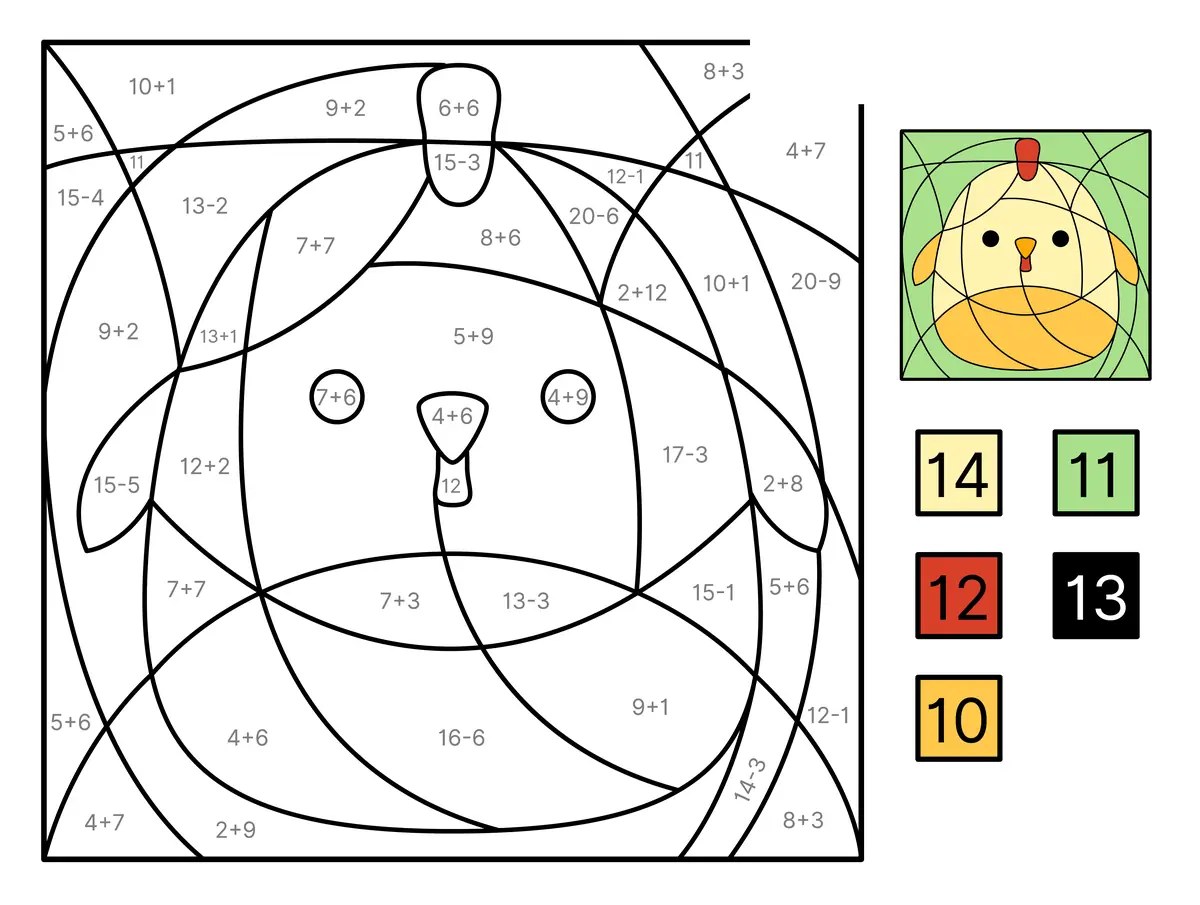
This sheet takes children past ten. The additions get a little bigger (6+6, 8+6, 7+7) and the subtractions more varied (15-3, 17-3, 20-6), with answers between 10 and 14. There are five colours to spot in the key (cream, green, red, black and orange). It’s a lovely mid-year challenge, rewarded with a wonderfully cute yellow chick.
🦄 The magic narwhal: sums up to 20
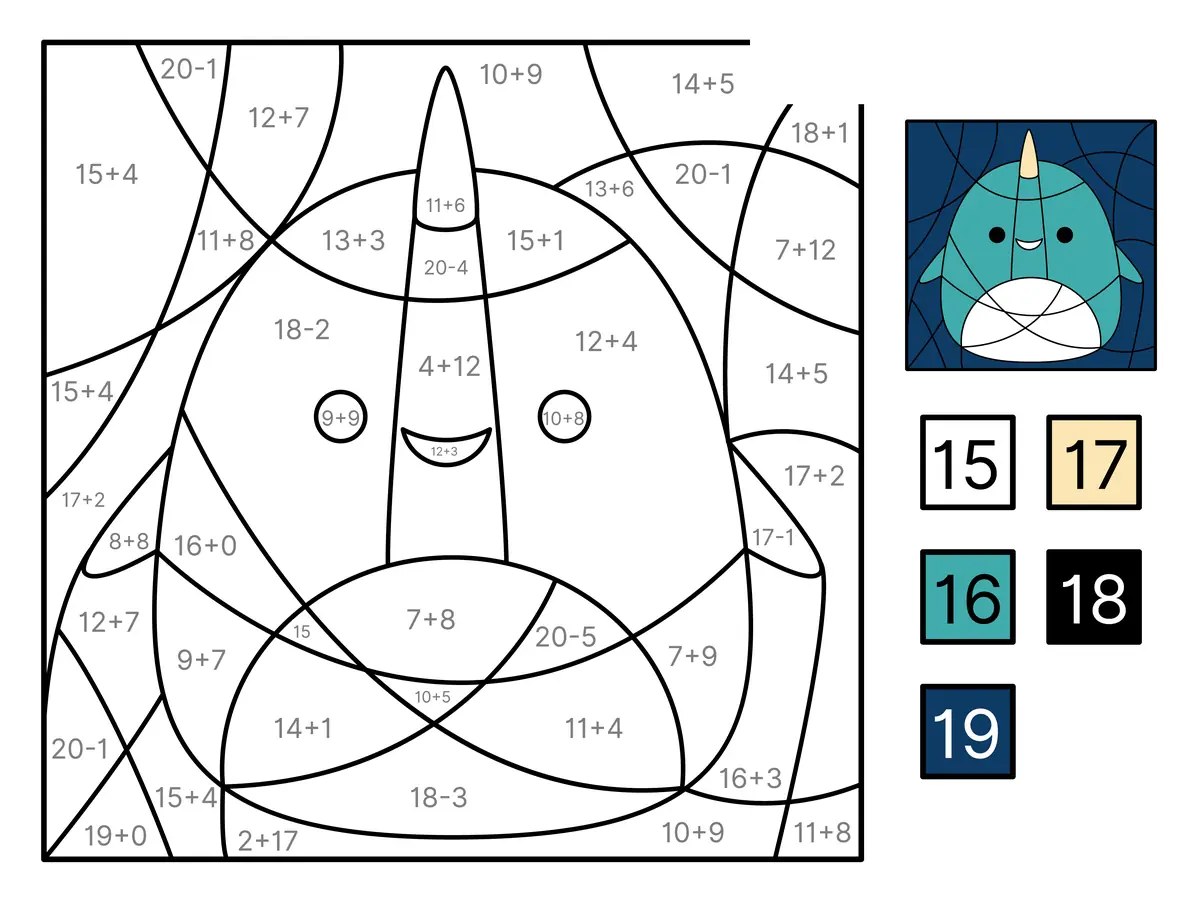
The most demanding sheet, for the end of the year. The sums climb to 20: bigger additions like 12+7, 10+9 or 14+5, and subtractions such as 20-1 or 18-2, with answers from 15 to 19. Five colours (white, cream, turquoise, black and blue) bring a magic narwhal to life — that sea unicorn children adore. Ideal for checking your child has truly mastered sums up to 20.
🧮 The benefits for learning maths
⚡ Making sums automatic
By redoing the same sums in a motivating setting, your child eventually memorises the answers. This automatic recall is essential: when they no longer need to count on their fingers to know that 4+3 makes 7, they free up mental energy for harder problems. Magic colouring, through playful repetition, speeds this up without your child feeling like they’re “revising”.
🔢 Building a sense of number
By mixing addition and subtraction on the same sheet, your child gradually understands that these operations are linked: if 4+5 makes 9, then 9-5 makes 4. This grasp of how numbers relate is far more valuable than simple recitation: it’s the foundation of a solid, lasting relationship with maths.
💪 Regaining confidence in maths
For some children, maths brings on stress from a very young age. Magic colouring creates a positive link between sums and pleasure. A child who finishes their sheet feels real pride: they’ve solved sums and created a lovely picture. This double success boosts self-confidence enormously, especially in children who give up easily.
💡 How to use these sheets with your child
📝 The three-step method: work it out, find it, colour it
Magic colouring always happens in three stages. One: work out the sum in the space (your child can use their fingers or a number line early on). Two: find that answer in the colour key. Three: colour the space with the right colour. Encourage your child to always follow this order, so they don’t muddle the working-out step with the colouring step.
🤝 Helping without giving the answer
If your child gets stuck on a sum, try not to whisper the answer. Instead, suggest handling objects (cubes, beans, fingers), counting on a number line, or breaking the sum apart (“for 6+4, you know that makes 10 — it’s a number bond to 10!”). These unblocking strategies build lasting maths tools, far more useful than a handed-over answer.
📅 Choosing the right sheet for the time of year
Early on, start with the rabbit (answers from 3 to 6). As the terms go by, move on to the penguin and then the chick, which work on crossing ten. Save the narwhal (sums up to 20) for the end of the year or for a child who’s already comfortable. Matching the difficulty to your child’s real level is the key to keeping them motivated without discouraging them.
📈 The progression: from first to second year
🧒 Where your child is coming from: magic colouring in nursery
Your child probably already knows the idea from nursery. There, magic colouring links a colour to a simple number or shape, with no sum involved. In the early-school years, we simply add the working-out step to find the right colour number. The continuity is natural and reassuring.
➕ Towards the second year: carrying and bigger numbers
These sheets prepare your child for what comes next, where additions go beyond 20 and introduce carrying, with two-digit numbers (tens and units). Once sums up to 20 are well mastered — exactly what the narwhal sheet is about — your child moves on with solid foundations and no jarring jump.
🎲 Going further with other maths activities
🃏 The addition memory game
To anchor the same sums another way, make a little memory game: the sum on one card (3+4), the answer on another (7). Your child turns the cards face down and looks for the pairs that go together. This game reinforces recall of the answers in a cheerful, challenge-like mood, as a family or solo.
🎵 Rhymes to help memory
Maths rhymes are wonderful allies for the memory. “1 and 1 make 2, 2 and 2 make 4, 3 and 3 make 6…”: these little songs anchor the doubles for a long time. 🎶 Paired with magic colouring, they create multi-sensory memorising (you hear, you sing, you work it out, you colour) that works especially well for young children.
❓ FAQ
👶 What age are these magic colouring sheets for?
They’re designed for children aged 6-7. The rabbit sheet (answers from 3 to 6) suits the very start of school, or even nursery for an advanced child. The penguin, chick and narwhal sheets follow the year’s progression. A second-year child who is struggling can also come back to them to firm up the basics.
📋 What sums are on the curriculum at this age?
At ages 6-7, your child learns to work out additions and subtractions with answers up to 10 early in the year, then up to 20 afterwards. They also memorise doubles, number bonds to 10 and small subtractions. Our four sheets cover this whole progression, from tiny sums right up to operations close to 20.
➖ Why are there subtractions on addition sheets?
Because at this age, addition and subtraction are learnt together and reinforce each other! Each sheet stays addition-led, but slips in a few simple subtractions (like 7-2 or 15-3) to revise both operations at once. It’s a real bonus: your child understands they’re two sides of the same coin.
🖨️ How do I print the sheets?
Nothing could be simpler: print the image you want and it goes straight to your printer, without the rest of the page. A black-and-white print on ordinary paper is plenty. You can also print several sheets at once to make a little home-made maths book.
✅ How do I check a magic colouring sheet?
Checking is visual and immediate: if the final animal looks right and is easy to recognise, the sums are correct. If a zone stands out or the picture looks messy, a calculation error is hiding there. You can then spot the odd spaces together and redo just those sums, without having to check every single space.
🏫 Can these sheets be used in the classroom?
Absolutely, and they’re perfect for differentiation: while one pupil works on the rabbit, another tackles the narwhal, yet the whole class is doing the same activity. Magic colouring is also a hit in support groups, because it works on sums in a motivating setting with no sense of failure — something struggling children often accept far more readily than a standard worksheet.
