
Explaining a solar eclipse to your children can feel like a real challenge when they’re bursting with curious questions. ☀️ This article breaks down this meeting between the Earth, the Moon and the Sun to help you share the moment stress-free. You’ll discover how to watch the ring of fire safely, plus fun activities to turn your garden into a real space observatory.
- Understanding a solar eclipse in simple words
- 3 types of eclipses to have fun spotting
- Why do you need to protect children’s eyes?
- Fun activities to watch safely
- Ancient legends and future dates to remember
- Differences between solar and lunar eclipses
🌑 Understanding a solar eclipse in simple words
Once you’ve looked up at the sky, you often wonder how such a show is even possible, so let’s break down this fascinating mechanism.
📐 A precise line-up between three neighbours
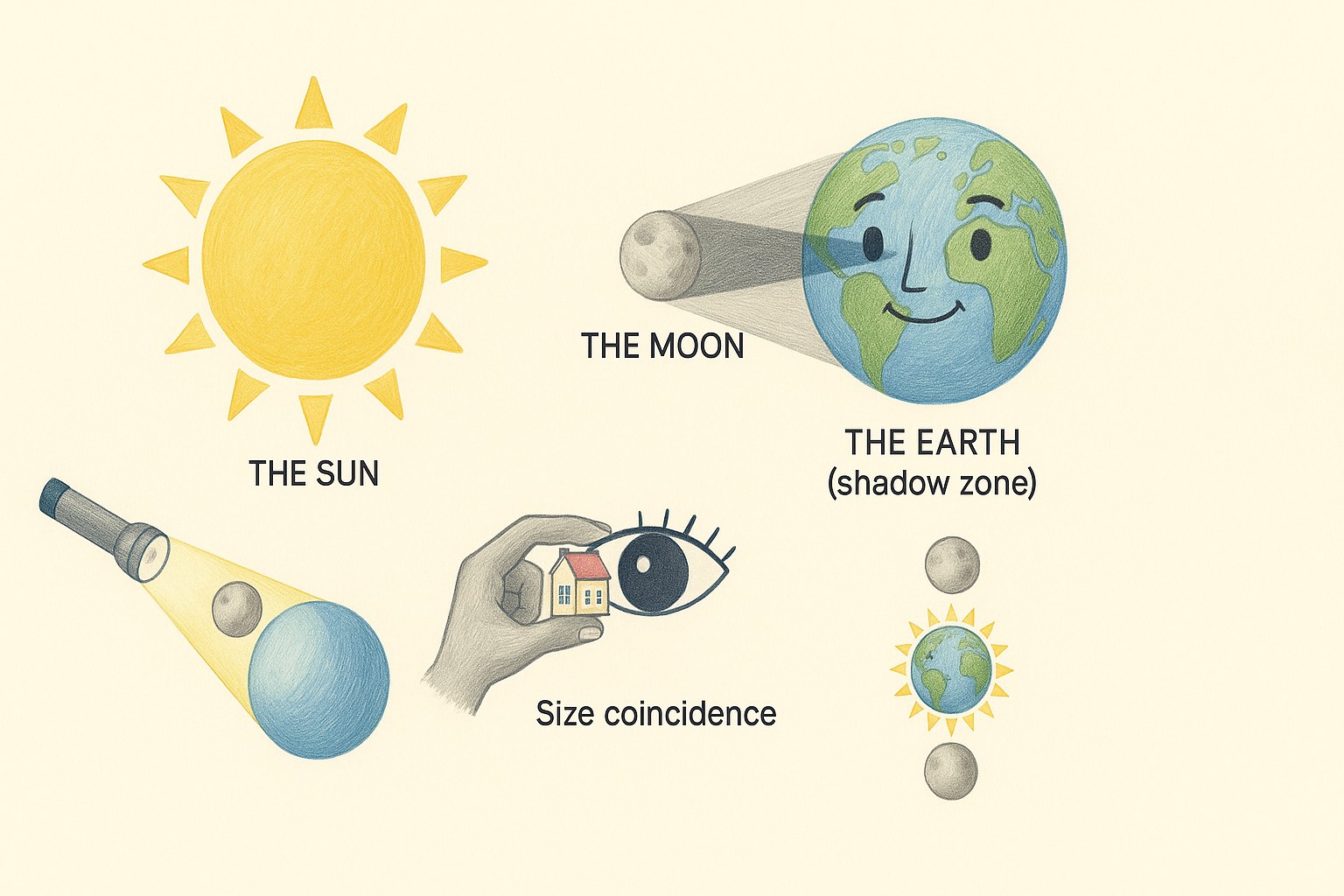
An eclipse is a natural astronomical event. The Moon slips exactly between the Earth and the Sun. This line-up then blocks the Sun’s light.
Picture a big torch for the Sun. A ball stands in for the Moon. It casts a round shadow on your face, which here is our Earth.
This patch of darkness is quite precise. The shadow only touches a tiny part of our blue planet each time.
📏 The coincidence of size in the sky
The Sun is huge but stays very far from us. The Moon, on the other hand, is small but really close. This view creates an incredible illusion that they’re the same size.
It’s like your thumb. It can hide a whole house if you hold it right in front of your eye. It’s magical and yet very mathematical.
This unique coincidence lets the Moon cover the Sun’s disc perfectly. The result is spectacular.
✨ How rare this space rendezvous is
The Moon’s orbit is tilted a little, by about 5.1 degrees. So it often passes above or below the Sun without ever touching it.
For an eclipse to happen, the line-up has to be absolutely perfect. That’s why it doesn’t happen at every new moon. It’s a rather rare event.
The zone of total shadow stays very narrow on the ground. You really have to be in the right place at the right time to see it.
🌒 3 types of eclipses to have fun spotting
Since nature loves to mix things up, you should know there’s more than one way for the Moon to cast its shadow on us.

🌑 The deep dark of the total eclipse
Darkness falls suddenly in broad daylight. The stars become visible in the sky. The birds stop singing all at once, thinking night has already returned. It’s truly amazing.
You can then see the solar corona. It’s a beautiful halo of silvery light. It gently surrounds the black disc of the Moon hiding the Sun. The sight is simply one of a kind.
The temperature drops fast too. You suddenly feel a little shiver of cool air. It’s the sign that the shadow has wrapped right around us.
🌒 The nibbling of the partial eclipse
Here, the Sun looks like a crescent with a bite taken out of it. It really seems like a giant has greedily munched into it. It’s a fun image for explaining solar eclipses to children.
The Moon hides only a piece of the Sun. The light dims slightly, but the sky stays blue. This is the type of eclipse you’re most likely to see often.
Without protection, you’d notice nothing. Be very careful.
💍 The golden ring of the annular eclipse
The Moon is too far from us to block the whole Sun. A bright circle then stays visible. The line-up is there, but the distance changes everything.
Picture a small coin placed on a bigger one. The edge of the big one peeks out all around. That’s exactly what happens during this particular astronomical event.
This “ring of fire” is gorgeous. Yet it stays very dangerous for our fragile eyes. So caution is a must.
👁️ Why do you need to protect children’s eyes?
However grand the show, it must never make us forget that our eyes are fragile tools we need to look after.
⚠️ The invisible dangers of the Sun’s rays
The retina has no pain receptors at all. You can suffer a serious burn without feeling a thing at the time. The body’s alarm signal is completely missing here.
A child’s eye works like a real magnifying glass, focusing the rays. This can cause permanent damage. The risk is highest before puberty.
Looking directly at a solar eclipse without proper protection can cause serious and permanent damage to the eyes of the very youngest.
The risk of permanent loss of sight is a medical reality. Safety is not optional for our little ones. Better to be safe than to regret it for a lifetime.
🕶️ Why ordinary sunglasses don’t work
Ordinary sunglasses don’t filter out infrared rays. They are useless for staring at the Sun. Your everyday lenses are not enough of a shield.
Forget the old tricks like X-ray film. Glass smoked over a candle is a false friend too. These homemade methods are extremely risky for your sight.
Even under a hazy sky, the rays pass straight through the clouds. Never let your guard down on a grey day. Caution still applies throughout the whole eclipse.
✅ Find and check the ISO 12312-2 standard
Only glasses carrying the ISO 12312-2 standard are valid. Buy them from qualified opticians. Specialist shops also guarantee they filter out 99.999% of the light.
Check that the filter isn’t scratched before you use it. A tiny hole lets an invisible danger through. So a careful inspection of the surface is essential.
For the youngest ones, use an elastic strap to hold them on. They mustn’t be able to take them off by themselves. Supervision must be constant and strict during the viewing.
- Check the CE marking
- Make sure there are no scratches
- Make sure the glasses fully cover the whole field of vision
🔭 Fun activities to watch safely
For anyone without glasses, or who prefers a bit of crafting, there are brilliant and completely safe solutions.
📦 Build a projector from a cardboard box
Take a shoebox and make a hole in it. Stick a piece of foil over it and make a tiny pinhole.
Turn your back to the Sun. The image of the eclipse will be projected onto a sheet of white paper at the back of the box.
It’s a perfect method of indirect projection. You look at the image, not at the Sun directly.
🥖 Use a colander to see little crescents
Take your kitchen colander out into the garden. The little holes will project dozens of tiny Suns on the ground.
During the eclipse, those dots of light will take the shape of crescents. It’s a really funny sight to photograph on the pavement or a wall.
The leaves on the trees do the same thing. Look at the shadows.
🤗 Reassure the little ones about the darkness
Explain to your children that it’s a giant game of hide-and-seek. The Sun always comes back very quickly after a few minutes.
Get them ready for the silence of the birds. It’s normal: they simply think it’s time for a little sleep.
Turn the moment into a science party. Plan a special little snack to celebrate the event together.
📅 Ancient legends and future dates to remember
Before they understood the science, people made up incredible stories to explain why the day went dark.
🐉 Monsters and dragons of ancient myths
In ancient China, people believed a sky dragon was devouring the Sun. It was a truly terrifying moment for everyone. The sudden darkness seemed like the end of the known world.
People banged on pots and pans to make noise. They wanted to scare the monster so it would spit the Sun back out. All that commotion always brought back the light they were waiting for.
Today, we know the truth. But these legends remain lovely stories to tell at bedtime. They’re a fascinating poetic legacy.
🗓️ Calendar of upcoming eclipses
Total eclipses are rare in many countries. The next one won’t arrive for several decades in some regions. You may have to wait until 2081 to enjoy this great show in certain places.
Luckily, partial eclipses happen more often. Note the dates in your calendar so you don’t miss the next one. These meetings with the stars are special moments to share as a family.
Some areas see the event better. Check whether your town is well placed.
| Date | Type of eclipse | Visibility |
|---|---|---|
| 12 August 2026 | Partial | High (depending on the area) |
| 2 August 2027 | Partial | Moderate |
| 26 January 2028 | Annular | Remarkable |
| 20 March 2034 | Partial | Low |
📱 Tools to check local visibility
Use mobile apps like Stellarium. They let you simulate the eclipse from your own garden with precision. Other tools such as Eclipse Calculator 2 also offer very detailed local calculations.
Look at the predicted percentage of cover. The higher it is, the darker and more impressive the show will be. The whole idea of a solar eclipse then becomes much more real and visual for children.
Don’t forget to check the weather. A big cloud can sadly spoil everything at the last second. So keep an eye on the sky.
🌙 Differences between solar and lunar eclipses
To finish, let’s not muddle things up: there’s another kind of eclipse that happens while we sleep.
🌗 Telling solar and lunar shadows apart
A lunar eclipse happens at night. This time it’s the Earth that hides the Sun from our little natural satellite. It’s a perfect line-up.
Unlike with the Sun, you can look at the Moon without any glasses at all. It’s completely safe for your eyes.
The Moon then turns a deep red. It’s a very poetic moment for watching the phases of the Moon.
🦉 How animals react during the event
Animals are often thrown off by this sudden night. Dogs may bark and cows sometimes head back to the barn. They lose their bearings.
Crickets start chirping as if evening were falling. It’s an impromptu concert that surprises everyone.
Everything goes back to normal as soon as the light returns. Nature picks up its usual rhythm.
🌕 Why the Moon matters for our planet
The Moon isn’t only there for eclipses. It steadies the Earth and drives the movement of the tides with its pull.
It drifts a few centimetres further away from us every year. One day, it will be too far for these celestial games of hide-and-seek.
So let’s enjoy these shows while they last. It’s an incredible chance to experience this as a family.
This celestial dance between the Sun and the Moon stays a magical memory, as long as you protect your eyes with ISO 12312-2 glasses. Get your filters ready quickly for 2026, because this rare show won’t wait for latecomers. Give your children this real-life astronomy lesson in complete safety.
❓ FAQ
🌑 What exactly is a solar eclipse?
To put it simply for children, it’s a huge game of hide-and-seek in space. It happens when the Moon passes exactly between the Earth and the Sun. Even though it’s much smaller than our star, it’s far closer to us, which lets it block the view and cast its shadow over a small part of our planet.
🕶️ Can you watch the eclipse with ordinary sunglasses?
Absolutely not! This is a very important safety question. Ordinary sunglasses, even very good ones, don’t filter out the rays that are dangerous for the retina. To watch this show safely, you must use special glasses with the ISO 12312-2 standard. Without them, you risk serious and permanent damage to your eyes, because you don’t feel the burn at the time.
🦉 Why do animals behave strangely during an eclipse?
It’s quite fascinating to watch! Animals rely on the light to know what to do. When darkness falls suddenly, birds stop singing and cows may decide to head back to the barn, thinking night is coming. It’s simply their body clock reacting to the drop in light. Everything goes back to normal as soon as the Sun pops out again.
📅 When will we see the next eclipse?
Get your diaries out so you don’t miss the next dates! A very impressive partial eclipse will take place on 12 August 2026, right as the Sun is setting. Another will follow on 2 August 2027. Even if they aren’t total everywhere, the show will be beautiful, as long as you have a clear horizon and your protective glasses on.
🌒 What’s the difference between a total and a partial eclipse?
During a total eclipse, the Moon covers the whole solar disc: it goes pitch dark in broad daylight for a few minutes and you can see the Sun’s silvery corona. In a partial eclipse, the Moon only “nibbles” a piece of the Sun. It then looks as if a giant has bitten into a glowing biscuit, leaving a thicker or thinner crescent in the sky.
