
Do you often wonder how astronauts manage not to fall, when Earth’s gravity still pulls on them at 90%? 🚀 This article explains why astronauts float in space thanks to the phenomenon of permanent free fall and their crazy speed of 28,000 km/h. You’ll discover how this orbital motion creates an illusion of weightlessness without ever cancelling out the pull of our planet.
- The force of gravity 400 km above the ground
- The phenomenon of endless free fall
- How to stay up with speed
- 3 differences between mass and felt weight
- How floating affects astronauts’ health
- Simulations and experiments in weightlessness
🌍 The force of gravity 400 km above the ground
We often picture space as a magical place where Earth’s pull stops dead. Yet the real physics of low orbit is very different. The Earth doesn’t let go of the objects around it so easily.
🌍 Earth’s pull stays strong in orbit
At 400 km up, gravity keeps about 90% of its usual strength. The Earth still has a massive pull on everything in its immediate neighbourhood. It’s this steady gravity that sets the rules of the game in orbit.
Forget the idea of an instant ‘zero’ zone. Without this invisible force, the space station would simply escape into the deep void. It would no longer be able to orbit.
Physics doesn’t stop at the edge of the atmosphere. The pull is right there, everywhere.
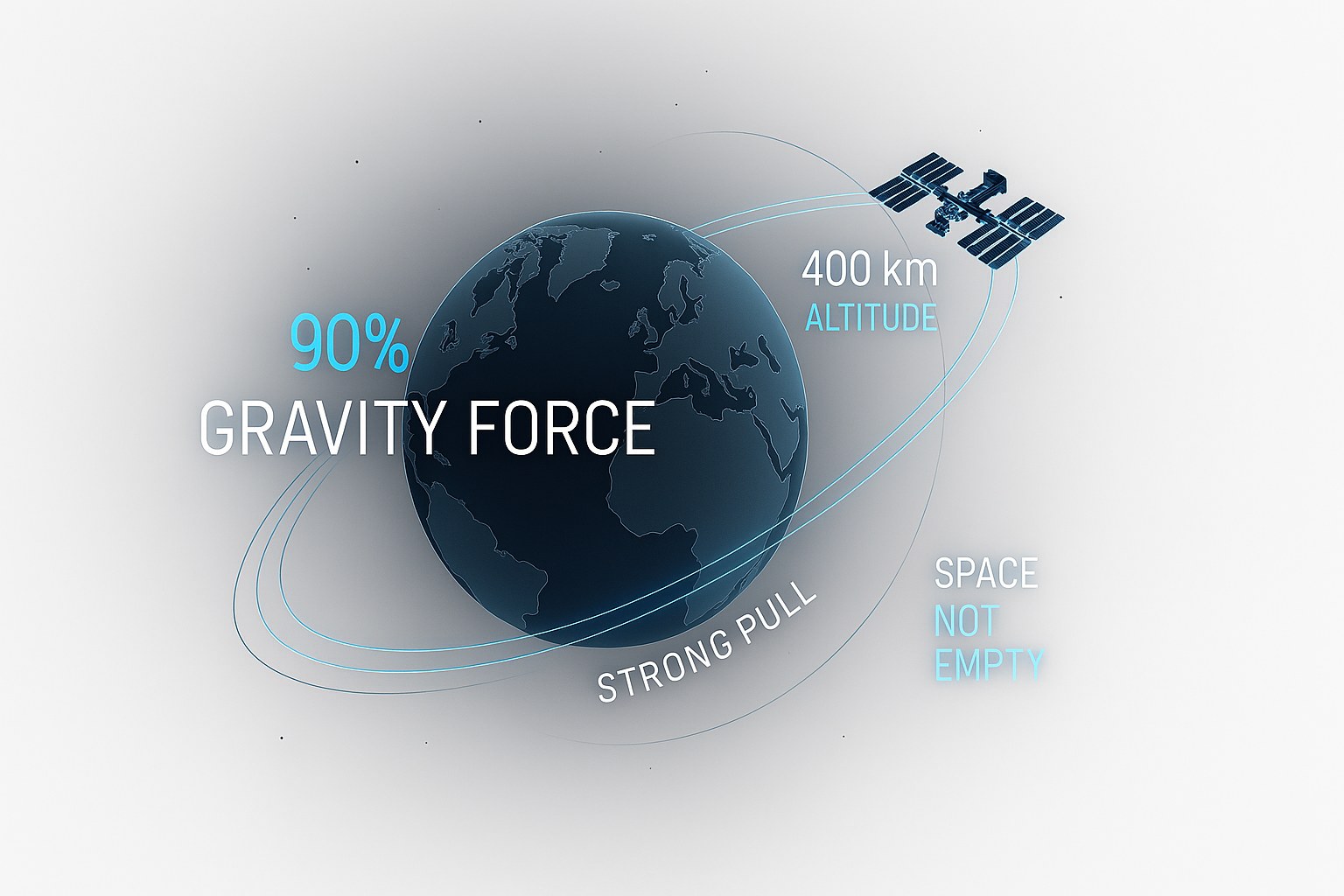
🌌 The myth of empty space with no force at all
The pull you feel at sea level is very close to the one the ISS feels. The difference is tiny in purely gravitational terms. This is a key point to understand.
The Earth pulls on objects across huge distances, far beyond the Moon. Space isn’t a magic shield against gravity. Nothing blocks this natural force.
It’s worth remembering this:
Gravity never disappears completely, even far from Earth, and weightlessness doesn’t mean empty space.
🛰️ The real numbers at the ISS’s altitude
400 km is barely the distance between two big cities. On a planetary scale, it’s tiny. The station almost skims Earth’s surface, despite our impression of endless height.
Distance alone isn’t enough to remove an object’s weight. If the station stopped dead, it would drop like a stone to the ground. Weight still physically exists up there.
So why do astronauts float in space? It’s not because there’s no pull. The reason lies elsewhere.
🪂 The phenomenon of endless free fall
Since gravity is clearly there, we need to understand why we no longer feel it, which brings us to the idea of free fall.
🛗 The lift-with-a-snapped-cable analogy
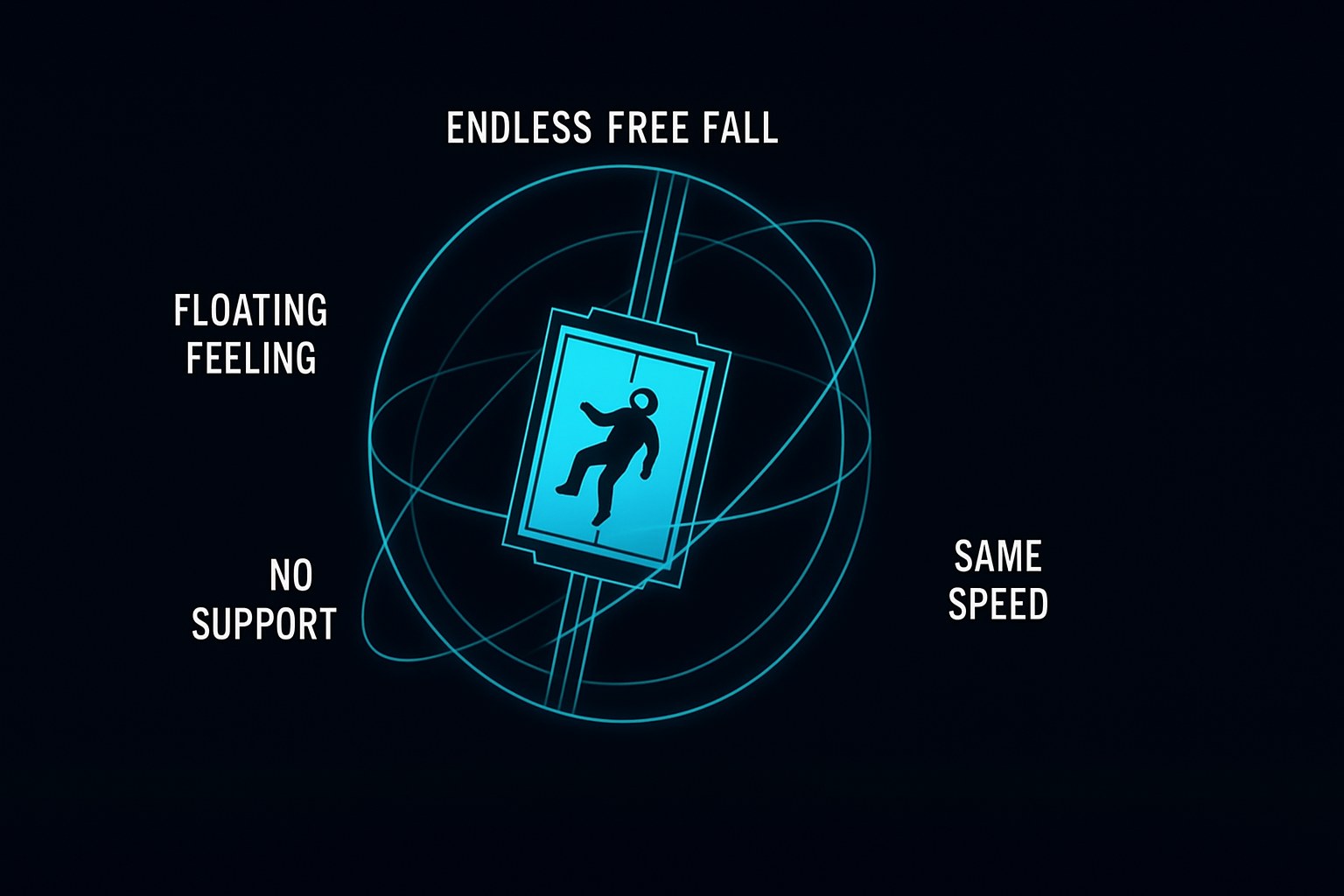
Imagine a lift suddenly falling down a shaft. If you fall at the same speed as the lift, you simply float inside it. It’s a famous thought experiment used to explain the physics.
During this sudden drop, a feeling of inner floating sets in. The floor no longer pushes you up. Your apparent weight seems to have vanished.
You fall together. That’s the secret of orbital flight.
🪶 Why falling lets you float
It all comes down to having no support under your feet. Normally, the ground holds us firmly in place. In orbit, the station’s ‘floor’ is falling towards Earth too.
The station’s acceleration is exactly the same as the passengers’. Everyone falls at the very same rate. It’s this perfect synchronisation that creates the illusion of floating.
So why do astronauts float in space? They are actually in a state of permanent free fall. It’s a fascinating balance between speed and pull.
🪂 The likeness to an endless parachute jump
You can compare the orbital state to a fall that never stops. Imagine jumping out of a plane and never touching the ground. That’s the surprising daily life of astronauts.
No impact comes to stop this never-ending motion. There’s no air up there to slow them down much. The fall stays pure, smooth and continuous.
In short, this state comes down to a few key points:
- No contact with the ground
- The same falling speed for every object
- A feeling of total lightness
💨 How to stay up with speed
If astronauts are falling, why don’t they crash into the ground? It’s all a question of sideways speed.
💨 The 28,000 km/h you need to avoid crashing
A speed of 28,000 km/h balances out Earth’s pull. It creates a curve that follows the shape of the Earth. You keep falling ‘past’ the planet. That’s the secret of floating without an engine.
Without this crazy pace, gravity would win the fight. The station would crash within minutes. Speed turns the fall into an endless journey.
It’s a race against the fall. Speed is the shield.
🔄 Curving your path to follow the Earth
Imagine a pebble thrown harder and harder. Thrown fast enough, it circles the whole world. It falls, but the Earth keeps curving away beneath it. It’s like magic.
The curve of the fall matches the curve of the planet exactly. It’s a perfect geometric balance. The station follows the horizon without ever reaching it, orbit after orbit.
You can understand the ideas of weight and orbit better by watching this motion. Why do astronauts float in space? Because they fall with elegance.
⚖️ The balance between thrust and pull
Orbital mechanics is like a battle of forces. Inertia wants to head straight out into the dark. Gravity wants to pull downwards. The result is a circle.
The engine is mainly useful at launch. You need huge energy to reach this stability. Once in place, inertia takes over almost on its own. It’s a natural energy saving.
It’s a ballistic ballet. Nothing moves by chance up there.
⚖️ 3 differences between mass and felt weight
To really grasp what happens to astronauts, you need to tell apart what we weigh and what we are.
🎈 A constant mass but a weight that vanishes
Mass is the amount of matter in you. Your body holds exactly the same number of atoms on Earth as up there. It’s a physical identity that stays fixed everywhere.
Weight depends only on the measurable pull. It’s a contact force between you and a support. With no ground under your feet, the scale reads zero, even though you still exist.
It’s important to tell mass apart from weight.
💭 The shades between weightlessness and microgravity
Weightlessness mainly describes a human feeling. It’s that total absence of any sense of weight. You no longer feel the usual pressure of the ground under your feet at all.
On the ISS, we’d rather call it microgravity. Tiny leftover forces remain because of equipment vibrations or air. It’s never a perfectly flat calm.
Words matter in science. Let’s not mix everything up.
🔍 Why we don’t talk about zero gravity
Saying gravity is absent is a misuse of language. It’s a technical mistake, yet a very common one. In reality, gravity is present everywhere in the known universe.
Weight measures a contact force. You don’t float because g = 0, but because nothing resists your motion. Why do astronauts float in space? Because they’re falling.
| Concept | Definition | State on the ISS |
|---|---|---|
| Mass | Amount of matter | Unchanged |
| Weight | Force exerted | Seemingly zero |
| Gravity | Earth’s pull | 90% present |
🩺 How floating affects astronauts’ health
Floating sounds fun, but for the human body it’s a real physical challenge that calls for constant adapting.
🤢 Space sickness and confused ears
The balance system loses its usual bearings. Without gravity, the inner ear can no longer tell which way is down. The brain then gets contradictory signals from the eyes. This total sensory confusion upsets the explorers’ balance and sense of direction.
The lack of bearings often causes nausea. This is the famous space sickness. Most astronauts go through it during the first few days.
The body fumbles around. This stage is unavoidable when adapting.
🦴 The weakening of bones and muscles
Bone density drops worryingly. With no weight to carry, the bones lose calcium. They become spongy and fragile in record time during the mission.
Muscle wasting sets in heavily and quickly. The body gets rid of unused fibres. The leg muscles shrink because they’re no longer used. It’s a major risk for the return to Earth.
Without effort, the body wastes away. Biological laziness creeps in.
🏋️ The tricks for staying fit in orbit
Doing two hours of exercise every day is compulsory. It’s an absolute iron discipline. Astronauts actively fight their own environment to stay healthy.
Using straps lets them run without flying off. Special elastic bands mimic the body’s weight. In this way they trick physics into working the lower limbs.
Here’s the kit used to mimic gravity:
- Treadmill with a harness
- Stationary bike with no saddle
- Weight machines with hydraulic resistance
🧪 Simulations and experiments in weightlessness
Luckily, we don’t need to go into orbit to study these phenomena or get ready for them.
✈️ Plane flights to taste zero-G
The plane follows a bell-shaped path called a parabola. The aircraft climbs very hard, then lets itself drop towards the ground. During this free fall, everyone lifts off the floor. The floating is instant.
You get exactly 22 seconds of total freedom. That’s the engine-off time at the top of the curve. The pilots repeat this manoeuvre thirty times per flight.
It’s the famous ‘Zero-G’ flight. A truly intense sensory experience.
🔥 Studying flames and liquids without weight
Liquids behave oddly without gravity. They form perfect spheres that float gently. Water becomes a see-through ball, which is quite pretty to watch. Surface tension then takes over.
Without rising warm air, fire changes too. Flames become small, very calm blue balls. This lets us study basic chemistry without the usual disturbances. It’s a pure and surprising science.
Research moves forward thanks to the void. We understand matter better.
🔮 The ideas for creating artificial gravity
Engineers imagine ships that spin around themselves. The spin creates a centrifugal force outwards. Objects are then pressed against the walls. This brings back the feeling of ground under your feet.
It’s a serious solution for going to Mars. Keeping artificial weight helps astronauts stay fit. Why do astronauts float in space? Because they fall, but to travel far, we’ll need to recreate something to push against.
- Centrifugal spin
- Ships shaped like a ring
- Protecting bone health over the long term
In short, floating is the result of permanent free fall at 28,000 km/h, not of an absence of gravity. Understanding this weightlessness phenomenon helps you better grasp the physical challenges astronauts face. Get ready to see the starry sky differently: up there, you don’t fly, you fall with style! ✨
❓ FAQ
🌌 Is there really no gravity in space?
It’s a very common myth, but gravity doesn’t disappear by magic! At 400 km up, where the International Space Station orbits, Earth’s pull is still present at around 90%. That’s almost as much as under our feet down here.
So if astronauts seem to float, it isn’t because gravity is absent. In fact, the Earth keeps pulling on them very hard. Without this invisible force, the station would shoot straight off into the void instead of staying neatly in orbit around our lovely blue planet.
👨🚀 Why do astronauts float if they’re still pulled by Earth?
The secret is that astronauts are in a state of permanent free fall. Imagine a lift whose cable snaps: if you’re inside, you fall at the same speed as the cabin and you feel like you’re floating. That’s exactly what happens in orbit.
The station and the people inside fall towards Earth at the very same rate. As there’s no longer any stable floor to hold their feet, the feeling of weight vanishes. They don’t float because gravity is missing, but because nothing stops their endless fall.
🛰️ How does the space station avoid crashing into the ground?
It’s all about speed, and not just any speed! The ISS races along at around 28,000 km/h. At this crazy pace, the station moves sideways so fast that, while falling, it follows the curve of the Earth. It literally keeps falling ‘past’ the planet.
It’s a delicate balance between inertia, which wants to send the station in a straight line, and gravity, which pulls it down. This speed lets it circle the whole world in just 90 minutes. Without this ultra-fast motion, gravity would win the match and the station would quickly fall back.
⚖️ What’s the difference between weight and mass in orbit?
This is an important difference for our little budding geniuses. Mass is the amount of matter your body is made of; it never changes, whether you’re in your kitchen or among the stars. You keep the same number of atoms everywhere.
Weight, on the other hand, is the force that gravity exerts on a support. In space, since astronauts have no contact with the ground, their weight seems to be zero on a scale. We then talk about weightlessness: mass stays fixed, but the feeling of weighing something disappears completely.
💊 Does floating in space affect astronauts’ health?
Even though it looks fun, the human body isn’t really a fan of having no weight. Without the usual pressure, bones lose density and muscles, used less, tend to shrink. That’s why astronauts have to do two hours of exercise a day with straps and elastic bands.
The balance system in the inner ear gets all confused too. With no sense of ‘up’ or ‘down’, the brain receives contradictory messages, which often causes nausea. This is what we call space sickness, while the body adapts to this new freedom.
